Spices · Profile
Horseradish Powder: What It Is, How to Wake Up Its Heat, and How to Use It
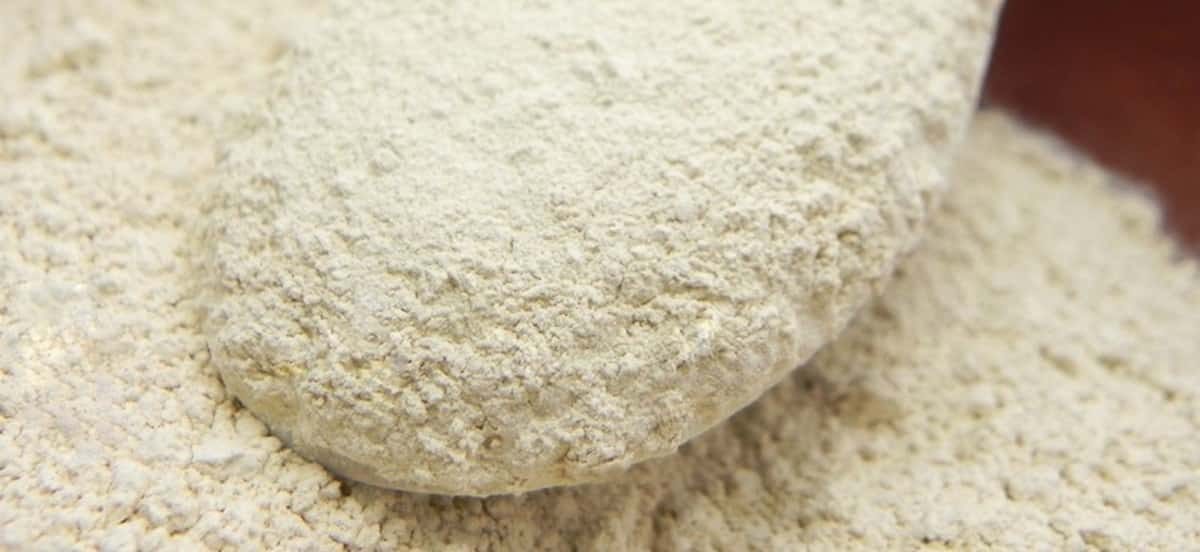
Horseradish powder is horseradish root that has been dried and ground. Like the fresh root, it has almost no bite until water reaches it; then the heat appears at once and fades quickly unless something acidic holds it.1 That behavior comes from the root’s chemistry, and it decides how the powder should be mixed and when it should go into a dish. This page covers what the powder is, why it behaves that way, how to use it, and what can and cannot be said about its nutrition.
At a glance
| What it is | Dried, ground horseradish root |
| Botanical name | Armoracia rusticana23 |
| Plant family | Brassicaceae (mustard family)3 |
| Native range | Southern Ukraine to southern European Russia (Kew)2 |
| Heat compound | Allyl isothiocyanate, formed when the root’s cells are broken4 |
| Activated by | Water; heat appears immediately and then dissipates (one merchant’s guidance)1 |
| Damaged by | Heat, which inactivates the enzyme behind the pungency5 |
| Main U.S. growing area | St. Clair, Monroe and Madison counties, Illinois6 |
Where the heat comes from
Horseradish heat is made, not stored. Britannica explains that isothiocyanates are released when the cells of horseradish and its relatives are ruptured by cutting or grating, and that allyl isothiocyanate gives horseradish its distinctive flavor and pungent taste.4 The reaction is driven by the enzyme myrosinase acting on glucosinolates in the root; that pairing is what a 2014 Wageningen conference study set out to measure in horseradish products.7
Three consequences follow, and all of them apply to the powder:
- Water starts it. Gewürzshop Mayer, a German spice merchant, says that a pronounced pungency develops immediately when its ground horseradish meets water.1
- The heat does not last. The same merchant says the pungency dissipates quickly.1 Tasting Table notes that the burn of horseradish subsides within minutes or even seconds.8
- Acid locks it in. The merchant says the pungency can be stabilized with vinegar or lemon juice.1 America’s Test Kitchen explains that vinegar preserves the heat of grated horseradish by slowing the enzyme down,9 and the 2014 study detected no myrosinase activity in a vinegar-based horseradish sauce, which its authors attribute to the vinegar’s low pH.7
Cooking kills it. In a 2024 study of commercial horseradish sauce, heat treatment inactivated myrosinase and caused what the authors called an undesired loss of pungency.5 No study was found of how commercial drying affects the pungency of horseradish powder, so no claim is made here about how much bite a given jar retains.
Flavor
Gewürzshop Mayer describes its powder as pungent, fresh and mustard-like, and also warns that the powder tastes quite bitter and should be used with restraint; it suggests a little sugar to balance the bitterness.1 Mixed with water and left to stand, the powder tastes sharp and clean with a root-vegetable sweetness underneath; that description is ours. The mustard likeness has a basis: Britannica notes that related compounds are found in mustard and radish.4
How to use it
Wake it up with cold water first. Stir the powder with a little water into a paste and let it sit a few minutes before tasting. That is kitchen practice; the merchant guidance above gives no resting time.1 For the fresh root, Tasting Table reports that waiting several minutes before adding vinegar gives a hotter result, while adding vinegar at once gives a milder one.8 Whether the same timing holds for reconstituted powder has not been tested in any source we found.
Then add acid if you want the heat to last. A splash of vinegar or lemon juice holds the pungency, per the merchant1 and per America’s Test Kitchen’s explanation for fresh horseradish.9
Keep it away from heat. Because heat strips pungency from horseradish,5 stir the powder into sauces after cooking, or use it in cold preparations.
Uses. Gewürzshop Mayer sells its powder as a base for horseradish sauce and suggests mixing it with a little water and cream.1 Other common uses, which are kitchen practice rather than sourced findings:
- Stirred into sour cream, crème fraîche or mayonnaise as a sauce for roast beef, smoked fish or sandwiches.
- In cocktail sauce with ketchup and lemon.
- In dry rubs and seasoning blends, where it adds a sharp note rather than lasting heat.
- In Bloody Mary mixes.
As “wasabi.” Much of what is sold as wasabi is horseradish. Chowhound reports that the vast majority of commercial wasabi is made from European horseradish,10 and the Embassy of Japan in Singapore describes the common substitute as a cheaper mixture of horseradish, mustard and food coloring.11 Read the label on wasabi powder if that matters to you. See wasabi powder vs. paste and wasabi vs. horseradish.
Origin and history
Where it is native. Kew’s Plants of the World Online gives the native range of Armoracia rusticana as southern Ukraine to southern European Russia.2 Britannica describes it as a hardy perennial of the mustard family.3
The name. The “horse” in horseradish is an old figurative use meaning strong, large or coarse.12
In the United States. The Madison Historical encyclopedia, published by Southern Illinois University Edwardsville, says commercial horseradish farming began in the American Bottom around the 1850s and that St. Clair, Monroe and Madison counties in Illinois have the most concentrated commercial growth of horseradish in North America.6 We found no statistical source for the share of U.S. supply grown there.
Several widely repeated claims about horseradish history could not be traced: that Egyptians used it around 1500 BC, that the ancient Greeks used it medicinally, that it spread north and west from Central Europe during the Renaissance, and that in England it was first eaten only by working people and rural folk. For more on the root itself, see horseradish.
Buying and quality
- Check the label. Pure horseradish powder lists only horseradish. “Wasabi” powders are often horseradish with mustard and coloring.1011
- Test it. Mix a pinch with cold water and wait a minute or two. If no sharpness comes up, the powder has lost its potency. Kitchen judgment, not a standard.
- No grade standard or adulteration record specific to horseradish powder was found.
Storage
The University of California Cooperative Extension lists air, light, moisture and heat as what speeds flavor and color loss in spices.13 Keep the powder sealed, dry and cool. No shelf-life figure from a regulator or standards body was found for horseradish powder. Once mixed with water and vinegar, treat it like prepared horseradish: America’s Test Kitchen reports that grated horseradish in vinegar, stored airtight in the refrigerator, holds its heat for up to two weeks.9 That figure is for fresh grated root, not for reconstituted powder.
Nutrition
USDA FoodData Central has no entry for horseradish powder. Its entry for prepared horseradish (the grated root in vinegar, 85.1% water) gives, per 100 g, 48 kcal, 3.3 g fiber, 246 mg potassium and 420 mg sodium, with 1 teaspoon weighing 5 g and 1 tablespoon 15 g.14 At a teaspoon, that is about 12 mg of potassium, well under 1% of the 4,700 mg Daily Value.1415 These figures describe prepared horseradish, not the powder; no measured values for the powder were found.
Claims that horseradish treats urinary tract or respiratory infections, or that its glucosinolates fight cancer, rest on research that was not reviewed for this page, and no such claim is made here.
Safety
No regulatory limit, recall pattern or interaction statement specific to horseradish powder was found for this page.
Substitutes and comparisons
- Horseradish and cooking with horseradish
- Horseradish substitutes
- Wasabi vs. horseradish, wasabi and wasabi powder vs. paste
- Mustard powder, whose heat comes from the same family of compounds4
- Too much wasabi, for cooling a dish that has gone too far
Footnotes
-
Horseradish ground, Gewürzshop Mayer (merchant product page). gewuerzshop-mayer.de · Merchant ↩ ↩2 ↩3 ↩4 ↩5 ↩6 ↩7 ↩8 ↩9
-
Armoracia rusticana, Plants of the World Online, Royal Botanic Gardens, Kew. powo.science.kew.org · Reference work ↩ ↩2 ↩3
-
“Horseradish”, Encyclopaedia Britannica. britannica.com · Reference work ↩ ↩2 ↩3
-
“Isothiocyanate”, Encyclopaedia Britannica. britannica.com · Reference work ↩ ↩2 ↩3 ↩4
-
Bianchi F et al., “Substitution of additives in horseradish sauce”, Applied Food Research, 2024. doaj.org · Peer-reviewed ↩ ↩2 ↩3
-
Angela Little, “Horseradish in Collinsville”, Madison Historical, SIUE, 2017. madison-historical.siue.edu · Reference work ↩ ↩2
-
Calabrone L et al., “Capture the pungency of horseradish products: study on glucosinolates and myrosinase”, International Glucosinolate Conference, 2014 (poster abstract). iris.unibas.it · Publication ↩ ↩2
-
Sylvia Tomczak, “Why Horseradish Is So Potent For Such A Short Time”, Tasting Table, 2022. tastingtable.com · Publication ↩ ↩2
-
Keeping the Kick in Fresh Horseradish, America’s Test Kitchen. americastestkitchen.com · Publication ↩ ↩2 ↩3
-
Elias Nash, “Why Genuine Wasabi Is So Expensive In The US”, Chowhound, 2023. chowhound.com · Publication ↩ ↩2
-
“Full of Zest: Shizuoka’s Wasabi Fields”, JCC E-Magazine, Embassy of Japan in Singapore, 2021. sg.emb-japan.go.jp · Regulator ↩ ↩2
-
horseradish (n.), Online Etymology Dictionary. etymonline.com · Reference work ↩
-
Add a Little Spice to Your Life! Part II, University of California Cooperative Extension. ucanr.edu · Reference work ↩
-
Horseradish, prepared (FDC 173472), USDA FoodData Central. fdc.nal.usda.gov · Regulator ↩ ↩2
-
Daily Value on the Nutrition and Supplement Facts Labels, FDA. fda.gov · Regulator ↩