Spices · Profile
Horseradish: The Root, Its Heat, and How to Keep the Kick
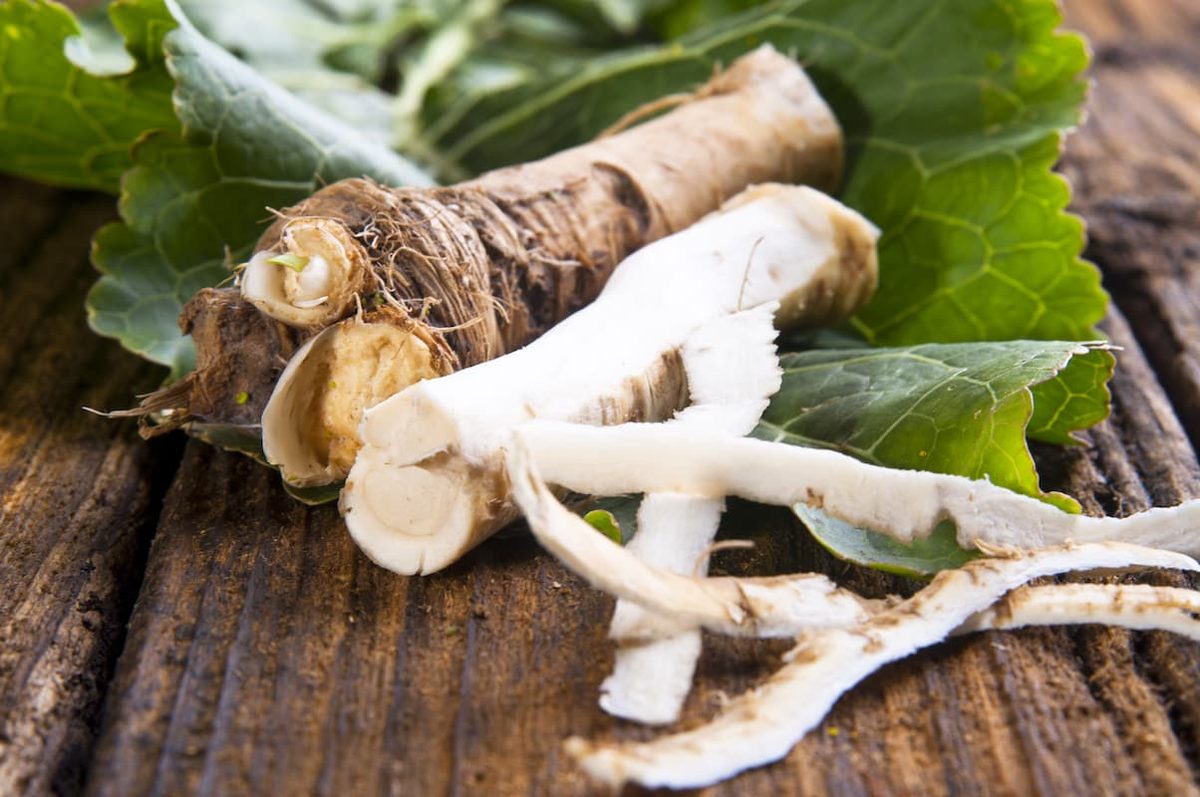
Horseradish is the thick, white taproot of Armoracia rusticana, a hardy perennial in the mustard family.1 Grated, it turns fiercely pungent, with a heat that climbs into the nose and is gone again within minutes. Understanding why it does that is the key to cooking with it: the heat is made at the moment of grating, it fades in open air, and vinegar is what holds it in place.
At a glance
| Botanical name | Armoracia rusticana21 |
| Plant family | Brassicaceae (mustard family)21 |
| Part used | Root1 |
| Native range | Southern Ukraine to southern European Russia (Kew); Mediterranean lands (Britannica)21 |
| Heat compound | Allyl isothiocyanate3 |
| Main U.S. growing area | St. Clair, Monroe and Madison counties, Illinois4 |
| Forms sold | Fresh root, prepared (grated in vinegar), sauces, dried powder |
Measured values
4 figures, sourced| Measure | Value | Scope | Source |
|---|---|---|---|
| Energy Nutrient | 48 kcal per 100 g | USDA FoodData Central, horseradish, prepared (SR Legacy) | fdc.nal.usda.gov |
| Fiber Nutrient | 3.3 g per 100 g | USDA FoodData Central, horseradish, prepared (SR Legacy) | fdc.nal.usda.gov |
| Vitamin C Nutrient | 24.9 mg per 100 g | USDA FoodData Central, horseradish, prepared (SR Legacy) | fdc.nal.usda.gov |
| Sodium Nutrient | 420 mg per 100 g | USDA FoodData Central, horseradish, prepared (SR Legacy)Page also shows per-tablespoon (15 g) values computed from these | fdc.nal.usda.gov |
Each figure is quoted as its source states it, with the samples or standard it applies to. Where sources differ, both are shown; nothing is averaged. All measured values
Flavor and the chemistry of the heat
Freshly grated horseradish is sharp, hot and clean, with a vegetal, slightly sweet root flavor underneath and a burn that registers in the sinuses more than on the tongue. That description is ours; the chemistry behind it is below.
Made on grating. Horseradish and its relatives release volatile compounds called isothiocyanates when their cells are ruptured by cutting or grating.3 In horseradish the main one is allyl isothiocyanate, which Britannica credits with its distinctive flavor and pungent taste.3 The enzyme behind the reaction is myrosinase: in a 2024 study of commercial horseradish sauce, heat treatment inactivated it and caused what the authors called an undesired loss of pungency.5
Gone in minutes. Because allyl isothiocyanate is volatile, the burn is intense but brief: Tasting Table notes that it subsides within minutes or even seconds, and that long exposure to air lets the volatile compounds evaporate.6 America’s Test Kitchen found the same in the kitchen: the longer grated horseradish sat, the milder it tasted.7
Not the same as wasabi. Real wasabi gets most of its heat from the same compound, but the profiles differ. A New Zealand doctoral study of wasabi found 2-phenylethyl isothiocyanate only in European horseradish, and credits it with horseradish’s radish-like flavor.8
Using fresh horseradish
Grate it close to serving. Because the heat fades in air,76 grating long before serving gives a milder result.
Vinegar sets the heat. America’s Test Kitchen explains that the vinegar in prepared horseradish preserves the root’s heat by slowing the enzyme down.7 Timing matters. Tasting Table, citing Taste of Home, says adding vinegar immediately after grating lessens the burn, while waiting several minutes first intensifies it.6 To get a hotter prepared horseradish, grate, wait a few minutes, then add vinegar; for a milder one, add it straight away.
Heat kills the bite. Since heat inactivates the enzyme and strips pungency from horseradish sauce,5 add horseradish to hot dishes at the end, or serve it on the side.
How it is used
Britannica notes that the grated root is commonly mixed with vinegar to make horseradish sauce.1 Other familiar uses, which are common practice rather than sourced findings:
- With roast beef, either as prepared horseradish or as a creamy sauce made with sour cream or whipped cream.
- In cocktail sauce with ketchup, for shrimp and oysters.
- In Bloody Marys, for heat.
At the Passover seder. Horseradish is widely used as maror, the bitter herb. Rabbi Ari Zivotofsky, writing in Jewish Action, explains that the custom spread among Eastern European Jews because lettuce and other leafy vegetables were hard to get in time for Passover, quoting a 19th-century Lithuanian authority to that effect.9 He also notes that the common identification of horseradish with one of the Mishnah’s five bitter vegetables is probably a mistranslation, and that many authorities prefer lettuce.9
As a stand-in for wasabi. Britannica notes that horseradish is commonly used as a substitute for true wasabi in Japanese cuisine,1 and Chowhound reports that the vast majority of commercial wasabi is made from European horseradish, often with mustard and green coloring.10 See wasabi vs. horseradish.
For more, see cooking with horseradish and horseradish powder.
Origin and history
Where it is native. Kew’s Plants of the World Online gives the native range as southern Ukraine to southern European Russia, and lists it as introduced across much of Europe, North America and parts of Asia.2 Britannica says it is native to Mediterranean lands.1 Kew is the botanical authority used on this site, but the two disagree.
The name. English “horseradish” is recorded from the 1590s. The “horse” is an old figurative use meaning strong, large or coarse, the same sense found in “horse mint” and “horse mushroom”.11 A popular story derives the word from German Meerrettich (“sea radish”) by way of a supposed English “mareradish”; the etymology checked for this page does not support that chain.
In the United States. The Madison Historical encyclopedia, published by Southern Illinois University Edwardsville, says commercial horseradish farming began in the American Bottom near St. Louis around the 1850s, started by German immigrant farmers, and that St. Clair, Monroe and Madison counties have the most concentrated commercial horseradish growing in North America.4
Several widely repeated claims about horseradish’s early history could not be traced to any source: that Egyptians used it around 1500 BCE, that the Greeks used it as a liniment or aphrodisiac, and that it became the British condiment for roast beef and oysters in the late 1600s.
Growing and harvest
Britannica describes how growers propagate horseradish in spring from pencil-sized root cuttings planted at a slight angle, remove all but the terminal shoots, and rub off side roots to keep the main root straight; the roots are harvested after one growing season.1 It also warns that the plant is a troublesome weed in many cool, moist areas,1 so home growers usually confine it.
Buying and quality
- Fresh root. Look for a firm root with no soft or shriveled spots and no green sprouting. This is kitchen judgment, not a standard.
- Prepared horseradish is grated root in vinegar, sometimes with salt, sugar or other ingredients; check the label. Its heat depends partly on when the vinegar went in.6
- Horseradish sauce is often made with cream or mayonnaise, which dilutes the heat; check the label.
- “Wasabi.” Much of what is sold as wasabi outside Japan is horseradish-based.10
Storage
America’s Test Kitchen reports that grated horseradish mixed with vinegar and stored airtight in the refrigerator holds its heat for up to two weeks.7 No sourced shelf-life figure for the whole fresh root or for commercial prepared horseradish after opening was found. Once prepared horseradish smells and tastes flat, its volatile heat has gone.
Nutrition
Horseradish is eaten a spoonful at a time. Per USDA FoodData Central (one SR Legacy entry for prepared horseradish), 100 g holds 48 kcal, 3.3 g fiber, 24.9 mg vitamin C and 420 mg sodium, and 1 tablespoon weighs 15 g.12
| Per 1 tbsp (15 g), computed from USDA | Amount | % Daily Value13 |
|---|---|---|
| Energy | about 7 kcal | |
| Vitamin C | about 3.7 mg | about 4% (DV 90 mg) |
| Dietary fiber | about 0.5 g | about 2% (DV 28 g) |
| Sodium | about 63 mg | about 3% (DV 2,300 mg) |
A widely repeated claim calls prepared horseradish an excellent source of vitamin C; at a tablespoon, it supplies about 4% of the Daily Value. Claims that allyl isothiocyanate in horseradish prevents cancer or its spread rest on laboratory and animal research that was not reviewed for this page, and no claim is made here that horseradish treats or prevents any disease.
Safety
No regulatory limit, recall pattern or interaction statement specific to horseradish was found for this page.
Substitutes and comparisons
- Horseradish substitutes
- Wasabi vs. horseradish and the wasabi profile
- Horseradish powder and cooking with horseradish
- Mustard powder, whose heat comes from the same compound family3
- Too much wasabi, for cooling an overdose of either
Footnotes
-
“Horseradish”, Encyclopaedia Britannica. britannica.com · Reference work ↩ ↩2 ↩3 ↩4 ↩5 ↩6 ↩7 ↩8 ↩9 ↩10
-
Armoracia rusticana, Plants of the World Online, Royal Botanic Gardens, Kew. powo.science.kew.org · Reference work ↩ ↩2 ↩3 ↩4
-
“Isothiocyanate”, Encyclopaedia Britannica. britannica.com · Reference work ↩ ↩2 ↩3 ↩4
-
Angela Little, “Horseradish in Collinsville”, Madison Historical, SIUE, 2017. madison-historical.siue.edu · Reference work ↩ ↩2
-
Bianchi F et al., “Substitution of additives in horseradish sauce”, Applied Food Research, 2024. doaj.org · Peer-reviewed ↩ ↩2
-
Sylvia Tomczak, “Why Horseradish Is So Potent For Such A Short Time”, Tasting Table, 2022. tastingtable.com · Publication ↩ ↩2 ↩3 ↩4
-
Keeping the Kick in Fresh Horseradish, America’s Test Kitchen. americastestkitchen.com · Publication ↩ ↩2 ↩3 ↩4
-
Tamanna Sultana, Factors affecting the yield of isothiocyanates in wasabi, PhD thesis, Lincoln University. researcharchive.lincoln.ac.nz · Reference work ↩
-
Ari Z. Zivotofsky, “What’s the Truth about Using Horseradish for Maror?”, Jewish Action. jewishaction.com · Publication ↩ ↩2
-
Elias Nash, “Why Genuine Wasabi Is So Expensive In The US”, Chowhound, 2023. chowhound.com · Publication ↩ ↩2
-
horseradish (n.), Online Etymology Dictionary. etymonline.com · Reference work ↩
-
Horseradish, prepared (FDC 173472), USDA FoodData Central. fdc.nal.usda.gov · Regulator ↩
-
Daily Value on the Nutrition and Supplement Facts Labels, FDA. fda.gov · Regulator ↩