Spice Substitutes · Substitutes
Horseradish Substitutes: Wasabi, Hot Mustard, Radish and Ginger Compared
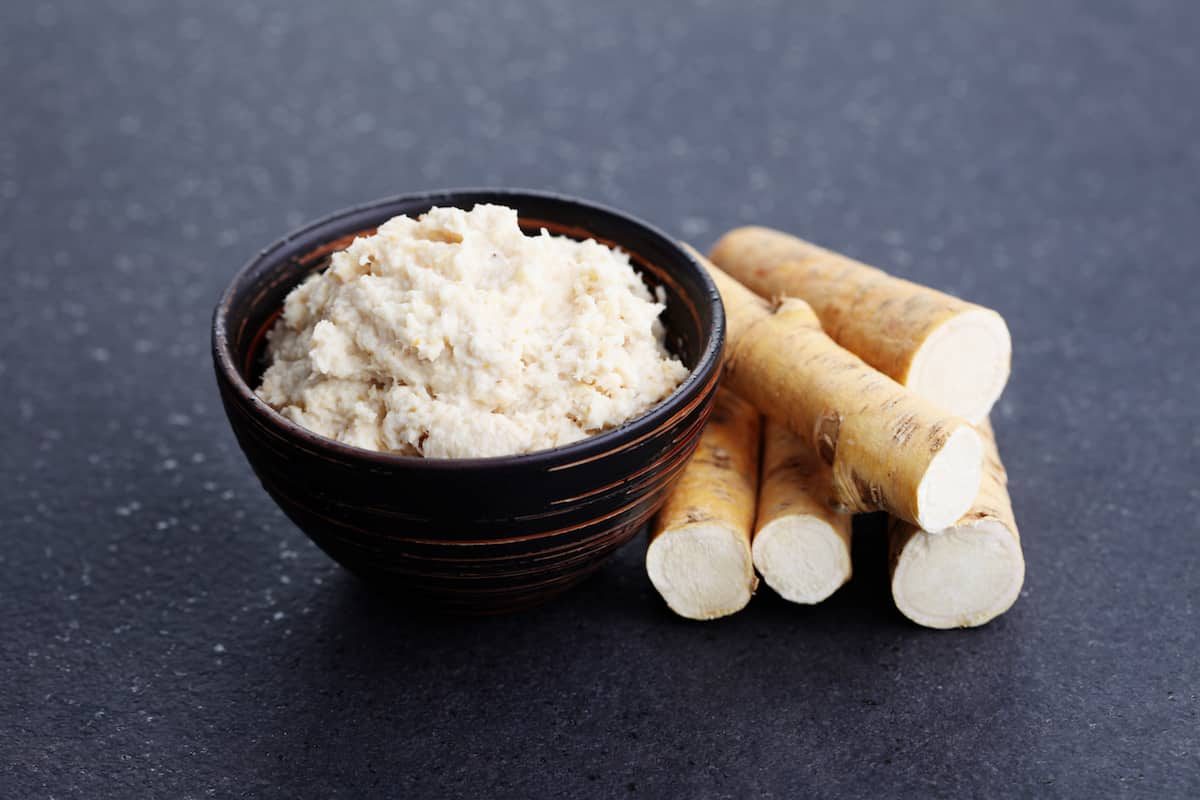
Horseradish is the root of a hardy perennial in the mustard family (Brassicaceae), usually grated and mixed with vinegar to make horseradish sauce.1 Its bite comes from allyl isothiocyanate, which forms when the root’s cells are broken by cutting or grating.2 Related compounds are found in mustard and radish,2 and that shared chemistry is why the best substitutes come from the same family. What you should reach for depends on whether you need horseradish’s nose-clearing heat, its texture, or just some warmth.
Quick answer
| What horseradish is doing | Best substitute | Starting amount, per 1 part prepared horseradish | Treatment |
|---|---|---|---|
| Sharp heat in a sauce (cocktail sauce, horseradish cream) | Wasabi paste | 1/2 part | Attributed |
| Sharp heat, mixed into a sauce or marinade | Hot mustard | 1 part | Attributed |
| You have the fresh root, not the jar | Freshly grated horseradish | 1/2 part | Attributed |
| Grated texture with milder bite (relishes, beets) | Grated winter or black radish | 1 part, then taste | Method |
| Gentle warmth with seafood or fried food | Ginger paste | 1 part | Attributed |
How the ratios on this page are labeled
Every ratio carries one of four labels.
- Computed: based on a measurable physical relationship, with the source named.
- Attributed: a named source publishes this ratio. We quote it as theirs.
- Disputed: named sources give different answers to the same swap. We show each one and do not average them.
- Method: we found no published ratio. We give a direction and a cautious starting point, and say so.
Most of the published ratios here come from one Tasting Table article on cocktail sauce. They are a food writer’s rules of thumb for that sauce, not measurements of pungency, and no study compares the heat of horseradish with any of its substitutes.
If horseradish is bringing sharp heat
This is horseradish’s main job in cocktail sauce, horseradish cream and on roast beef.
1. Wasabi paste
True wasabi is the rhizome of Eutrema japonicum, another member of the mustard family.3 Its chief pungent compound is the same as horseradish’s: in one New Zealand study, allyl isothiocyanate made up 86 to 94 percent of the isothiocyanates in wasabi.4 The profiles are not identical, though. The same study notes that 2-phenylethyl isothiocyanate is found only in European horseradish.4
In practice, the wasabi in most tubes and packets is horseradish. Britannica says the wasabi paste of Western restaurants is commonly made from horseradish,3 and Chowhound reports that the vast majority of commercial wasabi is made from European horseradish.5 Tasting Table adds that imitation wasabi is often horseradish paste with green food coloring.6 So the swap is close, but expect a green sauce.
Ratio (Attributed): Tasting Table’s Deb Kavis uses 1/2 teaspoon wasabi paste per teaspoon of horseradish, describing wasabi as similar but more intense.6 Check the label: a paste made from real wasabi will taste different from one made from horseradish.
2. Hot mustard
Brown mustard gets its heat the same way horseradish does. When mustard seed is ground and mixed with water, the enzyme myrosinase acts on a compound called sinigrin to produce allyl isothiocyanate.7 Tasting Table notes that Chinese hot mustard gets its kick when its brown mustard seeds are crushed and mixed with water.6
Ratio (Attributed): Tasting Table uses a 1:1 swap of hot mustard for horseradish, noting that hot mustard is thinner than prepared horseradish but packs a similar punch.6 That makes it better for mixing into sauces and marinades than for serving on its own.
If you are making your own from dry mustard, mix it with cool water. Popular Science warns that water that is too hot deactivates myrosinase, and that vinegar inhibits it,7 so add any vinegar after the heat has developed. Katzer notes that heating destroys isothiocyanates once they have formed,8 so stir mustard into a hot dish off the heat. Prepared yellow or brown mustard usually lists vinegar on the label; in our judgment, it adds flavor more than heat.
3. Fresh horseradish root
If the recipe calls for prepared horseradish and you have the root, you have the real thing.
Ratio (Attributed): NDSU Extension equates 1 tablespoon of fresh horseradish with 2 tablespoons of bottled.9 Grate it just before use. America’s Test Kitchen notes that grated horseradish turns milder the longer it sits, and that vinegar preserves the root’s heat by slowing the enzyme activity.10
4. Ground horseradish
Dried, ground horseradish is another form of the same plant. A German spice merchant notes that a pronounced pungency develops as soon as the powder meets water, that the powder can taste quite bitter, and suggests mixing it with a little water and cream for a sauce.11
Ratio (Method): We found no published equivalent between horseradish powder and prepared horseradish. Start with about 1 teaspoon of powder stirred into 1 tablespoon of cool water, let it stand a few minutes, then add vinegar and salt to taste. Treat this as a starting point.
If horseradish is adding grated texture
Winter or black radish
Radish is in the mustard family too, and Britannica notes that the large, slow-growing summer and winter types have pungent, firm flesh.12 Black radish is sold as a winter type; that is common market practice, not a sourced finding. Radish’s pungency comes from a related but different compound. A 2022 study names 4-methylthio-3-butenyl isothiocyanate (raphasatin) as the pungent compound isolated from radish root.13 That study measured a small Korean radish type, not black radish, and we found no measurement of black radish’s heat.
Ratio (Method): No published ratio was found. Grate the radish finely and start with an equal amount, then taste. Expect less bite than horseradish. It is sometimes said that leaving the skin on keeps more heat; we found no source for this.
If horseradish is adding gentle warmth
Ginger
Ginger is not related to horseradish. It is a rhizome in the ginger family (Zingiberaceae).14 It brings warmth rather than horseradish’s sinus-clearing burn.
Ratio (Attributed): Tasting Table says to start with a 1:1 swap of ginger paste for horseradish in cocktail sauce. It notes that ginger paste keeps the sauce’s texture close to the original and that its subtle sweetness suits fried foods and seafood.6
What isn’t known
- No study measures the pungency of horseradish against wasabi, mustard, radish or ginger. The Attributed ratios are cooks’ rules of thumb, most of them from a single article about cocktail sauce.
- It is sometimes said that wasabi paste is milder than horseradish. We found no source for this, and Tasting Table describes it as more intense.6 Strength varies by product.
- No published figure gives the heat of black radish.
Related
- Horseradish, horseradish powder and cooking with horseradish
- Wasabi, wasabi vs. horseradish, wasabi substitutes and fresh wasabi vs. wasabi paste
- Mustard powder, mustard powder vs. prepared mustard and brown mustard seeds
- Ginger and too much wasabi? how to fix the dish
Footnotes
-
Horseradish, Encyclopaedia Britannica. britannica.com · Reference work ↩
-
Isothiocyanate, Encyclopaedia Britannica. britannica.com · Reference work ↩ ↩2
-
Petruzzello, Wasabi, Encyclopaedia Britannica. britannica.com · Reference work ↩ ↩2
-
Sultana, Factors affecting the yield of isothiocyanates in wasabi, Lincoln University (PhD thesis). researcharchive.lincoln.ac.nz · Reference work ↩ ↩2
-
Nash, Why Genuine Wasabi Is So Expensive In The US, Chowhound, 2023. chowhound.com · Publication ↩
-
Kavis, 5 Easy Substitutes For Horseradish In Cocktail Sauce, Tasting Table, 2025. tastingtable.com · Publication ↩ ↩2 ↩3 ↩4 ↩5 ↩6
-
Gutierrez G., When the mustard shortage hits, make your own, Popular Science, 2022. popsci.com · Publication ↩ ↩2
-
Katzer, Mustard, Gernot Katzer’s Spice Pages. gernot-katzers-spice-pages.com · Reference work ↩
-
Garden-Robinson, Ingredient Substitutions (FN198), NDSU Extension. ksre.ksu.edu · Reference work ↩
-
Keeping the Kick in Fresh Horseradish, America’s Test Kitchen. americastestkitchen.com · Publication ↩
-
Horseradish ground, Gewürzshop Mayer. gewuerzshop-mayer.de · Merchant ↩
-
Radish, Encyclopaedia Britannica. britannica.com · Reference work ↩
-
Chae et al., Seasonal Effects of Glucosinolate and Sugar Content Determine the Pungency of Small-Type (Altari) Radishes, Plants, 2022. mdpi.com · Peer-reviewed ↩
-
Zingiber officinale Roscoe, Plants of the World Online, Royal Botanic Gardens, Kew. powo.science.kew.org · Reference work ↩