Spices · Profile
Mustard Powder: Where the Heat Comes From, How to Mix It and How to Use It
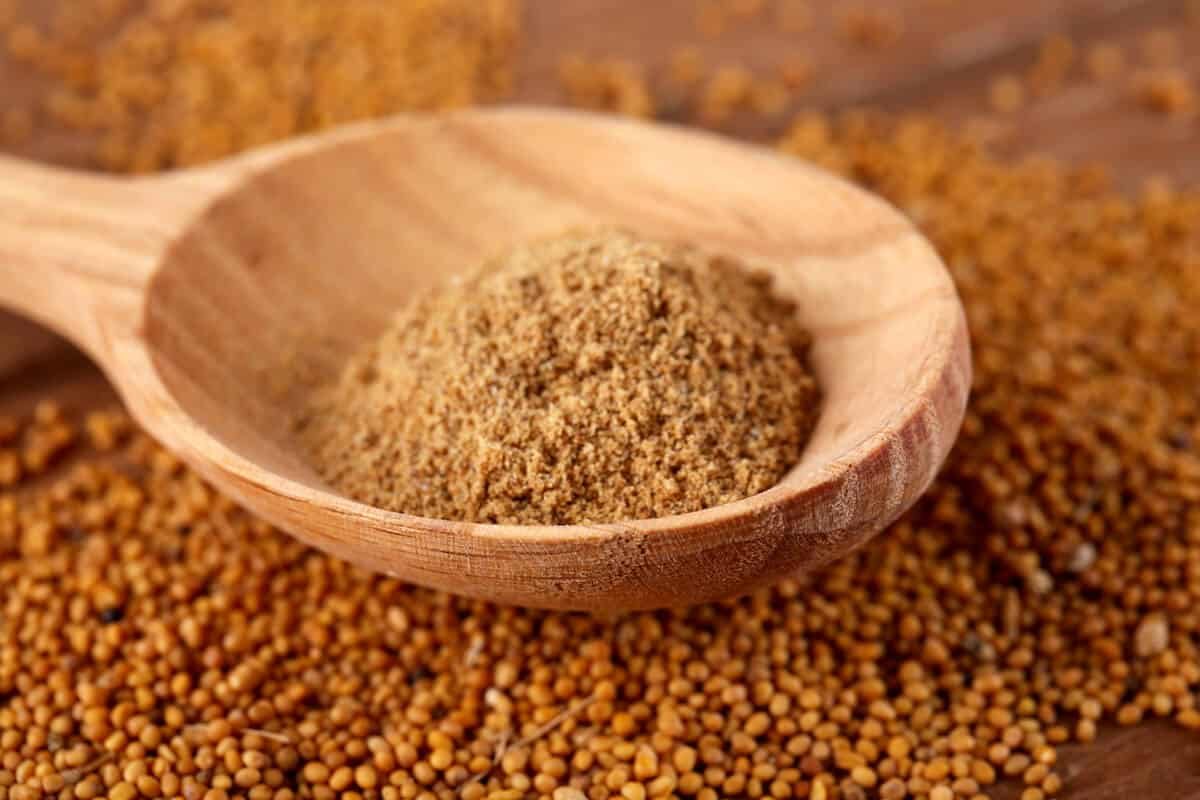
Mustard powder (also sold as ground mustard or dry mustard) is mustard seed milled to a fine flour. Dry, it smells of very little. Stir it into water and it turns sharp and nose-tingling, because the heat is made by a reaction that needs water to start. That one fact explains most of how to use it well: how you wet it decides how hot it gets.
At a glance
| What it is | Ground seed of mustard plants in the cabbage family, Brassicaceae1 |
| Species | White or yellow mustard (Sinapis alba); brown mustard (Brassica juncea, which Kew now lists as × Brassarda juncea); black mustard (Brassica nigra, which Kew now lists as Mutarda nigra)2345 |
| Part used | Seed |
| Where the heat comes from | Allyl isothiocyanate, formed when the enzyme myrosinase acts on sinigrin once crushed seed is wet6 |
| Key handling rule | Hot water slows or stops the enzyme; cool to room-temperature water does not67 |
| Main producing countries | No statistical source checked for this page |
| Forms sold | Powder (ground mustard), whole seed, prepared mustard |
| Allergen status | One of the 14 allergens food businesses in the UK must declare8 |
Measured values
4 figures, sourced| Measure | Value | Scope | Source |
|---|---|---|---|
| Energy Nutrient | 508 kcal per 100 g | USDA FoodData Central, ground mustard seed (SR Legacy) | fdc.nal.usda.gov |
| Protein Nutrient | 26.1 g per 100 g | USDA FoodData Central, ground mustard seed (SR Legacy) | fdc.nal.usda.gov |
| Fat Nutrient | 36.2 g per 100 g | USDA FoodData Central, ground mustard seed (SR Legacy) | fdc.nal.usda.gov |
| Selenium Nutrient | 208 µg per 100 g | USDA FoodData Central, ground mustard seed (SR Legacy) | fdc.nal.usda.gov |
Each figure is quoted as its source states it, with the samples or standard it applies to. Where sources differ, both are shown; nothing is averaged. All measured values
What mustard powder is made from
Three plants supply mustard seed, and their names are in flux.
- White (yellow) mustard, Sinapis alba. Britannica describes its seeds as light yellow, finely pitted, about 2.5 mm across, and less intensely flavored than brown mustard.9 Kew gives its native range as Europe to China; Britannica calls it native to the Mediterranean region.29
- Brown mustard, long called Brassica juncea and also known as Chinese or Indian mustard. Britannica describes it as stronger in flavor than white mustard, with dark yellow seeds about 2.5 mm across.5 Kew now accepts it as a hybrid, × Brassarda juncea, with Brassica rapa and black mustard as its parents.4 The two disagree on where it comes from: Kew gives the Caucasus, Britannica the Himalayas.45
- Black mustard, long called Brassica nigra, now accepted by Kew as Mutarda nigra. Kew’s native range runs from Europe to western and northern China and from the Mediterranean to Ethiopia, and includes India.3
The new Kew names are recent reclassifications, and most labels, cookbooks and older references still use the Brassica names. They refer to the same plants.
Popular Science notes that it is hard to find mustard powder made from anything other than yellow seed.6 Treat that as one writer’s observation rather than a survey of the market.
Flavor, and the chemistry of the heat
Whole mustard seeds are odorless.95 The heat is not sitting in the seed waiting to be released; it is made on demand. Crushed seed holds two separate ingredients, an enzyme called myrosinase and a glucosinolate called sinigrin. When water brings them together, the reaction forms allyl isothiocyanate, a highly volatile compound that gives mustard its kick.6 Britannica identifies allyl isothiocyanate as the compound behind horseradish’s pungency and notes that related compounds are found in mustard.10
Seed color is a rough guide to heat. Popular Science’s rule of thumb is that the darker the seed, the spicier,6 and Britannica describes white mustard as the milder of the white and brown.9
The taste itself, once mixed, is sharp and clean, with a heat that rises into the nose and fades fairly quickly, and an earthy, slightly bitter background. That description is ours.
How to mix mustard powder
Use cool or room-temperature water, not hot. Water temperature controls the enzyme. Popular Science, citing University of Guelph food science professor Loong-Tak Lim, reports that the enzyme works best somewhere between room temperature and slightly above it; that the hotter the water, the milder the mustard; and that water that is too hot deactivates myrosinase completely.6 Cold water is slower: mustard made with cold water needs to rest a while to reach full heat.6 A 2020 laboratory study of brown mustard seed found the same direction from a different angle: the hotter the enzyme was held, across 30 to 80°C, the more of it was inactivated.7 That study measured enzyme activity, not the taste of a finished dish.
So the common advice to mix dry mustard with cold water is sound in the sense that matters: it keeps the enzyme alive. Cold is not required, and boiling or very hot water is the thing to avoid.
Add acid after, not before, if you want full heat. Popular Science reports that strong acidity, like vinegar’s, completely inhibits myrosinase, and that vinegar is what sets the level of spiciness in mustard.6 In practice: wet the powder with water, let it stand and develop, then add vinegar, lemon juice or wine to fix the heat where you like it. Adding vinegar first gives a milder result.
Give it a few minutes. No source checked for this page gives a tested time for powder to reach full heat. Mix, wait, taste, and taste again. Popular Science recommends resting homemade mustard in the fridge for two to three days before eating, because freshly made mustard is far spicier than anything sold in stores.6
How it is used
Britannica lists cold meats, sausages and salad dressings among the foods mustard is commonly served with.1 Beyond that, the uses below are common kitchen practice rather than sourced findings:
- As a condiment. Mixed to a paste with water (the English style), for roast meats, sausages and sandwiches.
- In dressings and sauces. A pinch whisked into a vinaigrette or a cheese sauce adds a sharp edge without the vinegar of prepared mustard.
- In dry rubs and spice mixes, where it adds bite to pork, beef and chicken.
- In cheese dishes, such as macaroni and cheese and Welsh rarebit, where it sharpens the cheese flavor.
Powder in hot food. Because heat inactivates the enzyme,67 dry powder that goes straight into a hot pan or a simmering sauce may never develop full pungency. We found no test of how much survives. If you want the bite, mix the powder with a little cool water first and stir it in near the end.
For more ideas, see mustard powder uses, and for the whole seed, mustard seed uses.
History
The name. English took “mustard” from Old French mostarde in the late 13th century. The condiment was named for must, unfermented grape juice, from Latin vinum mustum, “new wine”: the paste was originally made by mixing must into the crushed seed.11
Rome. Pliny the Elder, writing in the first century CE, described three kinds of mustard. He records that Pythagoras ranked it among the very first of pungent plants, and that mustard pounded with vinegar was used as a liniment for the stings of serpents and scorpions.12 That medicinal use is Pliny’s report of ancient practice, not a recommendation.
Carolingian estates. The Capitulary De Villis, a ninth-century ordinance on the management of royal estates, lists mustard among the foods to be prepared on the estates, alongside garum, cheese, butter and malt, and among fast-day foods to be sent for the king’s use.13
Colman’s. Jeremiah Colman (1777–1851), a Norwich flour miller, bought Edward Ames’s flour- and mustard-making business at Stoke Holy Cross in 1814.14 It is sometimes said that he perfected a special grinding technique in 1866; he died in 1851, and no source for the technique was found.
Other common claims about mustard’s history, including its use in ancient Egypt and Greece and its arrival in India on Vasco da Gama’s ships, could not be traced. The second is unlikely: Kew lists India within black mustard’s native range.3
Buying and quality
No international grade standard for mustard powder was checked for this page. In practice:
- Check the label. Plain ground mustard should list only mustard; anything else on the ingredient list means a blend.
- Test the heat. Because the pungency forms only when the powder is wet,6 the smell of the dry powder tells you little. Mix a quarter teaspoon with a few drops of cool water, wait a few minutes and smell it. A weak result means old or poorly stored powder.
Storage
Keep mustard powder dry, airtight, and away from heat and light. Dry powder can’t form its pungent compound until water reaches it,6 so moisture is the thing to keep out. No published shelf-life figure from a regulator or standards body was found. Use the water test above to check an old jar.
Nutrition
Mustard powder is eaten in small amounts, so its contribution to a diet is small. Per USDA FoodData Central (one SR Legacy entry for ground mustard seed), 100 g holds 508 kcal, 26.1 g protein, 36.2 g fat and 208 µg selenium, and 1 teaspoon weighs 2.0 g.15
| Per 1 tsp (2.0 g), computed from USDA | Amount | % Daily Value |
|---|---|---|
| Energy | about 10 kcal | |
| Selenium | about 4.2 µg | about 8% (DV 55 µg)16 |
Lists that call mustard high in vitamins, sterols or omega-3s, or that credit its selenium with preventing asthma, could not be traced to a source, and no claim is made here that mustard powder treats or prevents any disease.
Safety
- Allergy. Mustard is one of the 14 allergens that the UK Food Standards Agency requires food businesses to declare.8 Anyone with a mustard allergy should treat mustard powder, prepared mustard and spice blends with the same care.
- Erucic acid (EU). EU law caps erucic acid at 35 g/kg in mustard as a condiment and at 50 g/kg in mustard oil, with an exemption for mustard oil that is produced and consumed locally.17 The regulation does not list a separate limit for mustard powder.
- Home remedies. Mustard plasters, mustard as an emetic and mustard paste for ringworm are folk uses. No regulator or systematic review supporting them was found for this page, and they are not recommended here.
Substitutes and comparisons
- Mustard powder substitutes
- Mustard powder vs. mustard seed and mustard powder vs. prepared mustard
- The seeds: yellow mustard seeds, brown mustard seeds, black mustard seeds, and yellow vs. black mustard seeds
- Related heat: horseradish and wasabi, which get their bite from the same compound family10
Footnotes
-
“Mustard”, Encyclopaedia Britannica. britannica.com · Reference work ↩ ↩2
-
Sinapis alba L., Plants of the World Online, Royal Botanic Gardens, Kew. powo.science.kew.org · Reference work ↩ ↩2
-
Mutarda nigra (L.) Bernh., Plants of the World Online, Royal Botanic Gardens, Kew. powo.science.kew.org · Reference work ↩ ↩2 ↩3
-
× Brassarda juncea (L.) Su Liu & Z.H.Feng, Plants of the World Online, Royal Botanic Gardens, Kew. powo.science.kew.org · Reference work ↩ ↩2 ↩3
-
“Brown mustard”, Encyclopaedia Britannica. britannica.com · Reference work ↩ ↩2 ↩3 ↩4
-
Sandra Gutierrez G., “When the mustard shortage hits, make your own”, Popular Science, 2022. popsci.com · Publication ↩ ↩2 ↩3 ↩4 ↩5 ↩6 ↩7 ↩8 ↩9 ↩10 ↩11 ↩12
-
Okunade, Methven and Niranjan, “A Comparison of Myrosinase Activity and Stability in Fresh Broccoli and Brown Mustard Seeds”, Turkish Journal of Agriculture: Food Science and Technology, 2020. doaj.org · Peer-reviewed ↩ ↩2 ↩3
-
Allergen guidance for food businesses, Food Standards Agency. gov.uk · Regulator ↩ ↩2
-
“White mustard”, Encyclopaedia Britannica. britannica.com · Reference work ↩ ↩2 ↩3 ↩4
-
“Isothiocyanate”, Encyclopaedia Britannica. britannica.com · Reference work ↩ ↩2
-
mustard (n.), Online Etymology Dictionary. etymonline.com · Reference work ↩
-
Pliny the Elder, Natural History 20.87, Perseus Digital Library. perseus.tufts.edu · Reference work ↩
-
The Capitulary De Villis, Medieval Sourcebook, Fordham University. sourcebooks.fordham.edu · Reference work ↩
-
Jeremiah Colman and James Colman, Norfolk Museums Service. museumscollections.norfolk.gov.uk · Reference work ↩
-
Spices, mustard seed, ground (FDC 170929), USDA FoodData Central. fdc.nal.usda.gov · Regulator ↩
-
Daily Value on the Nutrition and Supplement Facts Labels, FDA. fda.gov · Regulator ↩
-
Commission Regulation (EU) 2023/915, EUR-Lex. eur-lex.europa.eu · Regulator ↩