Cooking · Dish guide
Paella Spices: Saffron, Sweet Paprika and Rosemary, and What Valencian Recipes Leave Out
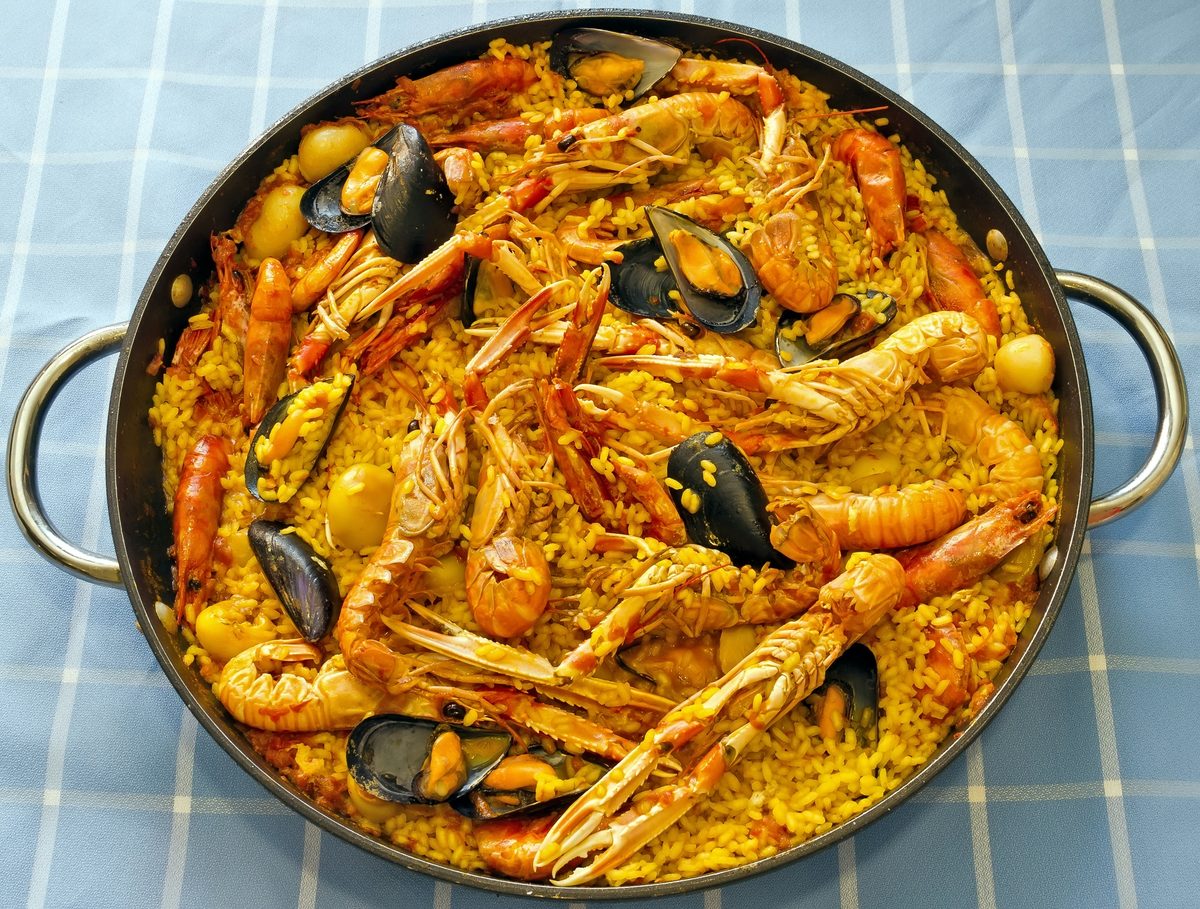
Valencian paella is lightly spiced. Its seasoning comes down to saffron, sweet paprika (pimentón), a sprig of rosemary and salt, with garlic as an option, in the two Spanish recipes compared here. Britannica defines paella by its saffron-flavored rice.1 There is no legal recipe: when the Valencian regional government declared paella a protected cultural good in 2021, the decree did not include an official recipe, because there are many versions.2 This page covers each spice, what the recipes leave out, and what to know when buying saffron. Quantities appear only where a named recipe gives them.
At a glance
| Spice | Job | In the two recipes cited |
|---|---|---|
| Saffron | Color and aroma; defines the dish | Both34 |
| Sweet paprika (pimentón) | Color and sweet pepper flavor, fried briefly in oil | Both: 1 tbsp sweet paprika; 6 g paprika34 |
| Rosemary | Resinous, piney note, added late | Both: a sprig; optional in one34 |
| Garlic | Savory depth | Optional in both34 |
| Smoked paprika | Smoky depth | Neither; a popular non-Valencian variation |
| Black pepper, cayenne | Heat | Neither |
| Chorizo | Pimentón and garlic in sausage form | Neither |
What paella is
Britannica describes paella as saffron-flavored rice cooked with meats, seafood and vegetables, originating in the rice-growing areas of Spain’s Mediterranean coast and especially associated with Valencia.1 It takes its name from the paellera, a flat, round two-handled pan, and is traditionally eaten from it.1 Britannica’s general version sautés meat or seafood in olive oil with onions, garlic and herbs, then simmers rice, tomatoes, saffron and stock together.1
The Valencian version is narrower. In 2021 Valencia’s regional government declared paella a bien de interés cultural, a protected cultural good, but the decree does not set an official recipe.2 Two official tourism bodies publish the classic version:
| Ingredient | Visit València (serves 4)3 | Spain.info, Turespaña4 |
|---|---|---|
| Meat | 1 chicken, 1 rabbit | 2 kg chicken, 1 kg rabbit |
| Beans | 300 g ferradura green beans, 200 g garrofón | 500 g green beans, 250 g garrofó |
| Tomato | 1 medium | 300 g |
| Saffron | Saffron (no amount given) | A few strands |
| Paprika | 1 tbsp sweet paprika | 6 g paprika |
| Rosemary | A sprig | A sprig (optional) |
| Garlic | “A bit,” opinions divided | Optional |
| Other | Snails, artichokes or duck are typical additions | Snails and peppers optional |
| Rice | 3 glasses | 1 kg |
Neither lists onion, chorizo, black pepper or cayenne.34
The core spices
Saffron: the one that defines the dish
Saffron is the dried stigmas of Crocus sativus, an iris-family (Iridaceae) plant; ISO’s specification covers saffron obtained from the flower’s pistils.567 Britannica calls it the most expensive spice in the world and notes that a pound represents 75,000 blossoms.5 Its color comes from crocin, and Britannica describes its taste as bitter, with a strong aroma.5 Britannica also records that the Arabs cultivated saffron in Spain around 961.5
In the Visit València recipe, saffron goes in with the beans and salt after the water is added; in the Spain.info recipe, the saffron strands and the rosemary go in together.34 Neither gives a weight for the saffron, so “a pinch” is as precise as the sources get. Because the color is water-soluble, steeping crumbled threads in a little warm water or stock first spreads it evenly (common practice). See cooking with saffron and saffron uses; if a pan has gone medicinal, see too much saffron.
Buying saffron. It is often said that Persian saffron is better than Spanish. No source checked supports a country ranking; the objective measure is grade. Under ISO 3632, saffron is tested by spectroscopy and sorted into four commercial grades: Extra Class, I, II and III.8 Fraud is a real issue: a 2022 adulterants bulletin listed corn stigmas dyed in beet juice among the substitutes found.9 Buy threads rather than powder from a seller who states the grade (our advice). See why saffron is so expensive and how to store saffron.
Sweet paprika: fried briefly
Both recipes use paprika: one tablespoon of sweet paprika for Visit València, 6 grams for Spain.info.34 Visit València fries it over very low heat for one minute before the liquid goes in.3 Paprika scorches easily, so that short time matters (our judgment).
Spanish pimentón comes sweet, bittersweet or hot; the Pimentón de la Vera specification describes the sweet type as mild and completely sweet.10 La Vera pimentón is smoke-dried, which gives the smoky flavor associated with smoked paprika.10 It is often said that paella calls for smoked paprika; neither recipe here asks for it, so smoked paprika is a variation rather than the Valencian standard. See paprika and paprika substitutes.
Rosemary: a sprig, late
Both recipes use a single sprig of rosemary, optional in Spain.info’s.34 Visit València adds it near the end and cooks it about five minutes.3 Britannica describes rosemary’s taste as pungent and slightly bitter.11 A fresh sprig can be lifted out; dried leaves stay in the rice, so in our judgment fresh is the better choice here. See dried vs. fresh rosemary and too much rosemary.
Garlic: optional
Spain.info lists garlic as optional, and Visit València says some cooks add a bit of garlic to the sauté while noting that opinions are divided.34 Britannica’s general description of paella includes garlic.1 See garlic.
What the recipes leave out
Black pepper and cayenne. Neither recipe uses them.34 A little heat is a personal choice, not part of the Valencian dish. See paprika vs. cayenne.
Chorizo. Chorizo appears in neither recipe.34 Spanish chorizo is not a cinnamon-and-clove sausage: the Chorizo de Cantimpalos specification names salt and pimentón as its basic ingredients, and Chorizo Riojano is seasoned with salt, pimentón and garlic.1213 So adding chorizo mostly adds more paprika, garlic and pork fat to the pan (our reading of those specifications).
Turmeric as a saffron stand-in. Turmeric, a plant in the ginger family, is traditionally used to give boiled white rice a golden color, and its yellow comes from curcumin.1415 It reproduces saffron’s color, not its flavor, so it is a budget stand-in rather than an equivalent (our judgment). See saffron vs. turmeric and saffron substitutes.
Related
- Saffron
- Smoked paprika
- Saffron vs. turmeric
- Safflower vs. saffron
- The master list of herbs and spices
Footnotes
-
Paella, Encyclopaedia Britannica. britannica.com · Reference work ↩ ↩2 ↩3 ↩4 ↩5
-
Valencia Declares Paella as a “Good of Cultural Interest”, Foods & Wines from Spain (ICEX), 2021. foodswinesfromspain.com · Regulator ↩ ↩2
-
Learn how to cook Valencian paella, Visit València. visitvalencia.com · Publication ↩ ↩2 ↩3 ↩4 ↩5 ↩6 ↩7 ↩8 ↩9 ↩10 ↩11 ↩12 ↩13 ↩14
-
Paella, Spain.info (Turespaña). spain.info · Publication ↩ ↩2 ↩3 ↩4 ↩5 ↩6 ↩7 ↩8 ↩9 ↩10 ↩11 ↩12
-
Saffron, Encyclopaedia Britannica. britannica.com · Reference work ↩ ↩2 ↩3 ↩4
-
Crocus sativus L., Plants of the World Online, Kew. powo.science.kew.org · Reference work ↩
-
ISO 3632-1:2025, Saffron: Specification. iso.org · Standard ↩
-
Quality Assessment of Saffron by UV-Vis Spectroscopy in Accordance with ISO 3632, Agilent Technologies, 2025. agilent.com · Publication ↩
-
Stephen Daniells, Adulterants Bulletin highlights ‘multifaceted fraud’ associated with saffron, NutraIngredients, 2022. nutraingredients.com · Publication ↩
-
Pimentón de la Vera PDO product specification. assets.publishing.service.gov.uk · Regulator ↩ ↩2
-
Rosemary, Encyclopaedia Britannica. britannica.com · Reference work ↩
-
Chorizo de Cantimpalos PGI specification, Spanish Ministry of Agriculture, 2023. mapa.gob.es · Regulator ↩
-
Chorizo Riojano PGI, Foods & Wines from Spain (ICEX). foodswinesfromspain.com · Regulator ↩
-
Turmeric: Usefulness and Safety, NCCIH, 2025. nccih.nih.gov · Regulator ↩
-
Prasad and Aggarwal, Turmeric, the Golden Spice, NCBI Bookshelf, 2011. ncbi.nlm.nih.gov · Reference work ↩