Blog · Profile
Why Is Saffron So Expensive? Flowers, Hours and Hectares
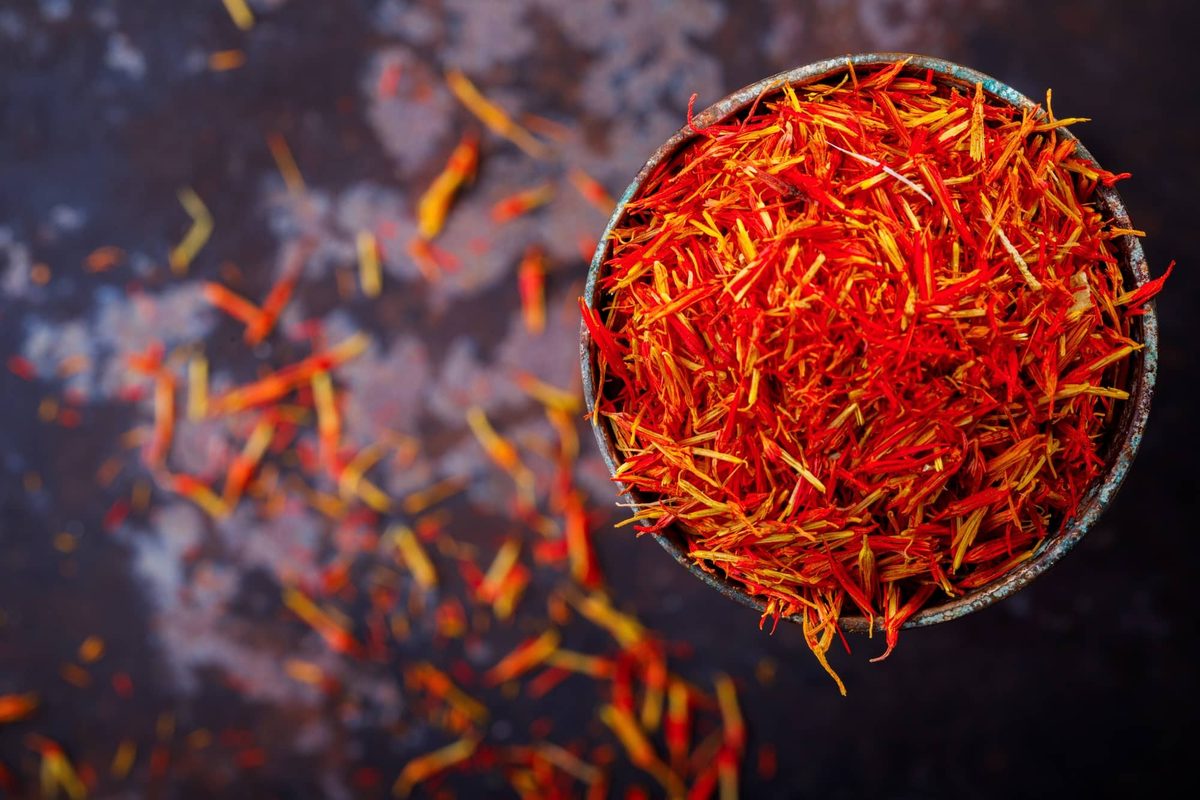
Saffron is expensive because nearly all the work of making it is done by hand, and it takes an enormous number of flowers to make a little spice. A 2020 good-practice guide from Kashmir’s agricultural university says producing one kilogram of dried saffron takes over 400 hours of hand labor and the stigmas of roughly 140,000 to 145,000 flowers, which weigh about 4 kg before drying.1 Add a two-week flowering window, low yields per hectare, a plant that cannot be grown from seed, and a supply concentrated in one country, and the price follows. Encyclopaedia Britannica still calls saffron the most expensive spice in the world.2
The short answer
| Reason | What the sources show |
|---|---|
| Hand labor | Over 400 hours of hand labor per kg of dry saffron (SKUAST-Kashmir)1 |
| Flowers per kilogram | Estimates range from about 22,000 to 300,000 (see table below)13452 |
| Weight lost in drying | About 4 kg of fresh stigmas make 1 kg dried, a loss of roughly 75% (computed)1 |
| Short harvest | Flowers appear for about two weeks in late October or early November3; picking starts shortly after dawn1 |
| Low yield per area | About 5 kg per hectare implied by Katzer; 8 to 10 kg/ha for one improved Kashmir line31 |
| No seed | The crop is propagated only from corms36 |
| Concentrated supply | Iran grows roughly 90% of the world’s saffron14 |
It is all picked and cleaned by hand
Saffron is the dried stigma of the Crocus sativus flower, three to a bloom.2 The stigmas have to be separated from each flower before drying. Katzer describes the whole process, through final drying, as work done by families using little or no modern technology.3 The Kashmir guide’s figure is the most specific found: over 400 hours of hand labor for 1.0 kg of dry saffron.1 That works out to about 180 hours per pound. A widely repeated figure of 80 hours per pound is less than half of that, and no source for it was found.
It is often said that the stigmas are too delicate for any machine to remove. That may be true in practice, but no source opened for this page says so.
It takes a great many flowers
How many flowers go into a unit of saffron is the most repeated statistic about it, and the sources do not agree:
| Source | Flowers per unit of dried saffron |
|---|---|
| SKUAST-Kashmir (2020)1 | 140,000 to 145,000 per kg |
| Katzer3 | About 150,000 per kg |
| AHPA (2022)5 | 100,000 to 150,000 per kg |
| Britannica2 | 75,000 per pound (0.45 kg) |
| Alonso et al. (2000), as cited by Bergomi et al. (2022)4 | 22,000 to 300,000 per kg |
These are different estimates from different places and are not averaged here. Converted to a common unit, all but the last fall between about 100,000 and 170,000 flowers per kilogram (Britannica’s figure is about 165,000 per kg). None of the sources explains what drives the spread. Our saffron page has more on these figures.
Drying removes most of the weight
The Kashmir guide says 1 kg of dried saffron requires 4 kg of fresh saffron.1 That means roughly three-quarters of the harvested weight is lost as water. The figure of 80% that circulates is close but is not what this source gives.
The harvest is short and early
Katzer says the flowers appear for about two weeks at the end of October or the beginning of November.3 The Kashmir guide says harvesting must begin shortly after dawn and be finished quickly, and recommends picking in the early morning hours.1
Yields per hectare are tiny
| Crop and scope | Yield | Source |
|---|---|---|
| Saffron, general figure | About 2,000 m² of field per kg, or about 5 kg/ha (computed) | Katzer3 |
| Saffron, line SD-1-13, Kashmir, 4-year average | 8 to 10 kg/ha of stigmas | SKUAST-Kashmir1 |
| Cumin, India national average, 2024-25 | About 746 kg/ha (computed from 1,163,907 t on 1,560,742 ha) | Spices Board India7 |
The cumin row is a national average for comparison, not a per-farm figure. In US units, 5 to 10 kg/ha is roughly 4.5 to 9 pounds per acre. A claim that saffron yields “about a pound per acre” against cumin’s “300 pounds per acre” circulates widely; neither number matches these sources. On the figures above, cumin out-yields saffron by roughly 75 to 150 times by weight (computed).
It cannot be grown from seed
Cultivated saffron is a sterile triploid, and vegetative propagation by daughter corms is considered the only way to reproduce it.6 Katzer says the same: propagation is possible only via corms.3
Supply is concentrated, and weather matters
Iran dominates production. The Kashmir guide gives Iran about 88.8% of world output, and a 2022 peer-reviewed paper puts it at around 90%; neither figure is tied to a specific crop year.14 AHPA lists India, Greece, Afghanistan, Morocco, Spain, Italy and China as smaller producers.5 Katzer’s page gives a different picture, with Spain and Iran together at more than 80% of about 300 tonnes a year, but the page gives no date for it.3
Weather affects the crop. The Kashmir guide says rainfall or irrigation in August and September helps boost early flowering and production.1 Claims that drought and climate change will keep prices high, or that Spain’s saffron industry shrank because of its labor costs, are often repeated, but no source opened for this page supports them.
What saffron actually costs
Saffron prices vary enormously by grade, origin and point of sale. Each figure below has a different scope, and they cannot be compared directly.
| Price | Scope | Date | Source |
|---|---|---|---|
| Up to 20,000 EUR/kg | Upper end of the market, described in a peer-reviewed paper on saffron quality | Published 2022 | Bergomi et al.4 |
| USD 32 per gram (USD 32,000/kg) | Market price assumed in a US farm trial’s economic analysis | Project covering the 2023 and 2024 seasons | SARE project report, Rodale Institute8 |
| USD 5,000 to 7,000/kg | Average retail prices, per a trade newsletter | 13 July 2020 | Der AUDITOR9 |
| EUR 389 to 614/kg | Export (FOB Iran) prices for 10-kg orders, from bunch (dasteh) to negin grade | 13 July 2020 | Der AUDITOR9 |
The same 2020 report says Iranian export prices had fallen from USD 4,000 to 5,000 per kg in 2009 to 2011 to around USD 400 to 500, while retail prices stayed high.9 Katzer, likewise, says saffron sells for about one-tenth as much in producing countries, though with lower quality.3 The newsletter also describes brokers reselling saffron at USD 7,000 per kg or more on the global market.9 Katzer also notes that cheaper qualities can include the yellow stamens, which have no taste of their own.3
Iranian trade names such as negin, sargol and pushal (poushal) appear in export price lists,9 but no source opened for this page defines them, so this page does not describe what each contains. The international standard, ISO 3632, grades saffron by measured color, bitterness and aroma rather than by cut; see saffron for how it works.
Why the price invites fraud
A high price per gram makes saffron a target for adulteration. Katzer calls coating the threads with a non-volatile liquid to add weight very common, and notes that cruder fraud sells something that is not saffron at all.3 Our saffron page lists the adulterants documented in the literature and how the ISO test works.
Related pages
- Saffron and the most expensive spices
- Cooking with saffron, saffron uses and how to store saffron
- Cheaper stand-ins: saffron substitutes, safflower vs. saffron, saffron vs. turmeric
- Overdid it? Too much saffron
Footnotes
-
Alie, Khan, Hassan et al., Good Practices for Production of Shalimar Saffron-1, SKUAST-Kashmir, 2020. nmhs.org.in · Reference work ↩ ↩2 ↩3 ↩4 ↩5 ↩6 ↩7 ↩8 ↩9 ↩10 ↩11 ↩12 ↩13 ↩14
-
“Saffron”, Encyclopaedia Britannica. britannica.com · Reference work ↩ ↩2 ↩3 ↩4
-
Saffron (Crocus sativus), Gernot Katzer’s Spice Pages. gernot-katzers-spice-pages.com · Reference work ↩ ↩2 ↩3 ↩4 ↩5 ↩6 ↩7 ↩8 ↩9 ↩10 ↩11 ↩12 ↩13
-
Bergomi et al., “Determination of Saffron Quality through a Multi-Analytical Approach”, Foods, 2022. pmc.ncbi.nlm.nih.gov · Peer-reviewed ↩ ↩2 ↩3 ↩4 ↩5
-
Touwaide and Appetiti, “Herbs in History: Saffron”, American Herbal Products Association, 2022. ahpa.org · Publication ↩ ↩2 ↩3
-
Kazemi-Shahandashti et al., “Ancient Artworks and Crocus Genetics Both Support Saffron’s Origin in Early Greece”, Frontiers in Plant Science, 2022. frontiersin.org · Peer-reviewed ↩ ↩2
-
Spice wise area and production in India, 2021-22 to 2025-26, Spices Board India. indianspices.com · Regulator ↩
-
Bharat Acharya, “Saffron: A new high-value crop for underserved farmers in Southern US”, SARE project OS23-166, Rodale Institute. projects.sare.org · Reference work ↩
-
“Saffron: exporters lose out big time”, Der AUDITOR, via mundus agri, 2020. mundus-agri.eu · Publication ↩ ↩2 ↩3 ↩4 ↩5