Spice Fixes · Fix
Too Much Saffron? How to Fix Your Dish Without Wasting It
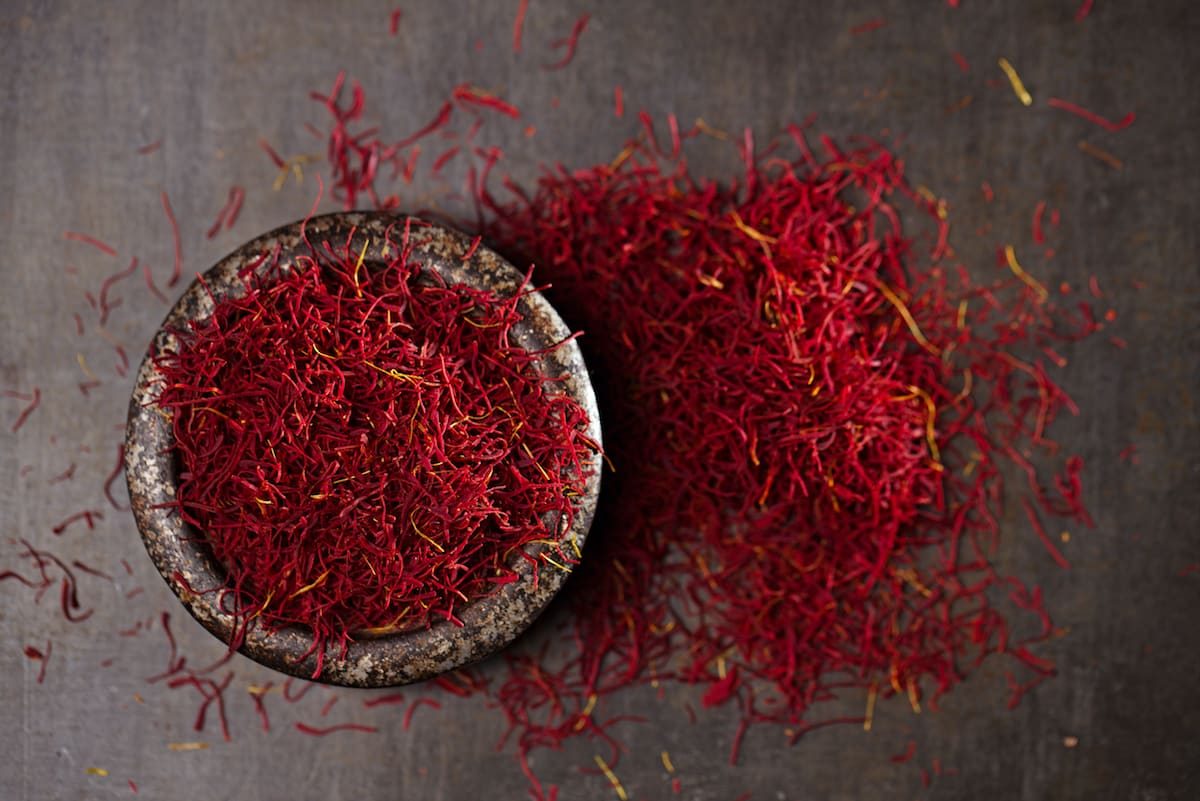
Too much saffron makes a dish bitter and harsh, with an aroma that turns from honeyed to medicinal, and a color that can look almost artificial. Because saffron is expensive, the fixes here are built around saving the food rather than starting over. Within each section the fastest fix comes first.
Quick answer
| What’s wrong | Fastest fix | If that’s not enough |
|---|---|---|
| Too much saffron flavor, overall | Split the dish: freeze half, then build the other half back up to a full recipe | Add more of everything else and keep the extra |
| Bitter edge | Dilute | A little sugar or honey, added in small steps |
| Rice dish too strong or too yellow | Cook a batch of plain rice in the same stock and fold it in | Serve it alongside an unsaffroned dish |
| Steeping liquid looks far too dark, and hasn’t gone in yet | Use part of it now, refrigerate the rest for another dish |
What overdone saffron tastes like, and why
Saffron’s three hallmarks line up with three compounds. A 2022 study of saffron quality identifies crocin as responsible for the color, picrocrocin for the bitter taste, and safranal as one of the molecules behind the characteristic aroma.1 Britannica sums up the spice as having a strong aroma and a bitter taste.2 A small amount gives color and fragrance with a faint bitter edge; in our judgment, too much is mostly a bitterness problem, with an aroma that tips into medicinal or metallic.
Sheer volume: too much saffron for the dish
Split, then rebuild. Britannica still calls saffron the most expensive spice in the world,2 and a 2022 paper puts its price as high as 20,000 euros per kilogram.1 The thriftiest fix keeps all of it: take half of the over-saffroned dish out and freeze it, then add the other ingredients (everything except saffron) to the remaining half to bring it back to a full recipe. The frozen half becomes the saffron for a future batch.
Or dilute the whole thing. Add more of every other ingredient and keep the extra. If you can’t add to the pot without changing the dish, Tasting Table’s method for an over-garlicked dish works the same way: cook a second batch without the spice and combine the two.3
For rice dishes. Rice is hard to dilute once cooked, and paella in particular is defined by its saffron-flavored rice.4 In our judgment the most practical fix is to cook a separate batch of plain rice in the same stock and fold it through, or serve the dish alongside something unsaffroned so each bite carries less of it.
A bitter edge
Add sweetness, carefully. In controlled taste tests, sweet tastes and sodium salts both suppressed bitterness, with sugar the strongest suppressor; citric acid was the weakest.5 Those were pure taste solutions, not food, but they point toward a pinch of sugar or a little honey rather than lemon juice. In a dessert or a sweet rice, add a little more of the sweetener the recipe already uses. In a savory dish, add a pinch at a time and taste; it’s easy to end up with a dish that is both sweet and bitter. Use this together with dilution, not instead of it.
Fixes that don’t hold up
Masking it with other spices. More of the other spices in the dish is sometimes suggested as cover. In our judgment that adds another strong flavor without lowering the saffron, and it risks an over-spiced dish on top of a bitter one. If you try it, choose a spice the recipe already uses and add a little at a time. (Fenugreek and tamarind are sometimes named as saffron’s usual partners for this purpose; we found no source for that pairing.)
Is too much saffron a safety issue?
Not at cooking amounts. A 2017 toxicology review concluded that therapeutic doses of saffron showed no significant toxicity in clinical or experimental studies,6 and the Drugs.com professional monograph says saffron is not generally associated with toxicity in culinary amounts.7
Large amounts are a different matter. The same monograph says amounts above 5 g, more than food uses, have uterine stimulant and abortive effects, and it gives 10 g as an abortive dose and 20 g as a lethal dose.7 The monograph does not show where those last two figures were measured, so treat them as cautions rather than precise thresholds. Pregnant people should not take saffron supplements without medical advice. A list of poisoning symptoms that circulates online, including bleeding from the nose and lips, did not appear in the sources we reviewed.
Don’t confuse it with meadow saffron. Meadow saffron, or autumn crocus (Colchicum autumnale), is a different, poisonous plant.8
Preventing it next time
Start low and taste. We found no sourced standard dose of saffron for cooking; a pinch is a common starting point. Steep it in a little warm water, stock or milk first, add part of the liquid, and taste before adding the rest. That steeping liquid is your control: anything you hold back can go into the next dish. More on technique in cooking with saffron.
Don’t swap threads and powder spoon for spoon. We found no published conversion between the two forms, so if a recipe gives threads and you have powder (or the reverse), start with less than you think and taste.
Store it well. In our judgment, faded saffron tempts you to add more, and a fresh packet can then overshoot. See how to store saffron.
Related
- Saffron substitutes
- Why saffron is so expensive
- Safflower vs. saffron
- Paella spices
- Too much turmeric
Footnotes
-
Bergomi A et al., Determination of Saffron Quality through a Multi-Analytical Approach, Foods, 2022. mdpi.com · Peer-reviewed ↩ ↩2
-
Saffron, Encyclopaedia Britannica. britannica.com · Reference work ↩ ↩2
-
Simple Ways To Tone Down The Pungency Of Garlic, Harmony Colangelo, Tasting Table, 2023. tastingtable.com · Publication ↩
-
Paella, Encyclopaedia Britannica. britannica.com · Reference work ↩
-
Green BG et al., Taste Mixture Interactions: Suppression, Additivity, and the Predominance of Sweetness, Physiology & Behavior, 2010. pmc.ncbi.nlm.nih.gov · Peer-reviewed ↩
-
Bostan HB et al., Toxicology effects of saffron and its constituents: a review, Iranian Journal of Basic Medical Sciences, 2017. journals.mums.ac.ir · Peer-reviewed ↩
-
Saffron, Drugs.com professional monograph. drugs.com · Reference work ↩ ↩2
-
Dyeing for Color, Carly Still, The Metropolitan Museum of Art, 2015. metmuseum.org · Publication ↩