Spice Comparisons · Comparison
Dried Galangal vs. Fresh: How Drying Changes the Aroma, and How to Swap Them
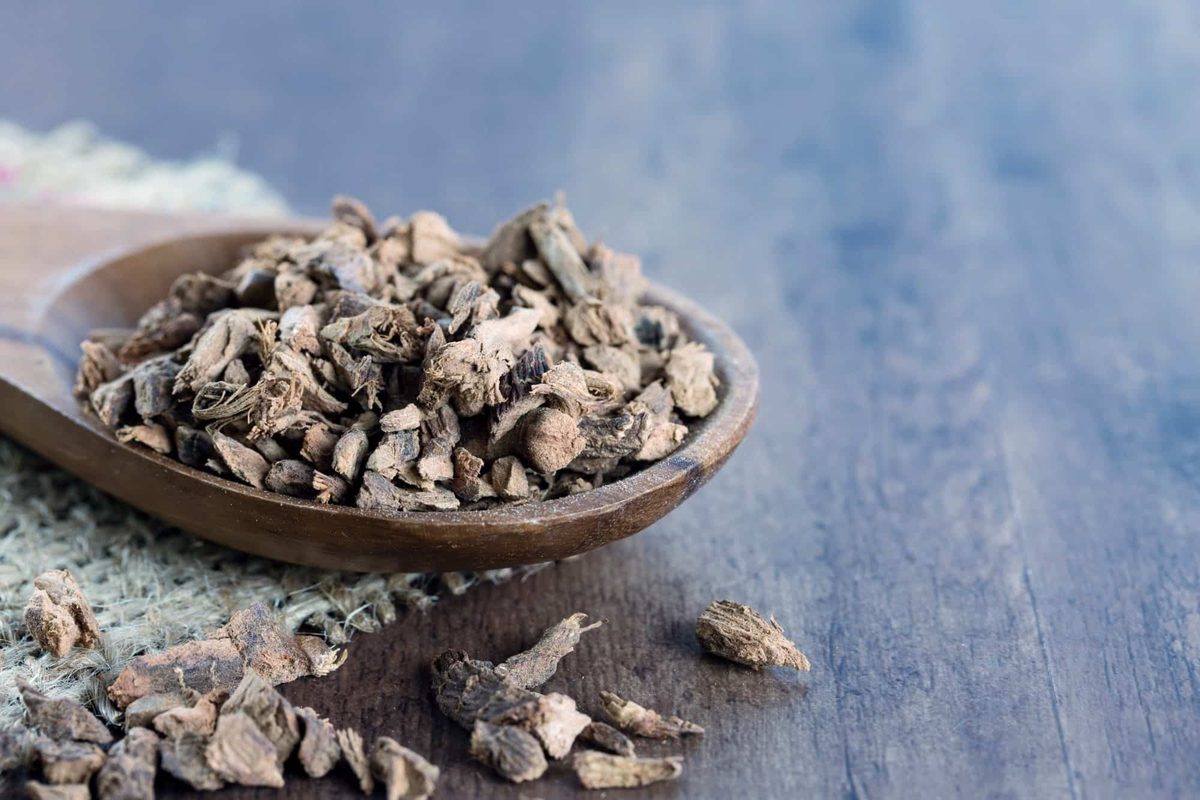
Galangal, the rhizome of Alpinia galanga, is sold both fresh and dried,12 and the two are not the same ingredient in different packaging. Spice writer Gernot Katzer says the choice makes “a great difference in flavour”: fresh galangal smells close to fir or pine needles, while dried galangal turns spicier and sweet-aromatic, almost like cinnamon.3 Use fresh when you can. Dried slices, soaked, are the better fallback for soups and curry pastes, and powder is a different spice again.
Side by side
| Fresh galangal | Dried galangal | |
|---|---|---|
| Plant | Alpinia galanga, ginger family (Zingiberaceae)14 | Same |
| Forms | Whole rhizome | Slices, to be soaked in warm water; powder32 |
| Aroma (Katzer) | Pure and refreshing, close to fir or pine needles, mildly spicy3 | More spicy and sweet-aromatic, almost like cinnamon; the powder, “something in between of ginger and cinnamon”3 |
| Aroma compounds | Several contribute about equally: α-pinene, 1,8-cineole, α-bergamotene, trans-β-farnesene and β-bisabolene (Katzer)3 | Less variety, mostly cineole and farnesene (Katzer)3 |
| Essential oil | Up to 1.5% of the rhizome (Katzer); 0.2 to 1.5% of dry weight, 1,8-cineole the main component (PROSEA)32 | Composition differs from fresh; depends on drying method (see below)35 |
| Flavor | Ginger-like with citrus, pepper and pine notes (Britannica);6 sharp and resinous to us | Warmer and rounder, with less lift (editorial) |
| Texture | Hard and fibrous; sliced or pounded | Woody slices that need soaking; or powder |
| Best uses | Thai soups and curry pastes, where it is the lead aroma78 | When fresh isn’t available; in Southeast Asia that’s the usual role of dried galangal3 |
| Keeps | In a Thai storage study, marketable for 7 days at room temperature9 | No published shelf-life figure found |
| Safety | No specific issue in sources reviewed | Codex lead limit of 2.0 mg/kg for dried rhizomes and roots, which include galangal1011 |
PROSEA, the Southeast Asian plant reference, and Katzer give different oil figures; neither states the sample, so they appear side by side rather than combined.23
What drying does to galangal
Katzer reports that the oil in dried galangal differs in its proportions from the oil in the fresh rhizome. In fresh galangal, several compounds seem to contribute to the taste about equally; in the dried rhizome, the variety of aroma components is smaller, mostly cineole and farnesene.3 That narrower profile fits his description of dried galangal as spicier and cinnamon-like rather than piney and fresh.3
How galangal is dried matters too. A 2022 study dried fresh galangal by hot air, vacuum drying and freeze-drying. Hot air was fastest, but freeze-drying kept the rhizome’s microstructure better, and the three methods could be told apart by the chemistry of the resulting oil.5 The authors concluded that freeze-drying suited galangal best because it kept its appearance and biological activity.5 Most retail dried galangal does not say how it was dried, so expect variation from brand to brand.
A widely repeated claim says that drying your own galangal gives “the same flavor” as fresh. The sources above say the opposite: drying changes the oil.35
Can one stand in for the other?
Katzer notes that in most Southeast Asian countries dried galangal is used only when fresh is not available.3 That is the right way to think about it.
Dried slices for fresh (Method). Dried slices must be reconstituted in warm water, and once soaked they come closer to fresh galangal in flavor.3 We found no published ratio between fresh and dried galangal, by weight or by volume. As on our galangal substitutes page, start with about the same number of soaked slices as the recipe’s fresh slices, simmer, and taste the broth before adding more. No source gives a soaking time; soak until the slices bend without snapping. This works best where galangal infuses a liquid, such as tom kha kai, which a Northern Illinois University recipe makes by simmering thin slices of young galangal with coconut milk, lemongrass and kaffir lime leaves.7
Dried slices in a curry paste (Method). Soaked slices can be pounded into a paste, but they stay woodier than fresh; in our judgment, chop them fine first. Expect a warmer, less piney paste.
Galangal powder for fresh. Katzer describes the powder as less fresh but more spicy, between ginger and cinnamon.3 PROSEA says dried galangal is usually ground before use, and warns that powder is sometimes adulterated with lesser galangal.2 Powder doesn’t behave like a fresh rhizome in a paste. There is no published ratio; if powder is all you have, start with a small pinch per slice called for and build up.
Fresh for dried. This usually improves the dish. A widely repeated rule says to use half as much fresh as dried; we found no source for that, or for its reverse (double the dried). Use roughly the same number of slices and taste. Remember that fresh is brighter and more piney,3 so a recipe written for dried may taste sharper.
Ginger in place of either. See galangal substitutes and galangal vs. ginger. Ginger is a separate genus in the same family.14 The substitutes page covers the one published ginger ratio and why it is only a rule of thumb.
When to use which
- Fresh is the first choice for Thai cooking where galangal leads: tom kha kai,7 and curry pastes such as the one for Pailin Chongchitnant’s kanom jeen nam ya, a fish curry with rice noodles.8
- Dried slices are the fallback for simmered soups and broths, where the slices infuse and come out.
- Powder suits dry spice mixes and rubs, and dishes where a warm, cinnamon-leaning note is welcome (editorial).
Buying and storage
Fresh. Look for firm, smooth rhizomes without cracks or mold (kitchen judgment). Shelf life in a home refrigerator is not well documented. A Thai postharvest study gives fresh galangal a marketable life of 7 days at room temperature as its starting point, and stored rhizomes at 13°C and 85% relative humidity for 36 days while testing treatments to slow quality changes.9 Those are trade-storage conditions, not a home fridge figure. For freezing, see can you freeze galangal? and how to store galangal.
Dried. We found no published shelf life for dried galangal. Dried galangal sits in the Codex group “dried rhizomes and roots”, for which the Codex Alimentarius Commission adopted a lead limit of 2.0 mg/kg in 2024; the committee noted the levels were based on data for ginger only.1011
What isn’t known
- No published fresh-to-dried ratio for galangal, by weight or volume.
- No published soaking time for dried slices.
- Shelf life of fresh galangal in a home refrigerator, and of dried galangal in a pantry.
- How retail dried galangal is dried.
Related
- Galangal: the full profile, greater vs. lesser galangal, and health claims
- Galangal substitutes: ginger, fingerroot and other stand-ins
- Galangal vs. ginger and galangal vs. turmeric
- Fresh ginger vs. ground ginger and fresh turmeric vs. powder
- Dried herbs vs. fresh
- How to store galangal, can you freeze galangal? and Thai spices
Footnotes
-
Alpinia galanga (L.) Willd., Plants of the World Online, Royal Botanic Gardens, Kew. powo.science.kew.org · Reference work ↩ ↩2 ↩3
-
J.J.C. Scheffer and P.C.M. Jansen, Alpinia galanga, Plant Resources of South-East Asia (PROSEA). uses.plantnet-project.org · Reference work ↩ ↩2 ↩3 ↩4 ↩5
-
Gernot Katzer, “Greater Galangale”, Gernot Katzer’s Spice Pages. gernot-katzers-spice-pages.com · Reference work ↩ ↩2 ↩3 ↩4 ↩5 ↩6 ↩7 ↩8 ↩9 ↩10 ↩11 ↩12 ↩13 ↩14 ↩15 ↩16 ↩17
-
Zingiber officinale Roscoe, Plants of the World Online, Royal Botanic Gardens, Kew. powo.science.kew.org · Reference work ↩ ↩2
-
Ge et al., “Assessment of fresh Alpinia galanga drying techniques for the chemical composition of essential oil and its antioxidant and biological activity”, Food Chemistry, 2022 (abstract, via The Pherobase). pherobase.com · Peer-reviewed ↩ ↩2 ↩3 ↩4
-
Jennifer Murtoff, “Galangal”, Encyclopaedia Britannica. britannica.com · Reference work ↩
-
“Tomkha Kai”, SEAsite, Northern Illinois University. seasite.niu.edu · Reference work ↩ ↩2 ↩3
-
Pailin Chongchitnant, “Thai Rice Noodles with Fish Curry (kanom jeen namya)”, Hot Thai Kitchen. hot-thai-kitchen.com · Publication ↩ ↩2
-
Suntudprom, Jannok and Kasim, “Effects of Hot Water Dipping and Storage Materials on Storage Quality of Fresh Galangal Rhizome”, Engineering Access, 2022. doi.nrct.go.th · Peer-reviewed ↩ ↩2
-
Report of the 17th Session of the Codex Committee on Contaminants in Foods (REP24/CF17), Codex Alimentarius Commission, 2024. fao.org · Regulator ↩ ↩2
-
Keller and Heckman, “Codex Alimentarius: Main Outcome of the 47th Session (CAC47)”, 2024. tomorrowsfoodandfeed.khlaw.com · Publication ↩ ↩2