Spice Comparisons · Comparison
Fresh Ginger vs. Ground Ginger: What Drying Changes and How Much to Use
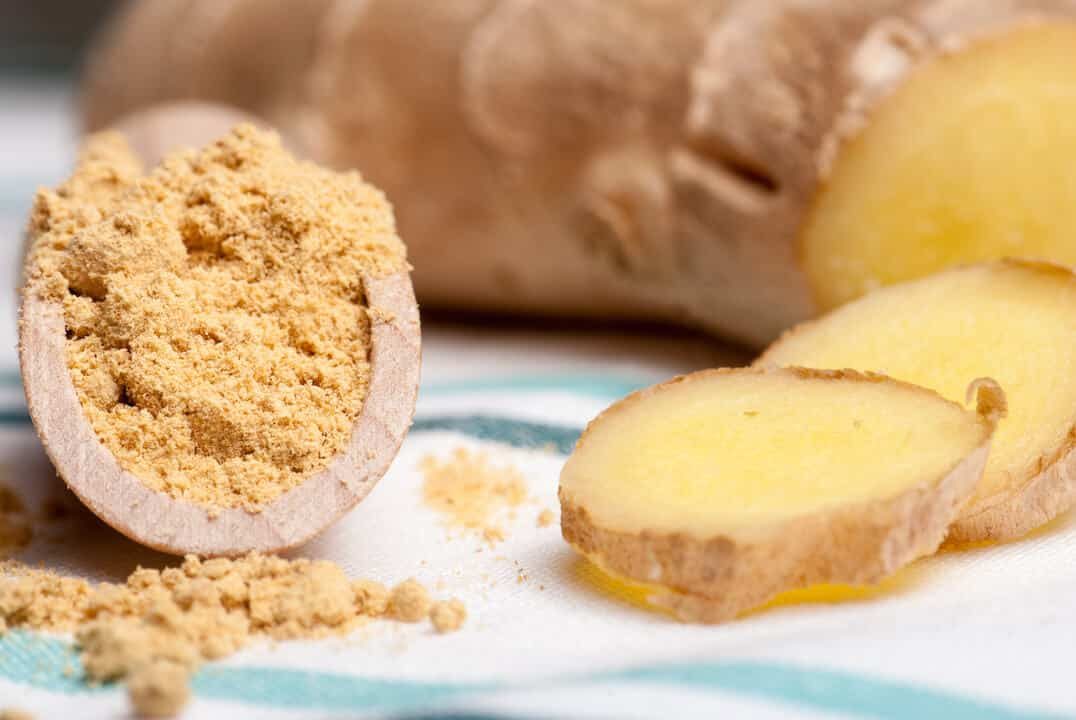
Fresh and ground ginger come from the same rhizome of Zingiber officinale,1 but drying does more than remove water. It changes the compounds that make ginger hot and the oil that makes it smell. Fresh ginger’s bite comes mostly from gingerols, which drying and heat turn partly into shogaols.23 So ground ginger is a different-tasting ingredient, not just a concentrated one, and the published conversions between the two disagree sixfold.
Side by side
| Fresh ginger | Ground ginger | |
|---|---|---|
| Plant and part | Rhizome of Zingiber officinale, family Zingiberaceae, the same family as turmeric14 | Same rhizome, dried and milled1 |
| Water | 78.9 g per 100 g5 | 9.94 g per 100 g6 |
| Weight of 1 teaspoon | 2 g5 | 1.8 g6 |
| Main pungent compounds | Gingerols; shogaol and zingerone appear to be absent from fresh ginger2 | Gingerols plus shogaols formed by heat; hot-air drying left less gingerol and more shogaol than sun drying in one study3 |
| Essential oil | Not measured in the sources reviewed | Usually 1–3% in the major types of commercial dried ginger; drying lowers the oil’s monoterpenes and raises its sesquiterpenes7 |
| Flavor (editorial) | Hot, juicy, bright and citrusy | Warmer, duller and more peppery; the Spice House calls it less bright and zesty than fresh8 |
| Where it’s favored | Kew: essential to many dishes in Asia1 | Kew: more popular in European cooking1 |
| Shelf life | No sourced figure found | 1 year for ground spices (UC extension);9 2–4 years (McCormick, its own guidance)10 |
What drying does to ginger
The heat changes form. Kew names gingerol, gingeridione and shogaol as ginger’s pungent principles, all non-volatile phenolic compounds.1 In 1969 Connell and Sutherland found that shogaol and zingerone appear to be absent from fresh ginger and form when heat or alkali acts on gingerol.2 A 2018 study of ginger grown in Iran compared sun drying, solar-tunnel drying and hot-air drying at 120 to 180°C. Hot-air drying left less gingerol and more shogaol than sun drying.3 The authors describe gingerols as the principal constituents of fresh ginger.3 A 2025 study of industrially spray-dried ginger extract found the same conversion of 6-gingerol to 6-shogaol.11
Hotter or milder? The sources disagree.
| Source | What it says |
|---|---|
| Warren-Walker et al., 2025 (spray-dried extract, lab)11 | Turning 6-gingerol into 6-shogaol raises ginger’s overall pungency |
| Gernot Katzer’s Spice Pages12 | Gingerols degrade to the milder shogaols; dried ginger tastes more aromatic than pungent |
| Katzer, on cooking fresh ginger12 | Cooking increases its pungency but decreases its freshness |
These are not the same experiment, and none of them tasted supermarket ground ginger against fresh. The question is covered in more depth in is ginger spicy?.
The smell changes too. PROSEA reports that drying lowers the share of monoterpenes in ginger oil and raises the share of sesquiterpenes.7 No source we found measured how that changes the aroma, so the common impression that fresh ginger smells sharper and more lemony remains a cook’s observation.
Can one stand in for the other?
Yes, for heat and general ginger flavor; no, for brightness. The Spice House says ground ginger is less bright and zesty than fresh and suggests a little citrus or pepper to brighten a stir-fry made with it.8 Katzer goes further and says dried ginger cannot substitute for fresh.12 Going the other way, fresh ginger in place of ground adds moisture and fiber to a dry mix or batter; grate it finely (our judgment).
Ground ginger per tablespoon of grated fresh (Disputed):
| Source | Ground ginger | Fresh ginger, grated |
|---|---|---|
| NDSU Extension, FN19813 | 1/8 tsp | 1 Tbsp |
| NMSU Extension, E-13114 | 1/8 tsp | 1 Tbsp (raw ginger) |
| The Spice House8 | 1/4 tsp | 1 Tbsp |
| McCormick conversion chart15 | 1/4 tsp | 1 tsp (that is, 3/4 tsp per Tbsp) |
None of these sources says how its figure was reached. USDA’s data let us check one thing: how much ginger solids each figure contains. A tablespoon of raw ginger, at 2 g per teaspoon and 78.9% water,5 holds about 1.27 g of solids. A teaspoon of ground ginger, at 1.8 g and 9.94% water,6 holds about 1.62 g. So, by solids alone, a tablespoon of fresh equals about 3/4 teaspoon of ground (our arithmetic). That is close to McCormick’s figure. The extension figures use a sixth as much ginger solids, the Spice House about a third. USDA does not say whether its teaspoon of raw ginger is grated or minced.
Equal solids do not mean equal flavor, since drying changes the pungent compounds and the oil.73 Our Method starting point, as on our ginger substitutes page: 1/8 teaspoon of ground ginger per tablespoon of fresh, added with the liquid, tasted once the dish has simmered, and increased toward 1/4 teaspoon or more for a stronger ginger note.
When to use which
These are cooking judgments, consistent with the sources above:
- Fresh for stir-fries, curries, marinades, dressings, broths and anything raw, where the bright, juicy bite matters. Kew notes fresh ginger is essential to many Asian dishes.1
- Ground for baking (gingerbread, gingersnaps, spice cakes), spice rubs and blends, where a dry, even powder mixes in and moisture would get in the way.
- Both in some baked goods: ground for the warm base, a little grated fresh for brightness.
Is one healthier?
No source we found compares the health effects of fresh and ground ginger in food amounts. The chemistry differs, as above, but the NIH’s summary of ginger research covers ginger in general: it says research shows ginger may be helpful for nausea and vomiting associated with pregnancy.16 Nothing we read ties a health effect to one form over the other.
What isn’t known
- No study compares the pungency of retail ground ginger with fresh ginger.
- No source explains any of the four conversion figures.
- How long fresh ginger keeps: we found no figure from a regulator, extension service or study.
- How the drying-related shift in ginger oil changes the smell.
Related
- Ginger, ginger substitutes, is ginger spicy? and too much ginger
- How to store ginger, can you freeze ginger? and cooking with ginger
- Fresh turmeric vs. powder and dried galangal vs. fresh
- Galangal vs. ginger, turmeric vs. ginger and garlic vs. ginger
Footnotes
-
Zingiber officinale Roscoe, Plants of the World Online, Royal Botanic Gardens, Kew. powo.science.kew.org · Reference work ↩ ↩2 ↩3 ↩4 ↩5 ↩6 ↩7
-
Connell and Sutherland, “A re-examination of gingerol, shogaol, and zingerone, the pungent principles of ginger”, Australian Journal of Chemistry, 1969. publish.csiro.au · Peer-reviewed ↩ ↩2 ↩3
-
Ghasemzadeh et al., “Formation of 6-, 8- and 10-Shogaol in Ginger through Application of Different Drying Methods”, Molecules, 2018. mdpi.com · Peer-reviewed ↩ ↩2 ↩3 ↩4 ↩5
-
Curcuma longa L., Plants of the World Online, Royal Botanic Gardens, Kew. powo.science.kew.org · Reference work ↩
-
Ginger root, raw, FDC ID 169231, USDA FoodData Central. fdc.nal.usda.gov · Regulator ↩ ↩2 ↩3
-
Spices, ginger, ground, FDC ID 170926, USDA FoodData Central. fdc.nal.usda.gov · Regulator ↩ ↩2 ↩3
-
H. Sutarno, E.A. Hadad and M. Brink, Zingiber officinale, Plant Resources of South-East Asia (PROSEA). uses.plantnet-project.org · Reference work ↩ ↩2 ↩3
-
“Ginger Substitute”, The Spice House, 2018. thespicehouse.com · Merchant ↩ ↩2 ↩3
-
Anna Martin, “Add a Little Spice to Your Life! Part II”, University of California Cooperative Extension, 2002. ucanr.edu · Reference work ↩
-
McCormick Kitchens, “How Long Do Spices Last?”, McCormick, 2025. mccormick.com · Merchant ↩
-
Warren-Walker et al., “Effect of Thermal Processing by Spray Drying on Key Ginger Compounds”, Metabolites, 2025. pmc.ncbi.nlm.nih.gov · Peer-reviewed ↩ ↩2
-
Ginger, Gernot Katzer’s Spice Pages. gernot-katzers-spice-pages.com · Reference work ↩ ↩2 ↩3
-
Julie Garden-Robinson, Ingredient Substitutions (FN198), NDSU Extension, 2018. ksre.ksu.edu · Reference work ↩
-
In a Pinch Ingredient Substitution (E-131), New Mexico State University Cooperative Extension, 2016. pubs.nmsu.edu · Reference work ↩
-
McCormick Kitchens, “How to Grind Your Own Spices, Plus Spice Conversions”, McCormick, 2025. mccormick.com · Merchant ↩
-
“Ginger: Usefulness and Safety”, National Center for Complementary and Integrative Health, 2025. nccih.nih.gov · Regulator ↩