Spice Substitutes · Substitutes
Galangal Substitutes, Ranked by the Job Galangal Is Doing
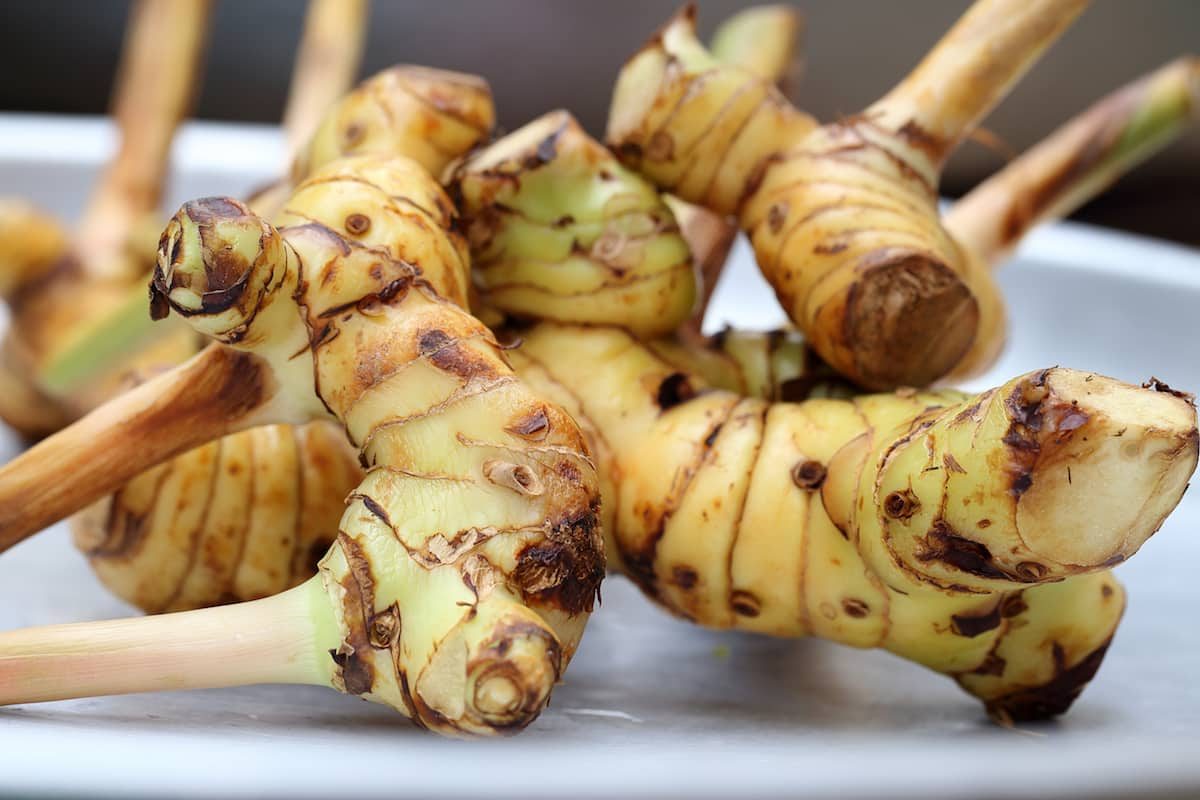
Galangal is the rhizome of Alpinia galanga, a member of the ginger family (Zingiberaceae).12 PROSEA describes its taste as strong and pungent, like a mixture of pepper and ginger, and notes that it is said to be indispensable in everyday cooking across South and Southeast Asia.3 Spice writer Gernot Katzer goes further and says it cannot be replaced by any other spice.4 He is right that nothing tastes the same. But a dish can still work without it, and which substitute works best depends on what galangal is doing in your recipe.
Quick answer
| What galangal is doing | Best substitute | Starting amount, per 1 part fresh galangal | Treatment |
|---|---|---|---|
| Lead aroma in a soup or broth (tom kha) | Frozen, dried or jarred galangal | Dried slices, soaked; no published ratio | Method |
| One aromatic among several (curry pastes, stir-fries, stews) | Fresh ginger, with a little lemon juice | 3 to 4 parts ginger | Attributed |
| The sharp, camphor-like edge in a Thai curry | Fingerroot (krachai) | 1/2 part, then add to taste | Method |
| Ground galangal in a spice mix or rub | Ground ginger plus a pinch of cinnamon or black pepper | 1 part ground ginger, pinch of the other | Method |
The rest of the page explains each choice.
How the ratios on this page are labeled
Every ratio carries one of four labels.
- Computed: based on a measurable physical relationship, with the source named.
- Attributed: a named source publishes this ratio. We quote it as theirs.
- Disputed: named sources give different answers to the same swap. We show each one and do not average them.
- Method: we found no published ratio. We give a direction and a cautious starting point, and say so.
No study has measured the flavor strength of galangal against ginger or any other substitute. The one published ratio we found is a food writer’s rule of thumb.
Why ginger is close but not the same
Galangal and ginger (Zingiber officinale) are in the same plant family, but in different genera.15 Their flavor chemistry differs:
- Galangal. Its essential oil makes up 0.2 to 1.5 percent of the dried rhizome, and studies from the 1980s identified 1,8-cineole as its main component.3 Britannica describes the flavor as ginger-like with citrus, pepper and pine notes.2
- Ginger. PROSEA attributes its pungency to gingerols, non-volatile phenolic compounds, and lists zingiberene among the main components of its aroma oil.6
America’s Test Kitchen tried the swap both ways. Used in place of ginger in frozen yogurt and a soy-based dipping sauce, galangal’s sharp, astringent, almost piney flavor was too strong. Its testers do use ginger in place of galangal in savory dishes, where galangal is usually one of several aromatics.7 Chowhound’s Shriya Swaminathan makes the same point from the other side: ginger is less intense, while galangal is sharper and more citrusy, with earthy undertones.8
In short, ginger gives you warmth and heat but less of galangal’s sharp, piney, citrusy lift. Expect a rounder, sweeter dish.
If galangal is the lead aroma
In some dishes galangal is the flavor you would name. Kha is the Thai name for galangal,3 as in tom kha kai. A Northern Illinois University recipe for that soup simmers six thin slices of young galangal with coconut milk, lemongrass and kaffir lime leaves.9 Here, the best substitute is another form of galangal.
1. Frozen, dried or jarred galangal
PROSEA notes that galangal is sold both fresh and dried.3 Katzer says the choice of fresh or dried makes “a great difference in flavour,” and that dried slices come closer to fresh once soaked in warm water.4 Asian groceries that don’t carry fresh galangal often stock it frozen, sliced in jars, or as dried slices. That is common practice, not a sourced finding. See can you freeze galangal? and dried vs. fresh galangal.
Ratio (Method): We found no published ratio for dried galangal against fresh. Soak the slices in warm water, use about the same number of slices the recipe asks for, and taste the broth before adding more. Treat this as a starting point, not a measured equivalent.
2. Fresh ginger, if nothing else is available
In a galangal-led soup, ginger will work but the dish will taste different. See the ratio below.
If galangal is one aromatic among several
In curry pastes, stir-fries and stews, galangal shares the work with garlic, shallots, chiles, lemongrass and lime leaves. This is where ginger stands in best.7
1. Fresh ginger, with a little lemon juice
Ratio (Attributed): Chowhound says to use three to four times more ginger than the galangal called for.8 It suggests adding lemon juice to echo galangal’s citrus notes, and turmeric or black pepper for an earthy edge.8 America’s Test Kitchen endorses the swap in savory dishes but gives no amount.7 Chowhound’s figure is a rule of thumb, not a measurement, so add the ginger in stages and taste as you go.
Use fresh ginger in place of fresh galangal. Galangal is much harder than ginger, so a recipe that slices galangal into coins may work better with grated or finely chopped ginger; that is kitchen judgment.
2. Ginger with a pinch of black pepper
PROSEA’s description of galangal as tasting like a mixture of pepper and ginger3 suggests this combination.
Ratio (Method): No published ratio exists. Start with ginger as above and add a small pinch of ground black pepper per tablespoon of ginger, then taste. The pepper adds bite. It does not supply galangal’s piney, citrusy aroma.
If galangal gives a Thai curry its sharp, camphor-like edge
Fingerroot (krachai)
Fingerroot is the rhizome of Boesenbergia rotunda, another member of the ginger family.10 Its essential oil contains 1,8-cineole (18 to 41 percent in PROSEA’s figures) and camphor,11 so it shares galangal’s main aroma compound. Katzer describes its flavor as strong and dominating, with a “medical” quality, stronger still when dried.12 He calls it an important flavoring only in Thai cooking, where it often goes into curries, particularly fish curries.12
Fingerroot is not a common pantry item either. Katzer says it is often available in Thai food stores,12 and Pailin Chongchitnant notes that it is also sold in brine in glass jars at Asian grocery stores.13 Shoppers should know that cookbooks very frequently confuse it with Kaempferia galanga, which Katzer calls lesser galangale and which is sold as sand ginger or kencur.14 See fingerroot and sand ginger.
Ratio (Method): No published ratio was found for using fingerroot in place of galangal. Because both Katzer and PROSEA describe strong flavors, start with about half as much fingerroot as galangal, then taste. Chongchitnant gives the reverse swap, saying a fish curry can be made without fingerroot or with more galangal instead,13 which suggests the two can share a role. It is not a ratio.
If you need ground galangal
Katzer describes dried, powdered galangal as less fresh but more spicy, “something in between of ginger and cinnamon.”4 That makes ground ginger the base, with cinnamon as a possible accent.
Ratio (Method): No published ratio was found. Start with an equal amount of ground ginger, add a small pinch of ground cinnamon or black pepper, and taste. Use ground ginger only where the recipe calls for ground galangal; in a fresh paste, ground spice does not behave like a fresh rhizome.
What isn’t known
- There are no published measurements comparing the flavor strength of galangal with ginger, fingerroot or any other substitute. The Chowhound ratio is a rule of thumb.
- No source we found gives a weight or volume equivalent between fresh and dried galangal.
- Mace and cinnamon are sometimes suggested as a blend to imitate galangal. We found no source supporting the idea that mace resembles galangal, so it is not recommended here.
- It is sometimes said that ginger and galangal share stomach-soothing properties. No source we reviewed shows this for galangal.
Related
- Galangal, galangal vs. ginger and galangal vs. turmeric
- Ginger and ginger substitutes
- Fingerroot and sand ginger
- Dried vs. fresh galangal, how to store galangal and can you freeze galangal?
- Thai spices and herbs
Footnotes
-
Alpinia galanga (L.) Willd., Plants of the World Online, Royal Botanic Gardens, Kew. powo.science.kew.org · Reference work ↩ ↩2
-
Murtoff, Galangal, Encyclopaedia Britannica. britannica.com · Reference work ↩ ↩2
-
Scheffer and Jansen, Alpinia galanga (PROSEA), Plant Resources of South-East Asia. uses.plantnet-project.org · Reference work ↩ ↩2 ↩3 ↩4 ↩5
-
Katzer, Greater Galangale, Gernot Katzer’s Spice Pages. gernot-katzers-spice-pages.com · Reference work ↩ ↩2 ↩3
-
Zingiber officinale Roscoe, Plants of the World Online, Royal Botanic Gardens, Kew. powo.science.kew.org · Reference work ↩
-
Sutarno, Hadad and Brink, Zingiber officinale (PROSEA), Plant Resources of South-East Asia. uses.plantnet-project.org · Reference work ↩
-
Substitute Ginger for Galangal, but Not Vice Versa, America’s Test Kitchen. americastestkitchen.com · Publication ↩ ↩2 ↩3
-
Swaminathan, Galangal Vs Ginger: Can You Substitute One For The Other?, Chowhound, 2025. chowhound.com · Publication ↩ ↩2 ↩3
-
Tomkha Kai, SEAsite, Northern Illinois University. seasite.niu.edu · Reference work ↩
-
Boesenbergia rotunda (L.) Mansf., Plants of the World Online, Royal Botanic Gardens, Kew. powo.science.kew.org · Reference work ↩
-
Ibrahim and Nugroho, Boesenbergia rotunda (PROSEA), Plant Resources of South-East Asia. uses.plantnet-project.org · Reference work ↩
-
Katzer, Fingerroot, Gernot Katzer’s Spice Pages. gernot-katzers-spice-pages.com · Reference work ↩ ↩2 ↩3
-
Chongchitnant, Thai Rice Noodles with Fish Curry, Hot Thai Kitchen. hot-thai-kitchen.com · Publication ↩ ↩2
-
Katzer, Lesser galangale (Kaempferia galanga), Gernot Katzer’s Spice Pages. gernot-katzers-spice-pages.com · Reference work ↩