Spice Comparisons · Comparison
Galangal vs. Ginger: Flavor, Texture and When to Swap
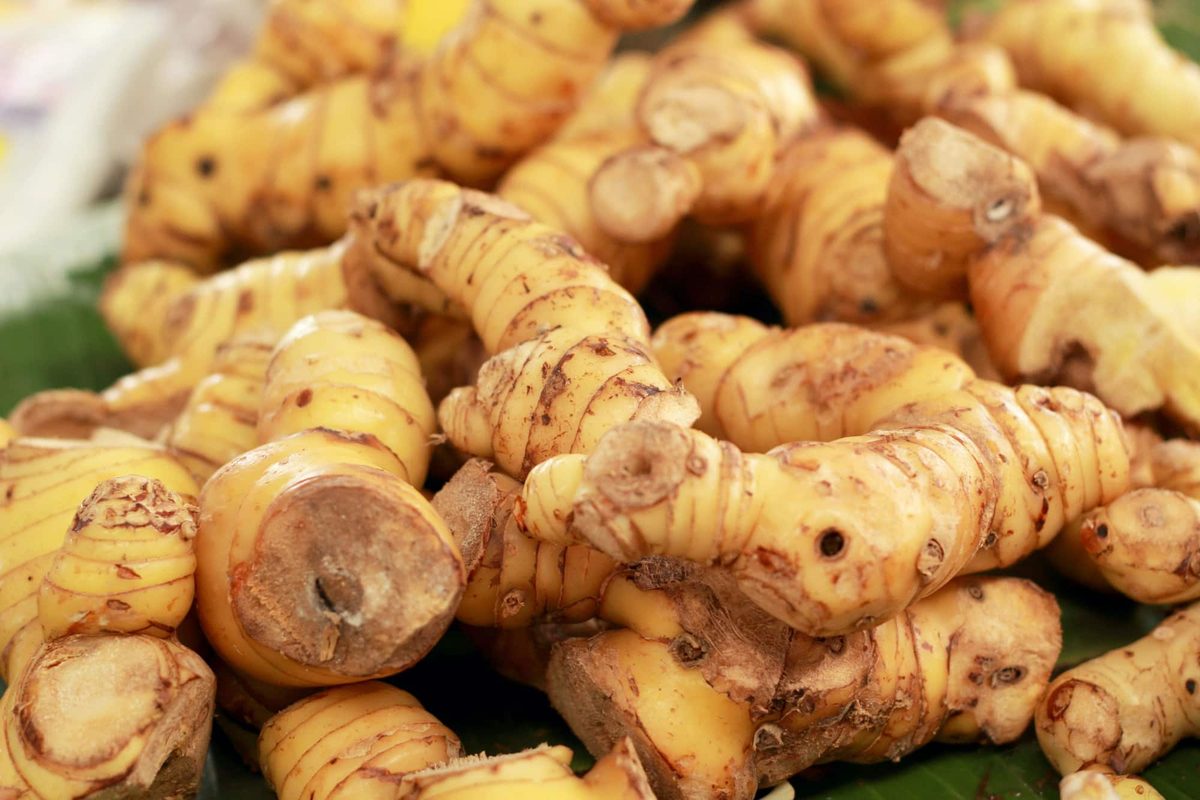
Galangal and ginger are cousins, not twins. Both are rhizomes from the ginger family, Zingiberaceae, but from different genera: galangal is Alpinia galanga, ginger is Zingiber officinale.12 Britannica notes that galangal also goes by Siamese ginger and Thai ginger, which adds to the confusion.3 Galangal is hard and fibrous and tastes sharp and resinous; America’s Test Kitchen calls it “sharp, astringent, and almost piney.”45 Ginger is softer, and ATK describes it as “lightly sweet and spicy.”5 In a savory dish where galangal is one aromatic among many, ginger can stand in. Where galangal is the point of the dish, as in tom yum, it can’t.
Side by side
| Galangal | Ginger | |
|---|---|---|
| Species | Alpinia galanga (greater galangal)1 | Zingiber officinale2 |
| Family | Zingiberaceae1 | Zingiberaceae2 |
| Native range (Kew) | Southern China to western and central Malesia1 | Eastern Himalaya to south-central China2 |
| Part used | Rhizome; flowers and young shoots also eaten4 | Rhizome2 |
| The rhizome | Hard, fibrous and shiny, light red or pale yellow (PROSEA); Katzer describes a pale reddish surface ringed with reddish-brown bands and a hard, woody interior46 | Softer (editorial); young ginger is milder, mature ginger hotter7 |
| Key compounds | Essential oil 0.2 to 1.5% of dry weight; 1,8-cineole confirmed as the main component in 1980s studies4 | Heat from gingerols and shogaols; aroma oil usually 1 to 3% of commercial dried ginger, with zingiberene, ar-curcumene and β-sesquiphellandrene8 |
| Flavor | Strong and pungent, like a mix of pepper and ginger (PROSEA); sharp, astringent, almost piney (ATK)45 | Lightly sweet and spicy (ATK)5 |
| Forms | Fresh or dried4 | Fresh, or dried and powdered; also preserved in syrup28 |
| Typical uses | Thai soups and curry pastes; Indonesian cooking69 | Fresh in Asian cooking; dried and ground in European cooking2 |
| Price | No dated, sourced retail comparison found | No dated, sourced retail comparison found |
The compound rows compare different things. For galangal the sources describe the aroma oil; for ginger they separate the non-volatile heat compounds from the aroma oil. No source we opened names galangal’s pungent compounds or measures the two rhizomes’ heat side by side.
For each spice on its own, see galangal and ginger.
The differences that change a dish
Flavor
The sources agree that galangal tastes different from ginger, but they describe its strength differently:
| Source | What it says about galangal |
|---|---|
| PROSEA | A strong pungent taste, like a mixture of pepper and ginger4 |
| America’s Test Kitchen | Sharp, astringent and almost piney; too strong in place of ginger in frozen yogurt and a soy dipping sauce5 |
| Chowhound (Shriya Swaminathan) | Much sharper and more citrusy than ginger, with deep, earthy undertones10 |
| Gernot Katzer | Fresh: a pure, refreshing odor and a mildly spicy flavor. Dried and powdered: less fresh but more spicy, between ginger and cinnamon6 |
These are descriptions, not measurements, and they are not averaged here. Katzer’s split between fresh and dried is the useful part for a cook: dried galangal is a different ingredient from fresh. See dried vs. fresh galangal.
Ginger varies too. Tasting Table describes young ginger, harvested about eight months after planting, as “mild and delicate with an almost floral sweetness,” and mature ginger as having “a potent yet pleasant heat.”7 PROSEA singles out Jamaican ginger for its delicate aroma and flavor.8 So “ginger” in a recipe is not one fixed strength either.
Texture and prep
PROSEA describes galangal’s rhizome as hard and fibrous, and Katzer calls its interior hard and woody.46 That is why recipes slice it into coins rather than grating it: the Northern Illinois University tom kha kai calls for six thin slices of young galangal, and Hot Thai Kitchen’s tom yum for eight slices.119 Hot Thai Kitchen notes that galangal, lemongrass and makrut lime leaves are traditionally left in the soup as garnish.9 Fresh ginger grates easily and can be peeled with the edge of a spoon; that is common kitchen practice, not a sourced finding.
Where each belongs
Kew notes that fresh ginger is an essential ingredient of many dishes in Asia, while the dried, powdered spice is more popular in European cooking.2 Galangal’s home is Southeast Asia: Katzer calls ground fresh galangal an essential ingredient in most Thai curry pastes and says Indonesians frequently use it fresh or dried, sliced or powdered.6 He also notes that it is not well known in Western countries today.6 That was not always so: Chaucer’s Cook in the Canterbury Tales seasons with “galyngale.”12
Can one stand in for the other?
ATK’s verdict is in the title of its piece: substitute ginger for galangal, but not the other way round.5
| Swap | Starting amount | Treatment |
|---|---|---|
| Fresh ginger for fresh galangal, where galangal is one of several aromatics | 3 to 4 times the galangal amount, plus a little lemon juice | Attributed |
| Fresh ginger for galangal in tom yum or tom kha | Not recommended; use frozen or dried galangal, or leave it out | Method |
| Ground ginger for ground galangal | Same amount, plus a pinch of cinnamon or black pepper | Method |
| Galangal for ginger in Thai or Southeast Asian soups and pastes | Same amount sliced; about half as much grated | Method |
| Galangal for ginger in sweets and baking | Not recommended |
- Ginger for galangal in curry pastes, stir-fries and stews. ATK doesn’t mind substituting ginger in savory dishes where galangal is one of several aromatics, but gives no amount.5 Chowhound says to use three to four times more ginger than the galangal called for, with lemon juice to echo the citrus notes.10 That figure is a food writer’s rule of thumb, so add the ginger in stages. See galangal substitutes.
- Not in tom yum. Pailin Chongchitnant’s tom yum recipe says not to substitute ginger, which tastes very different, and to use frozen or dried galangal instead, or leave it out.9 She calls lemongrass, galangal and makrut lime leaves the soup’s three iconic herbs.9
- Ground ginger for ground galangal. Katzer places dried galangal between ginger and cinnamon,6 which suggests ground ginger with a pinch of cinnamon. No source gives a ratio. Method: start with an equal amount of ground ginger and a small pinch of cinnamon or black pepper.
- Galangal for ginger. Our ginger substitutes page treats galangal as a Method swap in Thai and Southeast Asian soups and pastes: about the same amount sliced, or half as much grated, given its sharper flavor. In sweets, ATK found galangal too strong in frozen yogurt.5 Gingerbread made with galangal would be a different cake (editorial).
What isn’t known
- No study measures the pungency of galangal against ginger, and the sources describe galangal’s strength differently (see the table above).
- No source we opened names the compounds behind galangal’s bite, as gingerols are named for ginger.
- No dated price comparison was found. Galangal is often said to be costlier and harder to find in Western shops; Katzer says only that it is not well known there.
- Soto ayam is often listed as a galangal dish; we did not find a source we could check for it.
Related
- Galangal vs. turmeric and turmeric vs. ginger
- Fresh ginger vs. ground ginger and is ginger spicy?
- Sand ginger, fingerroot and lemongrass
- How to store galangal, cooking with ginger and too much ginger
Footnotes
-
Alpinia galanga (L.) Willd., Plants of the World Online, Royal Botanic Gardens, Kew. powo.science.kew.org · Reference work ↩ ↩2 ↩3 ↩4
-
Zingiber officinale Roscoe, Plants of the World Online, Royal Botanic Gardens, Kew. powo.science.kew.org · Reference work ↩ ↩2 ↩3 ↩4 ↩5 ↩6 ↩7 ↩8
-
Jennifer Murtoff, “Galangal”, Encyclopaedia Britannica. britannica.com · Reference work ↩
-
J.J.C. Scheffer and P.C.M. Jansen, Alpinia galanga, Plant Resources of South-East Asia (PROSEA). uses.plantnet-project.org · Reference work ↩ ↩2 ↩3 ↩4 ↩5 ↩6 ↩7 ↩8
-
“Substitute Ginger for Galangal, but Not Vice Versa”, America’s Test Kitchen. americastestkitchen.com · Publication ↩ ↩2 ↩3 ↩4 ↩5 ↩6 ↩7 ↩8
-
Gernot Katzer, “Greater Galangale”, Gernot Katzer’s Spice Pages. gernot-katzers-spice-pages.com · Reference work ↩ ↩2 ↩3 ↩4 ↩5 ↩6 ↩7
-
September Grace Mahino, “Young Ginger Vs Mature: What’s The Difference?”, Tasting Table, 2023. tastingtable.com · Publication ↩ ↩2
-
H. Sutarno, E.A. Hadad and M. Brink, Zingiber officinale, Plant Resources of South-East Asia (PROSEA). uses.plantnet-project.org · Reference work ↩ ↩2 ↩3
-
Pailin Chongchitnant, “Tom Yum Soup (Tom Yum Goong)”, Hot Thai Kitchen. hot-thai-kitchen.com · Publication ↩ ↩2 ↩3 ↩4 ↩5
-
Shriya Swaminathan, “Galangal Vs Ginger: Can You Substitute One For The Other?”, Chowhound, 2025. chowhound.com · Publication ↩ ↩2
-
“Tomkha Kai”, SEAsite, Northern Illinois University. seasite.niu.edu · Reference work ↩
-
Geoffrey Chaucer, General Prologue, Canterbury Tales, Harvard’s Geoffrey Chaucer Website. chaucer.fas.harvard.edu · Reference work ↩