Spices · Profile
Ginger: Flavor, Pungent Compounds, Origin, Uses and Safety
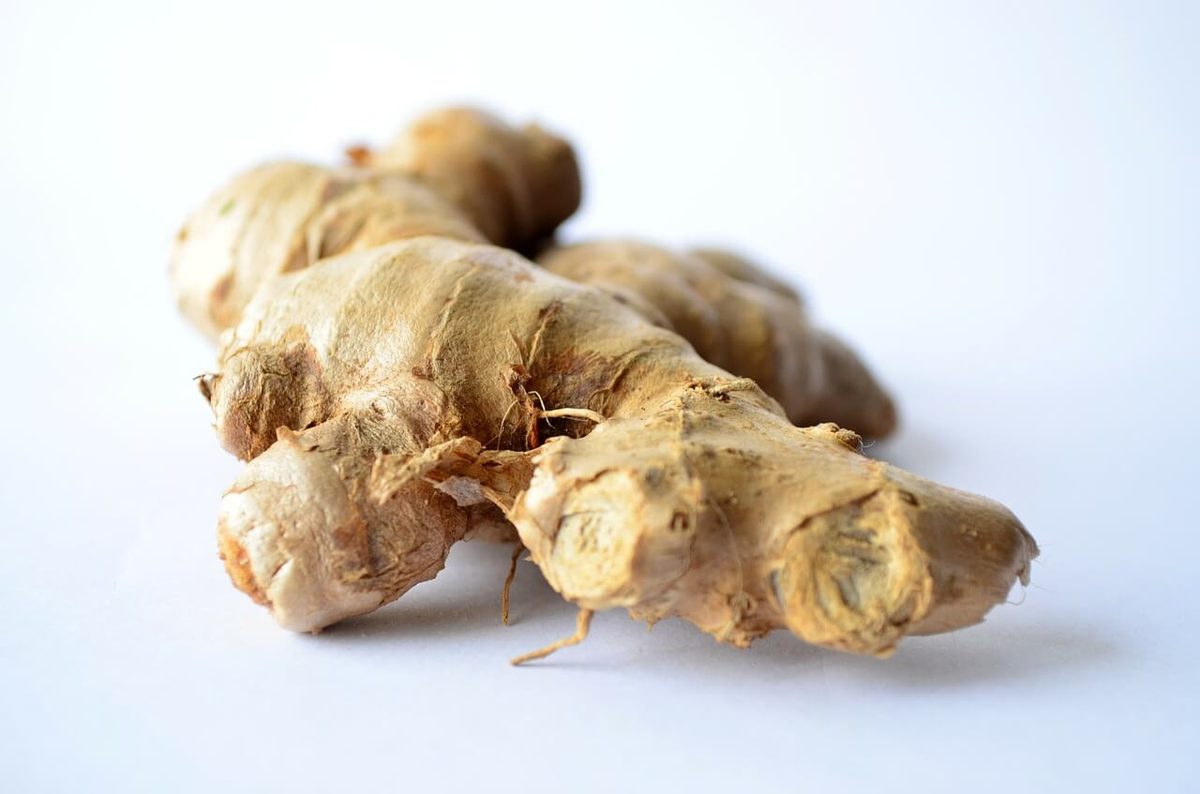
Ginger is the rhizome, the knobby underground stem, of Zingiber officinale, a tropical herbaceous plant.1 It is sold fresh, dried and ground, preserved in syrup and pickled, and it is one of the few spices used as heavily in sweets and drinks as in savory food. This page covers what makes ginger hot, where it comes from, how it is used and graded, and what the health research actually shows.
At a glance
| Botanical name | Zingiber officinale Roscoe1 |
| Plant family | Zingiberaceae (the ginger family), shared with turmeric and galangal123 |
| Part used | Rhizome (underground stem)14 |
| Native range | Eastern Himalaya to south-central China per Kew, which lists Assam as native and India as a whole as introduced (see Origin below)1 |
| Main producers | India, China, Indonesia and Nigeria (PROSEA); India 2,653,762 tonnes of fresh ginger in 2024-25, final figure56 |
| Pungent compounds | Gingerols, shogaols and gingeridione15 |
| Essential oil | Usually 1–3% in the major types of commercial dried ginger5 |
| Forms sold | Fresh rhizome, dried (whole, pieces, slices), ground, preserved in syrup, pickled, essential oil and oleoresin157 |
| International standard | Codex CXS 343-2021 (dried or dehydrated ginger)7 |
Measured values
9 figures, sourced| Measure | Value | Scope | Source |
|---|---|---|---|
| Essential oil | 1–3 % (usually), commercial dried ginger | major types of commercial dried ginger | uses.plantnet-project.org |
| Moisture, maximum Limit | 12.0 % w/w | Codex CXS 343-2021, whole, pieces and ground | fao.org |
| Total ash, maximum Limit | 8.0 % dry basis (unbleached) | Codex CXS 343-2021, whole, pieces and ground | fao.org |
| Total ash, maximum Limit | 12.0 % dry basis (bleached) | Codex CXS 343-2021, whole, pieces and ground | fao.org |
| Acid-insoluble ash, maximum Limit | 1.5 % dry basis | Codex CXS 343-2021, whole, pieces and ground | fao.org |
| Volatile oil, minimum Limit | 1.5 mL/100 g dry basis | Codex CXS 343-2021, whole and pieces | fao.org |
| Volatile oil, minimum Limit | 1.0 mL/100 g dry basis | Codex CXS 343-2021, ground | fao.org |
| Extraneous matter, maximum Limit | 1.0 % | Codex CXS 343-2021, whole and cut ginger | fao.org |
| Foreign matter, maximum Limit | 0.5 % | Codex CXS 343-2021, whole and cut ginger | fao.org |
Each figure is quoted as its source states it, with the samples or standard it applies to. Where sources differ, both are shown; nothing is averaged. All measured values
Flavor and the compounds behind it
Fresh ginger is hot, bright and slightly citrusy, with a clean sweetness under the bite. Dried ground ginger is warmer, duller and more peppery. That description is ours; the chemistry below explains the two parts of it, the heat and the smell.
The heat: gingerols and shogaols
Kew names the pungent principles of ginger as gingerol, gingeridione and shogaol, all non-volatile phenolic compounds.1 PROSEA likewise attributes the pungent taste to non-volatile phenols, the gingerols and shogaols.5
Heat changes the balance between them. A 2025 study of spray-dried ginger extract found that during thermal processing 6-gingerol loses a water molecule and becomes 6-shogaol, a change its authors describe as raising ginger’s overall pungency; zingerone also increased as gingerols broke down.8 That study measured an industrial drying process, not a home kitchen, and it did not compare the heat of commercial ground ginger with fresh, so it should not be read as a measured fresh-to-ground conversion.
The aroma: the essential oil
The smell comes from the essential oil, which PROSEA puts at usually 1–3% of the major types of commercial dried ginger.5 The compounds usually detected include α-zingiberene, β-zingiberene, ar-curcumene and β-sesquiphellandrene.5 Drying shifts the oil’s makeup: the monoterpene content falls and the sesquiterpene content rises.5 No source we found measured how that shift changes the smell, so the familiar sense that fresh ginger smells sharper than dried remains a cook’s observation.
Is ginger “spicy” in the way chiles are? Its burn comes from different compounds. See is ginger spicy? for more.
Origin and history
Where it comes from
Ginger’s wild origin is not settled. Kew’s Plants of the World Online gives the native range as the eastern Himalaya to south-central China (Assam, the eastern Himalaya and south-central China), lists Assam (a state of India) as native and India as a whole among the places it is introduced.1 PROSEA says its origin is uncertain but that it is thought to come from India, and that it has been grown in tropical Asia since ancient times.5 Britannica calls it probably native to southeastern Asia.4 AramcoWorld’s history of the spice describes several tropical areas of origin: southern China, Southeast Asia and India.9 AramcoWorld also notes that ginger does not propagate by seed.9
How it traveled
- China. According to AramcoWorld, Confucius noted in the Analects that he was never without ginger when he ate.9
- The classical Mediterranean. The Greek physician Dioscorides, writing between 50 and 70 CE, described ginger as warming and digestive.9
- The Indian Ocean. Arab traders played an important role in spreading ginger around the Indian Ocean, and the 14th-century traveler Ibn Battuta saw sailors on Chinese junks growing ginger in wooden tanks.9
- Africa and the Caribbean. Europeans later carried ginger to the West African coast and the Caribbean.9
Kew records ginger as introduced across South and Southeast Asia, the Indian Ocean islands, the Pacific, Central America and the Caribbean, from Cuba and Puerto Rico to Trinidad and Tobago.1
Production
India is by far the largest grower in the official data we could open. The Spices Board of India reports fresh ginger at 2,653,762 tonnes from 229,914 hectares in 2024-25 (final figure) and an advance estimate of 2,604,486 tonnes from 212,041 hectares for 2025-26.6 The Board’s figures for the three earlier years range from 2,201,187 tonnes (2022-23) to 2,503,325 tonnes (2021-22), and it notes that figures from 2020-21 onward are subject to revision.6
Other sources give different numbers for different scopes, so they are listed separately rather than reconciled:
| Figure | Scope | Source |
|---|---|---|
| 2,653,762 t | India, fresh ginger, 2024-25 (final) | Spices Board India6 |
| “Some 1.8 million metric tons a year” | India, no year or basis stated (article published 2021) | AramcoWorld9 |
| 600,000 t | World production estimate for 1998 (main producers India, China, Indonesia, Nigeria) | PROSEA5 |
AramcoWorld also names Nigeria, China, Indonesia and Nepal among the other large producers.9 We could not open FAO production statistics for ginger during this review, so no current world total or country ranking appears here.
How ginger is used
Kew notes that in Asia the fresh rhizome is an essential ingredient of many dishes, while the dried, powdered spice is more popular in European cooking.1 PROSEA says fresh ginger is widely used in Southeast Asian cooking and ground dried ginger is used worldwide in home cooking.5
- Drinks. Ginger oil (the oleoresin) flavors ginger beer and ginger ale, and fresh ginger is also used to make ginger ale and other drinks.15 In India, ginger is a core ingredient of masala chai.9
- Preserved ginger. Ginger preserved in syrup goes into home cooking and processed foods such as jams, and Chinese ginger has long been the standard for this product.5
- Japan. Gari, the pale pickled ginger served with sushi and sashimi, is pickled in rice vinegar and sugar and is meant to be eaten as a palate cleanser between pieces.10 Beni shoga is a different pickle, made from ginger and umezu (the brine from umeboshi plums), traditionally red, and served with richer dishes such as gyudon, yakisoba and okonomiyaki.10
- The Middle East and North Africa. Ginger has long been used in savory dishes there.9
- Baking. By common practice in Europe and North America, ground ginger is a mainstay of gingerbread, gingersnaps and spice cakes.
In the kitchen
These are cooking judgments rather than measured facts. Fresh ginger is usually grated, minced or sliced into coins; grated ginger gives the most flavor quickly, while slices infuse a broth more gently and can be lifted out. Ginger added early to hot oil mellows, while ginger stirred in at the end stays sharp. Ground and fresh ginger behave differently enough that they are not straightforward swaps; see fresh vs. ground ginger. More ideas are in cooking with ginger, and if a dish has gone too far, see too much ginger.
Ginger is commonly paired with garlic, turmeric, cinnamon, cardamom, cloves, lemongrass and soy sauce. That list is cooking judgment, not a sourced rule.
Buying and quality
The Codex Alimentarius standard for dried or dehydrated ginger (CXS 343-2021) covers whole rhizomes (single or branched, which may be cut at both ends), pieces (cut, diced or sliced) and ground ginger.7 Its key chemical limits:
| Requirement | Whole and pieces | Ground |
|---|---|---|
| Moisture, maximum (% w/w) | 12.0 | 12.0 |
| Total ash, maximum (% dry basis) | 8.0 unbleached / 12.0 bleached | 8.0 unbleached / 12.0 bleached |
| Acid-insoluble ash, maximum (% dry basis) | 1.5 | 1.5 |
| Volatile oil, minimum (mL/100 g dry basis) | 1.5 | 1.0 |
The standard also caps extraneous matter at 1.0% and foreign matter at 0.5% for whole and cut ginger, and allows no live insects in any form.7
In the dried-ginger trade, PROSEA describes rhizomes with the peel carefully scraped off as “uncoated” or white ginger and those with the peel left on as “coated” or black ginger, and singles out Jamaican ginger for its appearance and delicate aroma, with Cochin ginger from southern India of comparable quality.5
At the store, look for fresh rhizomes that are firm and heavy with smooth, taut skin, and avoid ones that are shriveled, soft or moldy. Ground ginger should smell clearly of ginger when the jar is opened. That is kitchen judgment, not part of any standard.
Storage
We found no shelf-life figure for fresh or ground ginger from a regulator or standards body, and the spans that circulate online have no traceable source. For practical methods, see how to store ginger and can you freeze ginger?. The test for ground ginger is smell: if the aroma is faint, it has faded.
Health evidence and safety
What the research shows
NIH’s National Center for Complementary and Integrative Health (NCCIH) summarizes the evidence as follows:11
| Use | What NCCIH says |
|---|---|
| Nausea and vomiting in pregnancy | Research shows ginger may be helpful |
| Nausea after surgery | Unclear whether it helps |
| Nausea from cancer chemotherapy | Unclear whether it helps |
| Motion sickness | Most studies have not shown it to be helpful |
| Knee osteoarthritis | Ginger supplements might help symptoms |
These findings concern ginger taken deliberately, mostly as supplements, not the amounts used in cooking. Sources disagree on surgery: Kew’s species profile says the evidence suggests ginger is most effective against nausea and vomiting associated with surgery,1 while NCCIH calls that use unclear.11 Both readings are shown here rather than resolved. A widely repeated claim says ginger strengthens the immune system; no source we reviewed supports it.
Safety
Taken by mouth, ginger can cause abdominal discomfort, heartburn, diarrhea, and mouth and throat irritation.11 NCCIH says ginger supplements during pregnancy may be safe and advises talking with a health care provider before using ginger if you take any medicine, since some herbs and medicines interact.11 Kew notes that ginger applied to the skin may cause allergic reactions.1
Lead limits. In 2024 the Codex committee on contaminants agreed lead maximum levels for dried spices including dried rhizomes and roots, and its report records that the proposed levels were based on data for one spice only: ginger.12 The Codex Alimentarius Commission adopted lead limits for dried rhizomes and roots later that year.13
Substitutes and comparisons
Ground ginger, galangal and other members of the ginger family can stand in for some of what fresh ginger does, but none matches it exactly. The ranked list is in ginger substitutes. For side-by-side comparisons, see galangal vs. ginger, turmeric vs. ginger, garlic vs. ginger and fresh vs. ground ginger. Related plants: sand ginger and ginger mint.
Footnotes
-
Zingiber officinale Roscoe, Plants of the World Online, Royal Botanic Gardens, Kew. powo.science.kew.org · Reference work ↩ ↩2 ↩3 ↩4 ↩5 ↩6 ↩7 ↩8 ↩9 ↩10 ↩11 ↩12 ↩13 ↩14
-
Curcuma longa L., Plants of the World Online, Royal Botanic Gardens, Kew. powo.science.kew.org · Reference work ↩
-
Alpinia galanga (L.) Willd., Plants of the World Online, Royal Botanic Gardens, Kew. powo.science.kew.org · Reference work ↩
-
“Ginger”, Encyclopaedia Britannica. britannica.com · Reference work ↩ ↩2
-
H. Sutarno, E.A. Hadad and M. Brink, Zingiber officinale, Plant Resources of South-East Asia (PROSEA). uses.plantnet-project.org · Reference work ↩ ↩2 ↩3 ↩4 ↩5 ↩6 ↩7 ↩8 ↩9 ↩10 ↩11 ↩12 ↩13 ↩14
-
Spice wise area and production in India, 2021-22 to 2025-26, Spices Board India. indianspices.com · Regulator ↩ ↩2 ↩3 ↩4
-
Standard for Dried or Dehydrated Ginger, CXS 343-2021, Codex Alimentarius. fao.org · Standard ↩ ↩2 ↩3 ↩4
-
Warren-Walker et al., “Effect of Thermal Processing by Spray Drying on Key Ginger Compounds”, Metabolites, 2025. pmc.ncbi.nlm.nih.gov · Peer-reviewed ↩
-
Jeff Koehler, “Spice Migrations: Ginger”, AramcoWorld, 2021. aramcoworld.com · Publication ↩ ↩2 ↩3 ↩4 ↩5 ↩6 ↩7 ↩8 ↩9 ↩10
-
Corin MJ Bae, “The Major Flavor Difference Between Beni Shoga And Gari Ginger”, Tasting Table, 2023. tastingtable.com · Publication ↩ ↩2
-
“Ginger: Usefulness and Safety”, National Center for Complementary and Integrative Health, 2025. nccih.nih.gov · Regulator ↩ ↩2 ↩3 ↩4
-
Report of the 17th Session of the Codex Committee on Contaminants in Foods (REP24/CF17), Codex Alimentarius Commission, 2024. fao.org · Regulator ↩
-
Keller and Heckman, Main Outcome of the 47th Codex Alimentarius Commission, 2024. tomorrowsfoodandfeed.khlaw.com · Publication ↩