Spice Substitutes · Substitutes
Holy Basil Substitutes: Italian Basil, Thai Basil and Why They Differ
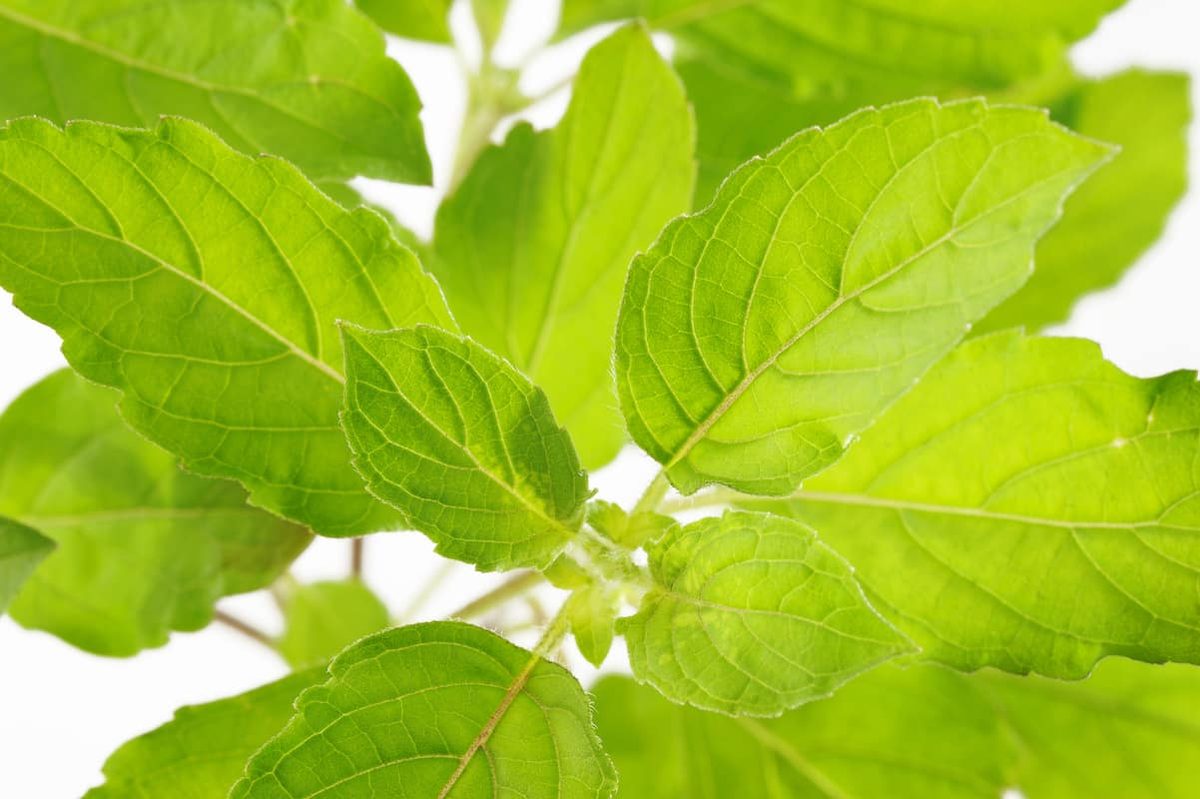
Holy basil is Ocimum tenuiflorum, a separate species from the sweet basil of Italian cooking.1 Britannica calls it tulsi or tulasi, notes that it is considered sacred in Hinduism, and says it is used as a culinary herb throughout Southeast Asia.2 In Thai it is kaphrao, the peppery “hot basil” that gives the stir-fry phat kaphrao its name.3 It can be hard to find outside Asian groceries.4 Two common basils can stand in for it, and the Thai cooking writers we consulted differ on how acceptable each swap is.
Quick answer
| What holy basil is doing | Best substitute | Starting amount, per 1 cup holy basil leaves | Treatment |
|---|---|---|---|
| The herb in phat kaphrao or another stir-fry, wilted at the end | Italian (sweet) basil | 1 cup | Attributed |
| The same, if you prefer a Thai basil flavor | Thai basil | 1 cup | Attributed |
| Either, if you have both | Italian and Thai basil, mixed | 1 cup in total | Method |
How the ratios on this page are labeled
- Computed: based on a measurable physical relationship, with the source named.
- Attributed: a named source publishes this ratio. We quote it as theirs.
- Disputed: named sources give different answers to the same swap. We show each one and do not average them.
- Method: we found no published ratio. We give a direction and a cautious starting point, and say so.
The one-for-one amounts here come from a single recipe that lists holy basil and its substitutes in the same quantity. No study compares the strength of holy basil with any other basil.
Try for the real thing first
Andy Ricker, in his Thai cookbook Pok Pok, notes that Indian grocers may sell true holy basil as tulsi, and warns that “holy basil” labels are sometimes put on purple-stemmed Thai or sweet basil.3 Pailin Chongchitnant, who runs the Thai cooking site Hot Thai Kitchen, adds that holy basil’s fragrance is milder than Thai basil’s and can be faint unless the herb is freshly picked from a healthy plant.5 So a limp bunch of real holy basil may not beat a fresh substitute.
How the basils differ
A 2018 Chiang Mai University study analyzed the oils of basils used as food in Thailand.6 Holy basil fell into a spice-like aroma group defined by methyl eugenol, β-caryophyllene and α-cubebene.6 Thai basil, a form of sweet basil, Ocimum basilicum,7 was led by estragole, followed by geranial and neral, and was linked to anise, lime-like and fresh aromas.6
Italian basil varies more. In one US field trial, ‘Genovese’ basil oil was 77 percent linalool and 12 percent 1,8-cineole.8 An Italian study of young ‘Genovese Gigante’ plants found methyleugenol and eugenol as the main components.9 So some Italian basil shares holy basil’s leading compound, while Thai basil’s leading compound is the anise-scented estragole. That is our reading of separate studies with different methods, not a taste test, but it fits what Chongchitnant reports below.
Chongchitnant describes holy basil’s fragrance as less floral and more peppery than Thai basil’s.5 Ricker also calls it peppery.3
If holy basil is the herb in a stir-fry
In phat kaphrao the basil goes in at the very end and is stirred just until it wilts and turns fragrant.3 Any substitute goes in the same way.
1. Italian (sweet) basil
Chongchitnant calls Italian basil her preferred substitute and says its flavor is closer to holy basil than Thai basil’s is.5
Ratio (Attributed): Her pad kra pao recipe calls for 1 1/4 cups of holy basil or regular basil leaves, the same amount either way.5 For comparison, SheSimmers’ version uses 1 cup of holy basil leaves, packed.4
2. Thai basil
Chongchitnant suggests that restaurants serving “holy basil” stir-fries may really be using Thai basil because holy basil is unavailable.5 She says Thai basil can be used and the dish will be just as tasty, but its flavor is so distinct from holy basil’s that the dish will taste quite different.5
Ratio (Attributed): Chongchitnant’s ingredient note says Thai basil will also work, in place of the same amount of holy basil.5
What it is called. SheSimmers notes that some cooks routinely use purple or sweet basil because it is easier to find, and says that if you only have sweet basil, you can use it but should call the dish Pad Bai Horapha.4 PROSEA gives horapha as the Thai name for sweet basil, Ocimum basilicum,10 the species that includes Thai basil.7 Phat kaphrao literally means “holy basil stir-fry,” as Chongchitnant notes.5
3. A mix of both
Ratio (Method): No source suggests this. If you have both, a mix of mostly Italian basil with a little Thai basil gives some of the Thai character without letting the anise take over. Start with about three parts Italian to one part Thai, in the same total amount as the holy basil. That is our judgment, based on the descriptions above.
Substitutes that don’t hold up
Oregano, rosemary and fennel are sometimes suggested in place of holy basil. We found no credible source recommending any of them for holy basil, and no ratio. Holy basil is used as a fresh leaf wilted into a dish,3 and in our judgment none of these behaves that way.
What isn’t known
- No study has compared the aroma of holy basil directly with Italian basil grown and analyzed the same way, so the chemistry above comes from separate studies.
- Basil oils vary with cultivar and growing conditions; the Thai study used plants from one site,6 and the Italian study found the balance of compounds changing as plants grew.9
- The one-for-one amounts come from one cook’s recipe, not from a test.
Related
- Holy basil, holy basil vs. basil, Thai basil vs. holy basil
- Thai basil, Thai basil substitutes, basil vs. Thai basil
- Basil, Genovese basil, lemon basil, how to store basil
- Thai spices
Footnotes
-
Ocimum tenuiflorum L., Plants of the World Online, Royal Botanic Gardens, Kew. powo.science.kew.org · Reference work ↩
-
Melissa Petruzzello, “Holy basil”, Encyclopaedia Britannica, 2026. britannica.com · Reference work ↩
-
Andy Ricker with J.J. Goode, “Stir-fried chicken with hot basil (kai kaphrao)”, from Pok Pok, via The Splendid Table. splendidtable.org · Publication ↩ ↩2 ↩3 ↩4 ↩5
-
“Pad Ka-Prao”, SheSimmers, 2011. shesimmers.com · Publication ↩ ↩2 ↩3
-
Pailin Chongchitnant, pad kra pao beef recipe, Hot Thai Kitchen. hot-thai-kitchen.com · Publication ↩ ↩2 ↩3 ↩4 ↩5 ↩6 ↩7 ↩8
-
Tangpao, Chung and Sommano, “Aromatic Profiles of Essential Oils from Five Commonly Used Thai Basils”, Foods, 2018. mdpi.com · Peer-reviewed ↩ ↩2 ↩3 ↩4
-
Ocimum thyrsiflorum L. (synonym of Ocimum basilicum), Plants of the World Online, Royal Botanic Gardens, Kew. powo.science.kew.org · Reference work ↩ ↩2
-
“Comparative evaluation of North American commercially available Ocimum basil cultivars”, Perspectives on New Crops and New Uses, Purdue NewCROP, 1999. hort.purdue.edu · Peer-reviewed ↩
-
Miele, Dondero, Ciarallo and Mazzei, “Methyleugenol in Ocimum basilicum L. cv. Genovese Gigante”, Journal of Agricultural and Food Chemistry, 2001 (abstract). agris.fao.org · Peer-reviewed ↩ ↩2
-
N.O. Aguilar, Pham Truong Thi Tho and L.P.A. Oyen, Ocimum basilicum, Plant Resources of South-East Asia (PROSEA). uses.plantnet-project.org · Reference work ↩