Herbs · Profile
Genovese Basil: The Pesto Basil, Its PDO Rules and Its Chemistry
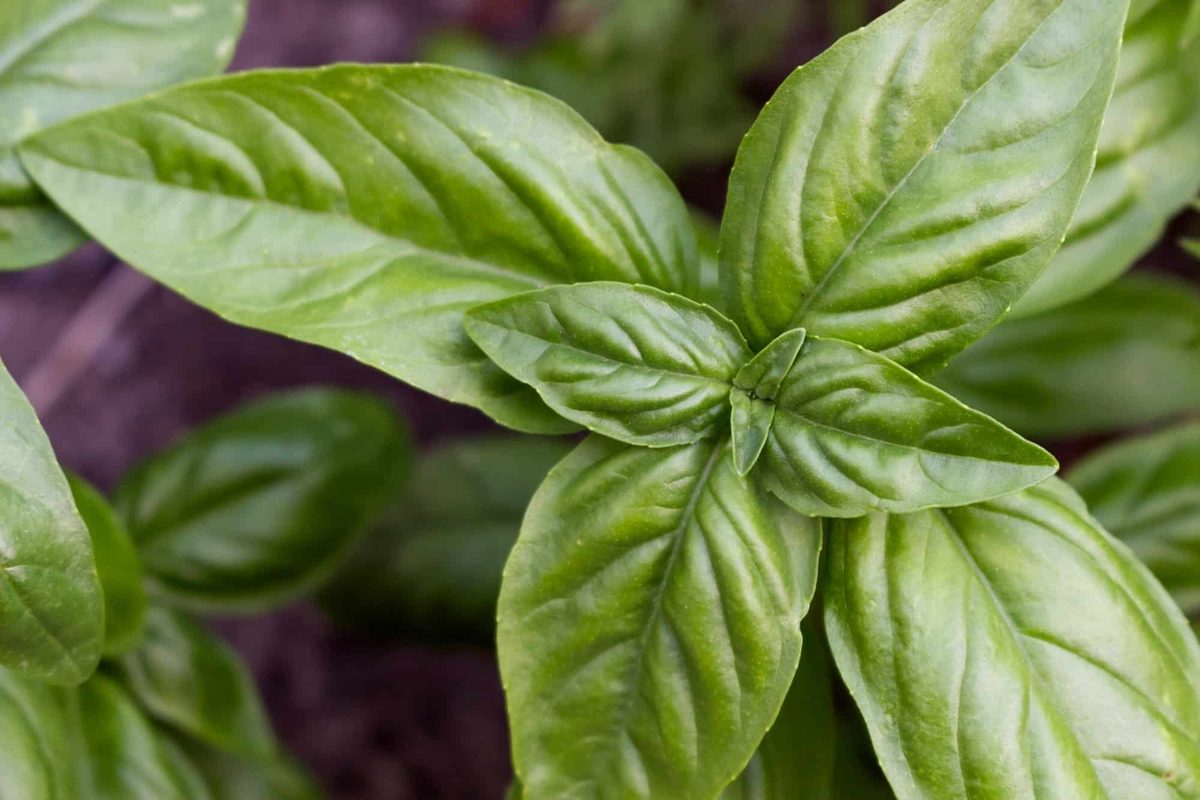
Genovese basil is the type of sweet basil, Ocimum basilicum, that Genoa made famous through pesto. The name covers two things: a family of cultivars sold everywhere as “Genovese,” and a legally protected product, Basilico Genovese PDO, that can only come from one stretch of the Italian coast. This page covers both: what the protected rules require, what is known about the chemistry, how it is used, and the one safety question researchers have raised.
At a glance
| Botanical name | Ocimum basilicum L., Genovese type12 |
| Plant family | Lamiaceae (mint family)3 |
| Part used | Leaves; under the PDO, whole young plants with roots1 |
| Native range of the species | Tropical and subtropical Asia to northern Australia (Kew)3 |
| Protected status | Basilico Genovese, EU Protected Designation of Origin since 20054 |
| PDO growing area | The Tyrrhenian side of Liguria1 |
| Key aroma compounds | Linalool and 1,8-cineole in one US trial; methyleugenol and eugenol in young Italian plants (see below)25 |
| Forms sold | Fresh bunches and plants; seed for growing |
Measured values
4 figures, sourced| Measure | Value | Scope | Source |
|---|---|---|---|
| Essential oil: linalool | 77 % of the oil | 'Genovese' seed from the North American trade, grown in a US field trial | hort.purdue.edu |
| Essential oil: 1,8-cineole | 12 % of the oil | 'Genovese' seed from the North American trade, grown in a US field trial | hort.purdue.edu |
| Essential oil yield | 0.90 % | 'Genovese' seed from the North American trade, grown in a US field trial | hort.purdue.edu |
| Vitamin K Nutrient | 1,710 µg per 100 g (dried basil) | USDA FoodData Central, dried basil, no cultivar namedNot specific to Genovese basil | fdc.nal.usda.gov |
Each figure is quoted as its source states it, with the samples or standard it applies to. Where sources differ, both are shown; nothing is averaged. All measured values
What Genovese basil is
Genovese is a cultivar group of sweet basil, not a separate species. A comparative trial of North American commercial basils lists ‘Genovese’ under Ocimum basilicum and records it at about 49 cm tall, with green leaves and stems and white flowers.2 The Herb Society of America calls it “an ideal pesto basil” and notes look-alikes such as ‘Nufar’, a Fusarium wilt-resistant cultivar similar to ‘Genovese’.6
Kew gives the native range of O. basilicum as tropical and subtropical Asia to northern Australia.3 How basil reached Liguria is recorded in the PDO specification, which says the Romans introduced it to the region and credited it with healing properties.1 For the rest of basil’s history and botany, see our basil profile.
Basilico Genovese PDO
The European Union added “Basilico Genovese (PDO)” to its register of protected names by Commission Regulation (EC) No 1623/2005 of 4 October 2005.4 The product specification sets out what the protected basil must be:1
- Plant. Seed of Ocimum basilicum from local ecotypes or selections; medium to very tall plants with elliptical leaves.
- Aroma. Intense and characteristic, with a total absence of mint aroma.
- Area. Growing and packing are limited to the Tyrrhenian side of the Liguria region.
- Growing. Allowed both under cover (ambiente protetto) and in open fields. Insect-proof greenhouses are explicitly excluded, and growing on substrates without natural soil is banned.
- How it is sold. As whole young plants with roots, packed when they have at least two and at most four pairs of true leaves. A bunch (mazzetto) holds 3 to 10 plants; a bouquet is the equivalent of 10 bunches. Plants may also go for processing.
The protected product is therefore a young whole plant, not cut stems of mature leaves. Italy’s official tourism site adds that pesto purists prefer basil from Pra’, a Genoa district where basil “has been grown since ancient times.”7 Pra’ is not named in the specification itself.1
Claims that the US is the largest export market for Genovese basil, and that Genoa built basil greenhouses in the 19th century, circulate widely; no source for either could be found.
Flavor and aroma
Good Genovese basil smells sweet and green, with clove and a peppery edge; that description is ours. The PDO specification asks for an intense, characteristic aroma and rules out any hint of mint.1 The Herb Society notes that a related Italian selection, ‘Genova Profumatissima’, has more of a spicy pungency of licorice, clove and cinnamon.6
The compounds
Two studies measured Genovese basil, in very different scopes, and their results should not be merged:
| Scope | Main compounds reported | Source |
|---|---|---|
| ‘Genovese’ seed from the North American trade, grown in a US field trial | Linalool (77% of the oil), 1,8-cineole (12%); oil yield 0.90% | 2 |
| ‘Genovese Gigante’ plants from northwestern Italy, analyzed 4 and 6 weeks after sowing | Methyleugenol and eugenol as the main components | 5 |
The Italian study found that the balance between the two compounds tracked plant height rather than age: methyleugenol predominated in plants up to 10 cm tall, and eugenol in taller plants.5 Eugenol is also the main component of clove bud oil, at 70 to 90% according to PROSEA.8 The authors flagged their result as relevant to the health risk of methyleugenol eaten in pesto (see Safety).5
The same US trial measured ‘Cinnamon’ basil at 47% linalool and 30% methyl cinnamate, a reminder of how much sweet basil cultivars differ.2 See cinnamon basil.
How Genovese basil is used
Pesto
Britannica traces pesto alla genovese to the city of Genoa and the name to the Italian verb pestare, “to crush.”9 Its best-known form combines basil, pine nuts, garlic, Parmesan and olive oil.9 Italy’s tourism site gives the traditional list as basil, pine nuts, garlic, Parmesan and Pecorino, salt and extra virgin olive oil, made with a marble mortar and pestle.7
On history, the same site says pesto most likely has roots in the Roman moretum, a mix of herbs, garlic, oil, vinegar and fresh cheese ground in a mortar, and that the recipe first appeared in print in 1865 in the Ratto brothers’ Cuciniera Genovese.7 We could not open the cookbook itself to confirm the date.
Tasting Table notes that blending basil too long can bruise the leaves and release bitter compounds, and that mature or damaged leaves taste more bitter than young ones.10
Other uses
Britannica lists pasta, vegetables, poultry, fish and bread as common partners for pesto.9 By common practice, Genovese basil also goes on pizza, into tomato sauces and salads, and on top of fresh mozzarella. LSU AgCenter groups basil with the delicate herbs best added a minute or two before cooking ends, since long heat costs flavor and aroma.11 For more, see basil uses, cooking with basil and dried basil vs. fresh.
Buying and storage
PDO Genovese basil is sold as bunches of whole young plants with roots, under the rules above.1 Outside Italy, “Genovese” on a seed packet or a supermarket clamshell names a cultivar type, not the protected product. For fresh leaves, look for perky, unblemished leaves with no black spots; that is kitchen judgment. We found no published shelf-life figure. See how to store basil, can you freeze basil? and how to dry basil.
Nutrition
No nutrient analysis specific to Genovese basil was found. USDA’s figures for basil do not name a cultivar; they show dried basil carrying 1,710 µg of vitamin K per 100 g.12 Because of that vitamin K, the NIH Office of Dietary Supplements’ advice to people on warfarin applies: keep vitamin K intake about the same from day to day.13 See the nutrition table on our basil page for per-serving figures.
Safety
Methyleugenol and estragole
Germany’s Federal Institute for Risk Assessment (BfR) says safrole, methyleugenol and estragole show mutagenic and carcinogenic properties in animal studies, and names basil-containing pesto among foods that may contain high amounts.14 The 2001 Italian study found methyleugenol predominant in Genovese Gigante plants up to 10 cm tall.5 The BfR made no consumption recommendation for consumers, and neither source tells people to stop eating basil or pesto. The evidence is from animal studies and composition measurements, not studies of people.
Health claims
The NIH’s National Center for Complementary and Integrative Health has no fact sheet on basil.15 Claims that Genovese basil lowers blood pressure or blood sugar could not be traced to human evidence, and this page makes no claim that it treats or prevents any condition.
Substitutes and comparisons
Any sweet basil is the closest stand-in; Thai basil or cinnamon basil change the dish. These are kitchen judgments, not tested swaps.
- Genovese basil vs. sweet basil
- Genovese basil vs. Thai basil
- Basil vs. Thai basil
- Lemon basil
- Too much basil
Footnotes
-
“Basilico Genovese” DOP, disciplinare di produzione, eAmbrosia, European Commission. webgate.ec.europa.eu · Regulator ↩ ↩2 ↩3 ↩4 ↩5 ↩6 ↩7 ↩8
-
“Comparative evaluation of North American commercially available Ocimum basil cultivars”, Table 1, Perspectives on New Crops and New Uses (1999), Purdue NewCROP. hort.purdue.edu · Peer-reviewed ↩ ↩2 ↩3 ↩4 ↩5
-
Ocimum basilicum L., Plants of the World Online, Royal Botanic Gardens, Kew. powo.science.kew.org · Reference work ↩ ↩2 ↩3
-
Commission Regulation (EC) No 1623/2005 of 4 October 2005, Annex. legislation.gov.uk · Regulator ↩ ↩2
-
Miele, Dondero, Ciarallo and Mazzei, “Methyleugenol in Ocimum basilicum L. cv. Genovese Gigante”, Journal of Agricultural and Food Chemistry, 2001 (abstract). agris.fao.org · Peer-reviewed ↩ ↩2 ↩3 ↩4 ↩5
-
Michele Meyers, Basil: An Herb Society of America Guide, The Herb Society of America, 2003. herbsociety.org · Reference work ↩ ↩2
-
“Pesto Genovese in Liguria”, Italia.it. italia.it · Publication ↩ ↩2 ↩3
-
E.W.M. Verheij and C.H.A. Snijders, Syzygium aromaticum, Plant Resources of South-East Asia (PROSEA). uses.plantnet-project.org · Reference work ↩
-
Gregory Lewis McNamee, “Pesto”, Encyclopaedia Britannica. britannica.com · Reference work ↩ ↩2 ↩3
-
Sara Klimek, “5 Possible Reasons Your Homemade Pesto Has A Bitter Taste”, Tasting Table, 2026. tastingtable.com · Publication ↩
-
“Flavorful Herbs”, LSU AgCenter. lsuagcenter.com · Reference work ↩
-
Spices, basil, dried (FDC 171317), USDA FoodData Central. fdc.nal.usda.gov · Regulator ↩
-
Vitamin K: Fact Sheet for Consumers, NIH Office of Dietary Supplements, 2021. ods.od.nih.gov · Regulator ↩
-
“Alkenylbenzenes in food: how large is the health risk?”, BfR Communication No. 22/2022. bfr.bund.de · Regulator ↩
-
Herbs at a Glance, National Center for Complementary and Integrative Health. nccih.nih.gov · Regulator ↩