Spice Comparisons · Comparison
Thai Basil vs. Holy Basil: Anise Horapha and Peppery Kaphrao
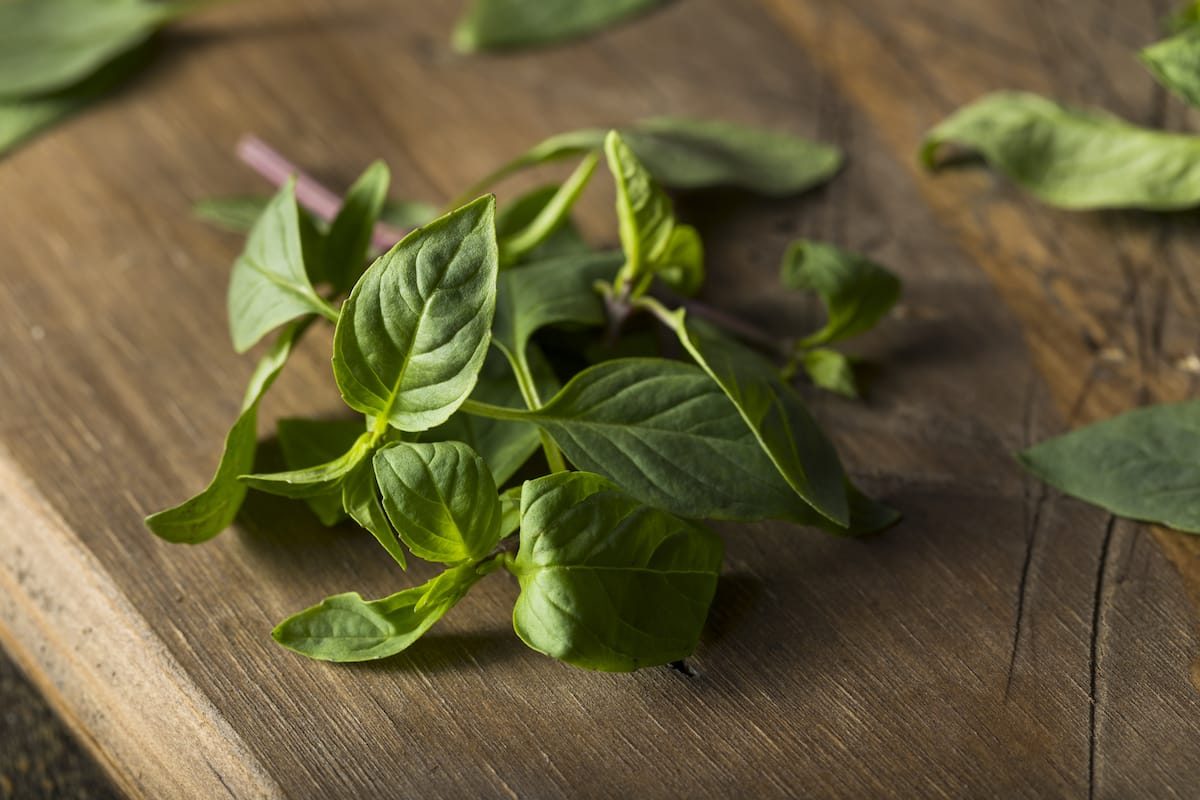
Thai basil and holy basil are different species. Thai basil (horapha) is a form of sweet basil, Ocimum basilicum, with an anise scent; holy basil (kaphrao, tulsi) is Ocimum tenuiflorum, a peppery basil sometimes called “hot basil.”1234 A 2018 study of basils used as food in Thailand put the two in different aroma groups: Thai basil’s oil was led by estragole and smelled of anise, while holy basil’s was led by methyl eugenol and fell into a “spice-like” group.5 That is the difference a cook tastes, and it is why phat kaphrao made with Thai basil is a different dish.
Side by side
| Thai basil | Holy basil | |
|---|---|---|
| Botanical name | Ocimum basilicum; the name O. thyrsiflorum is a synonym of sweet basil16 | Ocimum tenuiflorum (syn. O. sanctum)2 |
| Thai name | Horapha3 | Kaphrao; also called hot basil4 |
| Other names | Often sold as var. thyrsiflora6 | Tulsi or tulasi7 |
| Family | Lamiaceae (mint family)7 | Lamiaceae (mint family)7 |
| Native range of the species | Tropical and subtropical Asia to northern Australia8 | Tropical and subtropical Asia to the western Pacific2 |
| Types | Purple-stemmed forms common4 | Red and white forms5 |
| Aroma group in the Thai study | Anise, lime-like, fresh5 | Spice-like; strongest woody scent of the five basils tested5 |
| Leading oil compounds | Estragole, geranial, neral5 | Methyl eugenol, β-caryophyllene, α-cubebene (red); methyl eugenol (white)5 |
| Flavor (cooks’ descriptions) | Bolder and more aromatic than Italian basil, licorice-like (Pengjad)9 | Peppery (Ricker);4 astringent, with a strong aroma (Herb Society)10 |
| Signature uses | Green curry; raw on the pho garnish plate911 | Phat kaphrao, the stir-fry named after it412 |
| US food status | Sweet basil is a GRAS spice13 | Not on FDA’s GRAS spice list, which names sweet basil13 |
What the chemistry shows
The Chiang Mai University study analyzed five basils “used as food ingredients in Thailand,” grown at the same research center, which makes it the rare like-for-like comparison.5 Figures are concentrations in the oil, not percentages.
| Compound | Thai basil | Red holy basil (var. Shyama) | White holy basil (var. Rama) |
|---|---|---|---|
| Estragole (methyl chavicol) | 452.80 µg/mL | not among the top three | not among the top three |
| Geranial | 180.57 µg/mL | not among the top three | not among the top three |
| Neral | 151.16 µg/mL | not among the top three | not among the top three |
| Methyl eugenol | not among the top three | 683.90 µg/mL | 98.44 µg/mL |
| β-Caryophyllene | not among the top three | 145.81 µg/mL | not among the top three |
| α-Cubebene | not among the top three | 104.70 µg/mL | present; figure not reproduced here |
Source: Tangpao, Chung and Sommano, 2018.5
“Not among the top three” means the paper’s summary does not report it for that basil, not that it is absent. Two things stand out. The two basils share none of their leading compounds. And the red holy basil’s oil is far more concentrated in its lead compound than the white’s, so two bunches sold as holy basil can differ a good deal.
Flavor and strength
Holy basil is often described as intensely spicy, even numbing. The cooks we checked describe it more modestly. Andy Ricker calls it a basil with a peppery flavor and a distinctive aroma.4 Pailin Chongchitnant of Hot Thai Kitchen says its fragrance is less floral and more peppery than Thai basil’s, and also milder.12 The Herb Society of America calls its taste astringent and its aroma strong.10 We found no source for the claims that raw holy basil numbs the tongue like Sichuan pepper or that it gets spicier as it cooks.
Thai basil is the louder of the two in the Thai cooks’ accounts. Sherri Pengjad of Thai Foodie calls it bolder and more aromatic than Italian basil and says it is stirred into green curry right before serving for its licorice-like aroma.9 She also finds it sturdier than Italian basil in hot dishes.9
How each is used
- Holy basil: phat kaphrao. The stir-fry is named after the herb.12 Ricker’s version uses chicken, and he adds the leaves at the very end, stirring just until they wilt and turn very fragrant, about 15 seconds.4 Chongchitnant’s uses beef,12 so the dish is not tied to one meat.
- Holy basil: tea and ritual. Britannica notes that holy basil is considered sacred in Hinduism and that it is used as a culinary herb throughout Southeast Asia.7
- Thai basil: curries and stir-fries. Pengjad stirs it into green curry at the end.9 Drunken noodles and red curry usually take it too; that is common practice rather than a sourced fact.
- Thai basil: raw, at the table. Andrea Nguyen lists Thai basil (húng quế) on her pho garnish plate, adding it when it is at its peak in warmer months, and tells readers to add or subtract herbs as they like.11
Both are delicate herbs. LSU AgCenter notes that prolonged heat can cause flavor and aroma losses, so both go in at the end of cooking.14
Telling them apart when buying
Mislabeling runs in a known direction. Ricker warns that “holy basil” labels are sometimes put on purple-stemmed Thai or sweet basil, and notes that Indian grocers may sell true holy basil as tulsi.4 Purple stems are therefore not proof of either herb; PROSEA describes sweet basil’s stems as ranging from light green to dark purple.3 Smell is the better test: anise means Thai basil, pepper means holy basil (kitchen judgment, consistent with the aroma groups above5).
Can one stand in for the other?
Yes, by volume, with a different result. The published figure treats them as interchangeable in amount but not in flavor.
| Swap | Starting amount | Treatment |
|---|---|---|
| Thai basil in place of holy basil | Same amount | Attributed: Chongchitnant’s pad kra pao recipe lists holy or regular basil and notes Thai basil will also work12 |
| Holy basil in place of Thai basil | Same amount | Attributed: the same recipe line, read the other way12 |
What the cooks say about the result:
- Thai basil for holy basil. Chongchitnant says Thai basil can be used and the dish will be just as tasty, but that it tastes quite different; she prefers Italian basil as the closer match.12 She also suggests that restaurants serving “holy basil” stir-fries may be using Thai basil because holy basil is unavailable.12 SheSimmers says that if you only have sweet basil you can use it, but should call the dish Pad Bai Horapha.15
- Holy basil for Thai basil. Pengjad says holy basil will work in a pinch, but the dish will taste less traditional.9
For other options see Thai basil substitutes and holy basil substitutes.
Safety
Each basil’s leading compound is one regulators have examined. Germany’s BfR notes that safrole, methyl eugenol and estragole showed mutagenic and carcinogenic properties in animal studies, and concluded in 2022 that the risk from foods containing them cannot yet be conclusively assessed.16 The EU Scientific Committee on Food could not set a safe exposure limit for estragole in 2001.17 Neither body singles out Thai or holy basil or tells people to stop eating basil. Holy basil does not appear on the FDA’s GRAS spice list, which names sweet basil;13 we draw no safety conclusion from that absence. Health claims made for tulsi supplements are covered on our holy basil profile.
What isn’t known
- The Thai study grew one sample of each basil at one site. How much the oils vary between farms and markets is not known.
- No source we found measures how often “holy basil” on sale is really Thai or sweet basil.
- Claims that holy basil numbs the tongue, gets spicier with cooking, or is often called “Thai holy basil” could not be traced; neither could Thai basil’s use in Taiwanese three-cup chicken.
Related
- Profiles: Thai basil, holy basil and basil
- Substitutes: Thai basil substitutes and holy basil substitutes
- Comparisons: basil vs. Thai basil, holy basil vs. basil, Genovese basil vs. Thai basil and cinnamon basil vs. Thai basil
- More: lemon basil, how to store basil and too much basil
Footnotes
-
Ocimum thyrsiflorum L. (synonym of O. basilicum var. basilicum), Plants of the World Online, Royal Botanic Gardens, Kew. powo.science.kew.org · Reference work ↩ ↩2
-
Ocimum tenuiflorum L., Plants of the World Online, Royal Botanic Gardens, Kew. powo.science.kew.org · Reference work ↩ ↩2 ↩3
-
N.O. Aguilar, Pham Truong Thi Tho and L.P.A. Oyen, Ocimum basilicum, Plant Resources of South-East Asia (PROSEA). uses.plantnet-project.org · Reference work ↩ ↩2 ↩3
-
Andy Ricker with J.J. Goode, “Stir-fried chicken with hot basil (kai kaphrao)”, from Pok Pok, via The Splendid Table. splendidtable.org · Publication ↩ ↩2 ↩3 ↩4 ↩5 ↩6 ↩7 ↩8
-
Tangpao, Chung and Sommano, “Aromatic Profiles of Essential Oils from Five Commonly Used Thai Basils”, Foods, 2018. mdpi.com · Peer-reviewed ↩ ↩2 ↩3 ↩4 ↩5 ↩6 ↩7 ↩8 ↩9
-
“Basil”, Encyclopaedia Britannica, 2026. britannica.com · Reference work ↩ ↩2
-
Melissa Petruzzello, “Holy basil”, Encyclopaedia Britannica, 2026. britannica.com · Reference work ↩ ↩2 ↩3 ↩4
-
Ocimum basilicum L., Plants of the World Online, Royal Botanic Gardens, Kew. powo.science.kew.org · Reference work ↩
-
Sherri Pengjad, “Thai Basil: What It Is and How to Use It”, Thai Foodie, 2026. thai-foodie.com · Publication ↩ ↩2 ↩3 ↩4 ↩5 ↩6
-
Rickie Wilson, “Herb of the Month: Holy Basil”, The Herb Society of America blog, 2016. blog.herbsociety.org · Publication ↩ ↩2
-
Andrea Nguyen, “Pho Garnish Plate”, from The Pho Cookbook, via The Splendid Table, 2017. splendidtable.org · Publication ↩ ↩2
-
Pailin Chongchitnant, pad kra pao beef recipe, Hot Thai Kitchen. hot-thai-kitchen.com · Publication ↩ ↩2 ↩3 ↩4 ↩5 ↩6 ↩7 ↩8
-
21 CFR 182.10, Spices and other natural seasonings and flavorings, US Food and Drug Administration. ecfr.gov · Regulator ↩ ↩2 ↩3
-
“Flavorful Herbs”, LSU AgCenter. lsuagcenter.com · Reference work ↩
-
“Pad Ka-Prao”, SheSimmers, 2011. shesimmers.com · Publication ↩
-
“Alkenylbenzenes in food: how large is the health risk?”, BfR Communication No. 22/2022. bfr.bund.de · Regulator ↩
-
Opinion of the Scientific Committee on Food on Estragole, European Commission, 2001. food.ec.europa.eu · Regulator ↩