Spice Comparisons · Comparison
Holy Basil vs. Basil: Two Species, Two Different Jobs
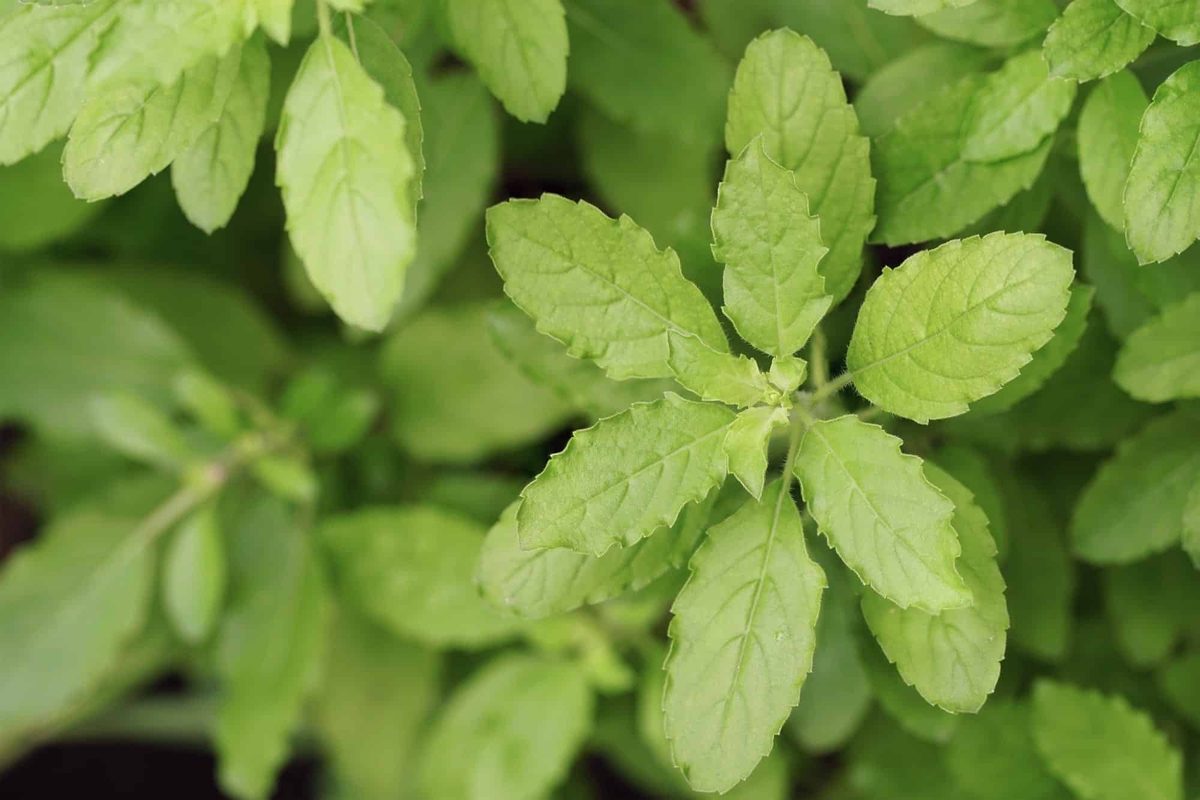
Holy basil and basil are different species. Holy basil is Ocimum tenuiflorum, called tulsi in India and kaphrao in Thailand; “basil” in most Western recipes means sweet basil, Ocimum basilicum.1234 Holy basil is the hairier plant, with a peppery, clove-like smell built on different compounds, and it is the herb a Thai cook wilts into phat kaphrao. Sweet basil is the softer, sweeter herb of pesto and tomato sauce.563
Side by side
| Holy basil | Basil (sweet basil) | |
|---|---|---|
| Species | Ocimum tenuiflorum (syn. O. sanctum)1 | Ocimum basilicum74 |
| Other names | Tulsi, tulasi; kaphrao in Thai; “hot basil”23 | Sweet basil; horapha in Thai89 |
| Family | Lamiaceae (mint family)2 | Lamiaceae (mint family)10 |
| Native range (Kew) | Tropical and subtropical Asia to the western Pacific1 | Tropical and subtropical Asia to northern Australia7 |
| Stems | Square, hairy, purple or green511 | Smooth or hairy when young, light green to dark purple8 |
| Leaves | Elliptic to oblong, hairy, edges toothed to smooth511 | Glossy, oval, smooth or slightly toothed, typically cupped a little10 |
| Main oil compounds, same 1999 US trial | β-caryophyllene 45 to 75% in two lots; methyleugenol 33% with β-caryophyllene 41% in a third6 | Linalool 65 to 77% in three sweet basil lots6 |
| Flavor and aroma | Peppery (Ricker); a spicy bite of clove, mint and basil (NC State)35 | Sweet and green, with a peppery edge and a hint of clove (editorial) |
| Typical uses | Thai stir-fries, above all phat kaphrao; herbal tea in India32 | Italian pizza, pasta and pesto; French omelets and soups8 |
| On the FDA’s list of spices generally recognized as safe | Not listed4 | Listed as sweet basil4 |
| Price | No dated, sourced retail comparison found | No dated, sourced retail comparison found |
For each herb in depth, see the holy basil and basil profiles.
How to tell them apart
Touch is the quickest test. North Carolina State’s extension plant guide describes holy basil’s square stems as highly pubescent, meaning densely hairy, and its leaves as hairy too, especially along the veins underneath.5 Singapore’s National Parks Board describes the stems as purplish and hairy and the leaf surface as densely covered in short hairs.11 Sweet basil’s leaves are glossy;10 PROSEA describes its stems as smooth or hairy only when young.8
Leaf edges are a weaker clue than they are often made out to be. A widely repeated claim says holy basil leaves are jagged like a saw blade and sweet basil’s are smooth. In fact both sources on holy basil allow a range, from toothed to smooth-edged,511 and Britannica says sweet basil leaves can be smooth or slightly toothed.10
Labels can mislead. Andy Ricker warns that the name “holy basil” is sometimes put on purple-stemmed Thai or sweet basil, and that Indian grocers may sell true holy basil as tulsi.3 In the Purdue trial described below, a seed lot sold as ‘Holy Sacred Red’ was classed by the researchers as O. basilicum, with a sweet-basil oil led by linalool.6 Smell before you buy: true holy basil should be peppery and clove-like rather than sweet or anise-like. That is kitchen judgment.
The difference in the oil
Purdue University researchers grew commercially available basils, holy basils included, in one field trial and distilled their oils the same way, so these rows compare like with like:6
| Cultivar as sold (one seed lot each) | Species per the researchers | Oil yield | Major aroma compounds |
|---|---|---|---|
| ‘Holy’ | O. tenuiflorum | 0.93% | β-caryophyllene 75% |
| ‘Sacred’ | O. tenuiflorum | 0.65% | β-caryophyllene 45% |
| ‘Tulsi or Sacred’ | O. tenuiflorum | 0.93% | Methyleugenol 33%, β-caryophyllene 41% |
| ‘Holy Sacred Red’ | O. basilicum | 0.83% | Linalool 77%, 1,8-cineole 14% |
| ‘Sweet’ | O. basilicum | 0.84% | Linalool 69%, 1,8-cineole 11%, methylchavicol 13% |
| ‘Genovese’ | O. basilicum | 0.90% | Linalool 77%, 1,8-cineole 12% |
The holy basils share almost nothing with the sweet basils at the top of the list. A 2018 Chiang Mai University study of basils used as food in Thailand found the same split in a different scope: both of its holy basils fell into a “spice-like” aroma group defined by methyl eugenol, β-caryophyllene and α-cubebene, while Thai basil, a form of sweet basil, was led by estragole.12 That study reported concentrations in µg/mL, not percentages, so its figures are not placed in the table above.
Flavor descriptions follow the chemistry. Ricker calls holy basil peppery with a distinctive aroma.3 NC State describes a spicy bite that mixes clove, mint and basil;5 Singapore’s National Parks Board says the leaves taste spicy and bitter;11 the Herb Society of America lists camphor, clove and cinnamon.9 Pailin Chongchitnant of Hot Thai Kitchen finds holy basil less floral and more peppery than Thai basil.13
Why “holy”
Britannica notes that holy basil is considered sacred in Hinduism and is widely used in Ayurvedic and folk medicine, often as an herbal tea.2 The Herb Society of America describes it as revered in the Vaishnava tradition and says it is common for Hindu families to grow it at home.14 Sweet basil has no comparable religious role in any source we found.
Differences that change the dish
Holy basil goes in hot and late. In phat kaphrao, the stir-fry named for it, Ricker adds the leaves at the very end and stirs just until they wilt and turn very fragrant.3 It is not only a Thai herb: Britannica says it is used as a culinary herb throughout Southeast Asia,2 and Singapore’s National Parks Board notes the leaves flavor salads and dishes with fruit, fish and chicken.11 A widely repeated claim says holy basil releases more flavor when heated than sweet basil does; we found no source that tests it.
Sweet basil is the raw herb. Pesto, Caprese salad and torn leaves on pizza are sweet basil’s ground; PROSEA lists pizzas, pasta, chicken and cheese dishes, and pesto among its Italian uses.8 For cooked dishes, LSU AgCenter puts basil among the delicate herbs to add a minute or two before cooking ends.15
Tea. Britannica notes holy basil’s wide use as an herbal tea.2 None of the sources we reviewed describe sweet basil as a tea herb.
Can one stand in for the other?
Our holy basil substitutes page covers this swap in detail; the treatments below match it.
- Sweet basil for holy basil: same amount (Attributed). Chongchitnant calls Italian basil her preferred substitute for holy basil and says it is a closer match than Thai basil.13 Her pad kra pao recipe calls for 1 1/4 cups of holy basil or regular basil leaves, the same amount either way.13 Add it at the very end, as you would holy basil. SheSimmers notes that if you only have sweet basil you can use it, but should call the dish Pad Bai Horapha.16 A more-for-less rule (1 1/2 times as much sweet basil) circulates; we found no source for it.
- Holy basil for sweet basil (Method). We found no source that publishes this swap or a ratio. In a cooked dish, start with about half the recipe’s basil and taste, since holy basil’s peppery, clove-like flavor is the stronger and more distinctive of the two (editorial). For pesto and other raw uses we would not swap: the result will not taste like basil pesto.
Health claims and safety
Holy basil is sold widely as a supplement and tea, often with claims about blood pressure and cholesterol. The main systematic review, by Jamshidi and Cohen (2017), found 24 human studies, covering metabolic disorders, cardiovascular disease, immunity and neurocognition, that all reported favorable results with no significant adverse events.17 But the authors judged only a minority to be high quality and found insufficient evidence to recommend any specific tulsi formulation for any one condition.17 The NIH’s National Center for Complementary and Integrative Health has no fact sheet on holy basil or basil.18 This page makes no claim that either herb treats or prevents any condition.
Both herbs contain alkenylbenzenes, the compound class regulators have examined: methyleugenol leads one of the holy basil oils above, and methylchavicol, also called estragole, appears in sweet basil.86 Germany’s BfR says these compounds showed mutagenic and carcinogenic properties in animal studies, names basil-containing pesto among foods that may contain high amounts, and made no consumption recommendation for consumers in 2022.19 Holy basil does not appear on the FDA’s list of spices generally recognized as safe, which names sweet basil and bush basil;4 this page draws no safety conclusion from that absence.
What isn’t known
- No study we found has grown holy basil and sweet basil side by side since the 1999 Purdue trial, which used one seed lot per cultivar.6
- No source tests whether holy basil gains flavor with heat, or compares how long either herb lasts in a hot dish.
- No published ratio exists for using holy basil in place of sweet basil.
- No survey measures how often “holy basil” on a label is really sweet or Thai basil.
Related
- Holy basil and basil profiles
- Holy basil substitutes and Thai basil vs. holy basil
- Basil vs. Thai basil, Genovese basil vs. sweet basil, lemon basil vs. basil
- Thai basil, Thai spices, how to store basil
Footnotes
-
Ocimum tenuiflorum L., Plants of the World Online, Royal Botanic Gardens, Kew. powo.science.kew.org · Reference work ↩ ↩2 ↩3
-
Melissa Petruzzello, “Holy basil”, Encyclopaedia Britannica, 2026. britannica.com · Reference work ↩ ↩2 ↩3 ↩4 ↩5 ↩6 ↩7
-
Andy Ricker with J.J. Goode, “Stir-fried chicken with hot basil (kai kaphrao)”, from Pok Pok, via The Splendid Table. splendidtable.org · Publication ↩ ↩2 ↩3 ↩4 ↩5 ↩6 ↩7 ↩8
-
21 CFR 182.10, Spices and other natural seasonings and flavorings, U.S. Food and Drug Administration. ecfr.gov · Regulator ↩ ↩2 ↩3 ↩4 ↩5
-
Ocimum tenuiflorum, North Carolina Extension Gardener Plant Toolbox, NC State University. plants.ces.ncsu.edu · Reference work ↩ ↩2 ↩3 ↩4 ↩5 ↩6 ↩7
-
“Comparative evaluation of North American commercially available Ocimum basil cultivars”, Table 1, Perspectives on New Crops and New Uses (1999), Purdue NewCROP. hort.purdue.edu · Peer-reviewed ↩ ↩2 ↩3 ↩4 ↩5 ↩6 ↩7
-
Ocimum basilicum L., Plants of the World Online, Royal Botanic Gardens, Kew. powo.science.kew.org · Reference work ↩ ↩2
-
N.O. Aguilar, Pham Truong Thi Tho and L.P.A. Oyen, Ocimum basilicum, Plant Resources of South-East Asia (PROSEA). uses.plantnet-project.org · Reference work ↩ ↩2 ↩3 ↩4 ↩5 ↩6
-
Michele Meyers, Basil: An Herb Society of America Guide, The Herb Society of America, 2003. herbsociety.org · Reference work ↩ ↩2
-
“Basil”, Encyclopaedia Britannica, 2026. britannica.com · Reference work ↩ ↩2 ↩3 ↩4
-
Ocimum tenuiflorum L., Flora & Fauna Web, National Parks Board, Singapore. nparks.gov.sg · Reference work ↩ ↩2 ↩3 ↩4 ↩5 ↩6
-
Tangpao, Chung and Sommano, “Aromatic Profiles of Essential Oils from Five Commonly Used Thai Basils”, Foods, 2018. mdpi.com · Peer-reviewed ↩
-
Pailin Chongchitnant, pad kra pao beef recipe, Hot Thai Kitchen. hot-thai-kitchen.com · Publication ↩ ↩2 ↩3
-
Rickie Wilson, “Herb of the Month: Holy Basil”, The Herb Society of America blog, 2016. blog.herbsociety.org · Publication ↩
-
“Flavorful Herbs”, LSU AgCenter. lsuagcenter.com · Reference work ↩
-
“Pad Ka-Prao”, SheSimmers, 2011. shesimmers.com · Publication ↩
-
Jamshidi and Cohen, “The Clinical Efficacy and Safety of Tulsi in Humans: A Systematic Review of the Literature”, Evidence-Based Complementary and Alternative Medicine, 2017. pmc.ncbi.nlm.nih.gov · Peer-reviewed ↩ ↩2
-
Herbs at a Glance, National Center for Complementary and Integrative Health. nccih.nih.gov · Regulator ↩
-
“Alkenylbenzenes in food: how large is the health risk?”, BfR Communication No. 22/2022. bfr.bund.de · Regulator ↩