Spice Substitutes · Substitutes
Thai Basil Substitutes, Ranked by the Job Thai Basil Is Doing
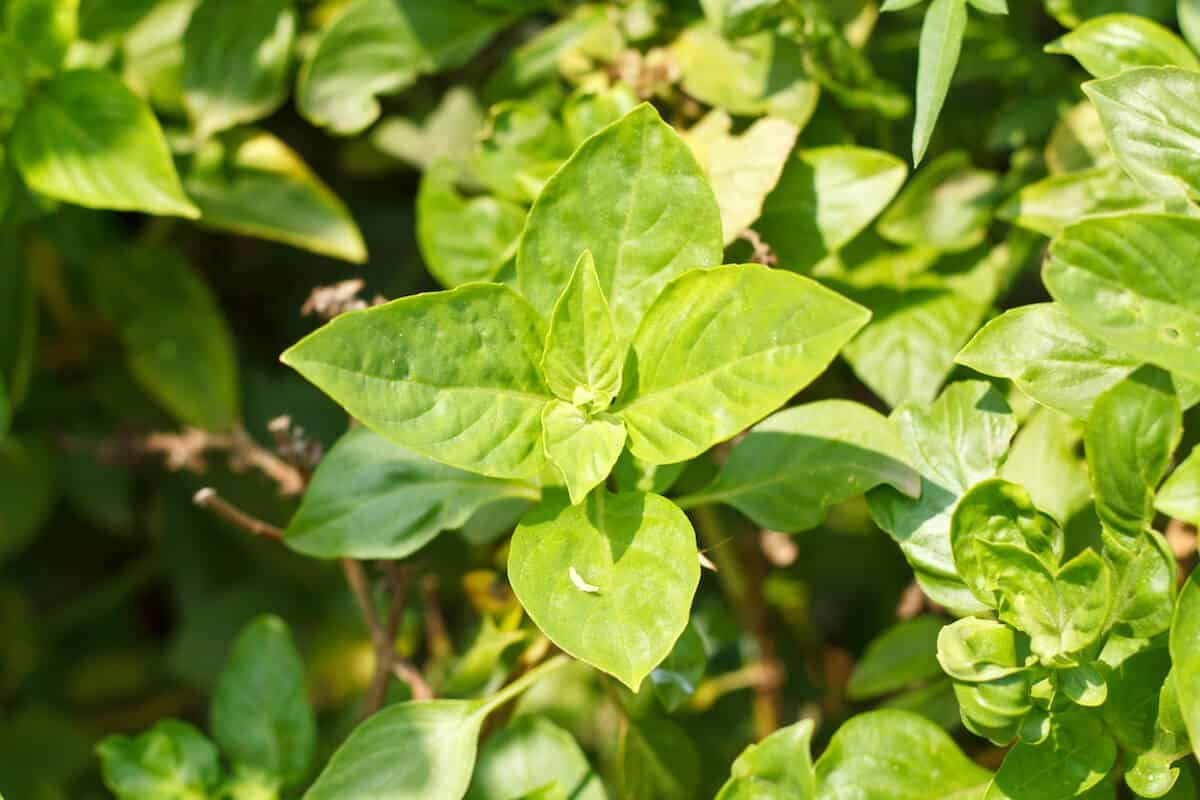
Thai basil is not a separate species. Kew treats the old name Ocimum thyrsiflorum as a synonym of sweet basil, Ocimum basilicum,1 and Britannica lists Thai basil as a variety of sweet basil that is common in Asian cuisine.2 What sets it apart is its smell. In a 2018 Thai study of basils used as food in Thailand, Thai basil’s oil was dominated by estragole, followed by geranial and neral, and was linked to anise, lime-like and fresh aromas.3 A good substitute replaces some of that anise lift and holds up to the job the herb is doing in your dish.
Quick answer
| What Thai basil is doing | Best substitute | Starting amount, per 1 part Thai basil | Treatment |
|---|---|---|---|
| Wilted into a stir-fry or curry at the end | Italian (sweet) basil | 1 part | Attributed |
| The same, if you have it | Holy basil | 1 part | Attributed |
| The same, with more of Thai basil’s lift | Italian basil plus a little mint | About 4 parts basil to 1 part mint, same total | Method |
| Raw, on a noodle-soup or spring-roll plate | Italian basil, with mint | 1 part in total | Method |
| The anise note specifically | Fresh tarragon, added to Italian basil | 1/2 part tarragon, then taste | Method |
The rest of the page explains each choice and the alternatives.
How the ratios on this page are labeled
Every ratio carries one of four labels.
- Computed: based on a measurable physical relationship, with the source named.
- Attributed: a named source publishes this ratio. We quote it as theirs.
- Disputed: named sources give different answers to the same swap. We show each one and do not average them.
- Method: we found no published ratio. We give a direction and a cautious starting point, and say so.
The one-for-one amounts here come from a single cook’s recipe that lists several basils in the same quantity. No study compares the strength of Thai basil with any substitute.
Why the substitutes work (and where they fall short)
| Herb | Main aroma compounds in the sources we reviewed | Source |
|---|---|---|
| Thai basil | Estragole, geranial, neral; anise and lime-like aromas | Tangpao et al.3 |
| Italian (French-type) sweet basil | Methyl chavicol (another name for estragole) and linalool, in one Philippine-grown oil | PROSEA4 |
| Holy basil | Methyl eugenol, β-caryophyllene, α-cubebene; a “spice-like” group | Tangpao et al.3 |
| French tarragon | Estragole, 60 to 75 percent of the oil | EU Scientific Committee on Food5 |
| Fennel and star anise | Anethole, responsible for their anise fragrance | PROSEA67 |
Italian basil is the same species and can share Thai basil’s leading compound, but the balance differs from plant to plant; PROSEA recognizes at least six chemical types of O. basilicum.4 Tarragon shares Thai basil’s estragole without being a basil at all. Fennel and star anise get their anise smell from a different compound, anethole.
If Thai basil is wilted into a stir-fry or curry
This is Thai basil’s most common job: a handful stirred into drunken noodles, a basil stir-fry or a green curry right before serving. Sherri Pengjad of Thai Foodie says Thai basil is stirred into green curry right before serving, adding a licorice-like aroma, and that it is sturdier than Italian basil and holds up much better in hot dishes.8
1. Italian (sweet) basil
Two cooks name it first. Nagi Maehashi of RecipeTin Eats writes that “the best substitute for Thai Basil is normal basil,” though it lacks the slight aniseed flavor of the Thai herb.9 Pengjad also calls Italian basil the best substitute.8
Ratio (Attributed): Pailin Chongchitnant’s pad kra pao recipe at Hot Thai Kitchen calls for 1 1/4 cups of holy basil or regular basil leaves and notes that Thai basil will also work, in the same line of the ingredient list.10 Her recipe treats the three basils as interchangeable by volume. Maehashi’s Thai basil chicken calls for 1 cup of Thai basil leaves and says the dish is still worth making with normal basil, without giving a different amount.9
Because Italian basil is softer, add it at the last moment and stir only until it wilts. LSU AgCenter advises adding delicate herbs such as basil a minute or two before the end of cooking.11
2. Holy basil
Holy basil (kaphrao) is a different herb: Andy Ricker describes it as a basil with a peppery flavor, called hot basil.12 Its oil falls into a spice-like aroma group rather than Thai basil’s anise group.3 Pengjad says holy basil is more peppery and intense, and will work in a pinch, but the dish will taste less traditional.8
Ratio (Attributed): Chongchitnant’s recipe uses the same 1 1/4 cups for holy basil or Thai basil.10
3. Italian basil with a little mint
Pengjad suggests mixing Italian basil with a little mint for a closer flavor, without giving amounts.8
Ratio (Method): No published ratio was found. Start with about four parts Italian basil to one part mint, in the same total amount as the Thai basil, and taste. Too much mint will take over the dish.
If Thai basil is a raw herb on the plate
In Vietnamese cooking, Thai basil goes raw onto the herb plate served with pho; Andrea Nguyen includes it on her pho garnish plate and tells readers to add or subtract herbs as they like.13 Here the leaves are eaten as they are, so a tender substitute is fine.
Ratio (Method): No published ratio was found. Use Italian basil leaves in the same amount, with a few mint leaves alongside. Because the herbs are added at the table, each diner can adjust.
If you want the anise note specifically
When Thai basil’s licorice-like aroma is the point, add an anise-scented herb or spice to Italian basil, rather than replacing the basil entirely.
1. Fresh tarragon
French tarragon’s oil is mostly estragole, 60 to 75 percent according to the EU Scientific Committee on Food,5 the same compound that leads Thai basil’s oil.3 University of Illinois Extension describes the leaves as having a licorice or anise flavor.14 It is one of the classic French fines herbes, alongside parsley, chives and chervil.15 It is stronger and more pointed than Thai basil, in our judgment, so use it as an accent.
Use it fresh: Illinois Extension notes that tarragon’s flavor is quickly lost when the leaves are dried.14
Ratio (Method): No published ratio was found. Start with about half the Thai basil amount in tarragon, or a smaller pinch mixed into Italian basil, and taste.
2. Fennel fronds
Illinois Extension says both forms of fennel have an anise or licorice flavor,16 and PROSEA credits anethole for the anise fragrance and sweet taste.6 The feathery leaves are the part to use here, not the bulb.
Ratio (Method): No published ratio was found. Start with an equal amount of chopped fronds, mixed with Italian basil, and taste.
3. Star anise, in simmered dishes only
Star anise is a dried spice, not a leaf, so it can only stand in for Thai basil’s aroma in something that simmers, such as a curry or broth. Its oil is mainly trans-anethole, 70 to 93 percent according to PROSEA,7 and NPR’s pho recipe simmers it in the broth with cinnamon, cloves and peppercorns.17
Ratio (Method): No published ratio was found. Simmer one whole star anise in a pot of curry or broth for a few minutes, remove it, and taste. Add fresh Italian basil at the end for the leafy part.
Dried basil
America’s Test Kitchen lists basil among the herbs to use fresh rather than dried,18 and Thai basil’s role as a fresh herb added at the end leaves little room for a dried version. We found no published conversion for dried Thai basil.
What isn’t known
- No study compares the aroma of Thai basil with Italian basil grown and analyzed the same way; the chemistry above comes from separate studies, and basil oils vary by cultivar.4
- The one-for-one amounts come from one cook’s recipe, not from a test.
- No published amount was found for tarragon, fennel or star anise in place of Thai basil.
- It is sometimes said that Thai basil is as important to Thai cooking as fish sauce and makrut lime leaves, or that sweet basil should be used at one and a half times the amount. We found no source for either.
Related
- Thai basil, basil vs. Thai basil, Thai basil vs. holy basil, Genovese basil vs. Thai basil
- Basil, holy basil, holy basil substitutes, cinnamon basil vs. Thai basil
- Tarragon, tarragon substitutes, star anise, fennel seed, bronze fennel
- Mint, dried basil vs. fresh, how to store basil
Footnotes
-
Ocimum thyrsiflorum L. (synonym of Ocimum basilicum), Plants of the World Online, Royal Botanic Gardens, Kew. powo.science.kew.org · Reference work ↩
-
“Basil”, Encyclopaedia Britannica. britannica.com · Reference work ↩
-
Tangpao, Chung and Sommano, “Aromatic Profiles of Essential Oils from Five Commonly Used Thai Basils”, Foods, 2018. mdpi.com · Peer-reviewed ↩ ↩2 ↩3 ↩4 ↩5
-
Aguilar, Pham Truong Thi Tho and Oyen, Ocimum basilicum, Plant Resources of South-East Asia (PROSEA). uses.plantnet-project.org · Reference work ↩ ↩2 ↩3
-
Opinion of the Scientific Committee on Food on Estragole, European Commission, 2001. food.ec.europa.eu · Regulator ↩ ↩2
-
Purwaningsih, Harmida and Brink, Foeniculum vulgare, Plant Resources of South-East Asia (PROSEA). uses.plantnet-project.org · Reference work ↩ ↩2
-
Vu Ngoc Lô, Illicium verum, Plant Resources of South-East Asia (PROSEA). uses.plantnet-project.org · Reference work ↩ ↩2
-
Sherri Pengjad, “Thai Basil: What It Is and How to Use It”, Thai Foodie, 2026. thai-foodie.com · Publication ↩ ↩2 ↩3 ↩4
-
Nagi Maehashi, “Thai Basil Chicken”, RecipeTin Eats, 2019 (updated 2025). recipetineats.com · Publication ↩ ↩2
-
Pailin Chongchitnant, pad kra pao beef recipe, Hot Thai Kitchen. hot-thai-kitchen.com · Publication ↩ ↩2
-
“Flavorful Herbs”, LSU AgCenter. lsuagcenter.com · Reference work ↩
-
Andy Ricker with J.J. Goode, “Stir-fried chicken with hot basil (kai kaphrao)”, from Pok Pok, via The Splendid Table. splendidtable.org · Publication ↩
-
Andrea Nguyen, “Pho Garnish Plate”, from The Pho Cookbook, via The Splendid Table. splendidtable.org · Publication ↩
-
“Tarragon: French”, University of Illinois Extension. extension.illinois.edu · Reference work ↩ ↩2
-
“Fines herbes”, Encyclopaedia Britannica. britannica.com · Reference work ↩
-
“Fennel”, University of Illinois Extension. extension.illinois.edu · Reference work ↩
-
T. Susan Chang, “One-Day Pho”, NPR, 2012. npr.org · Publication ↩
-
Danielle Lapierre, “When You Should Actually Use Dried Herbs (and Which Ones to Avoid)”, America’s Test Kitchen, 2022. americastestkitchen.com · Publication ↩