Spice Comparisons · Comparison
Lemon Basil vs. Basil: A Citrus Hybrid and the Herb It Came From
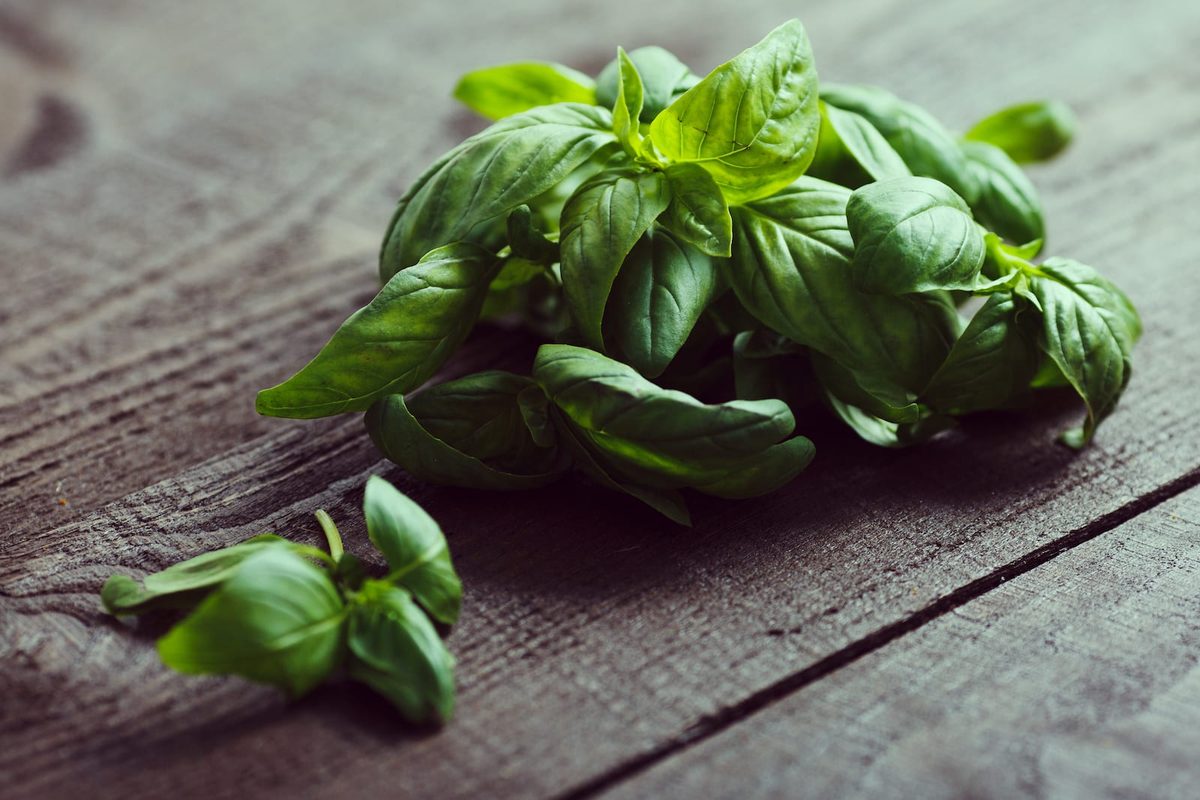
Lemon basil is not a lemony strain of ordinary basil. It is a hybrid: Kew’s Plants of the World Online records it as Ocimum × africanum, a cross between hoary basil (O. americanum) and sweet basil (O. basilicum), with O. × citriodorum, the name on most seed packets, as a synonym.1 What it adds is citral, the lemon-scented compound that made up 16 to 19% of the oil of two lemon basils in a US field trial and did not appear among the main compounds of sweet basil grown alongside them.2 So the question in the kitchen is simple: does the dish want lemon?
Side by side
| Lemon basil | Basil (sweet basil) | |
|---|---|---|
| Botanical name | Ocimum × africanum (syn. O. × citriodorum), hybrid of O. americanum × O. basilicum1 | Ocimum basilicum3 |
| Family | Lamiaceae (mint family)1 | Lamiaceae (mint family)4 |
| Native range (Kew) | Tropical and subtropical Asia to Australia1 | Tropical and subtropical Asia to northern Australia3 |
| Other names | Maenglak (Thai) and kemangi (Indonesian), names PROSEA gives for the parent hoary basil5 | Sweet basil; horapha in Thai67 |
| Main oil compounds, same 1999 US trial | Linalool 24 to 61%, citral 16 to 19%2 | Linalool 65 to 77%, no citral among the major compounds2 |
| Flavor (editorial) | Basil with lemon peel and a little lime; lighter and less peppery | Sweet and green, with a peppery edge and a hint of clove or anise |
| Forms sold | Fresh bunches and plants; rarely dried | Fresh, dried and ground dried |
| Typical uses | Hoary basil leaves eaten raw in Southeast Asia; Lao soups; drinks and desserts587 | Italian pizza, pasta and pesto; French omelets and soups6 |
| Price | No dated, sourced retail comparison found | No dated, sourced retail comparison found |
For each herb in depth, see the lemon basil and basil profiles.
What lemon basil is
Kew gives the hybrid formula as O. americanum × O. basilicum.1 PROSEA, the Southeast Asian plant handbook, notes that crosses between hoary basil and sweet basil are easy to make but have strongly reduced pollen fertility.5 Naming is not tidy. PROSEA lists O. africanum as a synonym of hoary basil itself, the plant it calls maenglak in Thai and kemangi in Indonesian,5 and the Herb Society of America lists “lemon basil” among the common names of O. americanum while filing named lemon cultivars such as ‘Lemon’ and ‘Sweet Dani’ under O. × citriodorum.7 So “lemon basil” in a Thai or Indonesian market and ‘Mrs. Burns’ Lemon’ from a Western seed catalog may not be exactly the same plant. Our lemon basil profile sets out the naming in full.
Sweet basil is the species O. basilicum, the common culinary basil;7 Genovese is one cultivar of it (see Genovese basil vs. sweet basil).
The difference in the oil
The Purdue University cultivar trial grew lemon and sweet basils in the same field and distilled them the same way, so these rows compare like with like:2
| Cultivar (one seed lot each) | Oil yield | Major aroma compounds |
|---|---|---|
| ‘Lemon’ (O. × citriodorum) | 0.27% | Linalool 24%, citral 19% |
| ‘Lemon Mrs. Burns’ (O. × citriodorum) | 1.28% | Linalool 61%, citral 16% |
| ‘Sweet’ (O. basilicum) | 0.84% | Linalool 69%, 1,8-cineole 11%, methylchavicol 13% |
| ‘Genovese’ (O. basilicum) | 0.90% | Linalool 77%, 1,8-cineole 12% |
Both kinds share linalool. Citral is what separates them, and the Purdue authors concluded it was the predominant compound in all the lemon-scented basils.2 A 2018 Chiang Mai University study of a lemon basil grown in northern Thailand found estragole at the top of its oil with citral and neral behind it, and anise and citrus scents dominant.9 That study reported concentrations in µg/mL, so it is not set against the Purdue percentages, but it shows that some lemon basils also carry estragole, a principal compound of sweet basil oil.64 PROSEA notes that hoary basil varies too, containing citral, camphor and methyl cinnamate in varying proportions.5
A widely repeated claim says limonene drives lemon basil’s scent. Neither study lists limonene among the main compounds.29
Differences that change the dish
Where lemon belongs. Lemon basil suits dishes that welcome citrus: fish and seafood, chicken, salads, fruit. PROSEA says the fragrant leaves of hoary basil are added to dishes with a fishy or disagreeable smell,5 and that its young leaves are eaten raw as a side vegetable in Indonesia, Malaysia and Thailand.5 In Laos, a soured bamboo soup published by the UN’s International Fund for Agricultural Development calls for a handful of lemon basil leaves (or holy basil), added after the fish sauce near the end.8 Where lemon would be out of place, as in a classic marinara or a Genoese pesto, sweet basil is the herb; that is our judgment.
Drinks and desserts. The Herb Society of America calls lemon and cinnamon basils unexpected but flavorful additions to desserts, uses lemon basil in muffins, basil syrups and a fruit cooler, and recommends ‘Mrs. Burns’ Lemon’ for vinaigrettes, beverages and desserts.7 Its basil syrup recipe allows anise, cinnamon, green or lemon basil;7 only the lemon one brings citrus. A lemon basil syrup also makes a good base for lemonade (editorial).
Heat. LSU AgCenter puts basil among the delicate herbs best added a minute or two before cooking ends, because long heat costs flavor and aroma,10 and the Herb Society says to add basil in the last few minutes.7 That applies to both. We found no source that compares how well citral and linalool survive cooking in the leaf.
Dried. Lemon basil is seldom sold dried. The Herb Society says most experts see no comparison between fresh and dried basil in flavor,7 so dried basil is a poor stand-in for fresh lemon basil.
Can one stand in for the other?
We found no published ratio for either direction, and there is no lemon basil substitutes page on this site, so both swaps below are Method: a direction and a starting point, not a tested ratio.
- Sweet basil for lemon basil. Use the same amount of fresh basil and add finely grated lemon zest, starting with about 1/2 teaspoon of zest per cup of loosely packed leaves, and taste. Basil alone gives the basil but not the lemon. Avoid dried basil here.
- Lemon basil for sweet basil. Use the same amount where a lemon note will help, as in salads, fish, chicken or a summer pesto made with that in mind. In tomato sauces and classic pesto, the lemon will be noticeable.
Safety
Some lemon basils, like the Thai sample above, contain estragole.9 The EU Scientific Committee on Food concluded in 2001 that estragole is genotoxic and carcinogenic, based mainly on studies in mice, and could not set a safe exposure limit;11 it did not single out lemon basil or tell people to stop eating basil. Our basil profile covers that evidence. We found no nutrient analysis of lemon basil itself, so figures for sweet basil should not be carried over to it.
What isn’t known
- The like-for-like comparison is one 1999 field trial with one seed lot per cultivar.2
- No source we opened compares the leaf width or color of lemon basil and sweet basil.
- No published ratio exists for swapping lemon basil and sweet basil, or for adding lemon zest to basil.
- Lemon basil’s place in Indonesian curries and in the Malaysian rice salad nasi ulam is often mentioned; we found no source that names it as an ingredient of either.
Related
- Lemon basil and basil profiles
- Genovese basil vs. sweet basil, holy basil vs. basil, basil vs. Thai basil
- Lemon balm, lemon verbena, lemongrass
- How to store basil, too much basil
Footnotes
-
Ocimum × africanum Lour., Plants of the World Online, Royal Botanic Gardens, Kew. powo.science.kew.org · Reference work ↩ ↩2 ↩3 ↩4 ↩5
-
“Comparative evaluation of North American commercially available Ocimum basil cultivars”, Table 1, Perspectives on New Crops and New Uses (1999), Purdue NewCROP. hort.purdue.edu · Peer-reviewed ↩ ↩2 ↩3 ↩4 ↩5 ↩6 ↩7
-
Ocimum basilicum L., Plants of the World Online, Royal Botanic Gardens, Kew. powo.science.kew.org · Reference work ↩ ↩2
-
“Basil”, Encyclopaedia Britannica, 2026. britannica.com · Reference work ↩ ↩2
-
A.T. Sunarto, Ocimum americanum, Plant Resources of South-East Asia (PROSEA). uses.plantnet-project.org · Reference work ↩ ↩2 ↩3 ↩4 ↩5 ↩6 ↩7
-
N.O. Aguilar, Pham Truong Thi Tho and L.P.A. Oyen, Ocimum basilicum, Plant Resources of South-East Asia (PROSEA). uses.plantnet-project.org · Reference work ↩ ↩2 ↩3
-
Michele Meyers, Basil: An Herb Society of America Guide, The Herb Society of America, 2003. herbsociety.org · Reference work ↩ ↩2 ↩3 ↩4 ↩5 ↩6 ↩7 ↩8
-
Chef Saeng, “Recipes for Change: Gaeng Nor Mai Som (Lao soured bamboo soup)”, International Fund for Agricultural Development, 2023. ifad.org · Publication ↩ ↩2
-
Tangpao, Chung and Sommano, “Aromatic Profiles of Essential Oils from Five Commonly Used Thai Basils”, Foods, 2018. mdpi.com · Peer-reviewed ↩ ↩2 ↩3
-
“Flavorful Herbs”, LSU AgCenter. lsuagcenter.com · Reference work ↩
-
Opinion of the Scientific Committee on Food on Estragole, European Commission, 2001. food.ec.europa.eu · Regulator ↩