Spice Comparisons · Comparison
Genovese Basil vs. Sweet Basil: A Cultivar and the Category It Belongs To
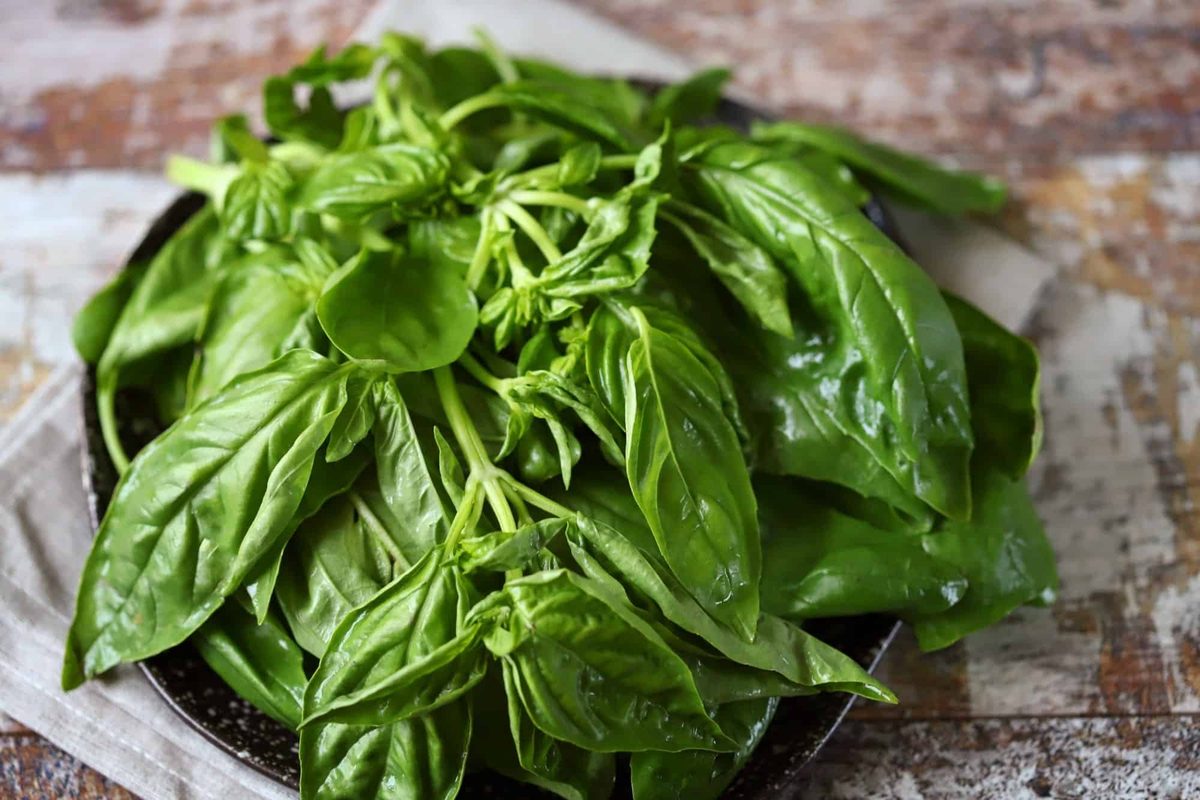
Genovese basil is not an alternative to sweet basil. It is one kind of it. “Sweet basil” is the everyday name for the species Ocimum basilicum,12 and Genovese is a large-leaved Italian cultivar within that species, the one the Herb Society of America calls “an ideal pesto basil.”2 So every Genovese plant is a sweet basil, but a pot or packet labeled only “sweet basil” could be Genovese or one of many other types. The useful question is how far a generic sweet basil can drift from Genovese, and when that matters in the kitchen.
Side by side
| Genovese basil | “Sweet basil” | |
|---|---|---|
| What the name covers | One cultivar group, sold under names like ‘Genovese’ and ‘Genovese Gigante’34 | The whole species Ocimum basilicum, including Genovese12 |
| Species | Ocimum basilicum32 | Ocimum basilicum1 |
| Family | Lamiaceae (mint family)5 | Lamiaceae (mint family)5 |
| Native range of the species | Tropical and subtropical Asia to northern Australia (Kew); other references differ (see below)6 | Same species |
| Leaves | “Very large leaves” on a plant about 30 inches tall (Herb Society)2 | Glossy, oval, smooth or slightly toothed, typically cupped a little; Britannica lists small-leaf, larger-leaf Italian and lettuce-leaf types in commerce5 |
| Main oil compounds, same 1999 US trial | Linalool 77%, 1,8-cineole 12%3 | The lot sold as ‘Sweet’: linalool 69%, methylchavicol 13%, 1,8-cineole 11%3 |
| Flavor (editorial) | Sweet and green, with clove and a peppery edge | Anywhere from close to Genovese to noticeably more anise-like, depending on the plant |
| Protected form | Basilico Genovese PDO, from the Tyrrhenian side of Liguria only7 | None |
| Forms sold | Mostly fresh bunches, plants and seed | Fresh, dried and ground dried |
| Typical uses | Pesto above all2 | Italian pizza, pasta, chicken and cheese dishes and pesto; French omelets and soups; Thai cooking8 |
| Price | No dated, sourced retail comparison found | No dated, sourced retail comparison found |
The flavor row is our description. The chemistry row compares like with like: both figures come from the same field trial of seed bought from North American suppliers, grown and distilled the same way, one seed lot per cultivar.3 For each herb in depth, see the Genovese basil and basil profiles.
What “sweet basil” means
The U.S. Food and Drug Administration’s list of spices generally recognized as safe gives “sweet” basil as Ocimum basilicum,1 and the Herb Society of America calls sweet basil “the common culinary basil.”2 It describes Genovese as having the familiar aroma and taste “of the numerous basils called ‘sweet basil.’”2 In other words, “sweet basil” is a family name, and Genovese is one member.
That family is unusually varied. PROSEA, the Southeast Asian plant handbook, recognizes at least six chemical types within O. basilicum.8 Thai basil is also O. basilicum; see basil vs. Thai basil. The Purdue trial found that ‘Genovese’, ‘Italian Large Leaf’, ‘Mammoth’, ‘Napoletano’ and ‘Sweet’ were among the cultivars dominating the American fresh and dry culinary herb markets at the time.3
Where the species is native is not settled. Kew gives tropical and subtropical Asia to northern Australia;6 Britannica says basil is likely native to India;5 PROSEA says it probably originated in western Asia.8 PROSEA traces its spread from the Middle East through Europe, reaching England in the 16th century and North America in the early 17th.8
The same trial, three sweet basils
The clearest look at how sweet basils differ comes from a single comparison. Purdue University researchers grew commercially available basils side by side and distilled their oils:3
| Cultivar (one seed lot each) | Height | Oil yield | Major aroma compounds |
|---|---|---|---|
| ‘Genovese’ | 49 cm | 0.90% | Linalool 77%, 1,8-cineole 12% |
| ‘Sweet’ | 49 cm | 0.84% | Linalool 69%, 1,8-cineole 11%, methylchavicol 13% |
| ‘Italian Large Leaf’ | 46 cm | 0.83% | Linalool 65%, methylchavicol 18% |
All three oils are led by linalool. The differences are in the supporting compounds. Methylchavicol, also called estragole,8 is the compound that makes up 60 to 75% of tarragon oil;9 it appeared among the major compounds of the ‘Sweet’ and ‘Italian Large Leaf’ lots but not the ‘Genovese’ lot.3 This is one lot of each, from one season, not a survey of what is sold, and nobody tested whether tasters could tell the three apart.
A second study points the other way for Genovese. Italian researchers analyzing young ‘Genovese Gigante’ plants found methyleugenol and eugenol as the main components, with methyleugenol dominant in plants up to 10 cm tall and eugenol in taller ones.4 Eugenol is also the main component of clove bud oil, at 70 to 90% according to PROSEA.10 The two studies measured different plants at different ages and cannot be merged.
Britannica adds a note on dried basil: the dried large-leaf varieties are faintly anise-scented, while dried common basil is less fragrant and more pungent.5
Basilico Genovese PDO
Only one version of Genovese basil is legally defined. The EU’s protected designation, Basilico Genovese PDO, must be grown on the Tyrrhenian side of Liguria,7 must have an intense, characteristic aroma with a total absence of mint,7 and is sold as bunches of 3 to 10 whole young plants with their roots.7 “Genovese” on a seed packet or supermarket clamshell outside Italy names a cultivar type, not this product. Our Genovese basil profile covers the rules in full.
Differences that change the dish
Pesto. This is where Genovese earns its name. The Herb Society calls it “an ideal pesto basil.”2 A sweet basil with more methylchavicol will make a pesto with more anise in it; that is our reading of the chemistry, not a tasting result.
Raw uses. On a Margherita pizza, in a Caprese salad or torn over tomatoes, any good sweet basil works, and the large, tender Genovese leaf is easy to tear or slice. That is common practice.
Cooking. LSU AgCenter groups basil with the delicate herbs best added a minute or two before cooking ends, because long heat costs flavor and aroma.11 The Herb Society similarly advises adding basil in the last few minutes of cooking.2 That applies equally to Genovese and any other sweet basil.
Dried. The Herb Society says most experts see no comparison between fresh and dried basil in flavor.2 Dried basil is usually sold simply as “basil” or “sweet basil,” with no cultivar named, so there is little point in seeking out dried Genovese. That is our judgment; see dried basil vs. fresh.
Can one stand in for the other?
Yes, one for one. Method: no source publishes a ratio for swapping one sweet basil cultivar for another, and none is needed for strength: in the Purdue trial, the ‘Genovese’ and ‘Sweet’ lots had nearly the same oil yield (0.90% and 0.84%).3 Use the same amount. Where basil is the main flavor, as in pesto, taste a leaf first; if it smells strongly of anise, the result will differ from a classic Genoese pesto.
What isn’t known
- No retail survey shows which cultivars are sold under the plain label “sweet basil.”
- The only like-for-like chemistry is one 1999 field trial with one seed lot per cultivar.3 Basil oil varies with plant age and growing conditions.4
- No source we found compares the leaf color or gloss of Genovese with other sweet basils.
- Claims that Genovese basil was first cultivated in Genoa could not be traced. The PDO specification says only that the Romans brought basil to Liguria.7
Safety
The same compounds raise the same question for any sweet basil. Germany’s BfR says methyleugenol and estragole showed mutagenic and carcinogenic properties in animal studies, names basil-containing pesto among foods that may contain high amounts, and makes no consumption recommendation for consumers.12 The EU Scientific Committee on Food put estragole at 20 to 43% of sweet basil oil in its 2001 assessment.9 Neither body tells people to stop eating basil. See the basil profile for the full evidence.
Related
- Genovese basil and basil profiles
- Genovese basil vs. Thai basil and basil vs. Thai basil
- Holy basil vs. basil and lemon basil vs. basil
- Cinnamon basil, basil uses, how to store basil, too much basil
Footnotes
-
21 CFR 182.10, Spices and other natural seasonings and flavorings, U.S. Food and Drug Administration. ecfr.gov · Regulator ↩ ↩2 ↩3 ↩4
-
Michele Meyers, Basil: An Herb Society of America Guide, The Herb Society of America, 2003. herbsociety.org · Reference work ↩ ↩2 ↩3 ↩4 ↩5 ↩6 ↩7 ↩8 ↩9 ↩10 ↩11
-
“Comparative evaluation of North American commercially available Ocimum basil cultivars”, Table 1, Perspectives on New Crops and New Uses (1999), Purdue NewCROP. hort.purdue.edu · Peer-reviewed ↩ ↩2 ↩3 ↩4 ↩5 ↩6 ↩7 ↩8 ↩9 ↩10
-
Miele, Dondero, Ciarallo and Mazzei, “Methyleugenol in Ocimum basilicum L. cv. Genovese Gigante”, Journal of Agricultural and Food Chemistry, 2001 (abstract). agris.fao.org · Peer-reviewed ↩ ↩2 ↩3
-
“Basil”, Encyclopaedia Britannica, 2026. britannica.com · Reference work ↩ ↩2 ↩3 ↩4 ↩5
-
Ocimum basilicum L., Plants of the World Online, Royal Botanic Gardens, Kew. powo.science.kew.org · Reference work ↩ ↩2
-
“Basilico Genovese” DOP, disciplinare di produzione, eAmbrosia, European Commission. webgate.ec.europa.eu · Regulator ↩ ↩2 ↩3 ↩4 ↩5
-
N.O. Aguilar, Pham Truong Thi Tho and L.P.A. Oyen, Ocimum basilicum, Plant Resources of South-East Asia (PROSEA). uses.plantnet-project.org · Reference work ↩ ↩2 ↩3 ↩4 ↩5
-
Opinion of the Scientific Committee on Food on Estragole, European Commission, 2001. food.ec.europa.eu · Regulator ↩ ↩2
-
E.W.M. Verheij and C.H.A. Snijders, Syzygium aromaticum, Plant Resources of South-East Asia (PROSEA). uses.plantnet-project.org · Reference work ↩
-
“Flavorful Herbs”, LSU AgCenter. lsuagcenter.com · Reference work ↩
-
“Alkenylbenzenes in food: how large is the health risk?”, BfR Communication No. 22/2022. bfr.bund.de · Regulator ↩