Blog · Uses
Basil Uses: Pesto, Pizza, Pistou, Thai Stir-Fries, Drinks and Preserving
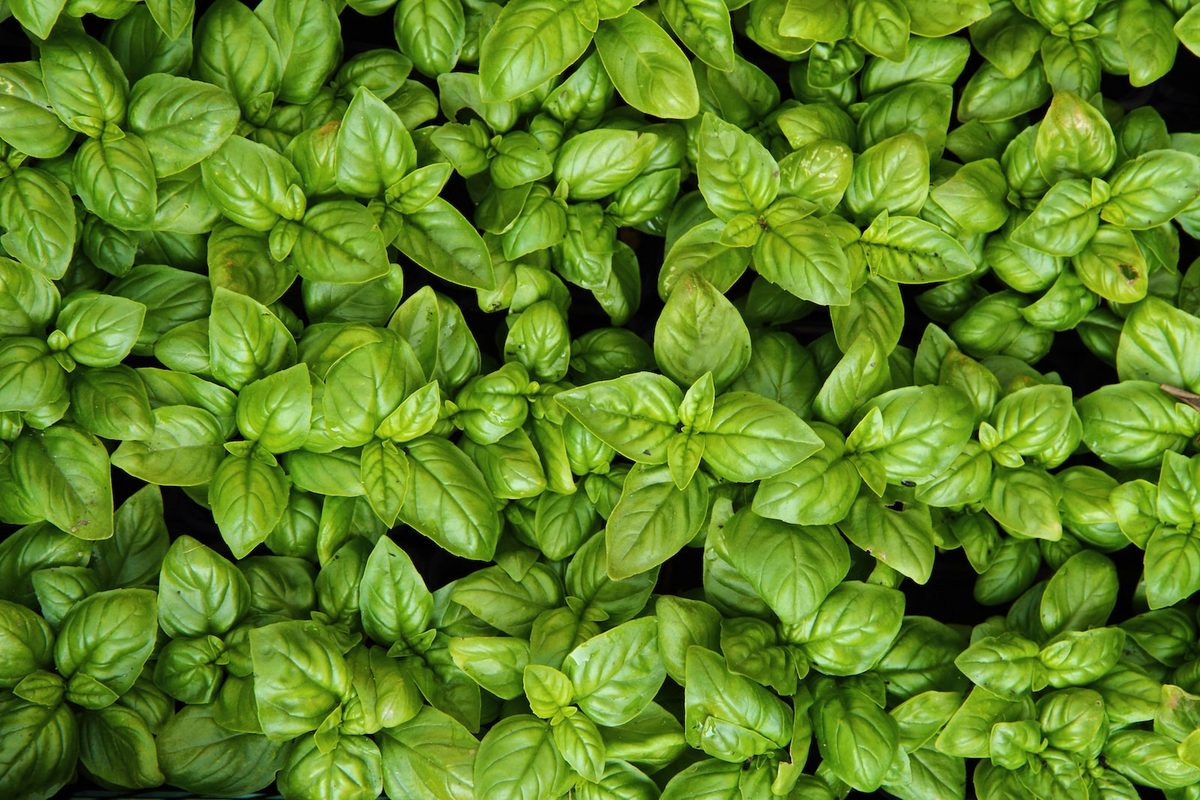
Basil earns its place in dishes where it stays raw or is barely cooked. PROSEA, the Southeast Asian plant reference, lists its Italian uses as pizza, pasta, chicken and cheese dishes and pesto, and notes that the leaves have a special affinity with tomatoes.1 Britannica adds meats, fish, salads and sauces.2 This page maps where basil goes: the dishes and cuisines built on it, the drinks, and the ways to keep it. For when to add it, how to cut it and how much to use, see cooking with basil.
At a glance
| Use | Which basil, in what form | Example from a named source |
|---|---|---|
| Pesto | Fresh sweet basil, pounded raw | 2 cups (70 g) packed leaves for 1 pound of pasta (Samin Nosrat)3 |
| Soupe au pistou | Fresh, raw, added at the table | 4 cups packed basil in the pistou (Saveur)4 |
| Pizza margherita | Fresh leaves with tomato and mozzarella | Described in Naples in 1853 (National Geographic)5 |
| Long-simmered tomato sauce | Dried early; fresh at the end | ATK; LSU AgCenter67 |
| Thai stir-fry (phat kaphrao) | Holy basil, cooked for seconds | About 15 seconds (Andy Ricker)8 |
| Pho | Thai basil, raw, on the garnish plate | Andrea Nguyen9 |
| Omelets and soups | Fresh leaves | France, per PROSEA1 |
| Drinks | Seeds soaked into a gel; leaves in liqueur | PROSEA110 |
| Basil vinegar | 3 to 4 fresh sprigs per pint | Colorado State University Extension11 |
Italian: pesto, pizza and tomato sauce
Pesto. Britannica traces pesto to Genoa and describes the classic as basil, pine nuts, garlic, grated Parmesan and olive oil; made that way, it is pesto alla genovese, and the name comes from the Italian verb pestare.12 Britannica lists pasta, vegetables, poultry, fish and bread as things it commonly tops.12 For scale, Samin Nosrat’s mortar-and-pestle version uses 2 cups (70 grams) of tightly packed basil to dress 1 pound of trofie or spaghetti.3 Her full recipe and the fixes for bitter pesto are on cooking with basil; see also Genovese basil, the cultivar most pesto recipes call for.
Pizza margherita. The story everyone knows says a Naples pizza maker named a tomato, mozzarella and basil pizza for Queen Margherita during her 1889 visit, its colors echoing the Italian flag. National Geographic reports that recent research calls the story a fabrication built on a forged letter, that local records show no contemporary mention of the event, and that the dish existed at least three decades before any royal visit: an 1853 essay by Emanuele Rocco already describes a pizza topped with basil, mozzarella and tomato.5 Whatever its name’s origin, the pairing itself is old.
Tomato sauces and pasta. Two forms of basil do two different jobs here. In America’s Test Kitchen’s tests, dried herbs held up best in recipes that cooked more than 20 minutes with plenty of liquid,6 though ATK also lists basil among the herbs that are much weaker once dried.13 Fresh basil, by contrast, should go in a minute or two before the end of cooking, according to LSU AgCenter.7 So dried basil belongs in a long-simmered sauce from early on, and fresh basil goes in at the end or on top. A widely repeated claim says basil appears in most tomato pasta sauces; we found no count to support it. See dried basil vs. fresh and Italian spices.
French: pistou, omelets and soups
PROSEA says that in France the leaves are particularly popular in omelets and soups.1 The best-known example is soupe au pistou. Saveur calls pistou the Provençal cousin of pesto and stirs it into a summer vegetable soup just before serving.4 Its pistou is 4 cups of packed basil processed with Parmesan, olive oil, salt, garlic and a plum tomato, with no pine nuts, and the soup is served with the pistou dolloped on top of each bowl.4 The basil never cooks, which is the point.
Southeast Asian: Thai and Vietnamese
Three basils are involved, and the recipe usually names one. See basil vs. Thai basil and Thai basil vs. holy basil.
- Holy basil in phat kaphrao. Pad kra pao literally means holy basil stir-fry, as Pailin Chongchitnant of Hot Thai Kitchen puts it.14 In Andy Ricker’s version the basil is stirred in just until it wilts and smells very fragrant, 15 seconds or so.8 Chongchitnant prefers Italian basil as the substitute when holy basil is unavailable and says Thai basil also works.14 See holy basil.
- Thai basil in curries and stir-fries. Britannica gives Thai basil as O. basilicum variety thyrsiflora,2 and Sherri Pengjad of Thai Foodie describes it as stirred in right before serving for its licorice-like aroma.15 See Thai basil.
- Sweet basil. PROSEA calls sweet basil an important ingredient of Thai cuisine,1 so Western basil is not out of place in Thai cooking.
- Pho. In The Pho Cookbook, Andrea Nguyen puts Thai basil (húng quế) on the garnish plate served with the soup, to be added raw at the table.9
For the wider picture, see Thai spices.
Drinks
- Basil seed drinks. PROSEA notes that sweet basil’s seed is mucilaginous and goes into non-alcoholic drinks.1 For the related Ocimum americanum, PROSEA describes the seeds swelling in water into a gelatinous mass often used in sweet cooling drinks.10
- Liqueur. PROSEA also says basil leaves are used to modify the flavor of chartreuse liqueurs.1
- Tea. The basil most often brewed as tea is holy basil, or tulsi, which Britannica says is widely used in Ayurvedic and folk medicine, often as an herbal tea.16 Basil tea is widely said to help with oral health and diabetes. We found no source that meets our standard for those claims, and this page makes none.
Preserving basil
Basil vinegar. Colorado State University Extension lists basil among the fresh herbs for flavored vinegar, at 3 to 4 sprigs per pint.11 Its method is more careful than simply steeping leaves in vinegar: heat the vinegar to just below boiling, use containers sterilized by simmering for a full 10 minutes, and allow at least 10 days for the flavor to develop.11 The vinegar keeps in a cool, dark place (65°F or below) for up to three months, or in the refrigerator for six to eight months; if you see mold or signs of fermentation, throw it away without tasting it.11 Use it in vinaigrettes and marinades (kitchen practice).
Basil in oil. PROSEA records that in Italy, dried basil leaves are preserved in olive oil, where they turn black but keep their flavor for several months.1 Modern home-preservation guidance is stricter. Oregon State University Extension explains that herbs are low-acid foods that can carry Clostridium botulinum, that oil creates an oxygen-free environment, and that even oil seasoned with dried herbs must be refrigerated and used within 4 days, or frozen.17 Treat the Italian practice as history, not a method.
Frozen pesto. Oregon State notes that pesto can be frozen in ice cube trays.17 That is the practical way to keep a summer glut of basil for winter sauces and soups.
Dried basil. Britannica describes dried basil as less fragrant and more pungent than fresh,2 so it is a different ingredient rather than a copy. See how to dry basil, how to store basil and can you freeze basil?
A note on safety
Basil contains estragole. Germany’s Federal Institute for Risk Assessment (BfR) says estragole and related compounds are mutagenic and carcinogenic in animal studies, and names basil-containing pesto among the foods that may contain high amounts.18 That evidence comes from animal studies and exposure estimates, not from people eating basil; the basil profile has the detail.
Not yet sourced
- A count of how many tomato sauce recipes use basil.
- Any health effect of basil tea from a source that meets our standard.
- A tested amount of basil per quart of tomato sauce.
Related
- Basil, cooking with basil and too much basil
- Genovese basil, Thai basil, holy basil, lemon basil and cinnamon basil
- Basil vs. oregano, basil vs. mint and basil vs. parsley
- Thai basil substitutes
Footnotes
-
Aguilar, Pham and Oyen, “Ocimum basilicum”, Plant Resources of South-East Asia (PROSEA), via Pl@ntUse. uses.plantnet-project.org · Reference work ↩ ↩2 ↩3 ↩4 ↩5 ↩6 ↩7 ↩8
-
“Basil”, Encyclopaedia Britannica, 2026. britannica.com · Reference work ↩ ↩2 ↩3
-
Samin Nosrat, “Basil Pesto”, Ciao Samin. ciaosamin.com · Publication ↩ ↩2
-
“Provençal Vegetable Soup With Garlic-Basil Paste (Soupe au Pistou)”, Saveur, 2012. saveur.com · Publication ↩ ↩2 ↩3
-
Braden Phillips, “Pizza Margherita may be fit for a queen, but was it really named after one?”, National Geographic, 2022. nationalgeographic.com · Publication ↩ ↩2
-
“Science: Substituting Dried Herbs for Fresh”, America’s Test Kitchen. americastestkitchen.com · Publication ↩ ↩2
-
“Flavorful Herbs”, LSU AgCenter. lsuagcenter.com · Reference work ↩ ↩2
-
Andy Ricker with J.J. Goode, “Stir-fried chicken with hot basil”, from Pok Pok, via The Splendid Table. splendidtable.org · Publication ↩ ↩2
-
Andrea Nguyen, “Pho Garnish Plate”, from The Pho Cookbook, via The Splendid Table. splendidtable.org · Publication ↩ ↩2
-
A.T. Sunarto, “Ocimum americanum”, PROSEA, via Pl@ntUse. uses.plantnet-project.org · Reference work ↩ ↩2
-
“Making Flavored Vinegar”, Fact Sheet 9.340, Colorado State University Extension, 2021. foodsmartcolorado.colostate.edu · Reference work ↩ ↩2 ↩3 ↩4
-
Gregory Lewis McNamee, “Pesto”, Encyclopaedia Britannica. britannica.com · Reference work ↩ ↩2
-
Danielle Lapierre, “When You Should Actually Use Dried Herbs (and Which Ones to Avoid)”, America’s Test Kitchen, 2022. americastestkitchen.com · Publication ↩
-
Pailin Chongchitnant, “Pad kra pao beef”, Hot Thai Kitchen. hot-thai-kitchen.com · Publication ↩ ↩2
-
Sherri Pengjad, “Thai Basil: What It Is and How to Use It”, Thai Foodie, 2026. thai-foodie.com · Publication ↩
-
Melissa Petruzzello, “Holy basil”, Encyclopaedia Britannica, 2026. britannica.com · Reference work ↩
-
Raab and Woodburn, “Herbs and Vegetables in Oil” (SP 50-701), Oregon State University Extension Service, 2025. extension.oregonstate.edu · Reference work ↩ ↩2
-
“Alkenylbenzenes in food: how large is the health risk?”, BfR Communication No. 22/2022. bfr.bund.de · Regulator ↩