Spice Comparisons · Comparison
Dried Basil vs. Fresh Basil: What Drying Does to the Flavor, and How to Swap Them
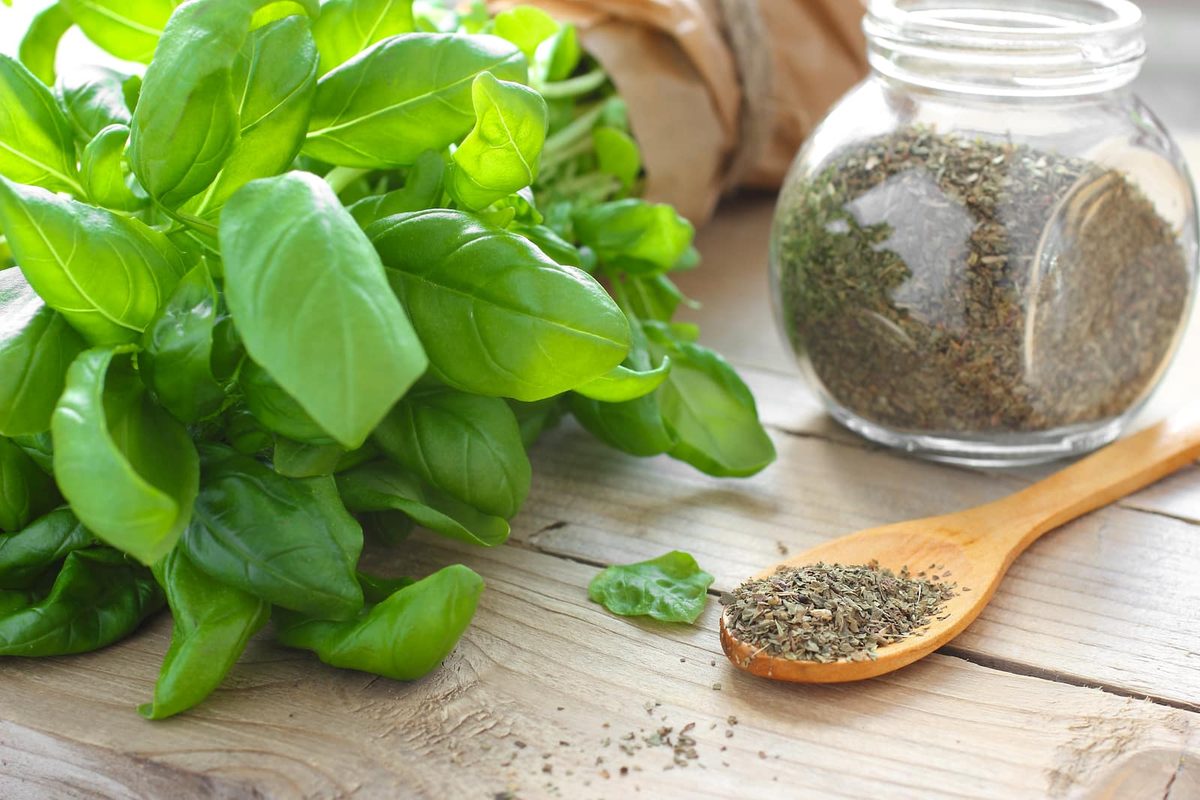
Fresh and dried basil are the same plant, Ocimum basilicum, a tender herb of the mint family,12 but drying changes what it smells like, not just how strong it is. In a 2004 drying study, fresh basil was described as fresh, herbaceous and floral, while the dried samples smelled mentholated, spicy, hay-like and earthy.3 That is why dried basil can season a sauce but can’t stand in for fresh leaves in pesto, a salad or a garnish.
Side by side
| Fresh basil | Dried basil | |
|---|---|---|
| Plant | Ocimum basilicum, family Lamiaceae12 | Same |
| Part used | Leaves2 | Leaves, crumbled or ground4 |
| Water | 92.1 g per 100 g5 | 10.4 g per 100 g4 |
| Aroma (lab panel) | Fresh, herbaceous and floral3 | Mentholated, spicy, hay-like and earthy3 |
| Main aroma compounds | Linalool first, then eugenol, in the 2004 study’s samples;3 linalool and methyl chavicol (estragole) in a 1999 study’s headspace6 | The same compounds, in amounts that depend heavily on how the leaves were dried (see below)36 |
| Strength, measure for measure | The baseline | Extension rule of thumb: 1 teaspoon dried for 1 tablespoon fresh.7 ATK finds basil much weaker dried than that rule implies8 |
| Flavor (editorial) | Sweet, green, peppery, with an anise edge | Flatter and duller; tea-like rather than bright |
| Best uses | Raw and finishing: pesto, salads, garnish, added at the end of cooking97 | Long-cooked dishes with liquid, where nothing better is on hand108 |
| Keeps | No published fridge life for fresh basil found | Penn State: most dried herbs keep well for a year11 |
The two studies in the aroma rows measured different things. Díaz-Maroto and colleagues compared fresh leaves with oven-dried, air-dried and freeze-dried leaves,3 and Yousif and colleagues compared air drying with vacuum-microwave drying.6 Their figures can’t be lined up against each other, but both show the same thing: the drying method decides how much of basil’s aroma survives.
What drying does to basil’s aroma
Some aroma is lost, but how much depends on the method. In the 2004 study, the aroma compounds fell considerably during oven drying at 45°C and during freeze-drying, while air drying at room temperature caused only small losses.3 In the 1999 study, vacuum-microwave drying left about 2.5 times the linalool and 1.5 times the methyl chavicol of air-dried samples.6 The authors also found that the vacuum-microwave samples gave off more volatiles than fresh basil, which they link to chemical reactions during drying,6 so “dried” does not always mean “less.”
The character changes too. The 2004 panel’s description of the dried samples (mentholated, spicy, hay-like, earthy) is a long way from the floral fresh leaf.3 America’s Test Kitchen gives the cook’s version of the same finding: basil is one of the delicate herbs whose flavor compounds are more volatile,10 and it is much weaker in flavor once dried.8 In ATK’s tasting of herbs across 24 recipes, dried herbs drew complaints of tasting “dusty” and “stale”, and ATK notes that drying leads to oxidation.10
Commercial practice. PROSEA, the Southeast Asian plant reference, says basil leaves should be dried at no more than 35°C to keep their aroma and color.9 We found no information on how retail dried basil is actually dried, so the label won’t tell you which of the results above your jar resembles.
A widely repeated claim says dried basil loses fresh basil’s anise note in particular. Neither study we read reports how the compounds that might carry that note change between fresh and dried leaves, so we can’t confirm it.
Is dried basil stronger than fresh?
Sources answer this differently, and the difference matters for how much you use.
| Source | What it says |
|---|---|
| University of Delaware Extension | Dried herbs, as a general rule, are stronger than fresh12 |
| Penn State Extension | Dried herbs are 3 to 4 times stronger than fresh, so use a quarter to a third as much11 |
| America’s Test Kitchen | Basil is among the herbs that are much weaker in flavor when dried8 |
The extension figures are general rules for herbs, not measurements of basil. ATK’s statement is specific to basil and the other delicate herbs, and its test kitchen tasted the difference.108 Dried leaves are denser in everything that survives drying, because the water is gone (92.1 g per 100 g in fresh basil against 10.4 g in dried).45 But a concentrated leaf is only stronger if the aroma survived drying, and for basil much of it may not have.
Can one stand in for the other?
Dried for fresh, in cooked dishes (Computed, with a caveat). The standard rule is 1 tablespoon of finely cut fresh herbs to 1 teaspoon of crumbled dried, a ratio given by LSU AgCenter and Penn State, and ATK’s tasting found 1 part dried to 3 parts fresh came closest to equal strength across herbs.71110 Because ATK finds basil much weaker dried,8 treat 1 teaspoon per tablespoon as a floor: start there, taste, and add more. ATK also found dried herbs work best with more than 20 minutes of cooking and a good amount of liquid,10 so dried basil belongs in a simmered tomato sauce or soup, not a quick sauté.
Dried for fresh, raw. Don’t. ATK warns that dried herbs used as a garnish can add an unpleasant texture and taste dusty.8 In our judgment, pesto, caprese, salads and finishing all need fresh leaves. If you have no fresh basil, a different fresh herb will usually do more for a raw dish than dried basil; see basil vs. mint and basil vs. parsley for how those compare.
Fresh for dried. This almost always works. Use about three times the dried amount, chopped (the same rule in reverse).7 LSU AgCenter groups basil with the delicate herbs best added in the last minute or two of cooking, because prolonged heat costs flavor and aroma.7 So add fresh basil late even if the recipe adds the dried basil early.
When to add dried basil. ATK advises adding dried herbs at the same point you would add fresh,8 and Delaware’s rule for long-simmered dishes is to add herbs in the last 45 minutes.12 Delaware also suggests crushing dried herbs first to release some of the oils.12 We found no source saying dried basil gains flavor the longer it cooks.
Nutrition: small amounts either way
Per tablespoon, using USDA values (1 tablespoon of dried leaves weighs 2.1 g; a tablespoon of chopped fresh leaves about 2.65 g, half of USDA’s 5.3 g for two tablespoons):45
| Per tablespoon | Fresh, chopped | Dried leaves |
|---|---|---|
| Vitamin K | about 11 µg | about 36 µg |
| Vitamin C | about 0.48 mg | about 0.02 mg |
| 18:3 polyunsaturated fat (USDA’s “PUFA 18:3”) | about 8.4 mg | about 6.2 mg |
These are our arithmetic from USDA’s per-100 g figures (fresh: 415 µg vitamin K, 18.0 mg vitamin C, 0.316 g PUFA 18:3; dried: 1,710 µg, 0.8 mg, 0.296 g).45 Drying all but removes the vitamin C, while vitamin K comes through concentrated. At herb portions, none of these amounts matters much except vitamin K; the basil profile covers what that means for people on warfarin.
What isn’t known
- No study we found measures retail dried basil against fresh in a cooked dish. The ratios above are rules of thumb.
- Whether the anise note specifically is lost on drying: not shown in the sources reviewed.
- How commercial dried basil is dried, and at what temperature.
- No published fridge life for fresh basil from a named source.
Related
- Basil: the full profile, including estragole safety
- Dried herbs vs. fresh: the general rules, which herbs dry well, and the conversion table
- How to dry basil, how to store basil and can you freeze basil?
- Cooking with basil, basil uses and too much basil
- Basil vs. oregano, basil vs. Thai basil and Thai basil vs. holy basil
- Dried vs. fresh cilantro
Footnotes
-
Ocimum basilicum L., Plants of the World Online, Royal Botanic Gardens, Kew. powo.science.kew.org · Reference work ↩ ↩2
-
“Basil”, Encyclopaedia Britannica, 2026. britannica.com · Reference work ↩ ↩2 ↩3
-
Díaz-Maroto et al., “Changes produced in the aroma compounds and structural integrity of basil during drying”, Journal of the Science of Food and Agriculture, 2004 (abstract, via FAO AGRIS). agris.fao.org · Peer-reviewed ↩ ↩2 ↩3 ↩4 ↩5 ↩6 ↩7 ↩8
-
Spices, basil, dried (FDC 171317), USDA FoodData Central. fdc.nal.usda.gov · Regulator ↩ ↩2 ↩3 ↩4 ↩5
-
Basil, fresh (FDC 172232), USDA FoodData Central. fdc.nal.usda.gov · Regulator ↩ ↩2 ↩3 ↩4
-
Yousif et al., “Flavor volatiles and physical properties of vacuum-microwave- and air-dried sweet basil”, Journal of Agricultural and Food Chemistry, 1999 (abstract, via FAO AGRIS). agris.fao.org · Peer-reviewed ↩ ↩2 ↩3 ↩4 ↩5
-
“Flavorful Herbs”, LSU AgCenter. lsuagcenter.com · Reference work ↩ ↩2 ↩3 ↩4 ↩5
-
Danielle Lapierre, “When You Should Actually Use Dried Herbs (and Which Ones to Avoid)”, America’s Test Kitchen, 2022. americastestkitchen.com · Publication ↩ ↩2 ↩3 ↩4 ↩5 ↩6 ↩7 ↩8
-
N.O. Aguilar, Pham Truong Thi Tho and L.P.A. Oyen, Ocimum basilicum, Plant Resources of South-East Asia (PROSEA). uses.plantnet-project.org · Reference work ↩ ↩2
-
“Science: Substituting Dried Herbs for Fresh”, America’s Test Kitchen. americastestkitchen.com · Publication ↩ ↩2 ↩3 ↩4 ↩5 ↩6
-
Stacy Reed, “Preserving Herbs by Drying”, Penn State Extension, 2024. extension.psu.edu · Reference work ↩ ↩2 ↩3
-
“Using Herbs and Spices”, University of Delaware Cooperative Extension, 2025. udel.edu · Reference work ↩ ↩2 ↩3