Spice Comparisons · Comparison
Fresh Parsley vs. Dried: Flavor, Nutrients and How Much to Use
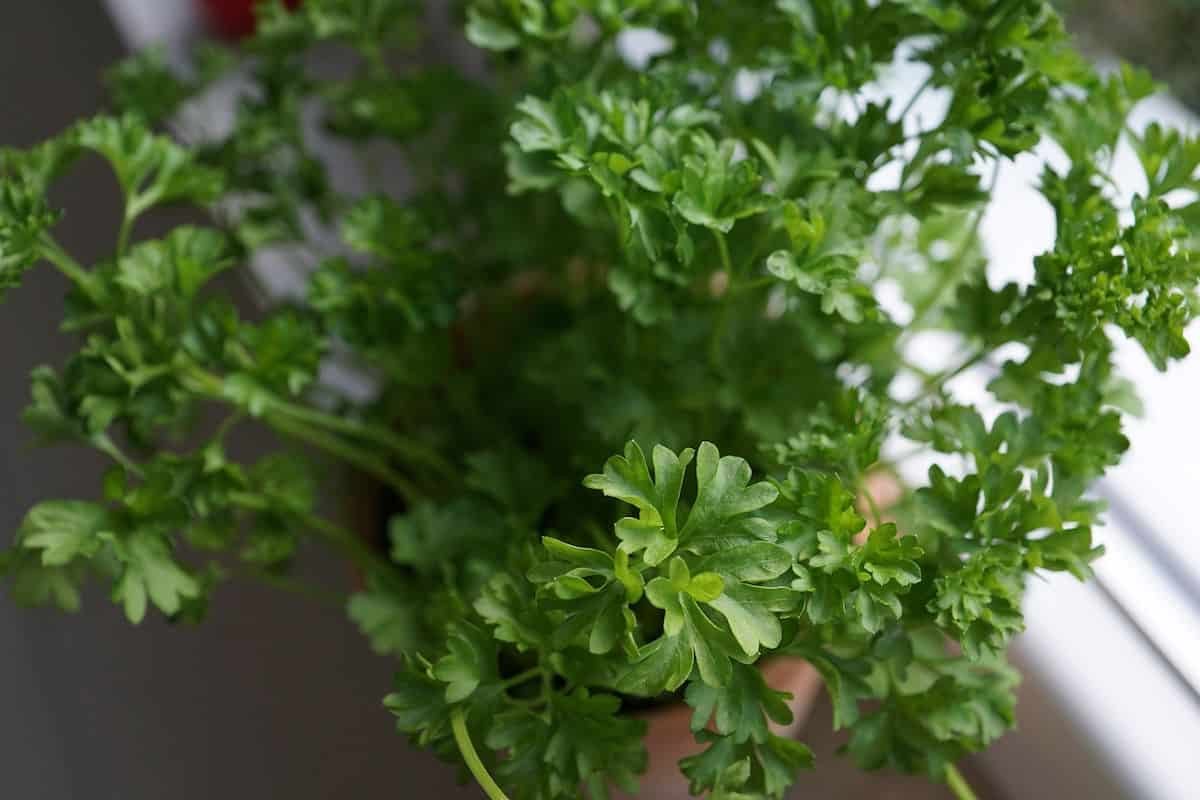
Fresh and dried parsley are the same herb, Petroselinum crispum, but drying costs parsley much of its flavor.1 America’s Test Kitchen lists it among the herbs that are better fresh, because delicate herbs like it are much weaker in flavor when dried.2 Dried parsley is still stronger than fresh by volume, so the swap is 1 teaspoon dried for 3 teaspoons fresh,3 and at the amounts cooks actually use, fresh parsley also delivers far more vitamins.45
Side by side
| Fresh parsley | Dried parsley | |
|---|---|---|
| Plant | Petroselinum crispum1 | The same plant |
| Family | Apiaceae (carrot or parsley family)6 | Same |
| Native range | Northwest Africa and the Balkan Peninsula (Kew)1 | Same |
| Types | Curly and flat-leaved; PROSEA says flat-leaved is stronger flavored7 | Usually not stated on the jar (editorial) |
| Key aroma compounds | 15 compounds in fresh leaves in one study, led by 1,3,8-p-menthatriene, pinene, myrcene, phellandrene and apiole8 | Reduced by drying, more so at higher temperatures8 |
| Essential oil | Less than 0.5% (Britannica)6 | No figure found |
| Water | 87.7 g per 100 g4 | 5.89 g per 100 g5 |
| Strength by volume | 3 teaspoons | 1 teaspoon3 |
| Flavor | Mildly aromatic (Britannica);6 green, fresh and lightly bitter (editorial) | Faint and hay-like (editorial) |
| Best for | Garnish, salads, sauces, finishing hot dishes69 | Soups, stuffings and sauces that cook a while (editorial) |
| Regulation | No herb-specific limit found | The EU caps pyrrolizidine alkaloids in dried herbs, parsley included, at 400 µg/kg10 |
For the plant itself, see parsley.
What drying does to parsley
A 2005 study in the Polish Journal of Food and Nutrition Sciences dried parsley leaves from 87–90% water down to 4–6% in two kinds of dryer, at 45 and 55 °C in a heat-pump dryer and at 55 and 65 °C in a cabinet dryer.8 The researchers found 15 volatile compounds in the fresh leaves, and both drying methods reduced the amount of volatile compounds as the temperature rose.8 Sensory panels found no significant difference in organoleptic tests,8 but the abstract does not say whether fresh leaves were part of that comparison.
ATK’s findings fill in the kitchen side. Its tests found that delicate herbs, parsley among them, tend to have more volatile flavor compounds,11 and Danielle Lapierre’s guide puts parsley among the herbs that are better fresh because such herbs are much weaker in flavor when dried.2
Nutrients: per 100 grams vs. per serving
A widely repeated claim says dried parsley keeps its nutrients, or even concentrates them. Per 100 grams, the minerals are indeed more concentrated in dried parsley, because the water is gone. But nobody uses 100 grams of dried parsley in place of 100 grams of fresh. The fair comparison is the amounts that substitute for each other: 1 tablespoon of fresh (3.8 g) against 1 teaspoon of dried (0.5 g), using USDA’s portion weights.45
| Per | Vitamin C | Vitamin K | Vitamin A (RAE) | Iron | Potassium | Calcium |
|---|---|---|---|---|---|---|
| 100 g fresh4 | 133 mg | 1,640 µg | 421 µg | 6.20 mg | 554 mg | 138 mg |
| 100 g dried5 | 125 mg | 1,360 µg | 97 µg | 22.0 mg | 2,680 mg | 1,140 mg |
| 1 tablespoon fresh (3.8 g) | 5.1 mg | 62 µg | 16 µg | 0.24 mg | 21 mg | 5.2 mg |
| 1 teaspoon dried (0.5 g) | 0.6 mg | 6.8 µg | 0.5 µg | 0.11 mg | 13 mg | 5.7 mg |
The per-spoon rows are our arithmetic from USDA’s per-100 g values and portion weights. At equal flavor strength, fresh parsley supplies about eight times the vitamin C, nine times the vitamin K and some thirty times the vitamin A of the dried teaspoon; only calcium comes out about even. PROSEA’s own composition figure for dried parsley, 122 mg of vitamin C per 100 g, is close to USDA’s.7
Two cautions. The fresh and dried entries are separate USDA analyses, not one batch measured before and after drying, so they show what each product typically contains rather than exactly what drying destroys. And at a teaspoon or a tablespoon, neither form is a major source of most nutrients. For vitamin K and warfarin, see parsley.
How much to use
Ratio (Attributed): NMSU Extension gives 1 teaspoon of dried parsley as equal to 3 teaspoons of chopped fresh parsley.3 The Spice House says to use about a third of the amount when using dried parsley instead of fresh.12 Both match ATK’s general finding that 1 part dried to 3 parts fresh came closest to equal strength,11 LSU AgCenter’s rule of 1 tablespoon fresh to 1 teaspoon dried,9 and Penn State’s rule for herbs in general.13
- Dried for fresh: 1 teaspoon dried per tablespoon of fresh. It brings strength, not fresh parsley’s flavor.
- Fresh for dried: 1 tablespoon fresh per teaspoon of dried. Fresh parsley is the stronger-flavored choice at that ratio, so it can stand out more against other herbs (editorial).
When to use each
Fresh parsley is the default. Britannica lists fish, meats, soups, sauces and salads among its uses.6 LSU AgCenter counts parsley among the delicate herbs best added at the end of cooking, since prolonged heat costs flavor and aroma.9 By kitchen judgment, that covers gremolata, chimichurri, tabbouleh, salsa verde, parsley butter and any plate that needs green on top. Parsley stems, by kitchen judgment, are good in stocks where they can be strained out.
Dried parsley earns its place where it can soften in liquid and only a mild background note is needed: soups, stuffings, meatballs and some dry rubs and blends (editorial). As a garnish, dried flakes add color but little flavor (editorial).
Can one stand in for the other?
Fresh can always replace dried at 3 to 1. Dried in place of fresh is a weak swap wherever parsley is the main flavor or the garnish. In those cases, chervil, a close relative with a milder, parsley-like flavor, may do better; The Spice House calls chervil closely related to parsley but milder.12 Parsley substitutes ranks the options by job, and chervil vs. parsley compares the two.
What isn’t known
- No study we found clearly compares the taste of fresh and dried parsley; the 2005 drying study’s abstract does not say whether its sensory test included fresh leaves.8
- The nutrient comparison uses two separate USDA entries; no before-and-after drying analysis of the same parsley was found.
- We found no shelf-life figure for dried parsley from a regulator or extension service. See how to dry parsley and how to store parsley.
- The claim that dried parsley holds polyphenols and carotenoids because it is dried soon after harvest could not be traced; USDA’s vitamin A figure for dried parsley is far lower than for fresh.45
Related
- Dried herbs vs. fresh: the general rules for every herb.
- Parsley, parsley substitutes and too much parsley?
- Can you freeze parsley?
- Italian vs. curly parsley, chervil vs. parsley and cilantro vs. parsley
- Fresh dill vs. dried dill, dried vs. fresh tarragon and dried basil vs. fresh: more delicate herbs.
Footnotes
-
Petroselinum crispum, Plants of the World Online, Royal Botanic Gardens, Kew. powo.science.kew.org · Reference work ↩ ↩2 ↩3
-
Danielle Lapierre, “When You Should Actually Use Dried Herbs (and Which Ones to Avoid)”, America’s Test Kitchen, 2022. americastestkitchen.com · Publication ↩ ↩2
-
In a Pinch Ingredient Substitution (E-131), New Mexico State University Cooperative Extension, 2016. pubs.nmsu.edu · Reference work ↩ ↩2 ↩3
-
Parsley, fresh (FDC 170416), USDA FoodData Central. fdc.nal.usda.gov · Regulator ↩ ↩2 ↩3 ↩4 ↩5
-
Spices, parsley, dried (FDC 170930), USDA FoodData Central. fdc.nal.usda.gov · Regulator ↩ ↩2 ↩3 ↩4 ↩5
-
“Parsley”, Encyclopaedia Britannica. britannica.com · Reference work ↩ ↩2 ↩3 ↩4 ↩5
-
I.B. Ipor & L.P.A. Oyen, Petroselinum crispum, Plant Resources of South-East Asia (PROSEA). uses.plantnet-project.org · Reference work ↩ ↩2
-
“Preservation of flavour components in parsley (Petroselinum crispum) by heat pump and cabinet drying”, Pol. J. Food Nutr. Sci., 2005 (abstract). journal.pan.olsztyn.pl · Peer-reviewed ↩ ↩2 ↩3 ↩4 ↩5 ↩6
-
“Flavorful Herbs”, LSU AgCenter. lsuagcenter.com · Reference work ↩ ↩2 ↩3
-
Commission Regulation (EU) 2023/915, Annex I, section 2.4. eur-lex.europa.eu · Regulator ↩
-
“Science: Substituting Dried Herbs for Fresh”, America’s Test Kitchen. americastestkitchen.com · Publication ↩ ↩2
-
“The 8 Best Parsley Substitutes”, The Spice House, 2018. thespicehouse.com · Merchant ↩ ↩2
-
Stacy Reed, “Preserving Herbs by Drying”, Penn State Extension, 2024. extension.psu.edu · Reference work ↩