Spice Substitutes · Substitutes
Parsley Substitutes, Ranked by the Job Parsley Is Doing
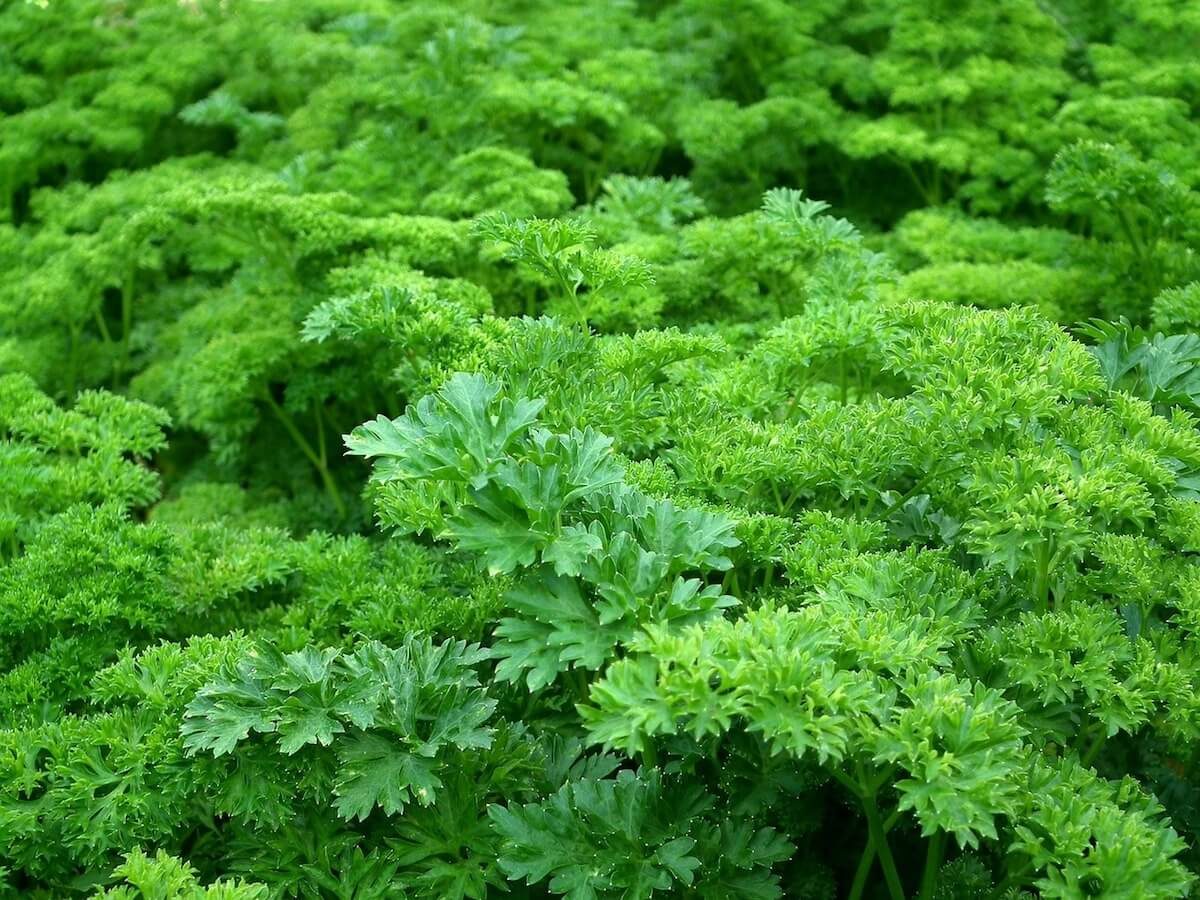
Parsley (Petroselinum crispum) is a biennial herb of the carrot family, also called the parsley family (Apiaceae).1 Britannica calls its flavor mildly aromatic and lists fish, meats, soups, sauces and salads among its uses.1 PROSEA describes the flavor of parsley oil as warm but slightly burning and bitter, and says flat-leaved parsley is stronger flavored than the curly type.2 A good substitute has to match whichever part of that matters in your dish: the green look, the mild fresh flavor, or parsley’s quiet work in a cooked soup or sauce.
Quick answer
| What parsley is doing | Best substitute | Starting amount, per 1 part fresh parsley | Treatment |
|---|---|---|---|
| Fresh garnish or a light herb finish | Chervil | 1 part, then more to taste | Method |
| Garnish where the look matters most | Celery leaves or cilantro | 1 part celery leaves; 1/2 part cilantro | Method |
| Cooked into soups, sauces or stuffing | Dried parsley | 1 part dried per 3 parts fresh | Attributed |
| Same job, more flavor wanted | Lovage or celery leaves | 1/4 part lovage; 1 part celery leaves | Method |
| One of the French fines herbes | More chervil | Make up parsley’s share with chervil | Method |
The rest of the page explains each choice.
How the ratios on this page are labeled
Every ratio carries one of four labels.
- Computed: based on a measurable physical relationship, with the source named.
- Attributed: a named source publishes this ratio. We quote it as theirs.
- Disputed: named sources give different answers to the same swap. We show each one and do not average them.
- Method: we found no published ratio. We give a direction and a cautious starting point, and say so.
We found no published ratio for replacing fresh parsley with any other herb. The one attributed figure on this page is for dried parsley.
If parsley is a fresh garnish or light herb finish
This is parsley scattered over a finished plate, folded into eggs or stirred into a sauce at the end. Its flavor is mild here, and it should stay that way. LSU AgCenter lists parsley among the delicate herbs best added at the end of cooking, and so are most of the substitutes below.3
1. Chervil
Chervil is the closest match. It is a member of the same family, Apiaceae,4 and PROSEA describes its flavor as light and parsley-like with a hint of myrrh.5 Britannica adds a delicate aroma and a taste reminiscent of anise.4 That anise note comes from its oil, which PROSEA characterizes by three constituents: undecane, methyl chavicol (estragole) and methyl eugenol.5 The Spice House and Healthline both describe chervil as closely related to parsley but milder.67
Ratio (Method): Healthline says you will need more chervil than parsley in cooking because it is milder, but gives no figure.7 We found no published ratio. Start with the same amount, taste, and add more until the dish has enough green flavor.
2. Cilantro
Healthline notes that cilantro looks similar to fresh flat-leaf parsley, which makes it a good garnish.7 The flavor is another matter. The Spice House calls it stronger and more citrusy,6 and Healthline warns that its very bright flavor may clash with some dishes that usually get parsley.7 The chemistry is different too: PROSEA reports that aldehydes make up more than 80 percent of cilantro leaf’s volatile compounds.8
Ratio (Method): No published ratio was found. Use it where its flavor suits the dish, as in Latin American or Southeast Asian food, and start with about half the parsley amount.
3. Celery leaves
Celery is another member of the parsley family.9 Its characteristic smell comes from a series of compounds called phthalides,10 not from parsley’s oil, so the leaves taste of celery. Healthline describes celery leaves as having an extremely subtle flavor and doubts they will stand in for parsley in cooking,7 which makes them better suited to the garnish job than the flavor job.
Ratio (Method): No published ratio was found. Use the same amount of the pale inner leaves, chopped, for a garnish.
4. Carrot greens
Healthline suggests carrot greens as a garnish and says they are perfectly safe to eat, though some people have long considered them inedible.7 It also notes that carrot greens can taste bitter.7
Ratio (Method): No published ratio was found. Use them as a garnish only, chopped fine, and start with about half the parsley amount because of the bitterness.
If parsley is cooked into a soup, sauce or stuffing
In a stock, a soup, a meatball mix or a stuffing, parsley is a background green note. Here the dried herb and stronger parsley-family relatives can fill in.
1. Dried parsley
Dried parsley is the obvious swap, but a weak one. America’s Test Kitchen’s Danielle Lapierre lists parsley among the herbs that are better fresh, saying such delicate herbs are much weaker in flavor when dried.11 ATK’s tests found that delicate herbs, parsley among them, tend to have more volatile flavor compounds.12 The Spice House suggests chervil as an alternative for dried parsley because of its milder flavor.6
Ratio (Attributed): NMSU Extension gives 1 teaspoon of dried parsley as equal to 3 teaspoons of chopped fresh parsley.13 The Spice House says to use about a third of the amount when using dried parsley instead of fresh.6 Both agree with ATK’s general finding that 1 part dried herb to 3 parts fresh came closest to equal strength,12 and with LSU AgCenter’s rule of 1 tablespoon fresh to 1 teaspoon dried.3 Add dried parsley early enough to soften in the liquid.
2. Lovage
Lovage is a perennial of the parsley family, and Britannica describes its flavor as sweet and similar to celery.14 It is stronger than parsley in our judgment, and closer to celery than to parsley in taste.
Ratio (Method): No published ratio was found. Start with about a quarter of the parsley amount, taste, and add more.
3. Celery leaves
For a soup or stock, the celery flavor that makes celery leaves an odd garnish can help.10
Ratio (Method): No published ratio was found. Use the same amount as the parsley and taste near the end.
If parsley is one of the fines herbes
Britannica describes fines herbes as a mix that commonly includes parsley, chives, tarragon and chervil, though the exact herbs vary.15 If parsley is the missing one, chervil, with its light, parsley-like flavor, covers its share best.5
Ratio (Method): No published ratio was found. Replace parsley’s share with chervil, and resist adding more tarragon, which is assertive. See fines herbes substitutes for the blend as a whole.
Other herbs sometimes suggested
The Spice House also lists tarragon, Greek oregano, chives, arugula, endive and basil as parsley substitutes,6 and Healthline lists most of the same. For these herbs, Healthline’s notes on amounts point one way: use less.
- Tarragon. PROSEA describes its scent as sweet and anise-like, with a peculiar bittersweet flavor.16 Healthline says to use it in small amounts.7
- Oregano. Healthline says to use less oregano than parsley because its flavor is much stronger.7
- Arugula. Healthline calls it very peppery and slightly bitter and says to use only a small amount.7
- Basil. Its oil is a different profile: PROSEA describes a French-type basil oil, 53.3 percent methyl chavicol, as sweet-spicy, slightly green and fresh.17 In our judgment it suits Italian dishes where basil already belongs.
Ratio (Method): No published ratio was found for any of these. Start with about a quarter of the parsley amount for tarragon or oregano, and about half for arugula or basil, then taste.
What isn’t known
- No source publishes a ratio for replacing fresh parsley with chervil, cilantro, celery leaves, carrot greens, lovage or any other herb. Every amount above except the dried-parsley conversion is a Method starting point.
- A widely repeated claim says chervil releases its flavor slowly and stands up to long cooking better than parsley. No source reviewed here supports it.
- A widely repeated claim says lovage tastes like a cross between celery and flat-leaf parsley. Britannica compares it with celery only.14
- Claims that carrot greens are full of nutrients could not be checked against a nutrient database during this review.
Related
- Parsley, fresh vs. dried parsley, flat-leaf vs. Italian parsley and Italian vs. curly parsley
- Chervil, chervil vs. parsley and chervil substitutes
- Cilantro, cilantro vs. parsley and coriander vs. parsley
- Celery leaves, lovage, basil vs. parsley and oregano vs. parsley
- Fines herbes and fines herbes substitutes
- How to store parsley, how to dry parsley and too much parsley
Footnotes
-
“Parsley”, Encyclopaedia Britannica. britannica.com · Reference work ↩ ↩2
-
I.B. Ipor and L.P.A. Oyen, Petroselinum crispum, Plant Resources of South-East Asia (PROSEA). uses.plantnet-project.org · Reference work ↩
-
“Flavorful Herbs”, LSU AgCenter. lsuagcenter.com · Reference work ↩ ↩2
-
“Chervil”, Encyclopaedia Britannica. britannica.com · Reference work ↩ ↩2
-
M.A. Nichols, Anthriscus cerefolium, Plant Resources of South-East Asia (PROSEA). uses.plantnet-project.org · Reference work ↩ ↩2 ↩3
-
“The 8 Best Parsley Substitutes”, The Spice House, 2018. thespicehouse.com · Merchant ↩ ↩2 ↩3 ↩4 ↩5
-
SaVanna Shoemaker, “10 Tasty Parsley Substitutes”, Healthline, 2020. healthline.com · Publication ↩ ↩2 ↩3 ↩4 ↩5 ↩6 ↩7 ↩8 ↩9 ↩10
-
Coriandrum sativum, Plant Resources of South-East Asia (PROSEA). uses.plantnet-project.org · Reference work ↩
-
Anoushka Pant, “Celery”, Encyclopaedia Britannica, 2026. britannica.com · Reference work ↩
-
Salehi et al., “Apium Plants: Beyond Simple Food and Phytopharmacological Applications”, Applied Sciences, 2019. mdpi.com · Peer-reviewed ↩ ↩2
-
Danielle Lapierre, “When You Should Actually Use Dried Herbs (and Which Ones to Avoid)”, America’s Test Kitchen, 2022. americastestkitchen.com · Publication ↩
-
“Science: Substituting Dried Herbs for Fresh”, America’s Test Kitchen. americastestkitchen.com · Publication ↩ ↩2
-
In a Pinch Ingredient Substitution (E-131), NMSU Cooperative Extension, 2016. pubs.nmsu.edu · Reference work ↩
-
“Lovage”, Encyclopaedia Britannica. britannica.com · Reference work ↩ ↩2
-
“Fines herbes”, Encyclopaedia Britannica. britannica.com · Reference work ↩
-
C.C. de Guzman and R.A. Reglos, Artemisia dracunculus, Plant Resources of South-East Asia (PROSEA). uses.plantnet-project.org · Reference work ↩
-
N.O. Aguilar, Pham Truong Thi Tho and L.P.A. Oyen, Ocimum basilicum, Plant Resources of South-East Asia (PROSEA). uses.plantnet-project.org · Reference work ↩