Herbs · Profile
Kasuri Methi: What Dried Fenugreek Leaves Taste Like and How to Use Them
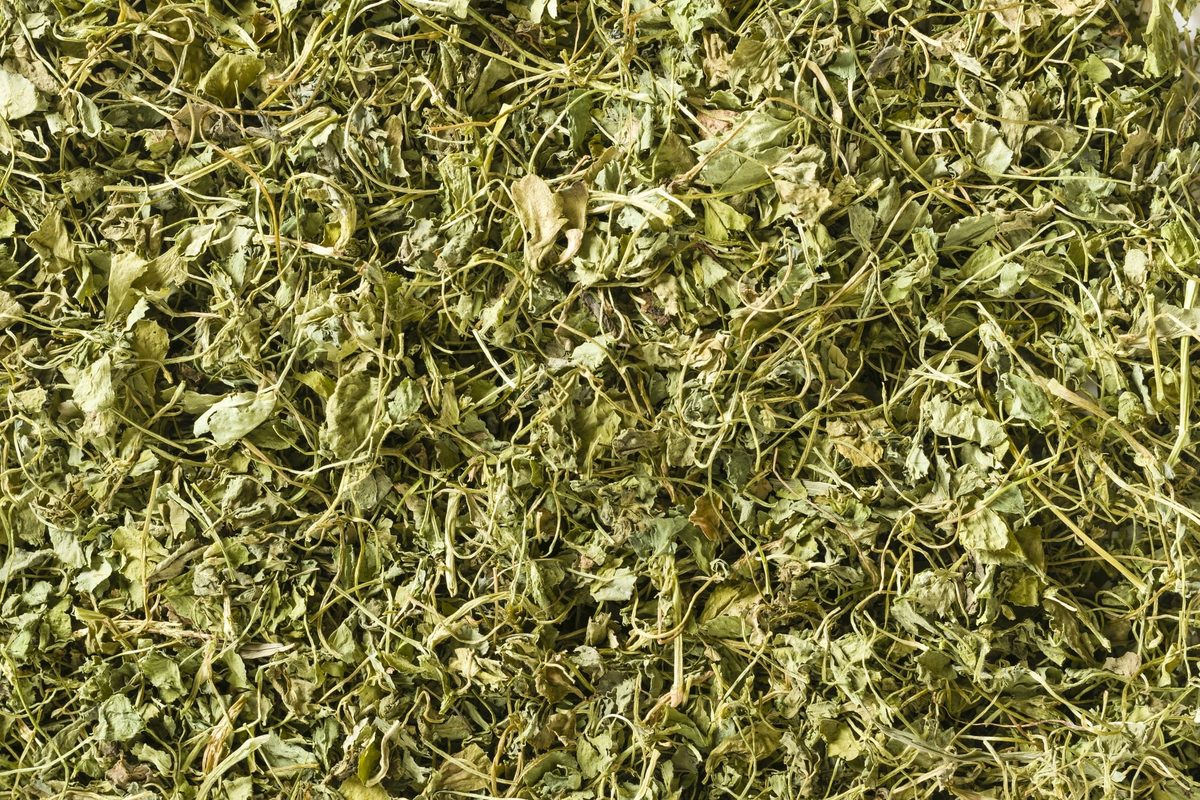
Kasuri methi (also written kasoori methi) is the dried leaf of fenugreek, Trigonella foenum-graecum, the same plant whose seeds are sold as the spice fenugreek. Crumbled into a sauce at the end of cooking, it adds a savory, slightly bitter, faintly maple-like herb note that is hard to get any other way. This page covers what it is, how it tastes, how it is used in North Indian and Iranian cooking, and what is known about its safety.
At a glance
| Botanical name | Trigonella foenum-graecum L.1 |
| Plant family | Fabaceae (pea family)1 |
| Part used | Leaves, dried; the seeds are the spice fenugreek2 |
| Native range of the plant | Iraq to northern Pakistan, per Kew1 |
| Names | Kasuri methi (dried leaves); methi or sag methi (fresh leaves)3 |
| Aroma | Dried leaves faintly resemble lovage; fresh leaves have little scent3 |
| Taste | Bitter2 |
| Main uses | North Indian sauces, gravies, potato dishes and methi naan; Iranian herb stews23 |
What kasuri methi is
Fenugreek is a pea-family annual grown for both its seeds and its leaves.12 PROSEA, the Southeast Asian plant-resources reference, records the leaves as a vegetable and condiment in India despite their bitter taste, and describes kasuri methi as the dried leaves of a special variety, used to flavor sauces and gravies.2 Gernot Katzer’s Spice Pages list “kasuri methi” as the Hindi and Urdu name for the dried leaves, and “methi” or “sag methi” for the fresh ones.3 In North India the fresh leaves are cooked as a green vegetable, while the dried leaves are used as a seasoning.3
The name is widely said to come from Kasur, a city in Pakistan’s Punjab province near the Indian border, about 50 km south of Lahore.4 We found no source that documents the link between the town and the herb, or that fenugreek grows wild there, so treat the etymology as likely but unconfirmed.
For the seed, see our fenugreek profile and fenugreek leaves vs. seeds.
Flavor and aroma
Katzer describes the dried leaves’ fragrance as slightly resembling lovage and notes that the fresh leaves have no remarkable scent.3 PROSEA calls the leaves bitter.2 In the pot, kasuri methi reads as savory and herbal, with a faint echo of fenugreek seed’s maple note and a bitter finish; that description is ours.
The maple smell of fenugreek seed comes from sotolon, which is covered on the fenugreek page. No source we opened analyzes the aroma compounds of the dried leaves themselves, so this page does not assume the leaf carries the same chemistry in the same amount.
How kasuri methi is used
North India. Katzer calls fenugreek leaves an important spice from Central Asia to northern India and says the use of the dried leaves is restricted to the north.3 He notes that they sometimes go into naan (then called methi naan) and are often used to flavor potato curries.3 PROSEA records them as a flavoring for sauces and gravies.2
Iran. Katzer writes that Iran has a particularly rich tradition of cooking with fenugreek leaves, and gives as one of the best-known examples a thick herb sauce in which mutton is slowly stewed.3
Technique
Common practice is to crush the dry leaves between the palms and stir them in near the end of cooking, so the aroma stays fresh; many cooks toast them briefly in a dry pan first. These are kitchen habits rather than measured findings. Kasuri methi suits creamy tomato gravies, lentils and potatoes, and a little goes a long way because of the bitterness; that is cooking judgment. For more ideas, see fenugreek uses and cooking with fenugreek. If a dish has gone over, see too much fenugreek.
Buying and quality
No grading standard for dried fenugreek leaves was found. As with other dried herbs, look for green rather than brown or yellow leaves, little stem and dust, and a clear smell when a pinch is rubbed; that is kitchen judgment, not a specification.
Storage
We found no published shelf-life figure for kasuri methi from a regulator or standards body. Keep it in an airtight container away from light and heat, which is common practice for dried herbs. If a crushed pinch has little smell, it has faded. For general background, see dried herbs vs. fresh.
Safety
NIH’s National Center for Complementary and Integrative Health (NCCIH) addresses fenugreek as a whole, mostly the seed and seed supplements, rather than the dried leaf specifically. It says fenugreek is believed to be safe in the amounts commonly found in foods.5 It also says fenugreek is not safe during pregnancy in amounts greater than those found in food, and that it can cause allergic reactions, including serious ones, in some people.5
Health claims
NCCIH reports that some research suggests fenugreek may help lower blood sugar in type 2 diabetes, but that many of the studies were not of high quality.5 Those studies concern supplements, not the pinch of dried leaf used in a sauce. Claims that kasuri methi lowers cholesterol, fights inflammation or relieves constipation, or that it is a notable source of particular vitamins, minerals or flavonoids, could not be traced to a source we could open, and this page makes no claim that it treats or prevents any condition.
Substitutes and comparisons
Nothing reproduces kasuri methi exactly. See kasuri methi substitutes for ranked options, and fenugreek substitutes for the seed. Katzer compares the dried leaves’ fragrance to lovage.3
Footnotes
-
Trigonella foenum-graecum L., Plants of the World Online, Royal Botanic Gardens, Kew. powo.science.kew.org · Reference work ↩ ↩2 ↩3 ↩4
-
C.S. Tawan and N. Wulijarni-Soetjipto, Trigonella foenum-graecum, Plant Resources of South-East Asia (PROSEA). uses.plantnet-project.org · Reference work ↩ ↩2 ↩3 ↩4 ↩5 ↩6 ↩7
-
Gernot Katzer, “Fenugreek”, Gernot Katzer’s Spice Pages. gernot-katzers-spice-pages.com · Reference work ↩ ↩2 ↩3 ↩4 ↩5 ↩6 ↩7 ↩8 ↩9 ↩10
-
“Kasur”, Encyclopaedia Britannica. britannica.com · Reference work ↩
-
“Fenugreek”, National Center for Complementary and Integrative Health, 2025. nccih.nih.gov · Regulator ↩ ↩2 ↩3