Cooking · Uses
Fenugreek Uses: Where the Seeds and Leaves Belong
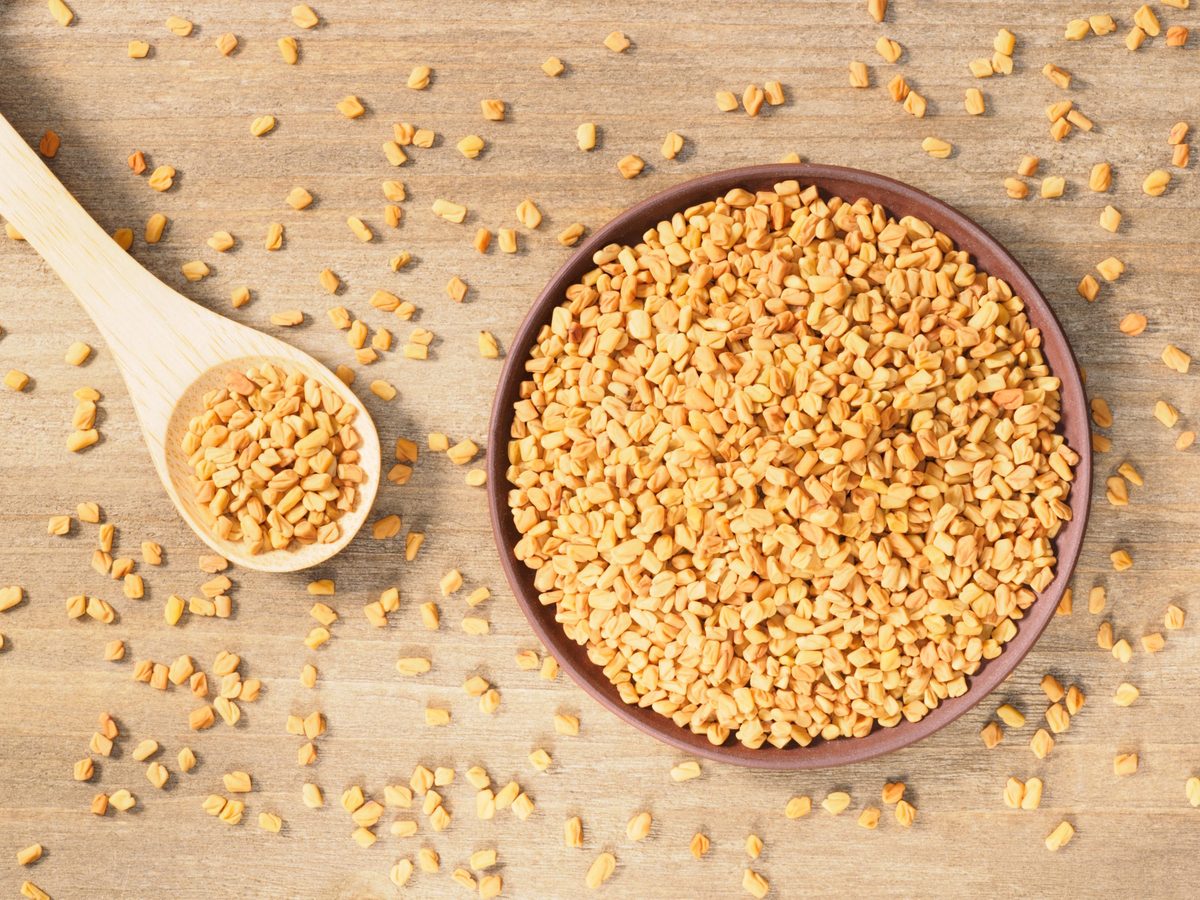
Fenugreek is two ingredients from one plant, Trigonella foenum-graecum: hard little seeds used as a spice, and leaves eaten fresh as a vegetable or dried as kasuri methi.12 Britannica describes the seed as strong, sweetish and somewhat bitter, reminiscent of burnt sugar,3 and NCCIH says the seeds smell and taste like maple syrup.4 This page is about what to put it in. For toasting, tempering and amounts, see cooking with fenugreek; for the plant and its chemistry, see the fenugreek profile.
At a glance
| Use | Part | Where | Source |
|---|---|---|---|
| Curry powder | Seed | British-style blends | USDA, Katzer52 |
| Sambar podi and sambar | Seed | South India | Katzer, Onmanorama26 |
| Panch phoron | Seed | Bengal | Katzer, Bong Eats27 |
| Berbere and niter kibbeh | Seed | Ethiopia | Katzer, Saveur289 |
| Hilbeh | Seed | Yemen | Katzer2 |
| Cemen paste on pastirma | Seed, ground | Turkey | Yetim et al.10 |
| Potato and chickpea curries | Dried leaf | North India | Katzer2 |
| Sauces and gravies | Dried leaf (kasuri methi) | India | PROSEA1 |
| Ghorme sabzi | Leaf | Iran | Katzer2 |
| Sprouts and salads | Sprouts, young shoots | Egypt and Asia; Nepal | PROSEA, Katzer12 |
| Imitation maple syrup | Seed | Industry | Britannica3 |
Spice blends
Most fenugreek seed is eaten as one part of a blend. PROSEA says the seeds go into spice blends and curry powders in Asian cooking.1
- Curry powder. The USDA’s curry powder specification lists fenugreek with turmeric, coriander, cinnamon, cumin, black pepper, ginger and cardamom,5 and Katzer says small amounts belong in any good curry powder.2 PROSEA credits a compound in fenugreek, sotolon, with its characteristic “curry” aroma.1 A common claim says fenugreek is the most identifiable flavor in commercial curry powder; we found no source that tests it.
- Sambar podi. Katzer lists fenugreek in the ubiquitous Tamil spice mix.2 The seeds also go whole into the tempering: Bincy Lenin’s simple sambar on Onmanorama splutters ¼ teaspoon of fenugreek with mustard seeds.6 See sambar powder.
- Panch phoron. Katzer calls the seeds an essential part of the Bengali five-spice mix.2 Bong Eats uses 1 tablespoon in a batch and puts the mix into dals, vegetables, chutneys and pickles.7
- Berbere. Katzer says the Ethiopian chile blend contains small amounts of fenugreek,2 and Saveur describes berbere as essential to many Ethiopian dishes.8
- Niter kibbeh. Saveur’s Ethiopian spiced clarified butter uses 1 teaspoon of fenugreek seeds, coarsely crushed.9
A common claim says some cooks put fenugreek in garam masala. None of the garam masala recipes and references we checked lists it, so treat it as possible but unusual.
Sauces, pastes and drinks
- Hilbeh. In Yemen, Katzer writes, the national sauce hilbeh consists mainly of fenugreek seeds and chiles.2 It is one of the few places fenugreek is the lead flavor.
- Cemen on pastirma. Pastirma, the Turkish dry-cured beef, is coated with a paste called cemen, which a 2006 study in Meat Science describes as made from ground fenugreek, garlic and red hot pepper.10 A common claim says pastirma is the ancestor of pastrami and that its name means “pressed”; neither was traced to a source here.
- Kirihodi. Katzer describes this Sri Lankan dish as a soupy preparation of cow’s or coconut milk with a sediment of fenugreek seeds, eaten with rice.2
- Coffee substitute. PROSEA says roasted fenugreek seeds are a substitute for coffee.1 A common claim says fenugreek is added to coffee in India; we found no source for that.
- Imitation maple syrup. Britannica says fenugreek is used to make imitation maple syrup,3 and NCCIH notes its maple-like flavor has made it a flavoring agent in foods and beverages.4
Meat and marinades
PROSEA says fenugreek enhances the taste of meat, poultry and marinated vegetables.1 In Great British Chefs’ chicken tikka masala by Alfred Prasad, the fenugreek comes as leaf: ¼ teaspoon of ground kasoori methi.11 A common claim says fenugreek is essential to roasted and grilled meats from India and North Africa; we found no source naming specific dishes.
The leaves: fresh and dried
PROSEA says that in India the leaves are important as a vegetable and condiment despite their bitter taste, and that the dried leaves of a special variety, kasuri methi, flavor sauces and gravies.1
| Dish or use | Leaf form | Source |
|---|---|---|
| Cooked as a vegetable, like spinach | Fresh | Katzer2 |
| Potato curries (alu methi) | Dried | Katzer2 |
| Spicy chickpea curries known as dal fry, mainly in the North | Dried | Katzer2 |
| Ghorme sabzi, the Iranian herb sauce in which mutton is slowly stewed | Fresh or dried | Katzer2 |
| Chicken tikka masala | Dried, ground | Great British Chefs11 |
Katzer says Iran has a particularly rich tradition of cooking with fenugreek leaves.2 A common claim pairs the leaves with tomatoes and peas; that is plausible kitchen practice, but we found no named recipe for it. For the difference between the two parts, see fenugreek leaves vs. seeds and kasuri methi.
Sprouts and salads
PROSEA says that in Egypt and Asia, sprouted seeds grown to 5 to 8 cm are eaten as a vegetable, and that chopped young shoots add a bitter bite to salads.1 Katzer notes that Newari cooks in Nepal use fenugreek sprouts in pickles and soups.2
Sprouts carry a real food-safety risk. In 2011, EFSA’s task force traced the E. coli O104:H4 outbreaks in Germany and France most likely to one lot of fenugreek seeds imported from Egypt and used to produce sprouts.12 EFSA’s consumer advice on sprouts is set out on the fenugreek profile.
Bread
PROSEA says that in North Africa, fenugreek is mixed with breadstuffs,1 and Britannica notes the ground seeds may be mixed with flour for bread.3
Fenugreek tea and breastfeeding
Fenugreek has a long history as a traditional remedy, including to stimulate milk production during breastfeeding, and it is still promoted that way as a supplement.4 NCCIH says it is uncertain whether fenugreek increases milk supply, because studies have had mixed results, and that little is known about the safety of amounts larger than food amounts while breastfeeding.4 It is believed to be safe in the amounts found in food, but it is not safe in pregnancy in larger amounts, and it can cause allergic reactions.4 This page makes no health claim for fenugreek tea.
Where fenugreek is native
Kew gives fenugreek’s native range as Iraq to northern Pakistan.13 A widely repeated description places it in the Mediterranean; the fenugreek profile sets out where the references disagree.
Not yet measured
- How much fenugreek commercial curry powders contain; labels do not say.
- Whether it appears in any regional garam masala.
Related
- Fenugreek and cooking with fenugreek
- Fenugreek substitutes and too much fenugreek
- Fenugreek leaves vs. seeds and fenugreek vs. fennel seed
- Kasuri methi, panch phoron, berbere and sambar powder
Footnotes
-
Trigonella foenum-graecum, Plant Resources of South-East Asia (PROSEA), via Pl@ntUse. uses.plantnet-project.org · Reference work ↩ ↩2 ↩3 ↩4 ↩5 ↩6 ↩7 ↩8 ↩9 ↩10
-
Fenugreek, Gernot Katzer’s Spice Pages. gernot-katzers-spice-pages.com · Reference work ↩ ↩2 ↩3 ↩4 ↩5 ↩6 ↩7 ↩8 ↩9 ↩10 ↩11 ↩12 ↩13 ↩14 ↩15 ↩16 ↩17 ↩18 ↩19 ↩20 ↩21
-
“Fenugreek”, Encyclopaedia Britannica, 2026. britannica.com · Reference work ↩ ↩2 ↩3 ↩4
-
“Fenugreek: Usefulness and Safety”, National Center for Complementary and Integrative Health, 2025. nccih.nih.gov · Regulator ↩ ↩2 ↩3 ↩4 ↩5
-
Commercial Item Description A-A-20001C, Spices and Spice Blends, USDA Agricultural Marketing Service, 2023. ams.usda.gov · Regulator ↩ ↩2
-
Bincy Lenin, “Simple sambar”, Onmanorama, 2021. onmanorama.com · Publication ↩ ↩2
-
Panch phoron, Bong Eats, 2017. bongeats.com · Publication ↩ ↩2
-
Ethiopian Spice Mix (Berbere), Saveur, 2008. saveur.com · Publication ↩ ↩2
-
Ethiopian Spiced Clarified Butter (Niter Kibbeh), Saveur, 2019. saveur.com · Publication ↩ ↩2
-
Yetim, Sağdıç, Dogan and Ockerman, “Sensitivity of three pathogenic bacteria to Turkish cemen paste and its ingredients”, Meat Science, 2006. avesis.erciyes.edu.tr · Peer-reviewed ↩ ↩2
-
Alfred Prasad, “Chicken tikka masala”, Great British Chefs. greatbritishchefs.com · Publication ↩ ↩2
-
EFSA Task Force report on the 2011 E. coli O104:H4 outbreaks, European Food Safety Authority, 2011. efsa.europa.eu · Regulator ↩
-
Trigonella foenum-graecum L., Plants of the World Online, Royal Botanic Gardens, Kew. powo.science.kew.org · Reference work ↩