Spice Comparisons · Comparison
Fenugreek Leaves vs. Seeds: Same Plant, Different Jobs
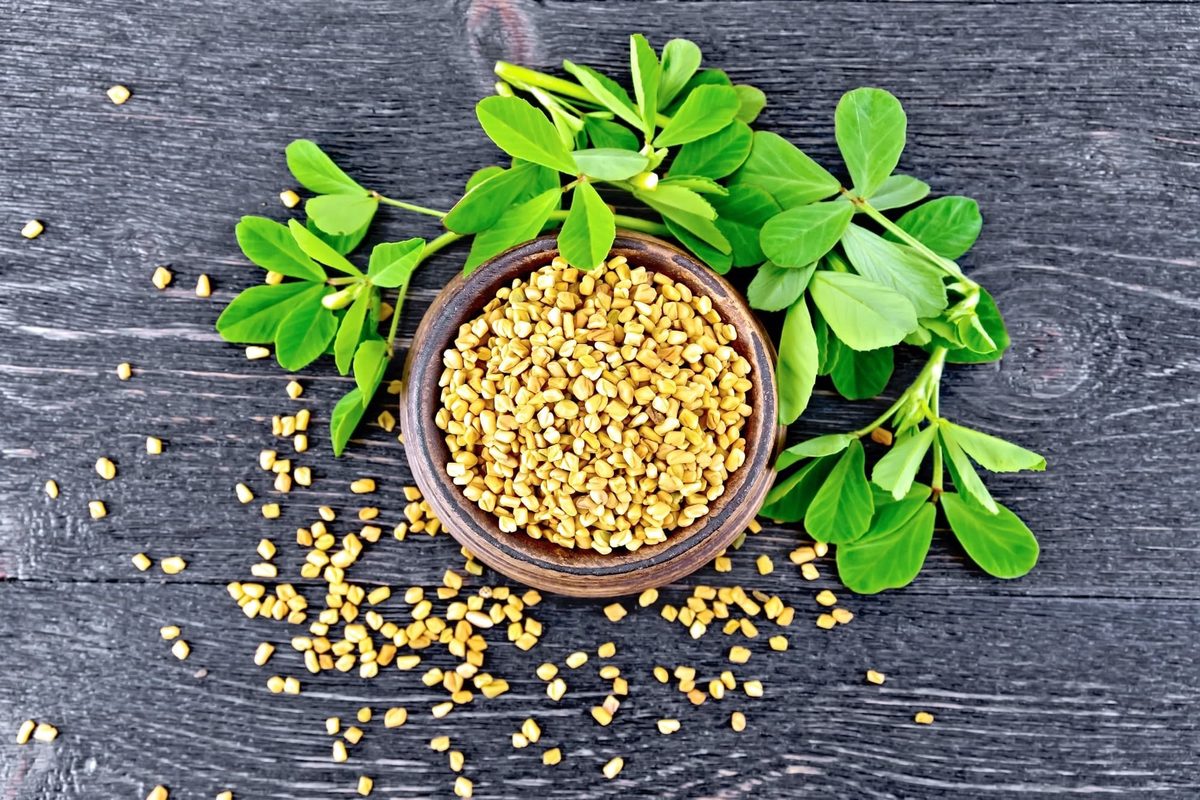
Fenugreek, Trigonella foenum-graecum, is a pea-family annual that gives cooks two ingredients: the hard, bitter, maple-scented seed, which is a spice, and the leaf, used fresh as a green vegetable or dried as the herb kasuri methi.123 They share a plant but not a job. The seed brings bitterness, a maple-like aroma and a mucilaginous texture.234 The dried leaf brings a savory herb note that Gernot Katzer likens to lovage.3
Side by side
| Fenugreek seed | Fenugreek leaves | |
|---|---|---|
| Species and family | Trigonella foenum-graecum, Fabaceae (pea family)1 | Same plant1 |
| Native range (Kew) | Iraq to northern Pakistan1 | Same |
| What it looks like | Oblong-rhomboid, 3 to 5 mm long, brownish, with a deep furrow2 | Leaves in threes (trifoliolate), leaflets 1.5 to 4 cm long2 |
| Forms sold | Whole or ground seed | Fresh (methi, sag methi) or dried (kasuri methi)3 |
| Aroma | Sotolon, the maple-syrup compound, is the dominant aroma component, at up to 25 ppm34 | Dried: faintly like lovage. Fresh: no remarkable scent3 |
| Taste | Strong, sweetish and somewhat bitter5 | Bitter2 |
| Bitterness | Katzer attributes it probably to furostanol glycosides, which are not aroma compounds3 | No source names the compound |
| Texture in a dish | Mucilaginous seed; source of an industrial mucilage, galactomannan2 | Leafy; fresh leaves cook down like a vegetable3 |
| Typical uses | Panch phoron, curry powder, Yemeni hilbeh, Ethiopian berbere3 | Fresh: cooked as a vegetable. Dried: sauces, gravies, potato curries, naan23 |
| Price | No dated, sourced retail comparison found | No dated, sourced retail comparison found |
The aroma row is the part most often gotten wrong. Sotolon has been measured in the seed. We found no analysis of the aroma compounds in the leaves, fresh or dried, so this page does not claim the leaves carry sotolon or share the seed’s flavor in a weaker dose. Katzer notes only that fresh leaves contain small amounts of sesquiterpenes.3
For each form on its own, see fenugreek and kasuri methi.
The differences that change a dish
Maple aroma: a seed trait
Sotolon is a well-known flavor impact compound in fenugreek, and maple syrup contains it too, which is why fenugreek smells of maple.4 Britannica and PROSEA both note that fenugreek is used to make imitation maple syrup.52 PROSEA credits sotolon with fenugreek’s characteristic curry aroma.2 Katzer gives its level in the seed as up to 25 ppm and describes its flavor simply as spicy.3
The dried leaves smell different. Katzer compares their fragrance to lovage, says fresh leaves have no remarkable scent, and says dried and soaked leaves actually give superior flavor.3 So if a recipe leans on kasuri methi’s herb note, the seed will not supply it, and the reverse.
Bitterness
Both are bitter. Britannica calls the seed somewhat bitter, and PROSEA says the leaves are eaten in India in spite of their bitter taste.52 The seed’s bitterness and its maple smell come from different compounds: Katzer attributes the bitterness probably to furostanol glycosides, non-volatile components, not to sotolon.3 No source we found ranks seed, fresh leaf and dried leaf by bitterness.
Toasting changes the seed. Katzer says dry toasting can enhance the flavor and reduce the bitterness, as long as the seeds don’t overheat, and that toasted seeds owe their nuttier flavor to pyrazines.3 Burned seeds turn harsh (editorial).
Texture
PROSEA describes the seeds as mucilaginous and lists them as a source of an industrial galactomannan mucilage.2 Cooks commonly describe soaked fenugreek seed as slick, a little like okra; that is kitchen observation, and we found no source that measures the effect in a finished dish. The leaves are not described as mucilaginous in any source we opened.
When each goes in
The seeds are a tempering spice: fried in oil at the start, as in panch phoron, which Bong Eats says is used in dals, vegetables, chutneys and pickles.6 Kasuri methi is commonly crushed between the palms and stirred in near the end; fresh leaves are cooked for a few minutes like a green. Those timings are common practice, not measured findings.
Can one stand in for the other?
Within the leaf, yes. Between leaf and seed, only partly, and Greedy Gourmet warns that the seeds are stronger in taste than the leaf, so use them with caution.7
| Swap | Starting amount | Treatment |
|---|---|---|
| Fresh leaves for kasuri methi | About 3 tablespoons chopped fresh per 1 tablespoon dried | Computed |
| Kasuri methi for fresh leaves | About 1 tablespoon dried per 3 tablespoons fresh | Computed |
| Ground seed for kasuri methi | About 1/8 teaspoon, toasted, per tablespoon of leaf, then taste | Method |
| Kasuri methi for seed | Not a practical swap; see below | Method |
- Fresh and dried leaves. The general herb rule is that dried leaves are about three times as strong as fresh by volume. Penn State Extension gives 1 tablespoon fresh as equal to 1 teaspoon dried, and America’s Test Kitchen found 1 part dried to 3 parts fresh came closest to equal flavor in its tests.89 Greedy Gourmet applies that rule to fenugreek, saying to use a third as much kasuri methi as fresh leaves.7 The rule was not measured on fenugreek itself, and fresh leaves bring bulk as well as flavor.
- Seed for dried leaf. We found no usable published ratio. Our kasuri methi substitutes page suggests about 1/8 teaspoon of ground, lightly toasted seed per tablespoon of kasuri methi, added with the other spices rather than at the end. That is a cautious starting point, not a measured equivalent.
- Dried leaf for seed. Reversed, that starting point means about a tablespoon of kasuri methi for each 1/8 teaspoon of seed. For a teaspoon of seed that becomes a handful of leaves, which tells you the leaf cannot do the seed’s job in a tempering or a spice blend. It brings no maple-scented sotolon that anyone has measured, and no mucilage. If a recipe’s fenugreek seed is a small background note in a sauce, a teaspoon or two of kasuri methi stirred in near the end gives a different but related herbal bitterness (Method; no source gives a figure). For other options, see fenugreek substitutes.
When to use which
- Seeds. Katzer calls the bitter and aromatic seeds an essential part of the Bengali five-spice mix panch phoron, says small amounts belong in any good curry powder, notes that Ethiopian berbere contains small amounts, and describes Yemeni hilbeh as a sauce made mainly of fenugreek seed and chiles.3 Bong Eats’s panch phoron uses one tablespoon of fenugreek seed alongside four other seeds.6
- Dried leaves (kasuri methi). PROSEA says the dried leaves of a special variety are used to flavor sauces and gravies.2 Katzer says they are often used in potato curries and sometimes in naan.3
- Fresh leaves. In northern India, fresh leaves are cooked as a green vegetable rather than used as an herb, and Katzer describes Iran’s particularly rich tradition of cooking with fenugreek leaves, including mutton slowly stewed in an herb sauce.3
Safety
NCCIH says fenugreek is believed to be safe for adults and children in the amounts commonly found in foods.10 One risk applies to the seed when it is sprouted, not to the leaf or the dried spice: in 2011, EFSA’s task force named one lot of fenugreek seed imported from Egypt and used to grow sprouts as the most likely common link in E. coli O104:H4 outbreaks in Germany and France.11 See the fenugreek profile for details.
What isn’t known
- No analysis of the aroma compounds in fenugreek leaves, fresh or dried, was found, so whether the leaves contain sotolon, and how much, is not known.
- No source compares the bitterness of seed, fresh leaf and dried leaf.
- No published ratio exists for swapping seed and leaf in either direction.
- Fenugreek leaves are sometimes said to appear in a Turkish spice blend called çemen. Katzer lists çemen only as the Turkish name for fenugreek, and we found no source for the claim.
Related
- Fenugreek vs. fennel seed, a common mix-up
- Too much fenugreek?, fenugreek uses and cooking with fenugreek
- Lovage, the herb Katzer compares the dried leaves to
- Dried herbs vs. fresh
Footnotes
-
Trigonella foenum-graecum L., Plants of the World Online, Royal Botanic Gardens, Kew. powo.science.kew.org · Reference work ↩ ↩2 ↩3 ↩4
-
C.S. Tawan and N. Wulijarni-Soetjipto, Trigonella foenum-graecum, Plant Resources of South-East Asia (PROSEA). uses.plantnet-project.org · Reference work ↩ ↩2 ↩3 ↩4 ↩5 ↩6 ↩7 ↩8 ↩9 ↩10 ↩11 ↩12
-
Gernot Katzer, “Fenugreek”, Gernot Katzer’s Spice Pages. gernot-katzers-spice-pages.com · Reference work ↩ ↩2 ↩3 ↩4 ↩5 ↩6 ↩7 ↩8 ↩9 ↩10 ↩11 ↩12 ↩13 ↩14 ↩15 ↩16 ↩17 ↩18
-
Podebrad et al., “Sotolone: the odour of maple syrup urine disease”, Journal of Inherited Metabolic Disease, 1999. pubmed.ncbi.nlm.nih.gov · Peer-reviewed ↩ ↩2 ↩3
-
“Fenugreek”, Encyclopaedia Britannica. britannica.com · Reference work ↩ ↩2 ↩3
-
“Panch phoron”, Bong Eats, 2017. bongeats.com · Publication ↩ ↩2
-
Michelle Minnaar, “Fenugreek Leaves Substitutes”, Greedy Gourmet, 2023. greedygourmet.com · Publication ↩ ↩2
-
Stacy Reed, “Preserving Herbs by Drying”, Penn State Extension. extension.psu.edu · Reference work ↩
-
“Science: Substituting Dried Herbs for Fresh”, America’s Test Kitchen. americastestkitchen.com · Publication ↩
-
“Fenugreek”, National Center for Complementary and Integrative Health, 2025. nccih.nih.gov · Regulator ↩
-
“EFSA publishes report from its Task Force on the E. coli O104:H4 outbreaks in Germany and France in 2011”, European Food Safety Authority. efsa.europa.eu · Regulator ↩