Spice Substitutes · Substitutes
Fenugreek Substitutes, Ranked by the Job Fenugreek Is Doing
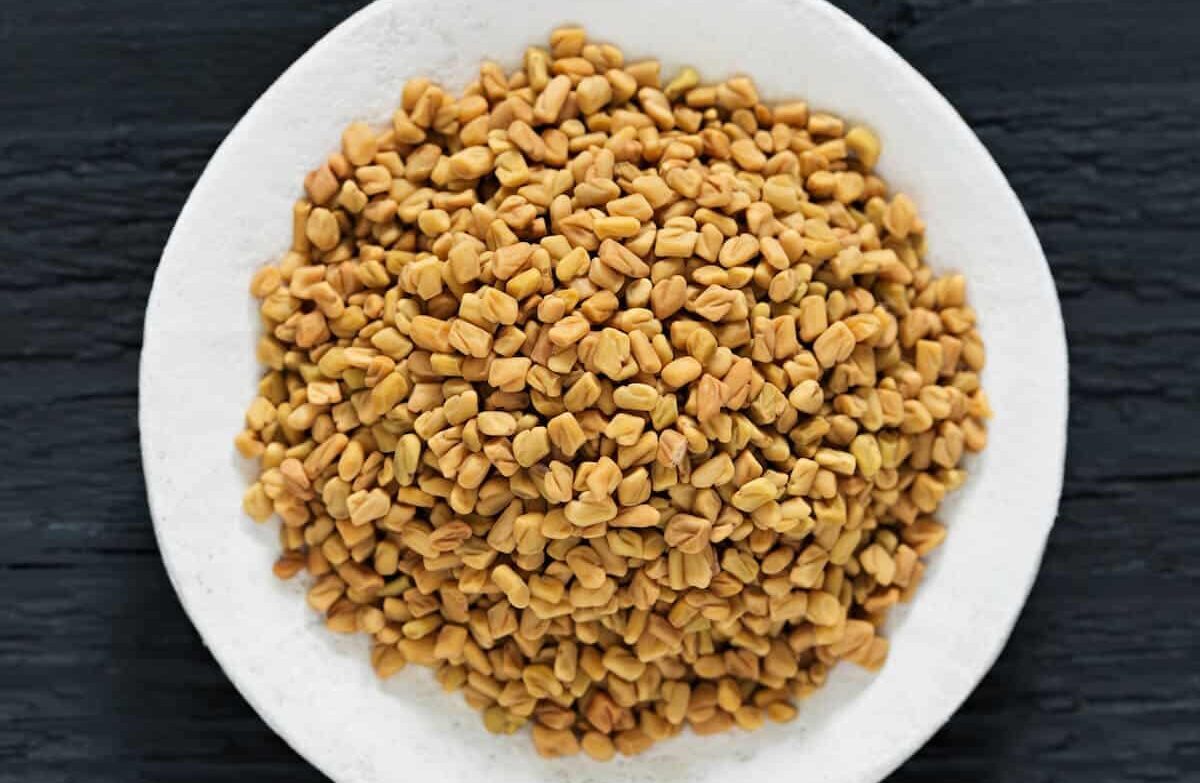
Fenugreek is the seed of Trigonella foenum-graecum, a plant in the pea family.1 Britannica describes its aroma and taste as strong, sweetish and somewhat bitter, reminiscent of burnt sugar.1 PROSEA describes a nutty taste with notes reminiscent of celery and maple, and credits a minor compound, sotolon, with fenugreek’s characteristic curry aroma.2 No single spice matches all of that. The best substitute depends on whether you need the maple-like aroma, the bitter seed note in a spice mix or tempering, a curry-blend background, or the leaves.
Quick answer
| What fenugreek is doing | Best substitute | Starting amount, per 1 part fenugreek (seed or leaf) | Treatment |
|---|---|---|---|
| Bitter, nutty seed note in a spice mix or tempering | Fennel seed and yellow mustard seed, mixed | 1 part of the mix | Attributed |
| One of many spices in a curry | Curry powder | 1 part to start, then taste | Method |
| The maple-like aroma (a sauce or glaze) | Maple syrup | A few drops, added at the end | Method |
| Fresh or dried leaves (methi, kasuri methi) | Mustard greens (fresh leaves) | 1 part | Attributed |
How the ratios on this page are labeled
- Computed: based on a measurable physical relationship, with the source named.
- Attributed: a named source publishes this ratio. We quote it as theirs.
- Disputed: named sources give different answers to the same swap. We show each one and do not average them.
- Method: we found no published ratio. We give a direction and a cautious starting point, and say so.
The attributed ratios here come from one publication, Tasting Table, and are cooks’ rules of thumb. No published study compares the strength of fenugreek with any substitute.
Why fenugreek is hard to replace
Two things set fenugreek apart.
Sotolon. A 1999 study describes sotolon as a well-known flavor impact compound in fenugreek and lovage, and notes that maple syrup also contains it.3 That shared compound is why fenugreek is used to make imitation maple syrup.12 It is also why maple syrup and lovage appear among the substitutes below.
Bitterness. PROSEA notes that fenugreek leaves are eaten in India despite their bitter taste,2 and Britannica calls the seed somewhat bitter.1 None of the sources we opened ties that bitterness to a specific compound. Substitutes that cover the bitter, savory side of fenugreek do not bring the maple note, and the reverse.
If fenugreek is a bitter seed note in a spice mix or tempering
This is fenugreek in whole-spice tempering, spice pastes and dry spice blends.
1. Fennel seed and yellow mustard seed
Tasting Table suggests a mix of fennel and mustard seeds, with the fennel providing a hint of sweetness and the mustard tempering it.4 Fennel’s sweetness comes from anethole, the main compound in sweet fennel oil.5 Yellow (white) mustard is the milder seed: Britannica says its seeds are less intensely flavored than brown mustard,6 and its whole seeds have no smell.6 Katzer notes that mustard seeds fried in fat or dry-toasted lose their pungency and take on a nutty, smoky taste.7 Toasting the mix lightly, or frying it in the oil as the recipe directs, keeps the mustard in the background.
Ratio (Attributed): Tasting Table says the fennel and mustard mix can replace fenugreek seeds 1 to 1.4 It does not give a split between the two seeds. Equal parts is a sensible start; that is our judgment.
2. Cumin seed
Tasting Table compares the complexity of cumin’s warm flavor to fenugreek’s.4 Cumin has no maple note and less bitterness, so expect a warmer, earthier dish.
Ratio (Attributed): Tasting Table says to swap cumin seeds 1 to 1, or ground cumin for ground fenugreek.4
3. Celery seed
PROSEA’s description of fenugreek includes notes reminiscent of celery,2 so celery seed covers part of the flavor, though not the maple.
Ratio (Attributed): Tasting Table says celery seed can be swapped 1 to 1.4 In our judgment celery seed is strong enough that it is safer to start with half and add more.
4. Brown mustard seed
Tasting Table finds brown mustard’s moderate taste a better fenugreek substitute than black mustard,4 but gives no amount. Ratio (Method): start with half the fenugreek amount, fried in oil until it pops, and adjust next time.
If fenugreek is one of many spices in a curry
Curry powder
The USDA’s purchase specification for curry powder lists turmeric, coriander, fenugreek, cinnamon, cumin, black pepper, ginger and cardamom as minimum ingredients.8 So a curry powder brings some fenugreek back, along with everything else. Turmeric will make the dish yellower. Tasting Table also lists curry powder as a substitute, without an amount.4
Ratio (Method): No published ratio. The specification sets no proportions,8 so the share of fenugreek varies by brand. If the recipe already uses curry powder, add a little more. If not, start with the same amount as the fenugreek and taste before adding salt or chile, since some blends include both.
If fenugreek is the maple-like aroma
Maple syrup
Because maple syrup contains sotolon,3 it brings the aroma that defines fenugreek. Tasting Table lists it for that reason.4 It also brings sugar and none of the bitterness.
Ratio (Method): No published ratio. Start with a few drops to 1/2 teaspoon per teaspoon of fenugreek, stirred in near the end of cooking, then taste. Use it only where a little sweetness suits the dish, such as a glaze or a tomato-based sauce. In a dry spice rub it will not work.
Lovage
The 1999 study names lovage as the other plant in which sotolon is a flavor impact compound.3 Katzer notes that the fragrance of dried fenugreek leaves slightly resembles lovage.9 Lovage leaves are a reasonable stand-in for fenugreek leaves if you can find or grow them.
Ratio (Method): No published ratio. Start with half as much chopped lovage as the fenugreek leaves called for; in our judgment it is assertive.
If the recipe uses fenugreek leaves
Fresh fenugreek leaves (methi) are eaten as a vegetable and condiment in India, and the dried leaves of a special variety are sold as kasuri methi.2 Leaves call for a leafy substitute.
- Mustard greens. Tasting Table says finely chopped mustard greens can be used 1 to 1, for their pepperiness.4 Ratio (Attributed). They are not bitter in the same way and have no maple note.
- Celery leaves. Given the celery note PROSEA describes in fenugreek,2 chopped celery leaves are a reasonable stand-in. Ratio (Method): no published ratio; start with half the amount and add to taste.
- Lovage, as above.
For the dried leaf specifically, see kasuri methi substitutes.
Other options
- Carom seed. Tasting Table suggests it for raw-seed recipes because, like raw fenugreek, it has bitter notes.4 No amount given. Method: start with a quarter of the fenugreek amount, since in our judgment carom is pungent.
- Worcestershire sauce. Tasting Table suggests a splash, tasted and added to as needed.4 In our judgment it suits stews and marinades, not dry blends, because it is a salty liquid.
What isn’t known
- No published measurement compares the flavor strength of fenugreek with any substitute. Tasting Table’s ratios are rules of thumb.
- No source we opened identifies the compound behind fenugreek’s bitterness.
- No published study measures how much sotolon maple syrup contains relative to fenugreek, so the maple-syrup amount above is only a starting point.
- How much fenugreek a given curry powder contains is not published; it varies by brand.
Related
- Fenugreek, fenugreek leaves vs. seeds, kasuri methi
- Fenugreek uses, cooking with fenugreek, too much fenugreek?
- Fenugreek vs. fennel seed, fennel seed, yellow mustard seeds, brown mustard seeds
- Curry powder, panch phoran, berbere seasoning, cumin, celery seeds, carom seeds, lovage
Footnotes
-
“Fenugreek”, Encyclopaedia Britannica, 2026. britannica.com · Reference work ↩ ↩2 ↩3 ↩4
-
C.S. Tawan and N. Wulijarni-Soetjipto, Trigonella foenum-graecum, Plant Resources of South-East Asia (PROSEA). uses.plantnet-project.org · Reference work ↩ ↩2 ↩3 ↩4 ↩5 ↩6
-
Podebrad et al., “Sotolone: the odour of maple syrup urine disease”, Journal of Inherited Metabolic Disease, 1999. pubmed.ncbi.nlm.nih.gov · Peer-reviewed ↩ ↩2 ↩3
-
Alice Rich, “11 Best Substitutes For Fenugreek”, Tasting Table, 2024. tastingtable.com · Publication ↩ ↩2 ↩3 ↩4 ↩5 ↩6 ↩7 ↩8 ↩9 ↩10 ↩11
-
Purwaningsih, Harmida and M. Brink, Foeniculum vulgare, PROSEA. uses.plantnet-project.org · Reference work ↩
-
“White mustard”, Encyclopaedia Britannica. britannica.com · Reference work ↩ ↩2
-
Gernot Katzer, “Mustard”, Gernot Katzer’s Spice Pages. gernot-katzers-spice-pages.com · Reference work ↩
-
Commercial Item Description A-A-20001C, Spices and Spice Blends, USDA Agricultural Marketing Service, 2023. ams.usda.gov · Regulator ↩ ↩2
-
Gernot Katzer, “Fenugreek”, Gernot Katzer’s Spice Pages. gernot-katzers-spice-pages.com · Reference work ↩