Spice Substitutes · Substitutes
Kasuri Methi Substitutes, Ranked by the Job the Dried Leaf Is Doing
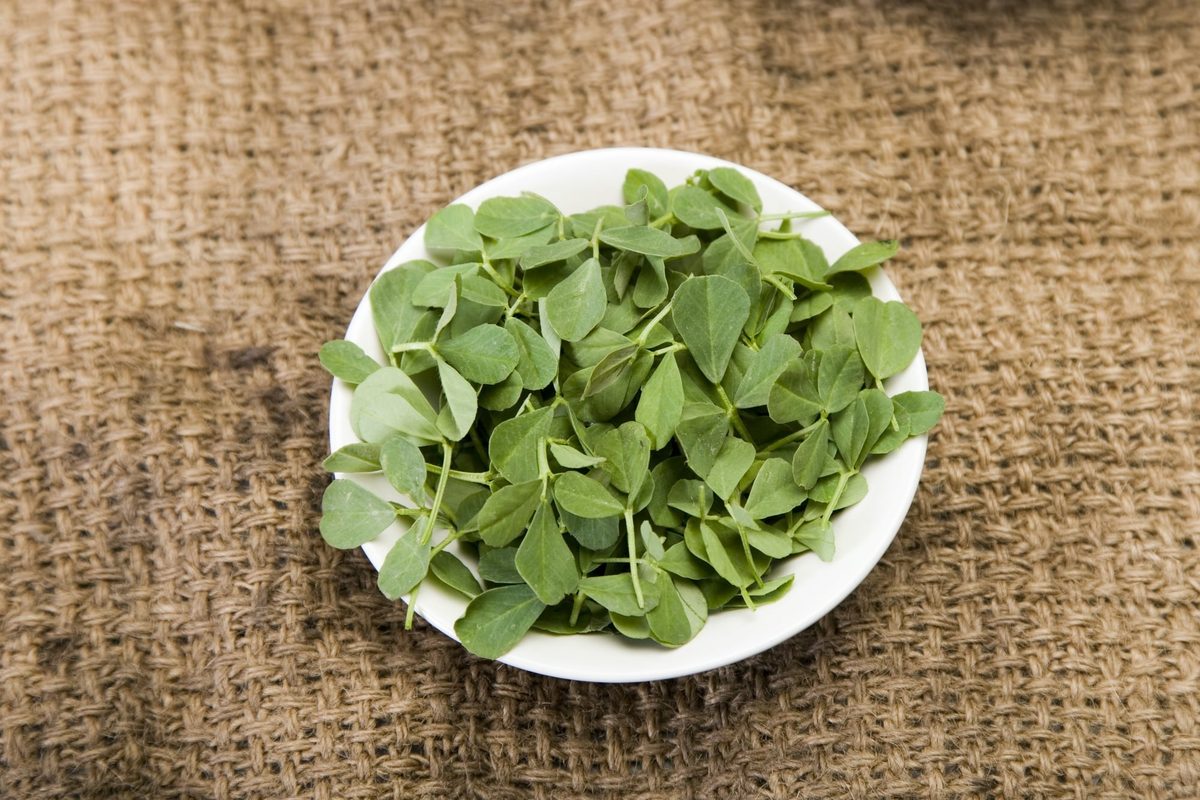
Kasuri methi is the dried leaf of fenugreek, Trigonella foenum-graecum. PROSEA, the Southeast Asian plant-resources handbook, describes it as the dried leaves of a special variety, used to flavor sauces and gravies, and calls fenugreek leaves bitter.1 Gernot Katzer says the dried leaves’ fragrance slightly resembles lovage and that their use as a seasoning is restricted to northern India, where they often flavor potato curries and sometimes go into naan.2 What you reach for in its place depends on which part of that you need: the herb note, the bitterness, or the faintly maple-like aroma.
Quick answer
| What kasuri methi is doing | Best substitute | Starting amount, per 1 tablespoon kasuri methi | Treatment |
|---|---|---|---|
| Herbal, bitter finishing note in a gravy, dal or potato dish | Fresh fenugreek leaves (methi), chopped | About 3 tablespoons | Computed |
| Fenugreek’s curry-like, maple-tinged aroma, no leaves to be had | Fenugreek seed, toasted and ground | About 1/8 teaspoon, then taste | Method |
| Green, herbal note when there’s no fenugreek at all | Fresh celery leaves or lovage, chopped | About 1 tablespoon, then taste | Method |
| One flavor among many in a curry | Curry powder | About 1/2 teaspoon, then taste | Method |
How the ratios on this page are labeled
Every ratio carries one of four labels.
- Computed: based on a measurable physical relationship, with the source named.
- Attributed: a named source publishes this ratio. We quote it as theirs.
- Disputed: named sources give different answers to the same swap. We show each one and do not average them.
- Method: we found no published ratio. We give a direction and a cautious starting point, and say so.
Most published fenugreek-leaf substitutes are written for fresh leaves, not for kasuri methi. Where a ratio below started out as a fresh-leaf figure, we say so.
If kasuri methi is the herbal, bitter finishing note
1. Fresh fenugreek leaves (methi)
This is the same plant. Katzer notes that fresh fenugreek leaves, called methi or sag methi, are cooked as a green vegetable in northern India, while the dried leaves are the seasoning.2 Fresh leaves bring the bitterness and herb note; Katzer says they have no remarkable scent, so expect less aroma than from the dried leaf.2 PROSEA’s note that kasuri methi comes from a special variety means the fresh bunch you find may not be the same plant type.1
Ratio (Computed): The general rule for herbs is that dried are about three times as strong as fresh by volume. Penn State Extension puts it as 1 tablespoon fresh to 1 teaspoon dried, and America’s Test Kitchen found that 1 part dried to 3 parts fresh came closest to equal flavor in its tests.34 Greedy Gourmet applies the same rule to fenugreek, saying to use a third as much kasuri methi as fresh fenugreek.5 Run backward, that is about 3 tablespoons of chopped fresh leaves for 1 tablespoon of kasuri methi. The rule was not measured on fenugreek itself.
Cook the fresh leaves for a few minutes in the sauce rather than sprinkling them on at the end, as you would the dried leaf. That is kitchen practice, not a tested finding.
2. Mustard greens
Tasting Table says finely chopped mustard greens can replace fenugreek leaves one to one, for their pepperiness.6 Greedy Gourmet says dried mustard greens can be swapped like for like.5 Both are written for fenugreek leaves in general. Mustard greens are not bitter in the same way and have none of fenugreek’s maple note.
Ratio (Method): If you are using fresh mustard greens in place of kasuri methi, start with about 2 tablespoons, chopped fine, per tablespoon of kasuri methi, and taste. That applies the fresh-to-dried rule above to Tasting Table’s one-to-one fresh-leaf figure, with some caution.
If kasuri methi is fenugreek’s curry-like aroma
Fenugreek seed
The seed is the same species and the more familiar spice. PROSEA credits a minor compound, sotolon, with fenugreek’s characteristic curry aroma,1 and a 1999 study describes sotolon as a well-known flavor impact compound in fenugreek.7 Britannica describes the seed’s aroma and taste as strong, sweetish and somewhat bitter, reminiscent of burnt sugar.8
Where it falls short: no source we opened analyzes the aroma compounds of the dried leaf, so we can’t say how much of its smell the seed shares. The seed also adds no green, leafy body.
Ratio (Method): We found no usable published ratio. Greedy Gourmet warns that the seeds are stronger in taste than the leaf and should be used with caution, but the amount it prints refers to leaves on both sides of the swap.5 Start with about 1/8 teaspoon of ground, lightly toasted seed per tablespoon of kasuri methi, add it with the other spices rather than at the end, and taste before adding more.
Maple syrup, a few drops
The 1999 study notes that maple syrup also contains sotolon,7 and Britannica and PROSEA both say fenugreek is used to make imitation maple syrup.81 A few drops can echo the maple side of fenugreek, which is why Tasting Table lists maple syrup as a fenugreek substitute.6 It brings sugar and none of the bitterness or herb note.
Ratio (Method): Greedy Gourmet suggests 1/3 teaspoon of maple syrup together with slightly less celery leaf than the fenugreek leaves called for, a fresh-leaf combination.5 For kasuri methi in a savory sauce, start with 2 or 3 drops and stop if the dish tastes sweet.
If there’s no fenugreek of any kind
Celery leaves or lovage
PROSEA describes fenugreek as having a nutty taste with notes reminiscent of celery and maple.1 Katzer says the dried leaves’ scent slightly resembles lovage,2 and the 1999 study names lovage, along with fenugreek, as a plant in which sotolon is a flavor impact compound.7 Of the leafy options, lovage is the closer match on paper; celery leaves are easier to find.
Ratio (Method): Greedy Gourmet says to swap celery leaves for fresh fenugreek leaves one to one.5 We found no figure for lovage or for either herb in place of the dried leaf. Start with about 1 tablespoon of chopped fresh celery leaves or lovage per tablespoon of kasuri methi, which is deliberately low, then taste. Lovage is assertive, so go lightly.
If kasuri methi is one flavor among many in a curry
Curry powder
The USDA’s purchasing specification for curry powder lists fenugreek among its minimum ingredients, along with turmeric, coriander, cinnamon, cumin, black pepper, ginger and cardamom.9 That fenugreek is seed, not leaf, and the turmeric will color the dish yellow.
Ratio (Method): No published ratio was found. Start with about 1/2 teaspoon per tablespoon of kasuri methi, added with the other spices, and taste. In a dish that already contains several of those spices, you may do better leaving the kasuri methi out.
What isn’t known
- No published analysis of the aroma compounds in dried fenugreek leaf was found, so it is not known how much sotolon kasuri methi contains compared with the seed or with maple syrup.
- No published ratio for any substitute in place of kasuri methi specifically was found. The fresh-to-dried figure is a general herb rule.
- How the “special variety” PROSEA mentions differs from ordinary fenugreek grown for leaves is not described in the sources we opened.
Related
- Kasuri methi
- Fenugreek, fenugreek leaves vs. seeds, fenugreek substitutes
- Cooking with fenugreek, fenugreek uses, too much fenugreek
- Celery leaves, lovage, curry powder
- Dried herbs vs. fresh
Footnotes
-
C.S. Tawan and N. Wulijarni-Soetjipto, Trigonella foenum-graecum, Plant Resources of South-East Asia (PROSEA). uses.plantnet-project.org · Reference work ↩ ↩2 ↩3 ↩4 ↩5
-
Gernot Katzer, “Fenugreek (Trigonella foenum-graecum L.)”, Gernot Katzer’s Spice Pages. gernot-katzers-spice-pages.com · Reference work ↩ ↩2 ↩3 ↩4
-
Stacy Reed, “Preserving Herbs by Drying”, Penn State Extension, 2024. extension.psu.edu · Reference work ↩
-
“Science: Substituting Dried Herbs for Fresh”, America’s Test Kitchen. americastestkitchen.com · Publication ↩
-
Michelle Minnaar, “Fenugreek Leaves Substitutes”, Greedy Gourmet, 2023. greedygourmet.com · Publication ↩ ↩2 ↩3 ↩4 ↩5
-
Alice Rich, “11 Best Substitutes For Fenugreek”, Tasting Table, 2024. tastingtable.com · Publication ↩ ↩2
-
Podebrad et al., “Sotolone: the odour of maple syrup urine disease”, Journal of Inherited Metabolic Disease, 1999. pubmed.ncbi.nlm.nih.gov · Peer-reviewed ↩ ↩2 ↩3
-
“Fenugreek”, Encyclopaedia Britannica. britannica.com · Reference work ↩ ↩2
-
Commercial Item Description A-A-20001C, Spices and Spice Blends, USDA Agricultural Marketing Service, 2023. ams.usda.gov · Regulator ↩