Herbs · Profile
Lemon Balm: Flavor, Citral, Kitchen Uses and What the Evidence Says
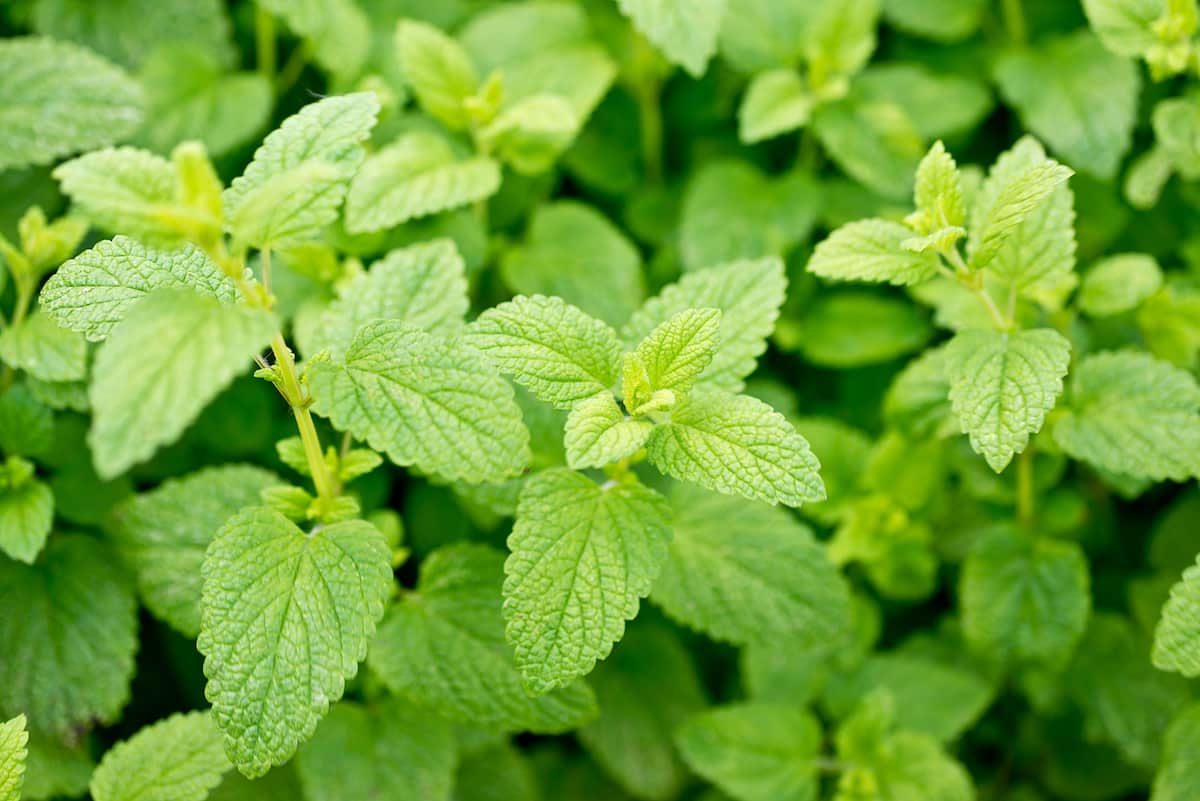
Lemon balm is Melissa officinalis, a perennial herb in the mint family grown for its lemon-scented leaves.12 Cooks use it in salads, soups, sauces, stuffings and drinks, and herbal medicine uses it for mild stress and sleep on the strength of tradition rather than clinical proof.23 This page covers what the plant is, the compounds behind its lemon scent, how it is used, and what regulators say about its safety and its medicinal use.
At a glance
| Botanical name | Melissa officinalis L.1 |
| Plant family | Lamiaceae (mint family)12 |
| Part used | Leaves, fresh or dried; essential oil24 |
| Native range | Mediterranean to Central Asia (Kew)1 |
| Key aroma compounds | Citral (geranial and neral) and citronellal45 |
| Oil content of the leaf | 0.06–0.8% (EMA assessment)4 |
| Forms sold | Fresh leaves, dried leaf and tea, essential oil |
| US status | On FDA’s GRAS lists as a spice and as an essential oil, under “Balm (lemon balm)”67 |
Measured values
9 figures, sourced| Measure | Value | Scope | Source |
|---|---|---|---|
| Leaf essential oil | 0.06–0.8 % | EMA assessment report on Melissa officinalis leafMainly citral, neral and citronellal | ema.europa.eu |
| Essential oil: beta-caryophyllene | 10 % of the oil (about) | EMA assessment report on Melissa officinalis leaf | ema.europa.eu |
| Essential oil: germacrene D | 10 % of the oil (about) | EMA assessment report on Melissa officinalis leaf | ema.europa.eu |
| Essential oil yield | 0.470 % of dry weight | one Algerian sample, leaves collected near Algiers in May 2018 | pmc.ncbi.nlm.nih.gov |
| Essential oil: geranial | 45.06 % of the oil | one Algerian sample, leaves collected near Algiers in May 2018 | pmc.ncbi.nlm.nih.gov |
| Essential oil: neral | 31.72 % of the oil | one Algerian sample, leaves collected near Algiers in May 2018 | pmc.ncbi.nlm.nih.gov |
| Essential oil: citronellal | 6.42 % of the oil | one Algerian sample, leaves collected near Algiers in May 2018 | pmc.ncbi.nlm.nih.gov |
| Rosmarinic acid, minimum (dried leaf) Limit | 1 % | European Pharmacopoeia, as cited in the EMA assessment report | ema.europa.eu |
| Pyrrolizidine alkaloids, maximum (dried herbs and herbal infusions) Limit | 400 µg/kg | EU Regulation 2023/915 | eur-lex.europa.eu |
Each figure is quoted as its source states it, with the samples or standard it applies to. Where sources differ, both are shown; nothing is averaged. All measured values
What lemon balm is
Kew describes lemon balm as a perennial of the temperate zone, native from the Mediterranean to Central Asia.1 It has been introduced far outside that range: Kew lists it across much of Europe, in South America, New Zealand and Tasmania, and in more than 30 US states and several Canadian provinces.1 Kew recognizes two subspecies, M. officinalis subsp. officinalis and subsp. inodora.1
Not the same as lemon verbena
The two are often mixed up because of their names and their scent, but they belong to different families. Lemon balm is in the Lamiaceae; lemon verbena, Aloysia citrodora, is a South American shrub in the Verbenaceae.18 See lemon verbena and lemon balm vs. lemon verbena.
Flavor and aroma
Fresh lemon balm smells clearly of lemon, with a soft, green, faintly minty background and none of the sourness of the fruit. The flavor is gentle and fades fast with heat or drying. That description is ours; the chemistry behind it is below.
The compounds
The leaf holds very little oil. The European Medicines Agency’s assessment gives an essential oil content of 0.06–0.8%, made up mainly of monoterpene aldehydes: citral, neral and citronellal.4 Citral itself is a mixture of two isomers, geranial and neral, the same pair that gives lemongrass its smell.9 The same EMA report puts β-caryophyllene and germacrene D at about 10% each of the oil.4
Figures from individual analyses vary, so they are shown here with their scope:
| Scope | Geranial | Neral | Citronellal | Source |
|---|---|---|---|---|
| General description of the leaf oil (EMA assessment) | Main constituents named, no percentages given | 4 | ||
| One Algerian sample, leaves collected near Algiers in May 2018; oil yield 0.470% of dry weight | 45.06% | 31.72% | 6.42% | 5 |
The Algerian figures describe one distilled oil, not the leaf you buy, and should not be read as typical.
The European Pharmacopoeia also sets a quality marker for the dried leaf that has nothing to do with scent: a minimum of 1% rosmarinic acid.4
Origin and history
Pliny the Elder wrote that if beehives are rubbed with melissophyllum, the bees will never desert them.10 In the 19th-century Bostock and Riley translation, a note on a related passage identifies a plant of that name as Melissa officinalis, or balm.11 We read it as Pliny’s description of a bee plant that his later translators equated with balm, not as proof that he meant the modern species.
The EMA notes that a long tradition of medicinal use of lemon balm leaf in Europe is well documented in handbooks.4 Many specific stories told about the herb could not be traced to a source we could open, and they are left out: a first record in 300 BCE, Moors bringing it to Spain, Dioscorides and Avicenna on its medical uses, the Carmelite nuns’ “Carmelite water”, its use as a church strewing herb or furniture polish, and Thomas Jefferson growing it.
How lemon balm is used
Britannica lists salads, soups, sauces, stuffings, liqueurs, wine, herbal teas and fruit drinks.2 The EMA assessment adds that it is used to give fragrance to wine, tea and beer.4 Its essential oil is also used in aromatherapy and as a scent in perfumery and cosmetics.2
In the kitchen, lemon balm works best raw or barely warmed: torn into salads and fruit, steeped in hot water for tea, infused into syrups and custards, or stirred into a sauce at the last minute. Long cooking leaves little of its scent behind. That advice is common practice rather than a measured finding.
Several cuisine-specific uses circulate online, including lemon balm in Indian curries, with Dutch pickled eel, and as an ingredient of Chartreuse. We could not trace any of them to a source we could open.
Buying and quality
Fresh lemon balm should be bright green and smell strongly of lemon when a leaf is rubbed; limp or browning leaves have lost much of that (kitchen judgment). We found no grading standard for culinary lemon balm beyond the pharmacopoeial marker above.
Storage
We found no published shelf-life figure for fresh or dried lemon balm from a regulator or extension service. The practical test is smell: rub or crush a little, and if the lemon scent is faint, it has faded.
Health and safety
What the EU regulator says about medicinal use. The European Medicines Agency’s herbal committee accepts lemon balm leaf as a traditional herbal medicine for relief of mild symptoms of stress, to aid sleep, and for mild digestive complaints such as bloating and wind.3 That status rests on long-standing use, not on clinical proof. The EMA says one small study on anxiety and sleep showed a possible improvement, but shortcomings in its design prevented firm conclusions.3 Its assessment concludes that the available information is insufficient to establish a recognized efficacy.4 It also judged studies on attention and memory to be of questionable relevance, partly because they used an extract not covered by its monograph.4
Cautions in the EMA assessment.43
- Lemon balm medicines are for adults and children over 12.
- They may cause drowsiness, and the risk may rise with alcohol or other sedatives.
- Lab findings suggest an effect on thyroid-stimulating hormone; the clinical relevance is not known.
- Use in pregnancy and breastfeeding is not recommended, for lack of data.
- At the time of assessment, no side effects had been reported for these medicines.
Food use. FDA lists lemon balm among spices and among essential oils generally recognized as safe for their intended use.67 In the EU, dried herbs and herbal infusions of lemon balm are both capped at 400 µg/kg of pyrrolizidine alkaloids, plant toxins that can contaminate harvests.12
This page makes no claim that lemon balm treats or prevents any condition. Claims that it fights cancer, relieves infant colic or is a rich source of vitamin C could not be traced to a source that supports them.
Substitutes and comparisons
Lemon verbena gives a stronger lemon scent, and lemongrass a grassier one; a little lemon zest with fresh mint gets close in a salad (editorial). See lemon balm substitutes.
- Lemon balm vs. lemon verbena
- Lemon balm vs. lemongrass
- Lemon balm vs. mint
- Profiles: lemongrass, lemon verbena, lemon thyme, mint
Footnotes
-
Melissa officinalis L., Plants of the World Online, Royal Botanic Gardens, Kew. powo.science.kew.org · Reference work ↩ ↩2 ↩3 ↩4 ↩5 ↩6 ↩7 ↩8
-
Melissa Petruzzello, “Lemon balm”, Encyclopaedia Britannica. britannica.com · Reference work ↩ ↩2 ↩3 ↩4 ↩5 ↩6
-
“Melissa leaf”, summary for the public, European Medicines Agency, 2014. ema.europa.eu · Regulator ↩ ↩2 ↩3 ↩4
-
Assessment report on Melissa officinalis L., folium, European Medicines Agency. ema.europa.eu · Regulator ↩ ↩2 ↩3 ↩4 ↩5 ↩6 ↩7 ↩8 ↩9 ↩10 ↩11 ↩12
-
Abdellatif et al., “Minerals, Essential Oils, and Biological Properties of Melissa officinalis L.”, Plants, 2021. pmc.ncbi.nlm.nih.gov · Peer-reviewed ↩ ↩2
-
21 CFR 182.10, US Food and Drug Administration. ecfr.gov · Regulator ↩ ↩2
-
21 CFR 182.20, US Food and Drug Administration. ecfr.gov · Regulator ↩ ↩2
-
Aloysia citrodora Paláu, Plants of the World Online, Royal Botanic Gardens, Kew. powo.science.kew.org · Reference work ↩
-
L.P.A. Oyen, Cymbopogon citratus, Plant Resources of South-East Asia (PROSEA). uses.plantnet-project.org · Reference work ↩
-
Pliny the Elder, Natural History 21.86, Perseus Digital Library. perseus.tufts.edu · Reference work ↩
-
Pliny the Elder, Natural History 20.45, translators’ note, Perseus Digital Library. perseus.tufts.edu · Reference work ↩
-
Commission Regulation (EU) 2023/915, Annex I, section 2.4. eur-lex.europa.eu · Regulator ↩