Cooking · Uses
Lemon Thyme Uses: Chicken, Fish, Vegetables, Butter, Baking and Drinks
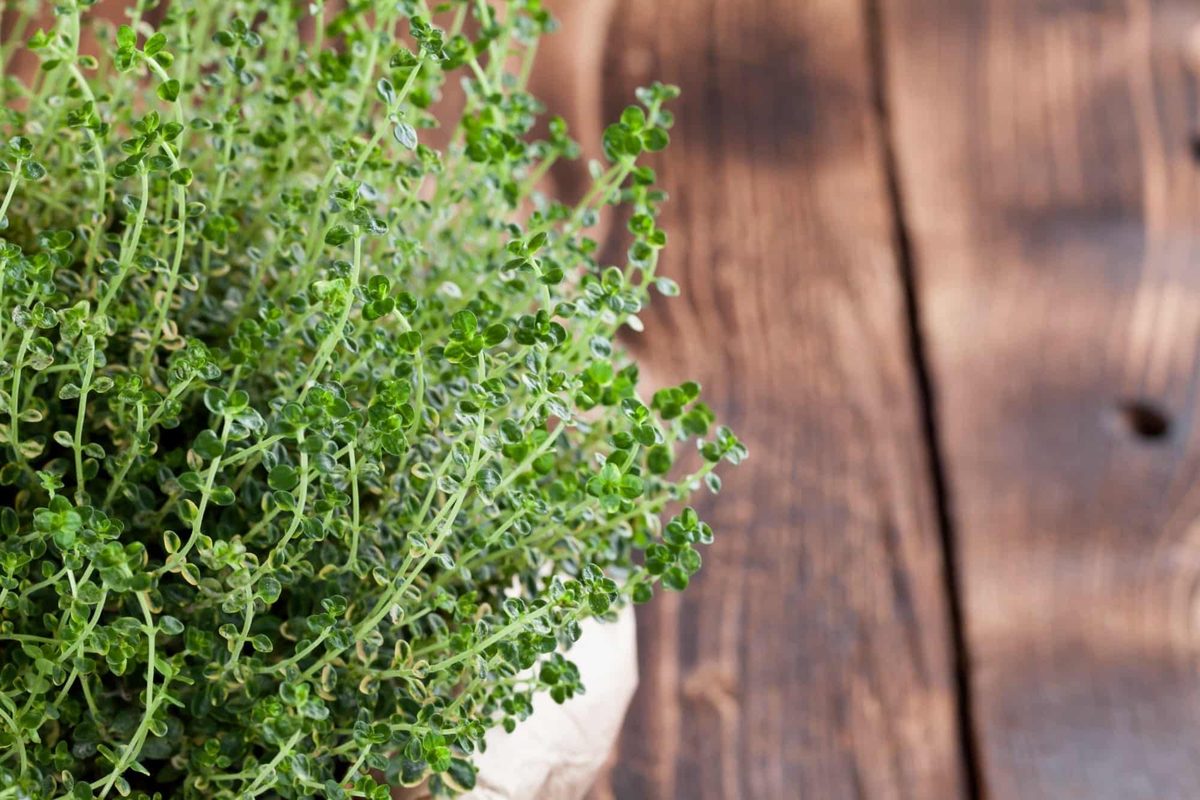
Lemon thyme is a mint-family thyme whose leaves smell of lemon.1 Penn State Extension describes the taste as distinctly thyme with overtones of lemon,2 and UF/IFAS Extension says it fits any recipe calling for lemon juice, lemon zest or lemon flavoring.3 So the short answer to where to use it is: anywhere thyme and lemon would both be welcome. Below are the uses with a source behind them, then a few that are plain kitchen judgment. For what the plant is and what is in its oil, see the lemon thyme profile.
Lemon thyme uses at a glance
| Use | What the source says | Source |
|---|---|---|
| Chicken | Add it to a marinade; use it in place of dried thyme in roast lemon chicken | Penn State, Tasting Table24 |
| Grilled fish | Lemon thyme butter on top | Penn State2 |
| Grilled summer vegetables | Green beans, tomatoes, eggplant, zucchini | Penn State2 |
| Roast potatoes and meats | Named by Tasting Table | Tasting Table4 |
| Salads and vinaigrettes | Leaves and flowers eaten raw | NC State, Tasting Table14 |
| Bouquet garni | A fragrant addition | Tasting Table4 |
| Baking | Berry cobbler; lemon thyme bars | Penn State, Tasting Table24 |
| Drinks | Herbal tea, lemonade, gin and tonic | Tasting Table4 |
Chicken
Penn State Extension’s first suggestion is to add lemon thyme to a marinade for chicken.2 Tasting Table’s Emery Pearson suggests using fresh lemon thyme in place of dried thyme in a roast lemon chicken.4 Leaves can go into a rub, or whole sprigs can go into the cavity or under the skin before roasting; those are common practice. Pearson’s handling advice applies here: strip the leaves from the stems before cooking, or cook whole sprigs and discard them afterward.4
Fish
Penn State suggests a lemon thyme butter to top grilled fish.2 Soften butter, beat in chopped leaves and a pinch of salt, chill, and slice a round onto the hot fish; that method is ours. Sprigs in the poaching liquid for white fish, or tucked inside a whole fish before baking, are other common uses. Lemon thyme has no acidity of its own, so a squeeze of lemon still belongs on the plate if you want sourness (our judgment).
Vegetables and potatoes
Penn State says lemon thyme goes well with summer grilled vegetables such as green beans, tomatoes, eggplant and zucchini.2 Tasting Table adds roasted vegetables and roasted potatoes.4 Roast carrots and beets with a few sprigs are a natural extension, as kitchen judgment.
Salads and dressings
NC State Extension notes that the leaves and flowers can be eaten raw in salads.1 Pearson recommends an everyday salad with an herby vinaigrette and lists dressings and marinades among its best uses.4 The small leaves need no chopping.
Compound butter
Tasting Table and Penn State both point to butter.24 Beyond fish, a lemon thyme butter suits corn, steamed green vegetables and warm bread. Those pairings are common practice.
Bouquet garni
Britannica gives the classic bouquet garni as sprigs of parsley and thyme with a bay leaf, a bundle removed before the dish is served.5 Tasting Table calls lemon thyme a fragrant addition to one.4 Using it in place of common thyme makes sense for chicken stews, fish soups and white bean dishes where a lemon note is welcome; in a red-wine braise it is less obviously at home. That split is our judgment, not a sourced rule. For other thyme uses, see cooking with thyme.
Baking and desserts
Lemon thyme and berry cobbler (Attributed). Penn State’s recipe whisks 1 tablespoon of minced fresh lemon thyme leaves into the sugar and cornstarch that coat 3 pints of blackberries, blueberries or a mix.2 Pearson also suggests lemon thyme in place of common thyme in lemon thyme bars.4 Shortbread, scones and herb breads are common homes for it too, and so are fruit salads. Those last are kitchen judgment.
Drinks
Tasting Table lists herbal teas, cocktails, an herbal lemonade and a gin and tonic.4 Bruise a sprig to release its scent before adding it, as with any herb (common practice).
Infused oil: keep it cold
A widely repeated method says to cover lemon thyme sprigs with oil and leave the jar in a sunny spot to infuse. That is unsafe. Oregon State University Extension warns that herbs are low-acid foods that can carry Clostridium botulinum, and that homemade mixtures of fresh herbs in oil must be refrigerated and used within 4 days, or frozen.6 Its guidance covers herbs in general, not lemon thyme by name. Make small batches, keep them in the refrigerator and use them for dressings and marinades within that window.
Infused vinegar
Herb vinegar is the shelf-friendly way to keep lemon thyme’s flavor in a liquid. The extension guides we read describe the method for herbs in general:
| Step | University of Maine Extension | Oregon State Extension |
|---|---|---|
| Herb per pint of vinegar | Two to three sprigs7 | About 3 to 4 sprigs of fresh herbs8 |
| Which vinegar | White or wine vinegar in its herb pairings7 | Distilled white is a good choice for delicate herbs8 |
| Steeping | Room temperature, 3 to 4 weeks7 | A cool, dark place, 3 to 4 weeks8 |
| Keeping | Refrigerate and use within 3 months7 | Cool, dark place; best within 4 to 6 months; refrigeration best for flavor8 |
The two guides disagree on keeping time and on whether refrigeration is required, so both are shown. Oregon State says vinegar showing mold, bubbling, cloudiness or sliminess should be thrown out without tasting.8 A common instruction to steep herb vinegar for only a few days is shorter than either guide’s 3 to 4 weeks.
Fresh or dried
UF/IFAS says lemon thyme can be used fresh or dried.3 Penn State notes that it dries easily on a screen or in a mesh colander and keeps its flavor well.2 Tasting Table says it is best fresh.4 For drying and keeping, see how to store thyme and can you freeze thyme.
Related
- Lemon thyme profile
- Lemon thyme substitutes
- Thyme vs. lemon thyme
- Bouquet garni and bouquet garni substitutes
- Good spices for chicken
Footnotes
-
Thymus citriodorus (Lemon Thyme), North Carolina Extension Gardener Plant Toolbox, NC State University. plants.ces.ncsu.edu · Reference work ↩ ↩2 ↩3
-
Smith and Marquesen, “Lemon-Scented Herbs in the Garden and the Kitchen”, Penn State Extension, 2025. extension.psu.edu · Reference work ↩ ↩2 ↩3 ↩4 ↩5 ↩6 ↩7 ↩8 ↩9 ↩10 ↩11
-
Busbee, Andrews and Criss, “Lemon Thyme”, UF/IFAS Extension, 2024. sfyl.ifas.ufl.edu · Reference work ↩ ↩2
-
Emery Pearson, “What To Know When Cooking With Lemon Thyme”, Tasting Table, 2024. tastingtable.com · Publication ↩ ↩2 ↩3 ↩4 ↩5 ↩6 ↩7 ↩8 ↩9 ↩10 ↩11 ↩12 ↩13 ↩14 ↩15
-
“Bouquet garni”, Encyclopaedia Britannica. britannica.com · Reference work ↩
-
Raab and Woodburn, “Herbs and vegetables in oil” (SP 50-701), Oregon State University Extension Service, 2025. extension.oregonstate.edu · Reference work ↩
-
Kathleen Savoie, “Let’s Preserve: Herbal Vinegar” (Bulletin #4049), University of Maine Cooperative Extension. extension.umaine.edu · Reference work ↩ ↩2 ↩3 ↩4
-
Nellie Oehler, “Flavored Vinegars” (SP 50-736), Oregon State University Extension Service, 2025. extension.oregonstate.edu · Reference work ↩ ↩2 ↩3 ↩4 ↩5