Spice Comparisons · Comparison
Thyme vs. Lemon Thyme: The Same Savory Base, Plus Citrus
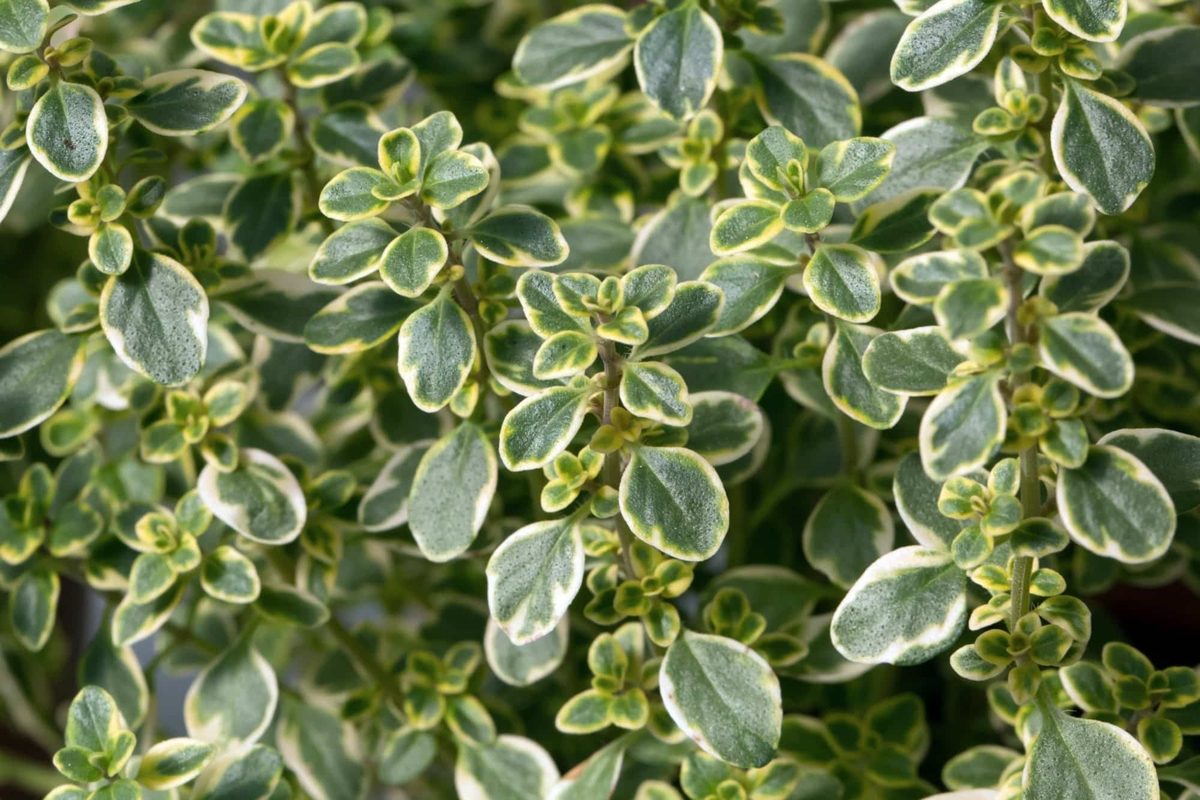
Lemon thyme is a close relative of common thyme that adds a citrus overtone to the usual thyme flavor.1 Common thyme is Thymus vulgaris; lemon thyme is Thymus × citriodorus, which Kew lists as a hybrid of T. pulegioides and common thyme.23 Common thyme’s oil is usually led by thymol, while lemon thyme’s oil varies from plant to plant, and one study calls it a natural source of geraniol and citral, compounds with a lemon character.45 In the kitchen, common thyme is the all-purpose savory herb and lemon thyme the one to use where lemon would also be welcome.
Side by side
| Thyme (common) | Lemon thyme | |
|---|---|---|
| Name | Thymus vulgaris, also called common or garden thyme26 | Thymus × citriodorus3 |
| Status | Accepted species2 | A hybrid of T. pulegioides × T. vulgaris (Kew); a distinct species (NC State); see below37 |
| Family | Lamiaceae (mint family)2 | Lamiaceae7 |
| Native range | Southwestern Europe and southeastern Italy (Kew)2 | Southwestern Europe (Kew)3 |
| Plant | Small evergreen subshrub, 10–30 cm, occasionally 50 cm8 | Evergreen subshrub, mounding 6–12 inches high and about 1 foot wide7 |
| Leaves | Opposite, linear to elliptical, 3–8 mm long8 | Small, ovate; some cultivars edged in cream, gold or silver7 |
| Key compounds | Thymol and carvacrol, usually thymol-led84 | Variable: geraniol and citral in one study; terpinolene-led in another59 |
| Flavor | Savory, sharp, slightly medicinal (editorial) | Thyme flavor with a citrus overtone (UF/IFAS); less bitter than common thyme (Tasting Table)110 |
| Typical uses | Butter, cheese, fish, meat, sauces, soups, stews, stuffings8 | Any recipe calling for lemon juice, zest or flavoring (UF/IFAS); chicken marinades and fish butter (Penn State)111 |
| Cost | No dated, sourced price comparison found | No dated, sourced price comparison found |
Hybrid or species?
The sources disagree, and the disagreement shows up on plant labels.
| Source | Position |
|---|---|
| Kew, Plants of the World Online | A hybrid, with the formula T. pulegioides × T. vulgaris; native range southwestern Europe3 |
| NC State Extension | Once thought to be a hybrid, but “DNA testing has now determined it to be a distinct species”7 |
NC State does not name the study it relies on, and we could not open one. Kew’s checklist is the botanical reference used across this site, so this page writes the name with the ”×”. Either way, the two plants are close relatives in the same genus.
The chemistry, sample by sample
Each row describes a particular oil from a particular study. They are not comparable to each other as numbers, and the lemon thyme studies were available to us only as abstracts.
| Herb and study | What it found | Source |
|---|---|---|
| Common thyme oil, 2023 study of eight thyme species | Thymol 42.44%, carvacrol 2.28%; six of eight oils thymol-type | Dong et al.4 |
| Common thyme, one chemotype reported by PROSEA | Thymol and carvacrol both under 5% | PROSEA8 |
| Lemon thyme, distilled for different lengths of time | A natural source of commercially important geraniol and citral | Jurevičiūtė et al. 20195 |
| Lemon thyme grown in southeastern Turkey, three growth stages | Main compounds terpinolene, α-terpineol and linalool, among others; terpinolene up to 71% at flowering | Toncer et al. 20179 |
Two things follow. Common thyme’s savory bite comes from thymol and carvacrol, which PROSEA names as the oil’s characteristic constituents.8 Lemon thyme’s lemon note has been tied to geraniol and citral in one study, but a second study found a quite different oil,59 so not every plant sold as lemon thyme will smell equally of lemon. Common thyme can lean citrusy too: Penn State describes the common thyme cultivar ‘Provencial’ as having a strong citrus aroma.12
The differences that change a dish
Where each one belongs
Common thyme is the default when a recipe says “thyme.” UC’s Master Gardeners call English thyme the one most commonly grown for culinary use.6 PROSEA lists it for butter, cheese, fish, meat, sauces, soups, stews and stuffings,8 and the classic bouquet garni is sprigs of parsley and thyme with a bay leaf.13 Thyme also turns up in the Caribbean: modern Jamaican jerk recipes may include it alongside Scotch bonnet peppers, scallions, garlic, ginger, pimento and cinnamon.14 It is not one of the French fines herbes, a mix that commonly includes parsley, chives, tarragon and chervil.15
Lemon thyme fits where lemon would also fit. UF/IFAS Extension suggests it in any recipe calling for lemon juice, lemon zest or lemon flavoring,1 Penn State suggests adding it to a marinade for chicken,11 and NC State notes that the leaves and flowers can be eaten raw in salads or cooked.7 By common practice it also goes on fish, roast vegetables and potatoes.
Cooking
America’s Test Kitchen groups thyme with the hearty herbs that go in early.16 Penn State says lemon thyme dries easily and retains its flavor quite well.11 We found no source on how lemon thyme’s citrus note holds up in long cooking; adding it late keeps the lemon brighter (editorial).
Can one stand in for the other?
Mostly yes, with a shift in character. No published ratio exists in either direction.
- Common thyme in place of lemon thyme (Method). Rebuild both halves of the flavor. For each teaspoon of fresh lemon thyme leaves, start with 3/4 teaspoon of fresh common thyme and 1/4 teaspoon of finely grated lemon zest, then taste. That is the starting point on our lemon thyme substitutes page. Tasting Table notes that lemon thyme is less bitter than common thyme,10 which is why the thyme amount is reduced. For scale, NDSU Extension counts 1 to 2 teaspoons of grated peel from one medium lemon.17
- Lemon thyme in place of common thyme (Method). Start with the same amount. The citrus note will show in a delicate dish and fade into a braise or stuffing (editorial). See thyme substitutes.
What isn’t known
- No published measurement compares the flavor strength of thyme and lemon thyme.
- The lemon thyme oil studies were read as abstracts, so the citral and geraniol percentages are not available.
- Lemon thyme cultivars with purple-backed leaves, often mentioned, are not among those NC State lists.7
- We found no source documenting thyme in Haitian rice and beans (riz et pois).
Related
- Profiles: thyme, lemon thyme, lemon balm, lemon verbena
- Substitutes: thyme substitutes, lemon thyme substitutes
- Comparisons: English thyme vs. French thyme, oregano vs. thyme, rosemary vs. thyme, fresh thyme vs. dried
- Lemon thyme uses, cooking with thyme, bouquet garni, jerk seasoning, too much thyme?
Footnotes
-
Busbee, Andrews and Criss, “Lemon Thyme”, UF/IFAS Extension, 2024. sfyl.ifas.ufl.edu · Reference work ↩ ↩2 ↩3 ↩4
-
Thymus vulgaris L., Plants of the World Online, Royal Botanic Gardens, Kew. powo.science.kew.org · Reference work ↩ ↩2 ↩3 ↩4 ↩5
-
Thymus × citriodorus (Pers.) Schreb., Plants of the World Online, Royal Botanic Gardens, Kew. powo.science.kew.org · Reference work ↩ ↩2 ↩3 ↩4 ↩5
-
Dong et al., “Chemical Compositions of Essential Oil Extracted from Eight Thyme Species and Potential Biological Functions”, Plants, 2023. mdpi.com · Peer-reviewed ↩ ↩2 ↩3
-
Jurevičiūtė et al., “Composition of essential oil of lemon thyme (Thymus × citriodorus) at different hydrodistillation times”, Natural Product Research, 2019. iris.unipa.it · Peer-reviewed ↩ ↩2 ↩3 ↩4
-
Pam Roper, “English Thyme”, UC Agriculture and Natural Resources. ccfruitandnuts.ucanr.edu · Reference work ↩ ↩2
-
Thymus citriodorus (Lemon Thyme), North Carolina Extension Gardener Plant Toolbox, NC State University. plants.ces.ncsu.edu · Reference work ↩ ↩2 ↩3 ↩4 ↩5 ↩6 ↩7
-
S.H. Widodo, Thymus vulgaris, Plant Resources of South-East Asia (PROSEA). uses.plantnet-project.org · Reference work ↩ ↩2 ↩3 ↩4 ↩5 ↩6 ↩7
-
Toncer et al., “Essential Oil Composition of Thymus x citriodorus (Pers.) Schreb. at Different Harvest Stages”, Notulae Botanicae Horti Agrobotanici Cluj-Napoca, 2017. acikerisim.dicle.edu.tr · Peer-reviewed ↩ ↩2 ↩3
-
Emery Pearson, “What To Know When Cooking With Lemon Thyme”, Tasting Table, 2024. tastingtable.com · Publication ↩ ↩2
-
Smith and Marquesen, “Lemon-Scented Herbs in the Garden and the Kitchen”, Penn State Extension, 2025. extension.psu.edu · Reference work ↩ ↩2 ↩3
-
Carol Kagan, “Herb Garden Plants: Thyme”, Penn State Extension, 2026. extension.psu.edu · Reference work ↩
-
“Bouquet garni”, Encyclopaedia Britannica. britannica.com · Reference work ↩
-
Vaughn Stafford Gray, “A Brief History of Jamaican Jerk”, Smithsonian Magazine, 2020. smithsonianmag.com · Publication ↩
-
“Fines herbes”, Encyclopaedia Britannica. britannica.com · Reference work ↩
-
Liz Bomze, “Our Guide to Fresh Herbs”, America’s Test Kitchen, 2019. americastestkitchen.com · Publication ↩
-
Julie Garden-Robinson, Ingredient Substitutions (FN198), NDSU Extension, 2018. ksre.ksu.edu · Reference work ↩