Spice Substitutes · Substitutes
Bouquet Garni Substitutes: What to Use When an Herb Is Missing
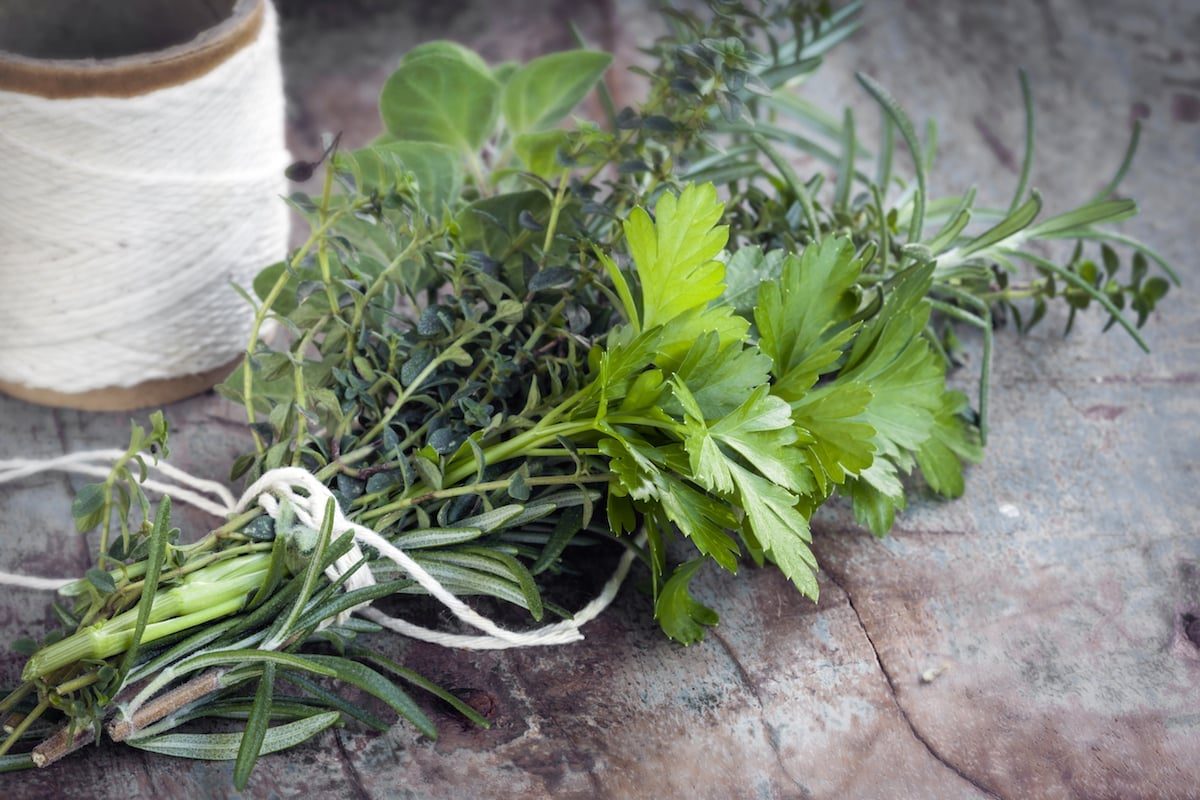
A bouquet garni is a bundle of herbs cooked in a soup, stew, sauce or poaching liquid and removed before the dish is served. Britannica gives the classic version as sprigs of parsley and thyme and a bay leaf, tied together if fresh or wrapped in cheesecloth if dried.1 Because it is a bundle rather than a fixed blend, the right substitute depends on which herb you are missing and how long the dish cooks.
Quick answer
| What’s missing | Best substitute | Starting amount | Treatment |
|---|---|---|---|
| All fresh herbs | A dried bouquet garni in cheesecloth or a tea ball | 1/4 tsp each dried thyme, parsley, basil and oregano, 1/2 tsp peppercorns, 4 bay leaves | Attributed |
| A fresh thyme sprig | Dried thyme | 1 tsp dried per 1 tbsp chopped fresh | Computed |
| The bay leaf | Dried thyme | 1/4 tsp per bay leaf | Attributed |
| Every herb, but you have a dried blend | Herbes de Provence without lavender | About 1 tsp per bouquet garni, plus a bay leaf if you have one | Method |
| The same, with a different blend | Italian seasoning | About 1 tsp per bouquet garni | Method |
| A short-cooked dish | Fines herbes, added at the end | To taste | Method |
How the ratios on this page are labeled
Every ratio carries one of four labels.
- Computed: based on a measurable physical relationship, with the source named.
- Attributed: a named source publishes this ratio. We quote it as theirs.
- Disputed: named sources give different answers to the same swap. We show each one and do not average them.
- Method: we found no published ratio. We give a direction and a cautious starting point, and say so.
A bouquet garni has no standard size. Escoffier’s white veal stock uses an ounce of parsley, one bay leaf and a small sprig of thyme,2 while Britannica’s classic version gives no quantities.1 So every “per bouquet garni” amount below is a starting point, not a measured equivalent.
If you have no fresh herbs at all
1. A dried bouquet garni
Britannica’s own method covers this case: wrap dried herbs in cheesecloth, add the bundle to the liquid, and remove it before serving.1
Formula (Attributed): Camellia Brand, which sells dried beans, publishes the dried bouquet garni its older bean-package recipes called for: 1/4 teaspoon each of dried thyme, dried parsley flakes, dried basil and dried oregano, 1/2 teaspoon whole peppercorns and 4 dried bay leaves.3 Camellia suggests a tea ball if you have no cheesecloth.3 This is one company’s blend for a pot of beans, not a universal standard, and it adds basil and oregano to the classic three.
Why dried works here: a bouquet garni cooks for as long as the dish does, and thyme and bay hold up. LSU AgCenter lists thyme among the less delicate herbs,4 and America’s Test Kitchen says the flavor compounds in hearty herbs are somewhat more heat-stable.5 Parsley is different: LSU classes it as a delicate herb and notes that prolonged heat can cause flavor and aroma losses.4 Dried parsley adds little to a long simmer. If you have fresh parsley, chop a little and add it at the end instead.
2. Dried thyme and a bay leaf, loose
If you have no cheesecloth or tea ball, add dried thyme and a whole bay leaf directly to the pot. The thyme stays in the dish. Fish out the bay leaf before serving. Bay leaves are rigid and can have sharp points, and a published case report describes a swallowed leaf perforating the bowel.6
Ratio (Method): No published amount for a loose substitute. Start with about 1/2 teaspoon dried thyme and one bay leaf for a pot of soup or stew serving four to six, then taste near the end. The University of Delaware suggests 1 to 2 teaspoons for 6 servings as a moderate amount of a medium-strength herb,7 so this starts below that.
If one herb is missing
Fresh thyme: use dried thyme
Ratio (Computed): LSU AgCenter gives the general rule that one tablespoon of finely cut fresh herbs equals one teaspoon of crumbled dried herbs.4 The University of Delaware gives a matching range: 3/4 to 1 teaspoon dried for 2 to 3 teaspoons fresh.7 Both are general herb rules, not thyme measurements. A sprig is not a fixed amount, so judge it by the leaves it would give.
The bay leaf: use dried thyme
Ratio (Attributed): Tasting Table’s Cassie Womack advises “¼ teaspoon of dried thyme per bay leaf.”8 She says thyme does a better job than other herbs at matching bay’s subtle flavor, but is stronger, so use it sparingly.8
The two herbs are not chemically alike. In one Italian sample studied, bay leaf oil was led by 1,8-cineole (31.9 percent), sabinene and linalool,9 while thyme oil’s characteristic constituents are thymol and carvacrol.10 Thyme fills the herbal gap; it will not taste like bay. If the bouquet garni already includes thyme, simply leave the bay leaf out and taste.
Parsley: add it fresh at the end, or leave it out
Ratio (Method): No published ratio. Because parsley is a delicate herb,4 adding chopped fresh parsley just before serving brings back more of its flavor than simmering a substitute. If you have none, leave it out.
If you only have a dried herb blend
1. Herbes de Provence
The French Label Rouge specification for herbes de Provence sets fixed proportions of thyme (19 percent), rosemary, savory and oregano.11 Thyme is the overlap with a bouquet garni. Savory and oregano bring thymol-type notes too: carvacrol and thymol make up about 78 to 85 percent of oregano oil.12 Rosemary is the stronger difference.
Avoid blends with lavender for a bouquet garni dish. The Label Rouge specification excludes lavender,11 and The Takeout reports that some commercial blends add it “to appease tourists.”13 The blend also has no bay leaf and no parsley, so add a bay leaf if you have one.
Ratio (Method): No published ratio. Start with about 1 teaspoon in cheesecloth or a tea ball per bouquet garni called for. That matches the total dried leafy herbs in Camellia’s blend,3 but it is our starting point, not a tested swap.
2. Italian seasoning
The USDA’s purchasing specification lists thyme, rosemary, sage, oregano and basil as Italian seasoning’s minimum ingredients.14 McCormick’s version lists marjoram first.15 Like herbes de Provence, it contains thyme but no bay or parsley. Tasting Table says the commercial blend is “more than likely an American invention.”16 Not all of its herbs come from Italy: Kew gives basil’s native range as tropical and subtropical Asia to northern Australia.17
Ratio (Method): No published ratio. Start with about 1 teaspoon per bouquet garni, add a bay leaf if you have one, and taste.
3. Fines herbes, only for short-cooked dishes
Fines herbes is a different kind of mix. Britannica lists its common ingredients as parsley, chives, tarragon and chervil, used as a seasoning or garnish.18 These are delicate herbs: LSU puts parsley and chives in that group,4 and the University of Illinois says tarragon’s flavor “is quickly lost if leaves are dried.”19 That makes fines herbes a poor fit for a long braise or stock, where a bouquet garni does its work.
Ratio (Method): No published ratio. In a quick sauce or a poaching liquid, stir chopped fresh fines herbes in at the end, to taste.
What isn’t known
- There is no standard size for a bouquet garni, so no substitute can be expressed as an exact equivalent.
- The fresh-to-dried figures above are general rules for herbs. We found no measurement specific to thyme or bay.
- No source we found tested herbes de Provence or Italian seasoning in place of a bouquet garni.
- Tarragon and peppercorns are sometimes listed as standard additions. Peppercorns appear in Camellia’s dried version,3 and chervil appears in Pierre de Lune’s 1656 bundle,20 but we found no source that includes tarragon.
Related
- Bouquet garni and French spices
- Bay leaves, bay leaf substitutes, cooking with bay leaves and too much bay leaf
- Thyme, thyme substitutes, fresh vs. dried thyme and cooking with thyme
- Parsley, fresh vs. dried parsley and chervil
- Herbes de Provence, herbes de Provence vs. Italian seasoning, Italian seasoning and fines herbes
- Tarragon and dried vs. fresh tarragon
Footnotes
-
“Bouquet garni”, Encyclopaedia Britannica. britannica.com · Reference work ↩ ↩2 ↩3
-
A. Escoffier, A Guide to Modern Cookery, Project Gutenberg. gutenberg.org · Reference work ↩
-
“Camellia’s Dry Herb Blend - Bouquet Garni”, Camellia Brand. camelliabrand.com · Merchant ↩ ↩2 ↩3 ↩4
-
“Flavorful Herbs”, LSU AgCenter. lsuagcenter.com · Reference work ↩ ↩2 ↩3 ↩4 ↩5
-
Liz Bomze, “Our Guide to Fresh Herbs”, America’s Test Kitchen, 2019. americastestkitchen.com · Publication ↩
-
Bell and Mustard, “Bay leaf perforation of Meckel’s diverticulum”, Canadian Journal of Surgery, 1997. canjsurg.ca · Peer-reviewed ↩
-
“Using Herbs and Spices”, University of Delaware Cooperative Extension, 2025. udel.edu · Reference work ↩ ↩2
-
Cassie Womack, “If You’re Out Of Bay Leaves, Use Dried Thyme”, Tasting Table, 2024. tastingtable.com · Publication ↩ ↩2
-
Caputo et al., “Laurus nobilis: Composition of Essential Oil and Its Biological Activities”, Molecules, 2017. mdpi.com · Peer-reviewed ↩
-
S.H. Widodo, Thymus vulgaris, Plant Resources of South-East Asia (PROSEA). uses.plantnet-project.org · Reference work ↩
-
Label Rouge LA 02/03 “Herbes de Provence”, specification, INAO. extranet.inao.gouv.fr · Regulator ↩ ↩2
-
Lombrea et al., “A Recent Insight Regarding the Phytochemistry and Bioactivity of Origanum vulgare L. Essential Oil”, International Journal of Molecular Sciences, 2020. mdpi.com · Peer-reviewed ↩
-
Leah Kaplan, “What Is Herbs De Provence, Really?”, The Takeout, 2025. thetakeout.com · Publication ↩
-
Commercial Item Description A-A-20001C, Spices and Spice Blends, USDA Agricultural Marketing Service, 2023. ams.usda.gov · Regulator ↩
-
McCormick Italian Seasoning, ingredient listing, Giant Food Stores. giantfoodstores.com · Merchant ↩
-
Zoë Lourey-Christianson, “Why Italian Seasoning Isn’t A Thing In Italy”, Tasting Table, 2024. tastingtable.com · Publication ↩
-
Ocimum basilicum L., Plants of the World Online, Royal Botanic Gardens, Kew. powo.science.kew.org · Reference work ↩
-
“Fines herbes”, Encyclopaedia Britannica. britannica.com · Reference work ↩
-
“Tarragon: French”, University of Illinois Extension. extension.illinois.edu · Reference work ↩
-
“Bouquet garni”, The Oxford Companion to Food, Oxford University Press. app.ckbk.com · Reference work ↩