Cooking · Cooking with
Cooking With Thyme: When to Add It, How Much, and Where It Belongs
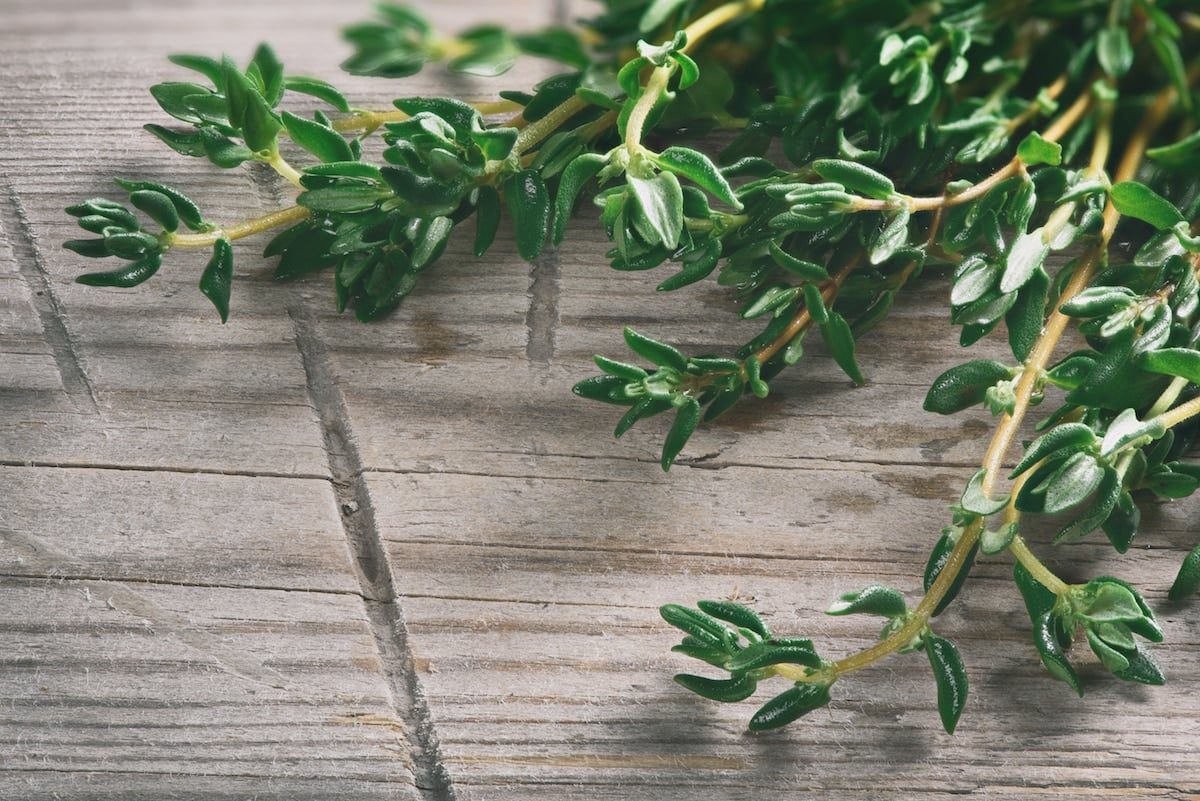
Common thyme (Thymus vulgaris) is a small shrubby herb native to southwestern Europe and southeastern Italy.1 Its oil is built on thymol and carvacrol,2 which give it the sharp, savory, slightly medicinal smell cooks know. America’s Test Kitchen classes it as a hearty herb,3 and that one fact explains most of how to cook with it: it can go in early and stand up to long cooking in a way basil or parsley cannot. This page covers where thyme belongs, when to add it, how to measure sprigs and convert fresh to dried, and how to keep it.
Where thyme belongs
French cooking. Gernot Katzer singles out fresh branches of thyme as especially typical of French cooking.4 The classic bouquet garni is parsley, thyme and a bay leaf, added to a soup, stew, sauce or poaching liquid to give flavor,5 and removed before serving.4 Dried thyme is part of herbes de Provence;4 France’s Label Rouge specification sets it at 19 percent of the blend.6 See bouquet garni and herbes de Provence.
Meat, sausage and poultry. PROSEA lists butter, cheese, fish and meat among the foods thyme flavors.2 Katzer notes that thyme is often combined with marjoram for sausages and goes well with bay.4 McCormick Culinary’s poultry seasoning lists thyme first, ahead of sage, marjoram and rosemary.7
Mediterranean vegetables. Katzer says fresh thyme suits Mediterranean vegetable dishes such as ratatouille.4 Tomatoes, lamb and other pairings often listed for thyme are reasonable, but they are cooking judgment; we found no reference that singles them out.
Jamaica and Louisiana. Katzer says Jamaican jerk often contains thyme, and that Creole cooking is known for its extensive use of it.4 Saveur’s Jamaican jerk chicken marinade uses 1 tablespoon of dried thyme with ground allspice and Scotch bonnet chiles, and marinates the chicken at least 6 hours.8
Za’atar. Katzer describes thyme as a vital aroma in the Jordanian blend.4 America’s Test Kitchen’s za’atar uses 2 tablespoons of dried thyme to 1 1/2 tablespoons of sumac.9 See za’atar.
When to add it
The sources disagree, and the difference is worth knowing.
| Source | Advice |
|---|---|
| America’s Test Kitchen | Hearty herbs such as thyme go in early; their volatile flavor compounds are somewhat more heat-stable.3 Dried thyme held up reasonably well in dishes cooked more than 20 minutes with a good amount of liquid.10 |
| University of Delaware Extension | Extended cooking loses herb flavor; when a recipe calls for long simmering, add herbs during the last 45 minutes.11 |
Our reading (Method): add sprigs or dried thyme early in a braise, stock or stew for a background note, and if the herb has faded by the end, add a little more fresh thyme in the last half hour. A widely repeated claim that long cooking makes thyme “mellower” has no test behind it that we found.
How much to use
The University of Delaware puts thyme in its medium-strength group and suggests 1 to 2 teaspoons for 6 servings (Attributed; it does not say fresh or dried).11 It also warns that herbs can taste objectionable when too much is used.11 If you have overdone it, see too much thyme.
Sprigs, leaves and stems
Recipes often call for sprigs. Food Network’s guide says sprigs typically run 2 to 4 inches, suggests choosing 3- to 4-inch sprigs with a few side branches, and says a 4-inch sprig yields 1/4 to 3/4 teaspoon of leaves.12 That range is wide, so treat “a sprig” as approximate.
To strip leaves, pinch the top of the sprig and run your fingers down the stem.12 The stem is edible but usually discarded after cooking.12 Pulling whole sprigs out before serving, as with a bouquet garni,4 is common practice.
Fresh vs. dried
Dried herbs are stronger than fresh by volume, the University of Delaware says,11 and Katzer puts dried thyme at two to three times the intensity of fresh.4 Published conversions do not agree:
| Source | Dried : fresh |
|---|---|
| America’s Test Kitchen (tested) | 1 part dried to 3 parts fresh10 |
| University of Delaware Extension | 3/4 to 1 teaspoon dried = 2 to 3 teaspoons fresh11 |
| Food Network | 1/2 teaspoon dried for 1 teaspoon fresh leaves12 |
Our starting point (Method): 1 teaspoon dried for 1 tablespoon fresh leaves, the ratio ATK tested, then taste. ATK’s tasters still preferred fresh herbs in most dishes, but dried thyme did well in long-cooked, liquid-rich ones.10 More in fresh vs. dried thyme.
Keeping fresh thyme
America’s Test Kitchen has given two different methods:
| ATK article | Method |
|---|---|
| 2016 buying and storage guide | Wrap in damp paper towels in a zipper-lock bag in the crisper13 |
| 2019 guide to fresh herbs | Keep hearty herbs dry: original packaging or an open zipper-lock bag, refrigerated3 |
Neither gives a storage time, and we found no source for the “up to two weeks” often quoted, or for leaves blackening when stored damp. For longer keeping, South Dakota State University Extension says thyme can be frozen on its stems,14 and Penn State Extension says most dried herbs keep well for one year.15 Full detail on how to store thyme and can you freeze thyme.
Related
- Thyme
- Thyme uses
- Thyme substitutes
- Fresh vs. dried thyme
- Thyme vs. lemon thyme
- Rosemary vs. thyme
- Oregano vs. thyme
Footnotes
-
Thymus vulgaris L., Plants of the World Online, Royal Botanic Gardens, Kew. powo.science.kew.org · Reference work ↩
-
S.H. Widodo, Thymus vulgaris, Plant Resources of South-East Asia (PROSEA). uses.plantnet-project.org · Reference work ↩ ↩2
-
Liz Bomze, “Our Guide to Fresh Herbs”, America’s Test Kitchen, 2019. americastestkitchen.com · Publication ↩ ↩2 ↩3
-
Gernot Katzer, “Thyme”, Gernot Katzer’s Spice Pages. gernot-katzers-spice-pages.com · Reference work ↩ ↩2 ↩3 ↩4 ↩5 ↩6 ↩7 ↩8 ↩9
-
“Bouquet garni”, Encyclopaedia Britannica. britannica.com · Reference work ↩
-
Cahier des charges du Label Rouge « Herbes de Provence », INAO, 2014. extranet.inao.gouv.fr · Regulator ↩
-
“Poultry Seasoning, 12 oz”, McCormick Culinary. mccormick.com · Merchant ↩
-
“Jamaican Jerk Chicken”, Saveur, 2012. saveur.com · Publication ↩
-
Bryan Roof, “Za’atar”, America’s Test Kitchen, 2017. americastestkitchen.com · Publication ↩
-
“Science: Substituting Dried Herbs for Fresh”, America’s Test Kitchen. americastestkitchen.com · Publication ↩ ↩2 ↩3
-
Diane Oliver (rev.), “Using Herbs and Spices”, University of Delaware Cooperative Extension, 2025. udel.edu · Reference work ↩ ↩2 ↩3 ↩4 ↩5
-
Layla Khoury-Hanold, “What Is a Sprig of Thyme?”, Food Network, 2022. foodnetwork.com · Publication ↩ ↩2 ↩3 ↩4
-
“How & Where to Buy, Use, and Store Fresh Herbs”, America’s Test Kitchen, 2016. americastestkitchen.com · Publication ↩
-
Lambert, Erickson and Kleine, “Preserving Herbs”, South Dakota State University Extension, 2022. extension.sdstate.edu · Reference work ↩
-
Stacy Reed, “Preserving Herbs by Drying”, Penn State Extension, 2024. extension.psu.edu · Reference work ↩