Herbs · Profile
Lemon Thyme: Hybrid or Species, What’s in Its Oil, and How to Cook With It
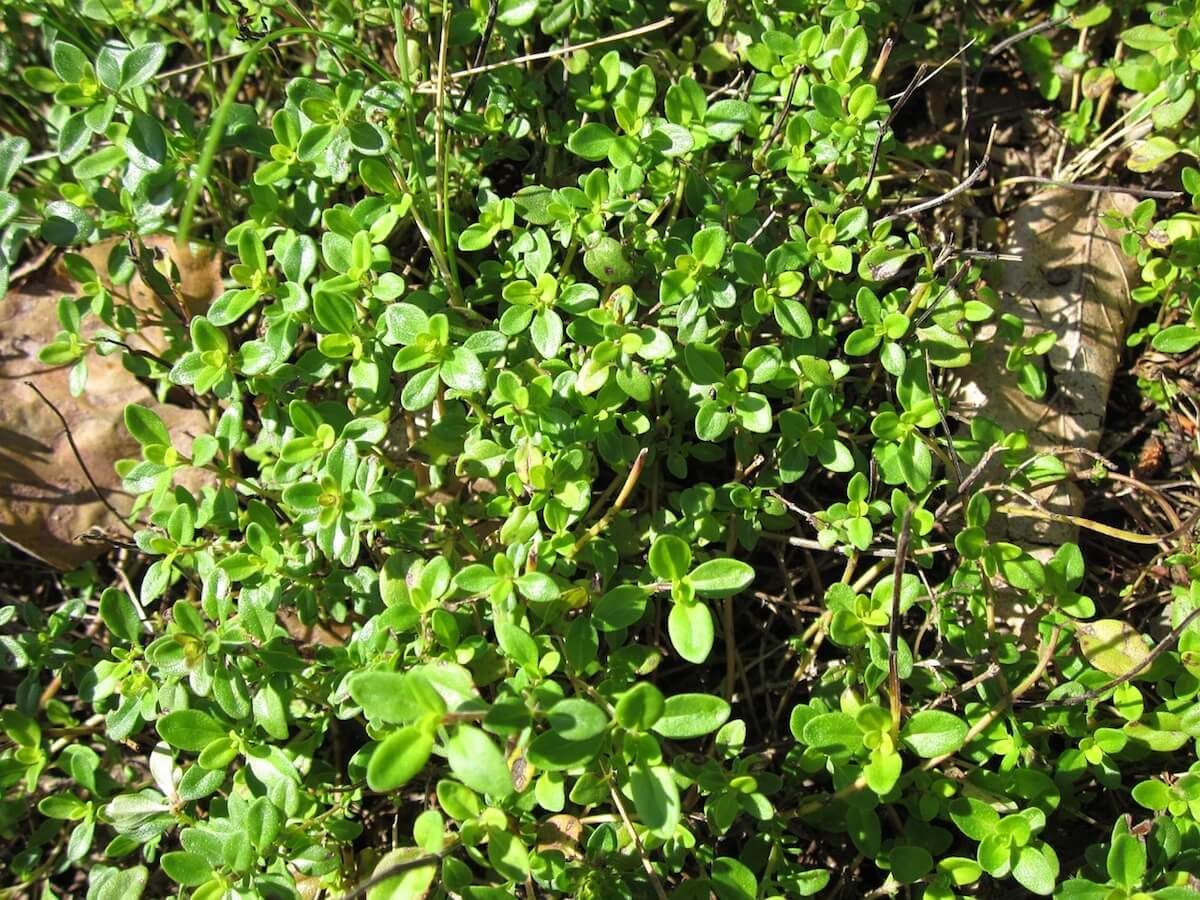
Lemon thyme is a small evergreen thyme whose leaves smell of lemon as well as thyme.12 It goes wherever both flavors fit: chicken, fish, vegetables, potatoes, stuffings and salads. Kew lists it as a hybrid, Thymus × citriodorus, but not every source agrees. This page covers that question, the surprisingly variable chemistry of its oil, how to cook with it, and the few safety points that apply.
At a glance
| Botanical name | Thymus × citriodorus (Pers.) Schreb.3 |
| Status | A hybrid of T. pulegioides × T. vulgaris per Kew; a distinct species per NC State Extension (see below)31 |
| Plant family | Lamiaceae (mint family)1 |
| Part used | Leaves and flowers, fresh or dried12 |
| Native range | Southwestern Europe (Kew)3 |
| Key aroma compounds | Geraniol and citral in some oils; other oils differ sharply (see below)45 |
| Plant size | Mounds 6–12 inches high, spreading to about 1 foot (NC State)1 |
| Forms sold | Fresh sprigs, potted plants, dried leaf |
Measured values
5 figures, sourced| Measure | Value | Scope | Source |
|---|---|---|---|
| Essential oil: terpinolene (peak) | 71 % of the oil | Toncer et al. 2017; plants grown in southeastern Anatolia, Turkey; at flowering | acikerisim.dicle.edu.tr |
| Essential oil yield | 2.0 % | Toncer et al. 2017; plants grown in southeastern Anatolia, Turkey; before flowering | acikerisim.dicle.edu.tr |
| Essential oil yield | 1.9 % | Toncer et al. 2017; plants grown in southeastern Anatolia, Turkey; at flowering | acikerisim.dicle.edu.tr |
| Essential oil yield | 1.3 % | Toncer et al. 2017; plants grown in southeastern Anatolia, Turkey; after flowering | acikerisim.dicle.edu.tr |
| Pyrrolizidine alkaloids, maximum (dried herbs) Limit | 400 µg/kg | EU Regulation 2023/915 | eur-lex.europa.eu |
Each figure is quoted as its source states it, with the samples or standard it applies to. Where sources differ, both are shown; nothing is averaged. All measured values
What lemon thyme is
NC State Extension describes lemon thyme as an evergreen subshrub in the mint family, possibly native to Europe, that mounds to 6–12 inches and spreads about a foot.1 Kew gives its native range as southwestern Europe.3 Its leaves and flowers are edible, raw or cooked.1
Hybrid or species?
The sources disagree, and the disagreement is worth knowing because it shows up on plant labels:
| Source | Position |
|---|---|
| Kew, Plants of the World Online | A hybrid, Thymus × citriodorus, with the formula T. pulegioides × T. vulgaris3 |
| NC State Extension | Once thought to be a hybrid, but DNA testing has determined it to be a distinct species1 |
NC State does not name the study it relies on, and we could not open one. Kew’s checklist is the botanical reference we follow elsewhere on this site, which is why the name on this page carries the ”×”. For common thyme, see thyme.
Cultivars
NC State lists several garden cultivars, including ‘Archers Gold’ and ‘Variegata’ with variegated leaves, ‘Doone Valley’ with leaves tipped in gold in fall and winter, and ‘Silver Queen’ with silver leaves and a lemon fragrance.1 We found no source describing cultivars named for other citrus fruits, such as an “orange thyme” form of lemon thyme.
Flavor and aroma
UF/IFAS Extension describes lemon thyme as adding a citrus overtone to the usual thyme flavor.2 Compared with common thyme it tastes softer and sweeter, with less of the sharp, medicinal edge; that comparison is ours. Common thyme’s oil is characterized by the phenols thymol and carvacrol,6 and see below for what has been measured in lemon thyme.
What’s in the oil
Lemon thyme is less studied than common thyme, and the two studies we could open point in different directions:
| Study and scope | What it found | Source |
|---|---|---|
| Jurevičiūtė et al. 2019, lemon thyme distilled for different lengths of time | Describes lemon thyme as a natural source of commercially important geraniol and citral; longer distillation lowered monoterpenes and raised sesquiterpenes, and distilling beyond 60 minutes added nothing | 5 |
| Toncer et al. 2017, plants grown in southeastern Anatolia, Turkey, at three growth stages | Main compounds terpinolene, α-terpineol, linalool, bornyl acetate and borneol; terpinolene peaked at 71% at flowering; oil yield 2.0% before flowering, 1.9% at flowering, 1.3% after | 4 |
Only the abstracts of both papers were available to us, so we cannot give the citral or geraniol percentages from the first study. The two results should not be merged: they describe different plant material grown in different places, and they show that “lemon thyme” oil is not one fixed composition.
Origin and history
Kew places lemon thyme’s native range in southwestern Europe.3 The word “thyme” came into English from Latin thymum, from Greek thymon.7 A popular explanation links it to Greek words for smoke or fumigation; the Online Etymology Dictionary reports that derivation and also notes that the linguist Beekes considered it doubtful and suggested a pre-Greek origin.7
Stories of Dioscorides and Pliny on thyme, and of Roman legions bringing thyme to England, concern thyme in general and could not be traced to a source we could open, so they are left out.
How lemon thyme is used
UF/IFAS Extension says lemon thyme can be used fresh or dried, and in any recipe calling for lemon juice, lemon zest or lemon flavoring.2 NC State notes that the leaves and flowers can be eaten raw in salads or cooked.1
Common kitchen uses, which are cooking judgment rather than sourced facts:
- Roast chicken and turkey, and the stuffing that goes with them.
- Fish and shellfish, especially baked or grilled with butter.
- Roast or boiled potatoes, carrots and green vegetables.
- Salads and dressings, using the small leaves raw.
- Shortbread, lemon cakes and fruit, where its lemon side leads.
Because its citrus notes are softer than the fruit, lemon thyme does not replace the acidity of lemon juice; add a squeeze if the dish needs sourness (editorial). It pairs naturally with oregano, basil, parsley and garlic. For more ideas, see lemon thyme uses.
Buying and quality
Fresh lemon thyme should smell of lemon when the leaves are rubbed; plants and sprigs vary, and some smell more of thyme than of lemon (kitchen judgment). We found no grading standard for lemon thyme.
Storage
We found no published shelf-life figure for fresh or dried lemon thyme from a regulator or extension service. Methods that work for common thyme apply; see how to store thyme. The practical test for dried lemon thyme is smell.
Safety
- US food status. FDA’s GRAS spice list names common thyme (Thymus vulgaris) and wild or creeping thyme (Thymus serpyllum).8 We found no separate entry for lemon thyme.
- Contaminants. EU law caps pyrrolizidine alkaloids in dried herbs at 400 µg/kg, apart from a short list of named exceptions that does not include thyme.9
This page makes no claim that lemon thyme treats or prevents any condition. Claims that it relieves bronchitis, whooping cough, gastritis or gingivitis, or that it is a rich source of vitamins, minerals, lutein or zeaxanthin, could not be traced to a source that supports them for lemon thyme.
Substitutes and comparisons
Common thyme plus a little lemon zest is the closest stand-in; lemon balm or lemon verbena bring the lemon but not the thyme (editorial). See lemon thyme substitutes.
- Thyme vs. lemon thyme
- Profiles: thyme, lemon balm, lemon verbena, lemongrass
- Related: too much thyme, cooking with thyme
Footnotes
-
Thymus citriodorus (Lemon Thyme), North Carolina Extension Gardener Plant Toolbox, NC State University. plants.ces.ncsu.edu · Reference work ↩ ↩2 ↩3 ↩4 ↩5 ↩6 ↩7 ↩8 ↩9 ↩10
-
Busbee, Andrews and Criss, “Lemon Thyme”, UF/IFAS Extension, 2024. sfyl.ifas.ufl.edu · Reference work ↩ ↩2 ↩3 ↩4
-
Thymus × citriodorus (Pers.) Schreb., Plants of the World Online, Royal Botanic Gardens, Kew. powo.science.kew.org · Reference work ↩ ↩2 ↩3 ↩4 ↩5 ↩6
-
Toncer et al., “Essential Oil Composition of Thymus x citriodorus (Pers.) Schreb. at Different Harvest Stages”, Notulae Botanicae Horti Agrobotanici Cluj-Napoca, 2017. acikerisim.dicle.edu.tr · Peer-reviewed ↩ ↩2
-
Jurevičiūtė et al., “Composition of essential oil of lemon thyme (Thymus × citriodorus) at different hydrodistillation times”, Natural Product Research, 2019. iris.unipa.it · Peer-reviewed ↩ ↩2
-
S.H. Widodo, Thymus vulgaris, Plant Resources of South-East Asia (PROSEA). uses.plantnet-project.org · Reference work ↩
-
“thyme (n.)”, Online Etymology Dictionary. etymonline.com · Reference work ↩ ↩2
-
21 CFR 182.10, US Food and Drug Administration. ecfr.gov · Regulator ↩
-
Commission Regulation (EU) 2023/915, Annex I, section 2.4. eur-lex.europa.eu · Regulator ↩