Spice Substitutes · Substitutes
Lemon Verbena Substitutes, Ranked by the Job Lemon Verbena Is Doing
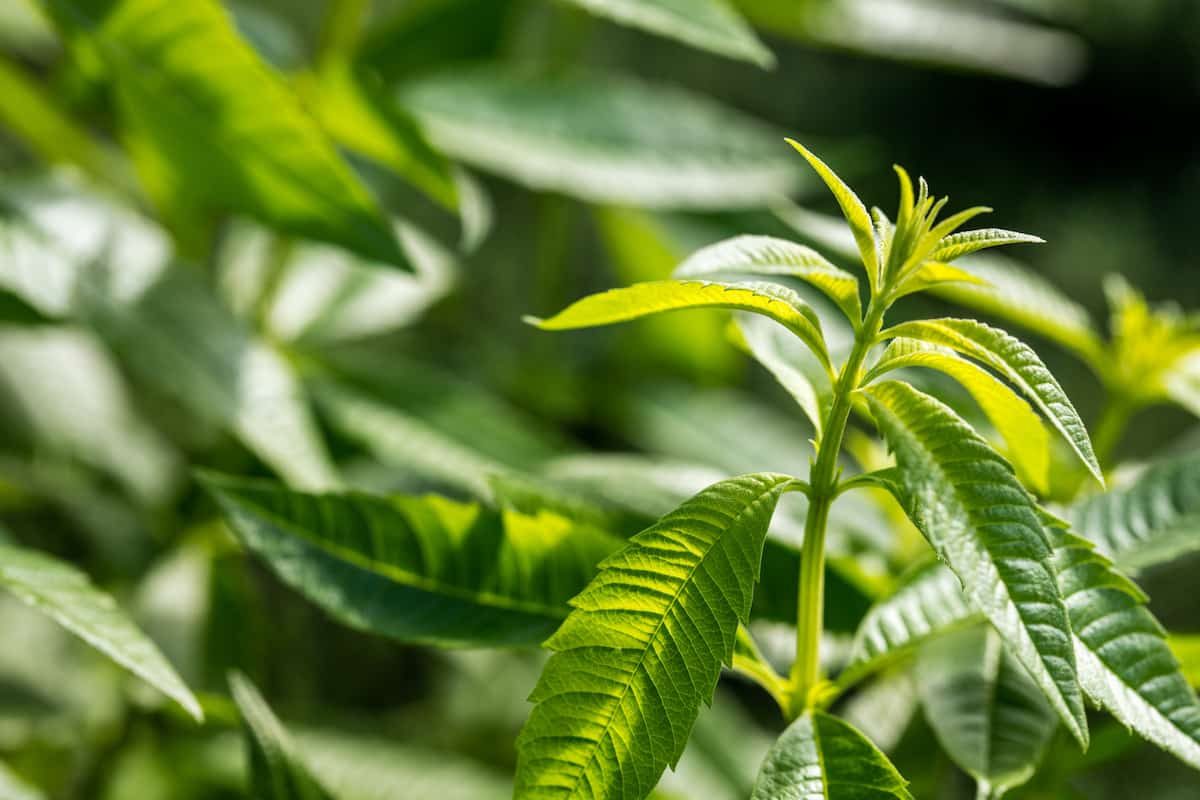
Lemon verbena, Aloysia citrodora, is a South American shrub in the verbena family, grown for its lemon-scented leaves.1 In a 2023 study, the two forms of citral, geranial and neral, were the major compounds of its oil,2 and Penn State Extension says the leaves “have the brightest and most intense lemon scent and flavor” of the lemon herbs.3 Several other plants owe their lemon scent to citral too, which is why they make the best substitutes. Which one to use depends on whether lemon verbena is steeped, eaten or cooked.
Quick answer
| What lemon verbena is doing | Best substitute | Starting amount, per 1 part fresh lemon verbena | Treatment |
|---|---|---|---|
| Tea, syrup, ice cream or sorbet infusion | Lemon balm | 1 part in a mixed tea blend; more if it is the only flavor | Attributed |
| Same, when you want a stronger lemon | Lemon myrtle | 1/4 part, then taste | Method |
| Fresh lemon perfume in desserts and raw dishes | Finely grated lemon zest | 1/4 part, then taste | Method |
| Lemon note in savory cooking (chicken, fish, broths) | Lemongrass | 1 part sliced stalk, then taste | Method |
| You have dried lemon verbena, not fresh | Dried lemon verbena | 1 teaspoon dried per 1 tablespoon fresh | Computed |
How the ratios on this page are labeled
- Computed: based on a measurable physical relationship, with the source named.
- Attributed: a named source publishes this ratio. We quote it as theirs.
- Disputed: named sources give different answers to the same swap. We show each one and do not average them.
- Method: we found no published ratio. We give a direction and a cautious starting point, and say so.
We found one published swap involving lemon verbena, in a single tea recipe. Everything else is a starting point, not a measured equivalence.
If lemon verbena is infused in tea, syrup or cream
According to Sprea and colleagues, fresh or dried lemon verbena leaves are often used in refreshing drinks and to flavor liqueurs, puddings and jams.2 Penn State suggests infusing the leaves for sorbet, ice cream or whipped cream.3 Here the leaf is steeped and strained out, so texture does not matter, only scent.
1. Lemon balm
Lemon balm, Melissa officinalis, is a mint-family herb, not a relative of lemon verbena.41 Its leaf oil is mainly citral, neral and citronellal,5 which puts it in the same chemical family of scents. It is the gentler herb: Penn State ranks lemon verbena as the most intense, and lemon balm has a soft, faintly minty background (our tasting note). Britannica lists herbal teas, fruit drinks and liqueurs among its uses.6
Ratio (Attributed): The Herb Society of America’s Sunshine Tea blend calls for “2 tablespoons lemon verbena (or substitute lemon balm),” alongside chamomile, green tea and lavender.7 That is an equal-volume swap inside a mixed blend. If lemon balm will be the only flavor in a tea or syrup, start with the same volume and add more after tasting, because it is milder; that adjustment is our judgment.
2. Lemon myrtle
Lemon myrtle is the leaf of an Australian tree whose distilled oil is typically 90 to 98 percent citral.8 Gernot Katzer groups it with lemon verbena, lemon balm and lemongrass as the herbs with the purest lemon scent.9 It suits teas, syrups and baking, but it is strong.
Ratio (Method): No published ratio was found. Start with a quarter of the lemon verbena amount if using dried lemon myrtle leaf, then taste.
3. Lemongrass
Lemongrass oil is also led by citral, a mix of geranial and neral.10 PROSEA describes its smell as fresh-grassy, lemon-like and tea-like,10 so expect a greener, grassier result than lemon verbena gives. For an infusion, slice and bruise a fresh stalk. Dried lemongrass works only where there is liquid: America’s Test Kitchen found it acceptable in a curry paste and a soup, but in a stir-fry it “retained the texture of hay.”11
Ratio (Method): No published ratio was found. Start with about the same volume of thinly sliced fresh stalk as lemon verbena leaves, steep, and taste.
If lemon verbena is a fresh lemon note in desserts or raw dishes
When chopped lemon verbena goes straight into a fruit salad, a cake batter or a dressing, you need something that can be eaten as is.
1. Lemon zest
Zest gives a clean lemon aroma that can be eaten without straining, but it has none of lemon verbena’s herbal, perfumed edge. That description is ours.
Ratio (Method): No published ratio was found. For each tablespoon of chopped fresh lemon verbena, start with about 3/4 teaspoon of finely grated zest, then taste. For scale, NDSU Extension counts 1 to 2 teaspoons of rind from one medium lemon.12
2. Lemon basil
In a 1999 Purdue comparison of commercial basil cultivars, citral was the predominant compound in all the lemon-scented basils.13 The Herb Society of America’s basil guide recommends ‘Mrs. Burns’ Lemon’ for vinaigrettes, beverages and desserts.14 Lemon basil still tastes of basil, and like other basils it is best added at the end of cooking, which LSU AgCenter advises for delicate herbs.15
Ratio (Method): No published ratio was found. Start with the same amount of torn or chopped leaves and taste.
If lemon verbena is seasoning a savory dish
1. Lemongrass
Britannica describes lemongrass as a rich lemon flavor without the acidity.16 The stalks are fibrous, so they are usually infused and then removed, while the tender center can be chopped finely and eaten.16 It is a natural fit for broths, marinades and fish cooked in parcels.
Ratio (Method): No published ratio was found. Start with 1 part sliced stalk per part lemon verbena, and remove the pieces before serving. With dried lemongrass, ATK uses half as much dried as fresh, in dishes with liquid only.11
2. Lemon thyme
Penn State describes lemon thyme as “a distinct thyme flavor with just overtones of lemon.”3 It works with chicken and fish, but its thyme character is strong for a dessert or a tea (editorial).
Ratio (Method): No published ratio was found. Start with the same amount and taste.
Fresh or dried lemon verbena
Penn State notes that lemon verbena leaves dry easily and says their scent and flavor last two to three years.3 That shelf-life figure is theirs; we found no other source to check it against.
Fresh to dried (Computed): NDSU and Penn State Extension both give the general herb rule of 1 tablespoon fresh to 1 teaspoon dried.1217 It was not measured for lemon verbena. In America’s Test Kitchen’s tests of dried herbs, tasters preferred fresh herbs in all but one application,18 so expect dried leaves to taste a little flatter.
What isn’t known
- No published measurement compares the lemon strength of lemon verbena with lemon balm, lemongrass, lemon myrtle, lemon basil or zest. Every ratio above except the Herb Society’s tea recipe is a starting point.
- Lemon verbena oil varies widely by origin. In studies reviewed by Sprea and colleagues, some samples were dominated by geranial and neral and others had little or none of either,2 so leaves from different sources may not taste the same.
- Lemon basil is sometimes described as a pungent herb used mostly in North African cooking. We found no source for the North African use, and PROSEA describes its parent, hoary basil, as mild in flavor and widely grown in Indonesia, Malaysia and Thailand.19 Kew lists lemon basil as a hybrid of hoary basil and sweet basil.20
Related
- Lemon verbena, lemon balm vs. lemon verbena and lemon verbena vs. lemongrass
- Lemon balm, lemongrass, lemon myrtle, lemon basil and lemon thyme
- Lemon balm substitutes, lemongrass substitutes and lemon thyme substitutes
- Dried vs. fresh herbs and cooking with lemongrass
Footnotes
-
Aloysia citrodora Paláu, Plants of the World Online, Royal Botanic Gardens, Kew. powo.science.kew.org · Reference work ↩ ↩2
-
Sprea et al., “Volatile Compounds and Biological Activity of the Essential Oil of Aloysia citrodora Paláu”, Molecules, 2023. mdpi.com · Peer-reviewed ↩ ↩2 ↩3
-
Smith and Marquesen, “Lemon-Scented Herbs in the Garden and the Kitchen”, Penn State Extension, 2025. extension.psu.edu · Reference work ↩ ↩2 ↩3 ↩4
-
Melissa officinalis L., Plants of the World Online, Royal Botanic Gardens, Kew. powo.science.kew.org · Reference work ↩
-
Assessment report on Melissa officinalis L., folium, European Medicines Agency. ema.europa.eu · Regulator ↩
-
Melissa Petruzzello, “Lemon balm”, Encyclopaedia Britannica. britannica.com · Reference work ↩
-
Paola Legarre, “Lavender in the Kitchen”, The Herb Society of America, 2025. blog.herbsociety.org · Publication ↩
-
Ian Southwell, “Backhousia citriodora F. Muell. (Lemon Myrtle), an Unrivaled Source of Citral”, Foods, 2021. mdpi.com · Peer-reviewed ↩
-
“Lemon Myrtle (Backhousia citriodora F. Muell.)”, Gernot Katzer’s Spice Pages. gernot-katzers-spice-pages.com · Reference work ↩
-
L.P.A. Oyen, Cymbopogon citratus, Plant Resources of South-East Asia (PROSEA). uses.plantnet-project.org · Reference work ↩ ↩2
-
“Dried vs. Fresh Lemongrass”, America’s Test Kitchen. americastestkitchen.com · Publication ↩ ↩2
-
Julie Garden-Robinson, “Ingredient Substitutions” (FN198), NDSU Extension, 2018. ksre.ksu.edu · Reference work ↩ ↩2
-
“Comparative evaluation of North American commercially available Ocimum basil cultivars”, Perspectives on New Crops and New Uses, Purdue University, 1999. hort.purdue.edu · Peer-reviewed ↩
-
Michele Meyers, “Basil: An Herb Society of America Guide”, The Herb Society of America, 2003. herbsociety.org · Reference work ↩
-
“Flavorful Herbs”, LSU AgCenter. lsuagcenter.com · Reference work ↩
-
Tony Hill, “Lemongrass”, Encyclopaedia Britannica. britannica.com · Reference work ↩ ↩2
-
“Preserving Herbs by Drying”, Penn State Extension. extension.psu.edu · Reference work ↩
-
“Science: Substituting Dried Herbs for Fresh”, America’s Test Kitchen. americastestkitchen.com · Publication ↩
-
A.T. Sunarto, Ocimum americanum, Plant Resources of South-East Asia (PROSEA). uses.plantnet-project.org · Reference work ↩
-
Ocimum × africanum Lour., Plants of the World Online, Royal Botanic Gardens, Kew. powo.science.kew.org · Reference work ↩