Herbs · Profile
Lemon Myrtle: Australia’s Citral-Rich Lemon Herb, Its Flavor and Uses
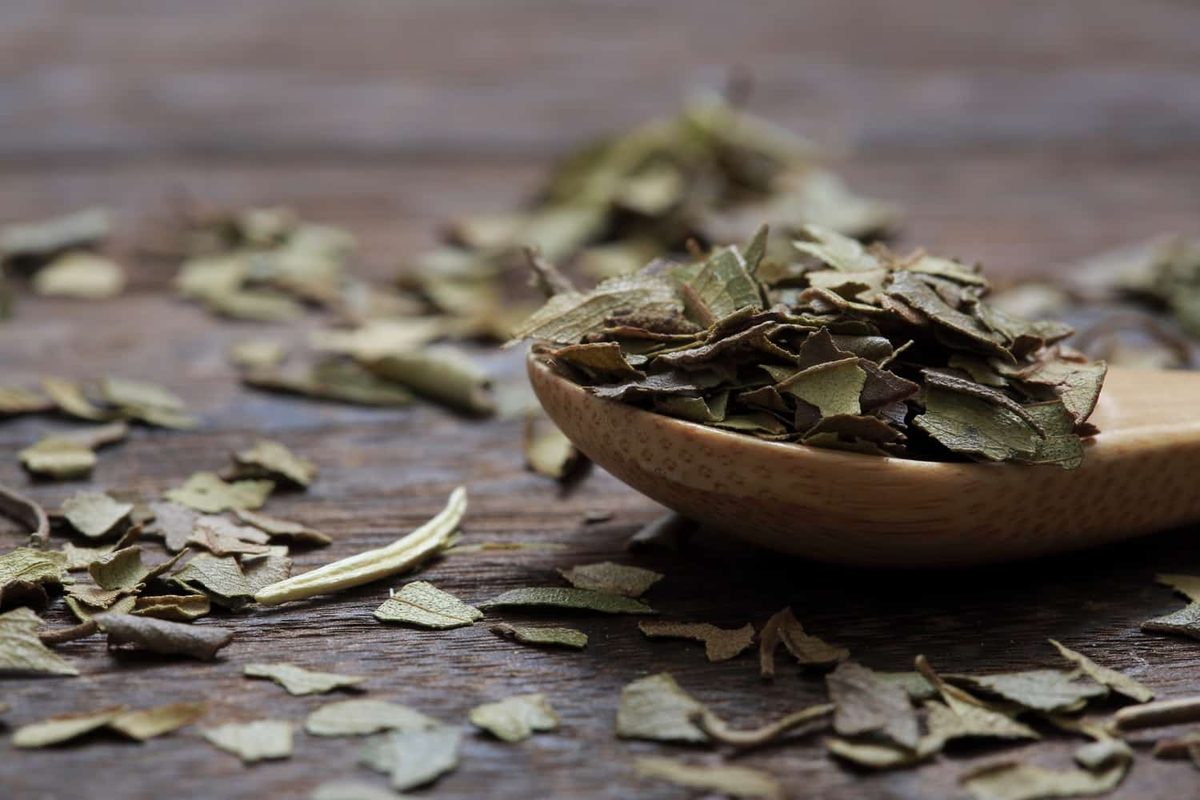
Lemon myrtle is the leaf of Backhousia citriodora, a shrub or small tree native to Queensland, Australia.1 Its leaf oil is almost all citral, the compound most responsible for a lemon note,23 and Katzer’s Spice Pages repeats a description of its scent as “more lemon than lemon.”2 A 2021 review rates it superior to the many other sources of citral.3 Cooks use the dried, ground leaf much as they would lemongrass or kaffir lime leaf, and in tea.
At a glance
| Botanical name | Backhousia citriodora F.Muell.1 |
| Plant family | Myrtaceae, the myrtle family1 |
| Native range | Queensland; wild populations include the Sunshine Coast around Eumundi, Maroochydore, Noosa and Woondum13 |
| Part used | Leaf, fresh or dried and ground; essential oil distilled from the leaf3 |
| Leaf essential oil | 4 to 5% of the leaf (Katzer); oil yield 1 to 3% from fresh leaf (Southwell)23 |
| Main aroma compound | Citral (neral plus geranial), about 90 to 98% of the oil234 |
| Australian production | 575 to 1,100 tonnes of leaf and 3 to 8 tonnes of oil in 2011 (2012 estimate)3 |
| Forms sold | Dried leaf, ground leaf, tea, essential oil |
Measured values
7 figures, sourced| Measure | Value | Scope | Source |
|---|---|---|---|
| Leaf essential oil | 4 to 5 % of the leaf | Katzer's Spice Pages; scope not further statedSources differ in basis: Katzer gives oil content of the leaf, Southwell gives distillation yield from fresh leaf | gernot-katzers-spice-pages.com |
| Essential oil yield | 1 to 3 % from fresh leaf | Southwell, as summarized in a 2021 reviewSources differ in basis (see Katzer row) | mdpi.com |
| Essential oil: citral (neral plus geranial) | 90 to 98 % of the oil | typical steam-distilled oil, as summarized in a 2021 review (Southwell)Sources differ | mdpi.com |
| Essential oil: citral (neral plus geranial) | 90 to 95 % of the oil | Katzer's reference figureSources differ | gernot-katzers-spice-pages.com |
| Essential oil: citral (neral plus geranial) | 89.78 % of the oil | one oil analyzed in a 2022 study (Lim et al.) | pmc.ncbi.nlm.nih.gov |
| Essential oil: geranial | 52.13 % of the oil | one oil analyzed in a 2022 study (Lim et al.) | pmc.ncbi.nlm.nih.gov |
| Essential oil: neral | 37.65 % of the oil | one oil analyzed in a 2022 study (Lim et al.) | pmc.ncbi.nlm.nih.gov |
Each figure is quoted as its source states it, with the samples or standard it applies to. Where sources differ, both are shown; nothing is averaged. All measured values
Flavor and aroma
Lemon myrtle tastes intensely of lemon peel and lemongrass, with a faint eucalyptus-like, herbal edge and none of a lemon’s sourness. That description is ours. Katzer describes the aroma as “intensive, refreshing and very, very lemon-like,” and the taste as very intense, pleasant and warm.2 He groups it with lemon verbena, lemon balm and lemongrass as having the purest lemon scent of all the lemon-scented herbs.2
The compounds
Citral occurs as two isomers, neral and geranial, and it dominates lemon myrtle oil:4
| Scope | Citral in the oil | Source |
|---|---|---|
| Typical steam-distilled oil, as summarized in a 2021 review | 90 to 98% | Southwell3 |
| Katzer’s reference figure | 90 to 95% | Katzer2 |
| One oil analyzed in a 2022 study | 89.78% (geranial 52.13%, neral 37.65%) | Lim et al.4 |
The review notes that both citronellal and citral can give a lemon note, and that citral is the preferred one; of the many sources of citral, it rates B. citriodora as superior.3 For other lemon-scented herbs, see lemongrass and lemon verbena vs. lemongrass.
Origin and history
The name. The genus is named after the English botanist James Backhouse, and the species was named by the botanist Ferdinand von Mueller.23 Citriodora means “lemon-scented.”2
Where it grows. Kew lists Queensland as its only native area.1 Katzer describes it as rare in the wild, restricted to Queensland and considered endangered.2
Aboriginal use. A lemon myrtle grower quoted by FoodNavigator in 2015 said it has been used as a flavoring and medicine by Aboriginal Australians “for 40,000 years.”5 That is a grower’s statement, not an ethnobotanical record. Specific traditional uses that are often described, such as inhaling vapors from heated leaves to treat colds, could not be traced to a documented source.
Commercial history. Katzer says the plant has been cultivated since the early 1990s.2 FoodNavigator reports that interest in Australian native foods around the Sydney 2000 Olympics helped revive the ingredient, and that Qantas later used it as a lemon flavoring on its premium menus.5 Several other details that circulate, including citral’s identification in lemon myrtle by the German firm Schimmel & Co. in the late 1880s, commercial distillation at Eumundi in the early 20th century, and use in soft drinks during World War II, could not be confirmed in any source checked for this page and are left out.
How it is used
- Poultry and seafood. Katzer says lemon myrtle leaves are often used to flavor poultry or seafood, and that one or two leaves give roast chicken a special touch.2
- In place of lime leaf. Australian cooks tend to use lemon myrtle instead of kaffir lime leaves in Southeast Asian recipes, though Katzer finds its very pure scent does not go so well with pungent fish pastes.2 See kaffir lime leaves.
- Dressings and condiments. It is popular in herbed vinegar, mayonnaise and vinaigrettes.2
- Tea and baking. The 2021 review notes its popularity as a lemon herbal tea and lists teas, breads, biscuits, cakes, cheeses and chutneys among the foods it turns up in.3
In practice, ground leaf is strong: start with a small pinch and add more after tasting, and add it late to sauces. That is kitchen judgment, not a sourced rate. It is also a way to bring lemon flavor to cream or custard without adding acid; that too is cooks’ practice.
For other Australian native flavorings, see Australian spices. For other lemon herbs, see lemon verbena, lemon balm, lemon thyme and lemon basil.
Buying and quality
Dried lemon myrtle should be green, not brown, and smell strongly of lemon when crushed; that is kitchen judgment. FoodNavigator reported in 2015 that farmgate prices for leaves reached up to US$25 per kilo, and that one producer had moved production to Malaysia.5
Storage
Keep dried or ground leaf airtight and away from light and heat. No shelf-life figure from a regulator or standards body was found for this page. A faint lemon smell when crushed is the practical sign it has gone stale; that is kitchen judgment.
Health claims and safety
What the research covers. Lemon myrtle oil has shown significant antimicrobial activity against Staphylococcus aureus, including methicillin-resistant strains (MRSA), in laboratory tests summarized in the 2021 review.3 A 2022 study measured activity of the oil against clinical S. aureus strains in the lab and cites another study in which it produced a large inhibition zone against MRSA.4 These are test-tube results on the concentrated oil. They do not show that eating lemon myrtle prevents or treats infections.
The review also says lemon myrtle extract is a source of lutein and other antioxidants, along with folate and the trace minerals magnesium and calcium.3 No measured amounts per serving were found, so claims that it protects eyesight or supplies meaningful calcium cannot be supported. Claims that it fights cancer could not be traced to any review or regulator, and none is made here.
Safety of the oil. The review reports that, in laboratory tests, both lemon myrtle oil and pure citral were highly toxic to human cell lines, and that citral was absorbed into skin.3 Citral is irritating and sensitizing to skin at high concentrations, and the review cites a recommendation to keep the oil below 1% in topical products.3 Australia’s Therapeutic Goods Administration had approved three lemon myrtle essential oil medicines by 2006.3
These findings concern the concentrated oil and pure citral, not the small amounts of dried leaf used in cooking. No regulator assessment of the culinary leaf was found for this page.
Substitutes and comparisons
- Lemongrass and lemongrass substitutes
- Lemon verbena and lemon verbena substitutes
- Lemon balm vs. lemon verbena
- Kaffir lime leaf substitutes
- Lemon pepper
Footnotes
-
Backhousia citriodora F.Muell., Plants of the World Online. powo.science.kew.org · Reference work ↩ ↩2 ↩3 ↩4 ↩5
-
Lemon Myrtle (Backhousia citriodora F. Muell.), Gernot Katzer’s Spice Pages. gernot-katzers-spice-pages.com · Reference work ↩ ↩2 ↩3 ↩4 ↩5 ↩6 ↩7 ↩8 ↩9 ↩10 ↩11 ↩12 ↩13 ↩14
-
Ian Southwell, “Backhousia citriodora F. Muell. (Lemon Myrtle), an Unrivaled Source of Citral”, Foods, 2021, MDPI. mdpi.com · Peer-reviewed ↩ ↩2 ↩3 ↩4 ↩5 ↩6 ↩7 ↩8 ↩9 ↩10 ↩11 ↩12 ↩13 ↩14 ↩15 ↩16
-
Lim et al., “Chemical Composition, Antioxidant, Antibacterial, and Antibiofilm Activities of Backhousia citriodora Essential Oil”, Molecules, 2022, MDPI, via PubMed Central. pmc.ncbi.nlm.nih.gov · Peer-reviewed ↩ ↩2 ↩3 ↩4
-
RJ Whitehead, “Lemon myrtle: Aboriginal functional favourite revived by Sydney Games”, 2015, FoodNavigator. foodnavigator.com · Publication ↩ ↩2 ↩3