Spices · Profile
Table Salt: What It Is, What’s Added to It, and Why It’s Iodized
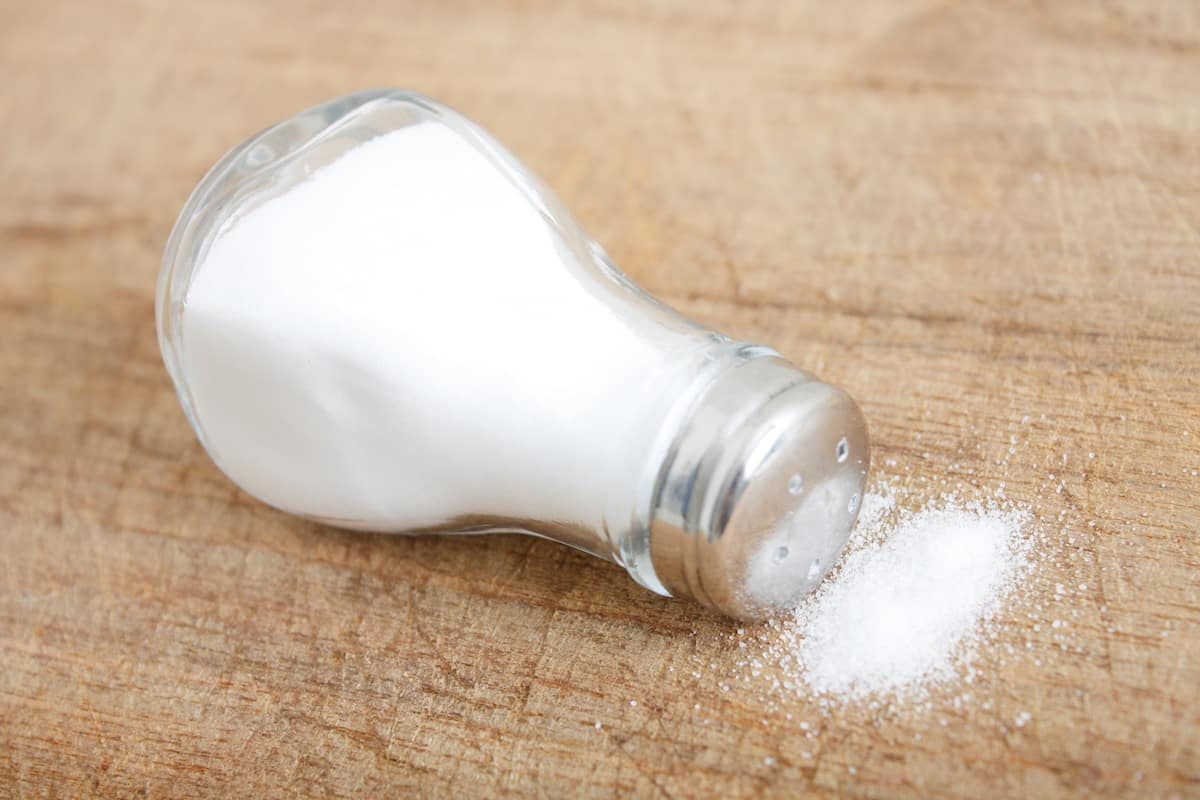
Table salt is fine-grained sodium chloride, about 40% sodium and 60% chloride by weight.1 It is the salt in the shaker and the one most American recipes assume when they say “salt.” What makes it different from kosher or sea salt is not the salt itself but the grain, which is small and uniform, and what is added to it: usually an anticaking agent, and in iodized salt, iodine.2 This page covers how it is made, what goes into the box, why iodization matters, and what salt does to flavor.
At a glance
| What it is | Sodium chloride, about 40% sodium and 60% chloride1 |
| How it’s made | Mined from salt deposits, processed to a fine texture1; crystals formed by rapid vacuum evaporation2 |
| Crystal form | Tiny, uniformly shaped crystals2 |
| Additives | Usually an anticaking agent2. Morton’s iodized salt lists salt, calcium silicate (anticaking agent), dextrose and potassium iodide3 |
| Iodine (iodized salt, US) | 45 mcg per gram4 |
| Grams per teaspoon | About 6 g (ATK); Morton’s label gives 1.5 g per ¼ teaspoon53 |
| Sodium per teaspoon | About 2,300 mg (FDA); 2,400 mg (AHA)61 |
| International standard | Codex CXS 150-1985: at least 97% sodium chloride on a dry basis7 |
Measured values
7 figures, sourced| Measure | Value | Scope | Source |
|---|---|---|---|
| Sodium Nutrient | about 40 % by weight | Table salt (American Heart Association) | heart.org |
| Chloride Nutrient | 60 % by weight | Table salt (American Heart Association) | heart.org |
| Sodium chloride, minimum Limit | 97 % of dry matter, excluding additives | Codex CXS 150-1985 (rev. 2012), food-grade salt | services.bis.gov.in |
| Iodine Nutrient | 45 mcg per gram | Iodized salt in the US (NIH ODS) | ods.od.nih.gov |
| Iodine | 47.5 to 50.7 mcg per gram, average | Measured samples of US iodized salt (NIH ODS) | ods.od.nih.gov |
| Sodium Nutrient | about 2,300 mg per teaspoon | Table salt, FDA (Daily Value described as about a teaspoon of table salt)Sources differ: AHA gives 2,400 mg. | fda.gov |
| Sodium Nutrient | 2,400 mg per teaspoon | Table salt, American Heart AssociationSources differ: FDA gives about 2,300 mg. | heart.org |
Each figure is quoted as its source states it, with the samples or standard it applies to. Where sources differ, both are shown; nothing is averaged. All measured values
What table salt is
All food-grade salt is mostly sodium chloride. The Codex Alimentarius standard requires at least 97% sodium chloride on a dry-matter basis, not counting additives, whether the salt comes from the sea, rock deposits or natural brine.7 Table salt sits at the refined end of that range. The American Heart Association describes it as mined from salt deposits and processed to a fine texture that is easy to mix, a process that strips out other minerals.1 America’s Test Kitchen describes its tiny, uniform crystals as the product of rapid vacuum evaporation, and notes that it usually contains anticaking agents that help it pour smoothly.2
In the United States in 2024, highway deicing alone accounted for about 41% of the salt consumed.8 By type, US salt sold or used that year was 42% salt in brine, 40% rock salt, 9% solar salt and 9% vacuum pan salt.8 Worldwide, the USGS puts 2024 production at about 280 million tonnes, led by China (55 million), the United States (40 million) and India (28 million).8
What’s in the box
Read the ingredient list. Morton’s iodized table salt lists salt, calcium silicate (an anticaking agent), dextrose and potassium iodide.3 Under US rules, salt with added iodide (as potassium or cuprous iodide) may be labeled “iodized salt” and must carry the statement “This salt supplies iodide, a necessary nutrient”; plain salt must say it does not supply iodide.9 Salt containing an anticaking agent may also be labeled “free flowing.”9
Flavor
Salt does more than make food taste salty. In lab taste studies, salt suppresses bitterness: in one 2010 study of taste mixtures, sodium chloride and sucrose together were the main sources of bitterness suppression.10 Salt also sharply reduced perceived sourness in a 1967 study of salt and citric acid mixtures, tested in water and in a vegetable purée.11 Both were tests of solutions or simple mixtures, so they show the direction of the effect, not how it plays out in every dish.
Iodine is often blamed for a bitter or metallic edge in table salt. ATK’s tasters found no detectable difference in taste between iodized and noniodized salt.2 Where table salt does differ is texture and density: its fine grains dissolve fast and pack tightly into a spoon, so a teaspoon of table salt holds more salt than a teaspoon of most kosher or flaky salts (see kosher salt for the numbers).
History
Salt has a long political history, though much of what circulates about it is hard to source. Two episodes are well documented:
- France. The gabelle was a tax in prerevolutionary France; from the 15th century the word came to mean specifically the salt tax. Its unpopularity showed up in the lists of grievances drawn up for the Estates-General of 1789, and it was abolished in March 1790.12
- India. The Salt March led by Mahatma Gandhi, also called the Dandi March, took place in Gujarat in March and April 1930. Britannica describes it as a major nonviolent protest action and the first act of a larger civil disobedience campaign against British rule.13
Other widely repeated stories, that Greeks bought slaves with salt (the supposed source of “not worth his salt”), that salt was worth its weight in gold in Rome, that Venice rose on a salt monopoly, and that salt shaped the Lewis and Clark expedition and Civil War strategy, could not be traced to a source we could open, so they are left out here.
How table salt is used
Table salt is the default for most cooking and nearly all baking. ATK makes it the go-to for most cooking because it dissolves easily.2 In baking, where salt must disperse evenly through a dough or batter and is measured by volume, fine table salt is the predictable choice; that is common practice. Iodized and noniodized salt can be used interchangeably for flavor, per ATK’s test.2 For canning and pickling, cooks often reach for a pure salt without additives; see pickling salt.
Converting from table salt
Because table salt is dense, swapping in another salt by volume changes the amount of salt. ATK gives 1 teaspoon of table salt as equal to 1½ teaspoons of Morton kosher salt or 2 teaspoons of Diamond Crystal; Morton’s own chart gives 1¼ teaspoons of its kosher salt. The sources disagree, and the kosher salt page sets out both. When in doubt, weigh.
Storage
We found no shelf-life figure for plain salt from a regulator or standards body. For iodized salt, the Codex standard includes storage precautions intended to limit iodine loss.7 Keep it dry and closed.
Iodine
Salt iodization programs have dramatically reduced iodine deficiency worldwide.4 US salt makers have added iodine to table salt since the 1920s, and iodization is still voluntary in the United States.4 Iodized salt in the US contains 45 mcg of iodine per gram, and measured samples have averaged 47.5 to 50.7 mcg per gram.4 The adult recommended intake is 150 mcg a day.4
Two catches. First, most salt in the American diet comes from processed foods, and food manufacturers almost always use noniodized salt; if they use iodized salt, they must say so in the ingredient list.4 Second, specialty salts such as sea salt, kosher salt, Himalayan salt and fleur de sel are not usually iodized.4 A kitchen that cooks only with noniodized specialty salt gets little or no iodine from it; the ODS notes that noniodized sea salt provides virtually no iodine.4
Internationally, the Codex standard says food-grade salt shall be iodized in iodine-deficient areas, with levels set by national health authorities.7 The WHO’s 2014 guideline covers fortifying food-grade salt with iodine to prevent iodine deficiency disorders, and the WHO recommends potassium iodate for its stability.144 About 88% of households worldwide now use iodized salt.4 For more, see iodized vs. non-iodized salt.
Sodium and health
Table salt is the reference point for sodium advice. The FDA’s Daily Value for sodium is less than 2,300 mg a day, about a teaspoon of table salt, and Americans average about 3,400 mg.6 The AHA puts a teaspoon of table salt at 2,400 mg of sodium.1 The WHO recommends adults stay under 2,000 mg of sodium (under 5 g of salt) a day and names raised blood pressure as the main health effect of high sodium intake.15
Claims that table salt treats low blood pressure or that low salt intake causes type 2 diabetes appear in older writing on salt. We found no regulator or systematic review supporting them, and this page makes no claim that salt treats or prevents any condition. Its established public-health role is as a carrier for iodine.4
Comparisons and related pages
- Kosher salt vs. table salt
- Table salt vs. sea salt
- Himalayan salt vs. table salt
- Rock salt vs. table salt
- Celtic sea salt vs. table salt
- Sea salt vs. iodized salt
- MSG vs. salt
- The best salt for cooking
If a dish has gone over, see too much salt or how to fix salty gravy.
Footnotes
-
Sodium Sources: Where Does All That Sodium Come From?, American Heart Association, 2025. heart.org · Reference work ↩ ↩2 ↩3 ↩4 ↩5 ↩6
-
Salt Types and Measurements, America’s Test Kitchen. americastestkitchen.com · Publication ↩ ↩2 ↩3 ↩4 ↩5 ↩6 ↩7 ↩8
-
Morton Iodized Table Salt, product page, Morton Salt. mortonsalt.com · Merchant ↩ ↩2 ↩3
-
Iodine: Fact Sheet for Health Professionals, NIH Office of Dietary Supplements. ods.od.nih.gov · Regulator ↩ ↩2 ↩3 ↩4 ↩5 ↩6 ↩7 ↩8 ↩9 ↩10 ↩11
-
Kate Shannon Levine, The Best Kosher Salt, America’s Test Kitchen, 2019. americastestkitchen.com · Publication ↩
-
Sodium in Your Diet, U.S. Food and Drug Administration. fda.gov · Regulator ↩ ↩2
-
Standard for Food Grade Salt, CXS 150-1985 (rev. 2012), Codex Alimentarius. services.bis.gov.in · Standard ↩ ↩2 ↩3 ↩4
-
Wallace P. Bolen, Salt, Mineral Commodity Summaries 2025, U.S. Geological Survey. pubs.usgs.gov · Regulator ↩ ↩2 ↩3
-
21 CFR 100.155, Salt and iodized salt, Electronic Code of Federal Regulations. ecfr.gov · Regulator ↩ ↩2
-
Green BG et al., Taste Mixture Interactions: Suppression, Additivity, and the Predominance of Sweetness, Physiology & Behavior, 2010. pmc.ncbi.nlm.nih.gov · Peer-reviewed ↩
-
Pangborn RM, Trabue IM, Detection and apparent taste intensity of salt–acid mixtures in two media, Perception & Psychophysics, 1967 (abstract). doi.org · Peer-reviewed ↩
-
Gabelle, Encyclopaedia Britannica. britannica.com · Reference work ↩
-
Kenneth Pletcher, Salt March, Encyclopaedia Britannica. britannica.com · Reference work ↩
-
Guideline: fortification of food-grade salt with iodine for the prevention and control of iodine deficiency disorders, World Health Organization, 2014. who.int · Regulator ↩
-
Sodium reduction, World Health Organization fact sheet, 2026. who.int · Regulator ↩