Seasonings · Profile
Garlic Salt: What’s in the Jar, How Much Sodium It Carries, and How to Use It
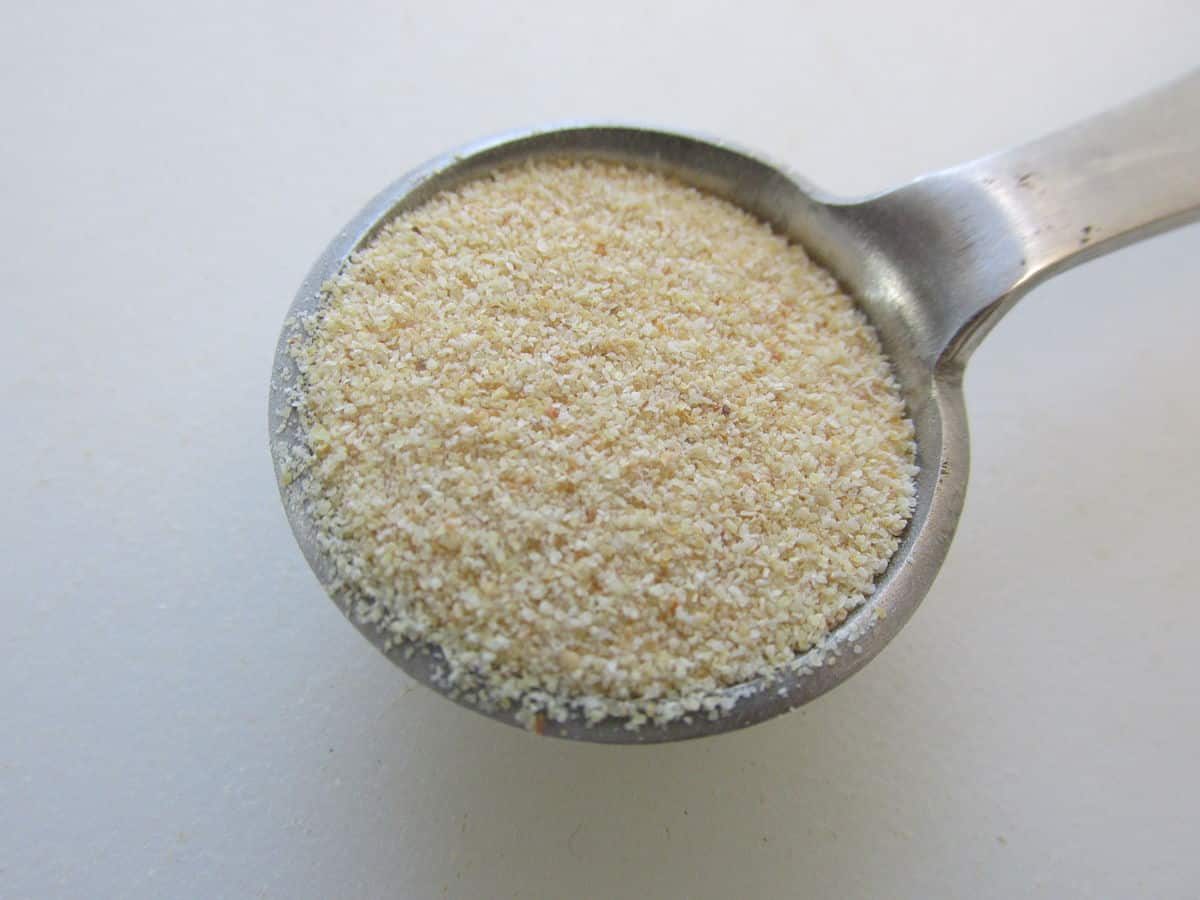
Garlic salt is salt blended with dried garlic, and it is mostly salt. McCormick’s garlic salt lists salt, garlic, an anticaking agent and garlic oil, and carries 540 mg of sodium per ¼ teaspoon.1 Morton’s iodized table salt carries 590 mg in the same measure.2 By volume, then, garlic salt is a salt that tastes of garlic, and it should be measured like one.
At a glance
| What it is | Salt plus dried garlic, often with an anticaking agent; some brands add parsley, sugar or starch13 |
| Plant | Garlic, Allium sativum L., family Amaryllidaceae4 |
| Native range of garlic | Central Asia to northeastern Iran4 |
| Sodium, per ¼ teaspoon | McCormick Garlic Salt 540 mg; Lawry’s Garlic Salt with Parsley 350 mg; Morton Iodized Table Salt, for comparison, 590 mg132 |
| Home ratio | 4 parts salt to 1 part garlic powder (UC Agriculture and Natural Resources)5 |
| Swap with fresh garlic | ¾ teaspoon garlic salt for 1 medium clove (NDSU Extension)6 |
Measured values
2 figures, sourced| Measure | Value | Scope | Source |
|---|---|---|---|
| Sodium | 540 mg per 1/4 teaspoon | McCormick Garlic Salt label, 5.25 ozcompany's own figures | stopandshop.com |
| Sodium | 350 mg per 1/4 teaspoon | Lawry's Garlic Salt with Parsley label, 6 ozDifferent brand and formula from the McCormick row; brand figures, not a category value; company's own figures | stopandshop.com |
Each figure is quoted as its source states it, with the samples or standard it applies to. Where sources differ, both are shown; nothing is averaged. All measured values
What’s in it
Garlic salt is a blend, and the blend differs by brand. Two common US jars show how much:
| Brand | Ingredients, as labeled | Sodium per ¼ tsp |
|---|---|---|
| McCormick Garlic Salt | Salt, garlic, calcium silicate (to make free flowing) and garlic oil1 | 540 mg1 |
| Lawry’s Garlic Salt with Parsley | Salt, garlic, modified corn starch, sugar, parsley, garlic oil and extractives of carrot (color)3 | 350 mg3 |
Neither label gives the proportion of salt to garlic. For a homemade version, UC Agriculture and Natural Resources gives 4 parts salt to 1 part garlic powder, blended briefly, so salt is four-fifths of the mix.5
The garlic itself is dried garlic. Powdered or dehydrated garlic is usually made from cloves that are sliced and dried at a low temperature.7 McCormick says its garlic salt starts with fresh, whole garlic, dried and ground before it is blended with a touch of garlic oil and salt.1 The anticaking agent is there to keep the blend pouring; McCormick’s is calcium silicate.1
Flavor and the compounds behind it
In garlic, the enzyme alliinase acts on alliin to create allicin, and heat can inactivate alliinase.87 America’s Test Kitchen found that garlic powder straight from the jar has not developed its full flavor, and that mixing it with water first activates alliin and alliinase to create allicin.8 That test was on garlic powder; we found no equivalent test on garlic salt.
In the jar, garlic salt tastes of salt first and garlic second. The garlic is the milder, rounder flavor of dried garlic rather than the bite of fresh cloves. Because the two are fixed together, you cannot add more garlic flavor without adding more salt. Those points are editorial.
Origin and history
Garlic is native to Central Asia to northeastern Iran, according to Kew.4 We found no record of who first sold garlic salt or when, and no source for its early history, so this page doesn’t offer one.
How garlic salt is used
As the salt in a dish. Garlic salt works best when it replaces some or all of the plain salt, not when it is added on top. McCormick suggests it for burgers, chili, tacos and meatloaf.1 It is a common choice for garlic bread, rubs for grilled meat, roasted potatoes, popcorn and roasted nuts; those are common uses, not sourced claims.
In place of fresh garlic. NDSU Extension pairs ¾ teaspoon of garlic salt with one medium clove of garlic or ½ teaspoon of minced fresh garlic.6 Going from garlic salt to fresh garlic removes salt from the dish, so add plain salt back to taste. Going the other way, cut the recipe’s salt.
Getting more garlic flavor. Following America’s Test Kitchen’s result for garlic powder, stir garlic salt into a little water, butter or the dish’s liquid before using it, rather than sprinkling it dry onto a hot pan.87
Buying and quality
Read the ingredient list. A plain garlic salt lists salt and garlic and perhaps an anticaking agent; others add parsley, sugar, starch or color.13 Sodium varies by brand too: per ¼ teaspoon, McCormick’s has about 54% more than Lawry’s.13 Common practice is to replace a jar once it no longer smells clearly of garlic.
Storage
UC Agriculture and Natural Resources advises packing dried garlic in an airtight container.5 We found no shelf-life figure for garlic salt from a regulator or standards body. Keep it closed, dry and away from heat, as with other ground seasonings.
Safety and health
Sodium. At McCormick’s figure of 540 mg per ¼ teaspoon, one teaspoon of garlic salt carries about 2,160 mg of sodium, close to the FDA’s Daily Value of less than 2,300 mg a day.19 The World Health Organization recommends that adults stay below 2,000 mg of sodium a day and names raised blood pressure as the main health effect of high intake.10 Table salt is about 40% sodium,11 and garlic salt is mostly salt.
Health claims. Garlic salt is sometimes said to supply useful amounts of iron, copper, vitamin B6, amino acids and fiber. At the amounts anyone eats, the sodium is the figure that matters, and we found no analysis showing garlic salt as a meaningful source of any of these. The garlic research summarized by the NIH’s National Center for Complementary and Integrative Health concerns garlic supplements: limited evidence suggests they may reduce blood pressure, and they may reduce total cholesterol.12 None of that applies to a salt blend, and this page makes no such claim for it.
Substitutes and comparisons
- Garlic salt substitutes
- Garlic powder vs. garlic salt
- Garlic powder, granulated garlic vs. garlic powder and garlic powder vs. fresh garlic
- Garlic and too much garlic powder
- Other flavored salts: onion salt, celery salt, seasoned salt
- Table salt and too much salt
Footnotes
-
McCormick Garlic Salt, label ingredients, Nutrition Facts and description as listed by Stop & Shop. stopandshop.com · Merchant ↩ ↩2 ↩3 ↩4 ↩5 ↩6 ↩7 ↩8 ↩9 ↩10 ↩11
-
Morton Iodized Table Salt, Nutrition Facts, Morton Salt. mortonsalt.com · Merchant ↩ ↩2
-
Lawry’s Garlic Salt with Parsley, label ingredients and Nutrition Facts as listed by Stop & Shop. stopandshop.com · Merchant ↩ ↩2 ↩3 ↩4 ↩5 ↩6
-
Allium sativum L., Plants of the World Online, Royal Botanic Gardens, Kew. powo.science.kew.org · Reference work ↩ ↩2 ↩3
-
Linda J. Harris, Garlic: Safe Methods to Store, Preserve, and Enjoy, UC Agriculture and Natural Resources, 2016. ccfruitandnuts.ucanr.edu · Reference work ↩ ↩2 ↩3
-
Julie Garden-Robinson, Ingredient Substitutions, NDSU Extension, 2018. ksre.ksu.edu · Reference work ↩ ↩2
-
Garlic, Linus Pauling Institute, Oregon State University. lpi.oregonstate.edu · Reference work ↩ ↩2 ↩3
-
Carolyn Grillo, For Great Garlic Bread, Hydrate Your Garlic Powder First, America’s Test Kitchen, 2021. americastestkitchen.com · Publication ↩ ↩2 ↩3
-
Sodium in Your Diet, U.S. Food and Drug Administration. fda.gov · Regulator ↩
-
Sodium reduction, World Health Organization fact sheet, 2026. who.int · Regulator ↩
-
Sodium Sources: Where Does All That Sodium Come From?, American Heart Association, 2025. heart.org · Reference work ↩
-
Garlic: Usefulness and Safety, National Center for Complementary and Integrative Health, 2025. nccih.nih.gov · Regulator ↩