Seasonings · Profile
Seasoned Salt: What’s in It, How Much Sodium It Has and How to Use It
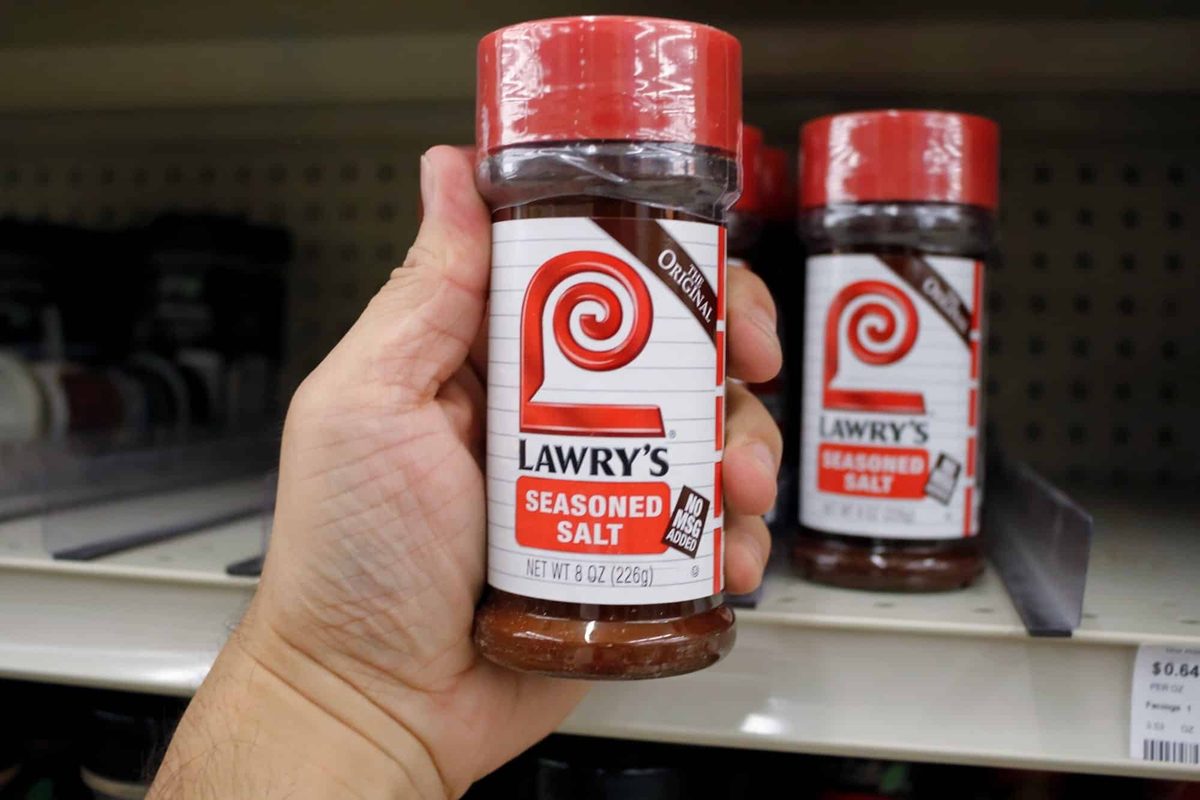
Seasoned salt is salt blended with a little sugar and a savory mix of paprika, onion, garlic and other spices, used as an all-purpose shake-on seasoning for meat, potatoes and fries. Salt is the first ingredient in every brand checked here, so it behaves in cooking mostly like salt with a warm color and a hint of sweetness. This page compares the labels of named brands, shows how much sodium they carry, tells the documented part of the Lawry’s story, and covers how to use it.
At a glance
| What it is | A blend of salt, sugar or a starch, and ground spices and aromatics |
| Main ingredient | Salt, listed first on every label checked123 |
| Typical spices | Paprika, celery seed, onion, garlic; turmeric (Lawry’s); chili and black pepper (Morton)13 |
| Sodium | 350 to 380 mg per 1/4 teaspoon in the regular blends checked13 |
| Best-known brand | Lawry’s, created by Lawrence Frank in 19384 |
| Standard recipe | None; each maker sets its own |
Measured values
3 figures, sourced| Measure | Value | Scope | Source |
|---|---|---|---|
| Sodium Nutrient | 380 mg per 1/4 teaspoon (1.2 g) serving | Lawry's The Original Seasoned Salt, 16 oz, Nutrition Facts via retailer listing (17% DV)Company's own figures. | shoprite.com |
| Sodium Nutrient | 270 mg per 1/4 teaspoon (1.2 g) serving | Lawry's 25% Less Sodium Seasoned Salt, 8 oz, Nutrition Facts via retailer listing (12% DV)Company's own figures. | shoprite.com |
| Sodium Nutrient | 350 mg per 1/4 teaspoon (1.1 g) serving | Morton Season-All Seasoned Salt, 8 oz, product page (15% DV)Company's own figures. | mortonsalt.com |
Each figure is quoted as its source states it, with the samples or standard it applies to. Where sources differ, both are shown; nothing is averaged. All measured values
What’s in it: labels side by side
| Product | Ingredients as labeled | Sodium per 1/4 tsp | Source |
|---|---|---|---|
| Lawry’s The Original Seasoned Salt | Salt, sugar, spices (including paprika, celery seed, turmeric), onion, corn starch, garlic, tricalcium phosphate (to make free flowing), extractives of paprika and natural flavor | 380 mg in 1.2 g (17% DV) | 1 |
| Lawry’s 25% Less Sodium Seasoned Salt | Salt, potassium chloride, sugar, spices (including paprika, celery seed, turmeric), onion, corn starch, garlic, extractives of paprika, natural flavor | 270 mg in 1.2 g (12% DV) | 2 |
| Morton Season-All Seasoned Salt | Salt, spices (including chili pepper, black pepper and celery seed), maltodextrin, paprika; 2% or less of onion, garlic, silicon dioxide, annatto (color), calcium silicate | 350 mg in 1.1 g (15% DV) | 3 |
| For comparison: Morton Iodized Table Salt | Salt, calcium silicate, dextrose, potassium iodide | 590 mg in 1.5 g | 5 |
US labels list ingredients in descending order of predominance by weight,6 so salt is the largest ingredient in each. Lawry’s lists sugar second; Morton lists no sugar but includes maltodextrin. The reduced-sodium Lawry’s lists potassium chloride as its second ingredient.2
Dividing each label’s sodium by its serving weight (our arithmetic) gives about 32% sodium by weight for both regular seasoned salts, about 22% for the reduced-sodium Lawry’s, and about 39% for Morton’s table salt. The American Heart Association puts table salt at about 40% sodium.7 So, gram for gram, regular seasoned salt carries roughly four-fifths of the sodium of plain salt.
Both Lawry’s and Morton call their products “seasoned salt.”13
Flavor
Seasoned salt tastes salty first, then mildly sweet and savory, with paprika’s warm color and a background of onion, garlic and celery; Morton’s version adds a little heat from chili and black pepper. That description is ours. Neither label lists MSG.13
History: Lawry’s
Lawry’s own timeline tells the story. Brothers-in-law Lawrence Frank and Walter Van de Kamp co-founded a Los Angeles roadhouse in 1922 that became the Tam O’Shanter, and partnered again in 1938 to open Lawry’s The Prime Rib.4 The same timeline says that, after three months of nightly experiments in his home kitchen, Frank developed a combination of 17 herbs and spices to complement prime rib, and lists Lawry’s Seasoned Salt under 1938.4 Richard N. Frank built Lawry’s Foods into an international brand before the company was sold in 1979.4
McCormick bought the Lawry’s and Adolph’s brands from Conopco, a Unilever subsidiary, for $604 million in cash, completing the deal on 1 August 2008.8
Several further details circulate: that the blend was first kept only on the restaurant’s tables, that diners carried the shakers home, that it reached stores in 1938 as the first product of its kind, and that it came to rival table salt in sales. We could not find a source for any of them, so they are not given as fact here.
How to use it
Morton suggests Season-All for ribs, beef, pork, chicken and potatoes.3 Beyond that, common uses include:
- As a table seasoning on fries, eggs, corn and baked potatoes.
- On beef before roasting or grilling: prime rib, steaks, roast beef.
- In ground meat for burgers and meatloaf, mixed in or sprinkled on the outside.
- As the base of a dry rub, with extra pepper, garlic or brown sugar added.
Those suggestions are cooking judgment. The one rule that matters: seasoned salt is salt, so treat it as part of the dish’s salt, not as a spice on top of it. If a recipe already calls for salt, cut that salt when you add seasoned salt.
Buying and storage
Compare labels for sugar, MSG, anticaking agents and sodium per serving; they differ more than the name suggests. No regulator publishes a shelf life for seasoning blends. Common practice is to keep the container closed and dry so it does not clump, and to replace it when the paprika has faded from red to brown.
Health and sodium
Sodium is the health point. A teaspoon of Lawry’s Original works out to about 1,520 mg of sodium (4 times the 380 mg label serving; our arithmetic),1 against the FDA’s Daily Value of less than 2,300 mg a day9 and the World Health Organization’s advice that adults take in less than 2,000 mg a day.10 The WHO says the main health effect of high-sodium diets is raised blood pressure, which increases the risk of cardiovascular diseases, gastric cancer and kidney disease, among others.10
The reduced-sodium Lawry’s carries 270 mg per serving instead of 380 mg, and lists potassium chloride right after salt.12 The spices themselves are present in amounts too small to matter nutritionally; this page makes no health claims for them.
Substitutes and related pages
See seasoned salt substitutes for stand-ins. Related blends: garlic salt, onion salt, celery salt and all-purpose seasoning. Key ingredients: table salt, paprika, garlic powder and onion powder. For dishes it suits, see spices for hamburgers, best spices for steak and seasonings for fries. If a dish ends up too salty, see too much salt.
Footnotes
-
Lawry’s The Original Seasoned Salt, 16 oz, label ingredients and Nutrition Facts via ShopRite. shoprite.com · Merchant ↩ ↩2 ↩3 ↩4 ↩5 ↩6 ↩7 ↩8
-
Lawry’s 25% Less Sodium Seasoned Salt, 8 oz, label ingredients and Nutrition Facts via ShopRite. shoprite.com · Merchant ↩ ↩2 ↩3 ↩4
-
Season-All Seasoned Salt, Morton Salt. mortonsalt.com · Merchant ↩ ↩2 ↩3 ↩4 ↩5 ↩6 ↩7
-
Our Story, Lawry’s The Prime Rib. lawrysonline.com · Merchant ↩ ↩2 ↩3 ↩4
-
Morton Iodized Table Salt, Morton Salt. mortonsalt.com · Merchant ↩
-
21 CFR 101.4, Food; designation of ingredients, eCFR. ecfr.gov · Regulator ↩
-
Sodium Sources: Where Does All That Sodium Come From?, American Heart Association. heart.org · Reference work ↩
-
“McCormick Completes Acquisition of Lawry’s”, McCormick & Company, 1 Aug 2008. ir.mccormick.com · Merchant ↩
-
Sodium in Your Diet, U.S. Food and Drug Administration. fda.gov · Regulator ↩
-
Sodium reduction, World Health Organization, 2026. who.int · Regulator ↩ ↩2