Spice Comparisons · Comparison
Pickling Salt vs. Kosher Salt: Grain, Additives and Safe Swaps for Pickles
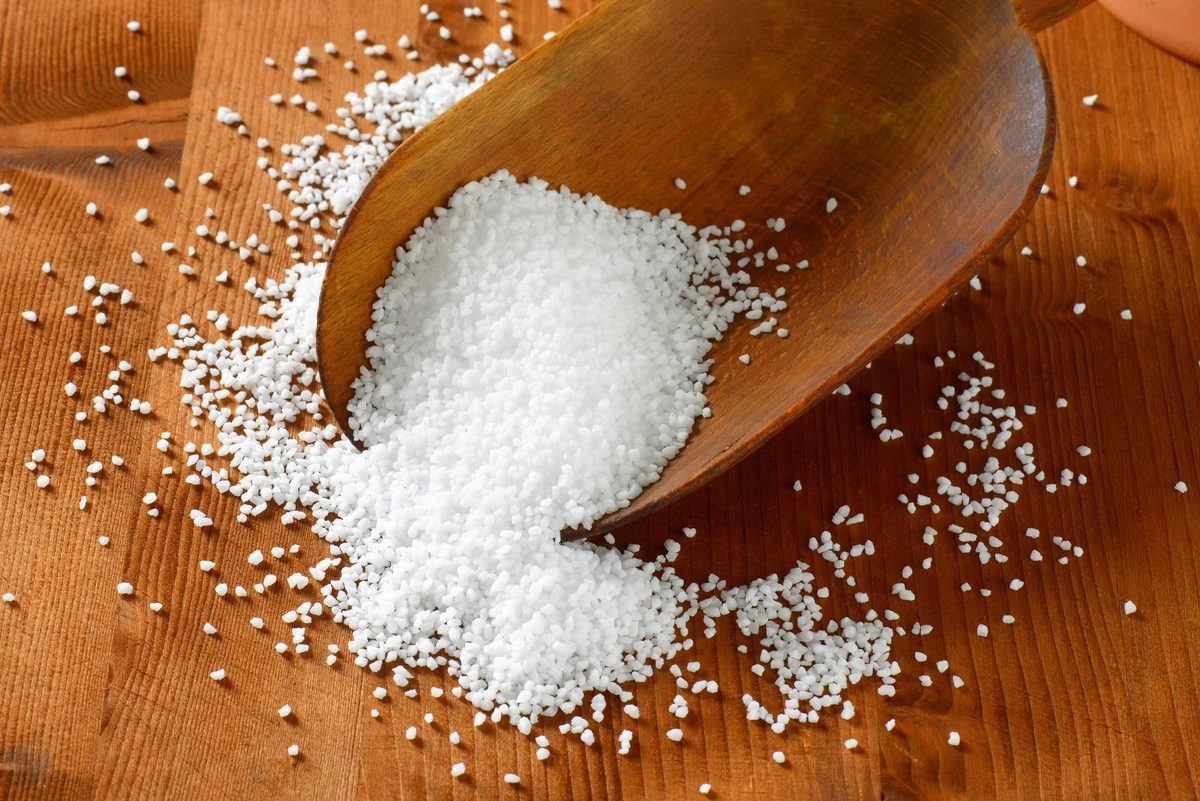
Pickling salt and kosher salt are both sodium chloride, and either can go into a jar of pickles. The difference is the grain. Pickling salt has the same crystal size as table salt, so it packs densely into a spoon; kosher salt is much coarser, so a spoonful holds less salt.12 In a fermented pickle, where salt is part of what keeps the food safe, that gap matters, and Oklahoma State University Extension’s fix is simple: swap them by weight, not by the spoon.13
Side by side
| Pickling salt | Kosher salt | |
|---|---|---|
| What it is | Salt sold for canning and pickling; Morton says its version blends easily with liquid to make a clear brine4 | Coarse-grained salt named for its use in koshering meat2 |
| Grain | Same crystal size as table salt1 | Much coarser than table salt.2 Diamond Crystal forms hollow pyramids; Morton is pressed into thin flakes5 |
| Additives | Sold for clear brines; check the label, since Morton’s product page lists no ingredients | Morton: yellow prussiate of soda, an anticaking agent.6 Diamond Crystal: none, per ATK5 |
| Iodine | Not stated on Morton’s product page | Not usually iodized7 |
| Grams per teaspoon | No published figure; Morton’s chart treats it as equal to table salt, which ATK weighs at about 6 g85 | Morton 4.8 g; Diamond Crystal 2.8 g (ATK)5 |
| Canning guidance | Recommended by the National Center for Home Food Preservation9 | Usable for brined or fermented pickles only if weighed (OSU)1 |
| Other jobs | Morton lists cooking, baking, marinating and brining4 | Morton suggests brining poultry6 |
| Flavor (editorial) | Salty | Salty |
Grain: why a spoonful isn’t a spoonful
Larger grains leave more air between them. OSU Extension explains that more of pickling salt’s finer grains fit in a tablespoon, so measuring kosher salt by the spoon in a pickling recipe puts in less salt than the recipe calls for.1 The AHA makes the same point about coarse salts generally: they have less sodium per teaspoon only because fewer crystals fit.10
How much less depends on the brand of kosher salt, and the published conversions don’t agree. Since Morton treats its canning and pickling salt as equal to its table salt by volume,8 the table-salt conversions apply:
For 1 teaspoon of pickling (or table) salt: the sources disagree
| Source | Morton kosher | Diamond Crystal |
|---|---|---|
| ATK’s rule of thumb | 1½ teaspoons | 2 teaspoons |
| Morton’s conversion chart (Morton products only) | 1¼ teaspoons | not covered |
| Computed from ATK’s own gram weights (6.0 ÷ 4.8 and 6.0 ÷ 2.8) | 1¼ teaspoons | about 2⅛ teaspoons |
Sources: ATK rule,1112 Morton chart,8 ATK weights.5 We publish the disagreement rather than pick one; the same table appears on our kosher salt page. Note what it implies: a rule of “50% more kosher salt” fits Morton’s brand at best, and leaves a recipe made with Diamond Crystal short by about 30% (our arithmetic: 1½ teaspoons of Diamond Crystal at 2.8 g a teaspoon is about 4.2 g against about 6 g of fine salt).
Additives and a clear brine
Home-canning guidance from the National Center for Home Food Preservation (NCHFP), adapted from the USDA, recommends canning or pickling salt.9 The reasons are about appearance, not safety:
- Anticaking agents in other salts may make the brine cloudy,3 and an anticaking agent or other additives can leave a white sediment in the jar.13
- Iodized salt is listed as one cause of dark or discolored pickles, though pickles can be made safely with either iodized or noniodized table salt.139
- Flake salt is not recommended, because its density varies.9
That makes the kosher brand matter. Morton’s kosher salt contains yellow prussiate of soda, an anticaking agent,6 the kind of additive canning guides warn can cloud a brine; Diamond Crystal has none, according to ATK.5 We found no test of how much Morton’s additive actually clouds a pickle brine. A common claim says no kosher salt has additives; that is true of one major brand, not both.
Dissolving
Tufts notes that kosher salt’s coarser grains dissolve more slowly than table salt.2 Morton describes its canning and pickling salt as blending easily with liquid to make a clear brine.4 We found no timed comparison of the two in brine. In practice, stirring until the brine is clear settles the question for either salt.
Why the amount matters in pickles
For sauerkraut and brined or fermented pickles, salt favors the growth of desirable bacteria while holding back others, and NCHFP warns against making them with less salt than the recipe calls for.3 The University of Kentucky’s extension guide says plainly that in these products the salt is necessary for safety.14 Quick vinegar pickles are different: both sources say their salt can be safely reduced, at some cost to quality.314
So a short measure of kosher salt is a quality problem in a quick pickle, and OSU says it puts quality and, more importantly, safety at risk in a brined or fermented one.1
Can one stand in for the other?
Yes, if you mind the measurement. These treatments follow our pickling salt substitute and kosher salt substitute pages.
| Swap | Starting amount | Treatment |
|---|---|---|
| Kosher salt for pickling salt, fermented or brined pickles | Weigh the recipe’s amount of table or pickling salt, then use the same weight of kosher salt | Computed |
| Kosher salt for pickling salt, quick vinegar pickles | Per tablespoon: 1¼ tablespoons Morton or 2 tablespoons Diamond Crystal, then taste the brine | Disputed |
| Pickling salt for kosher salt, either job, by weight | The same weight | Computed |
| Pickling salt for 1 teaspoon Morton kosher salt | ¾ teaspoon, then taste | Method |
| Pickling salt for 1 teaspoon Diamond Crystal | ½ teaspoon, then taste | Method |
How these were worked out. By weight: OSU Extension says kosher salt can substitute if measured by weight, and since table salt has the same crystal size as canning and pickling salt, it suggests weighing the recipe’s amount of table salt and matching it.1 The Codex standard requires food-grade salt to be at least 97% sodium chloride on a dry basis,15 so equal weights carry close to the same salt. By volume: for quick pickles we start at the lower figures in the disagreement table above, because NCHFP and Kentucky say their salt can be safely reduced.314 Pickling salt in place of kosher reverses the conversions (1 ÷ 1¼ is ⅘ and 1 ÷ 2 is ½), rounded down so you start low. For seasoning meat by hand, fine salt is easy to overdo; sprinkle from a height and taste. That is kitchen judgment.
Which to use when
- Pickling salt: tested canning and pickling recipes, which is what NCHFP recommends,9 and anywhere you’d use fine table salt. Without an anticaking agent it may clump in humid weather.
- Kosher salt: seasoning meat and vegetables by hand, and brining poultry, which Morton suggests for its kosher salt.6 In pickles, weigh it, and choose an additive-free brand if a clear brine matters to you.
Those uses are kitchen judgment beyond the cited guidance.
Health notes
- Sodium. Weight for weight, the same: table salt, kosher salt and most sea salts are about 40% sodium.10 Morton’s kosher label gives 1.2 g and 480 mg of sodium per ¼ teaspoon.6 Kosher salt only lowers sodium if you end up using less salt by weight.
- Iodine. Kosher salt is not usually iodized,7 and pickling salt is sold as a plain salt for brines. If you rely on salt for iodine, keep iodized salt for the table; see iodized vs. non-iodized salt.
What isn’t known
- No published grams-per-teaspoon figure for canning and pickling salt; Morton’s product page carries no nutrition panel or ingredient list.
- No test of how much Morton kosher salt’s anticaking agent clouds a pickle brine.
- No timed comparison of how fast either dissolves in brine.
- ATK’s rule of thumb and its own gram weights disagree for Morton kosher salt.
Related
- Pickling salt and kosher salt, the full profiles
- Pickling salt substitutes and kosher salt substitutes
- Pickling salt vs. sea salt, kosher salt vs. table salt and kosher salt vs. sea salt
- Pickling spice, for the aromatics in the jar
- Cooking with kosher salt
Footnotes
-
Canning and Pickling Salt, Oklahoma State University Extension, 2026. extension.okstate.edu · Reference work ↩ ↩2 ↩3 ↩4 ↩5 ↩6 ↩7
-
What’s the difference between kosher salt and other salt?, Tufts Health & Nutrition Letter, 2013 (updated 2019). nutritionletter.tufts.edu · Publication ↩ ↩2 ↩3 ↩4
-
General Information on Pickling, National Center for Home Food Preservation, reviewed 2018. nchfp.uga.edu · Reference work ↩ ↩2 ↩3 ↩4 ↩5
-
Morton Canning and Pickling Salt, product page, Morton Salt. mortonsalt.com · Merchant ↩ ↩2 ↩3
-
Kate Shannon Levine, The Best Kosher Salt, America’s Test Kitchen, 2019. americastestkitchen.com · Publication ↩ ↩2 ↩3 ↩4 ↩5 ↩6
-
Morton Kosher Salt Flakes, product page, Morton Salt. mortonsalt.com · Merchant ↩ ↩2 ↩3 ↩4 ↩5
-
Iodine: Fact Sheet for Health Professionals, NIH Office of Dietary Supplements. ods.od.nih.gov · Regulator ↩ ↩2
-
Salt Conversion Chart, Morton Salt. mortonsalt.com · Merchant ↩ ↩2 ↩3
-
Salts Used in Pickling, National Center for Home Food Preservation, adapted from USDA Complete Guide to Home Canning. nchfp.uga.edu · Reference work ↩ ↩2 ↩3 ↩4 ↩5
-
Sodium Sources: Where Does All That Sodium Come From?, American Heart Association, 2025. heart.org · Reference work ↩ ↩2
-
Salt Types and Measurements, America’s Test Kitchen. americastestkitchen.com · Publication ↩
-
Eden Faithfull, The Wrong Brand of Kosher Salt Could Ruin Your Dinner, America’s Test Kitchen, 2022. americastestkitchen.com · Publication ↩
-
Causes and Possible Solutions for Problems with Pickled Foods, National Center for Home Food Preservation. nchfp.uga.edu · Reference work ↩ ↩2
-
Sandra Bastin and Annhall Norris, Home Canning Pickled and Fermented Foods (FCS3-582), University of Kentucky Cooperative Extension Service, reviewed 2019. publications.ca.uky.edu · Reference work ↩ ↩2 ↩3
-
Standard for Food Grade Salt, CXS 150-1985 (rev. 2012), Codex Alimentarius. services.bis.gov.in · Standard ↩