Cooking · Cooking with
Cooking With Kosher Salt: Know Your Brand, Then Salt Meat, Brine and Bake
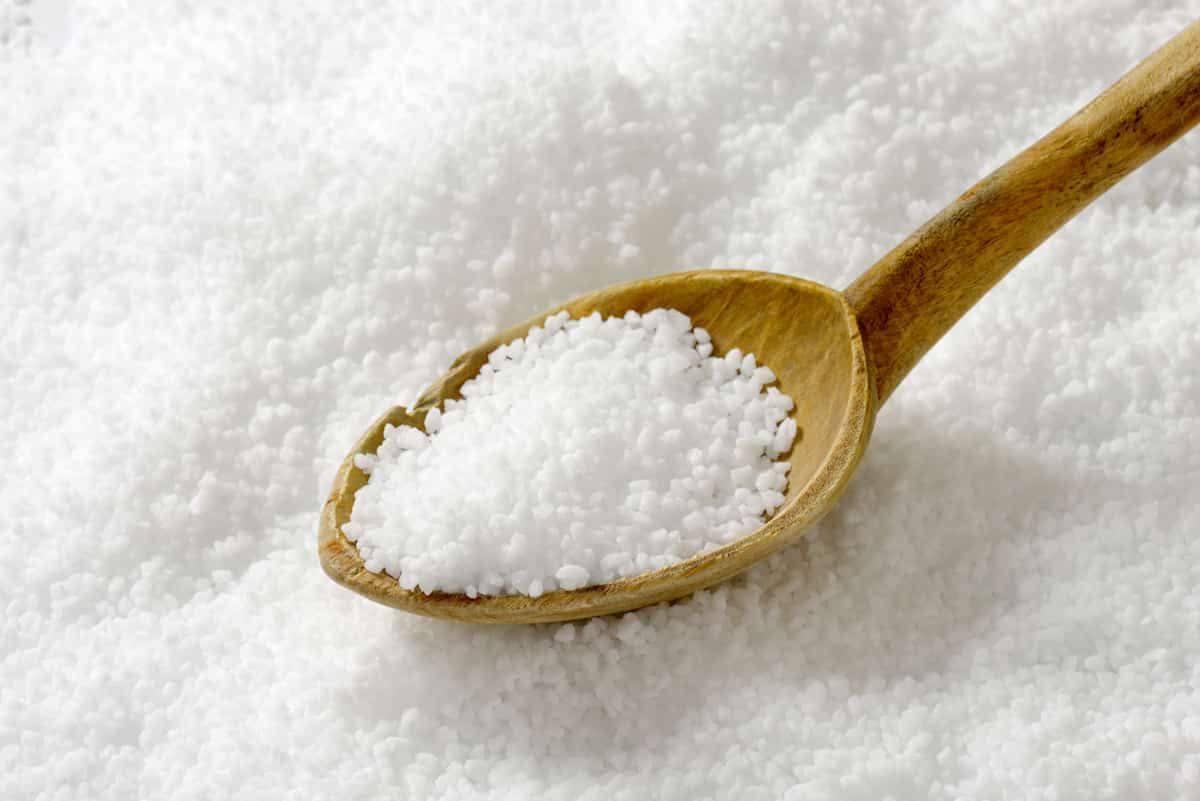
Kosher salt is coarse sodium chloride named for koshering meat, and it is the salt many American recipes are written for.1 The single most useful thing to know before cooking with it is which box you own. America’s Test Kitchen weighed a teaspoon of Morton kosher salt at 4.8 grams and a teaspoon of Diamond Crystal at 2.8 grams, so the same spoonful puts very different amounts of salt into food.2 This page covers how that changes measuring, then the jobs kosher salt does best: salting meat ahead, brining, seasoning by hand and finishing.
Quick guide
| Job | What to do | Basis |
|---|---|---|
| Following a recipe | Use the brand the recipe names, or weigh the salt | ATK recommends weighing3 |
| Salting meat or poultry ahead | ATK: 1 teaspoon Diamond Crystal per pound for a whole chicken, 6 to 24 hours ahead | Attributed4 |
| Brining | ATK brines with table salt, because its tiny grains dissolve quickly | Attributed4 |
| Seasoning by hand | Kosher salt; ATK says the larger grains are easier to distribute evenly | Attributed4 |
| Baking | Weigh it, or use fine salt for quick doughs and batters | Method |
First, know your brand
The two big US brands are made differently and pack differently. ATK describes Diamond Crystal as hollow pyramid-shaped crystals formed in open pans, and Morton as brine evaporated under vacuum and pressed into thin flakes.2 That is why a teaspoon of Morton weighs nearly twice what a teaspoon of Diamond Crystal does.2 ATK’s 2022 article rounds the figures to about 5 grams and 3 grams.3
Grams per teaspoon
| Salt | Grams per teaspoon | Source |
|---|---|---|
| Table salt | About 6 g, “regardless of the brand” (ATK) | 2 |
| Morton kosher | 4.8 g (ATK); Morton’s label gives 1.2 g per ¼ teaspoon | 25 |
| Diamond Crystal kosher | 2.8 g (ATK) | 2 |
Swapping by volume: the published rules disagree
| For 1 teaspoon of table salt, use | Morton kosher | Diamond Crystal | Source |
|---|---|---|---|
| ATK’s rule of thumb | 1½ teaspoons | 2 teaspoons | 1 |
| ATK’s chicken-salting guide (3 tsp Diamond Crystal = 2¼ tsp Morton = 1½ tsp table) | 1½ teaspoons | 2 teaspoons | 4 |
| Morton’s chart (Morton products only) | 1¼ teaspoons | not covered | 6 |
| Computed from ATK’s gram weights (6.0 ÷ 4.8; 6.0 ÷ 2.8) | 1¼ teaspoons | about 2⅛ teaspoons | 2 |
ATK’s two rules agree with each other, and Morton’s chart agrees with ATK’s own weights; the two pairs do not agree with each other. The gap also shows up between brands. ATK says to cut the volume by 25% when using Morton in a recipe written for Diamond Crystal, and its chicken guide’s equivalence implies the same cut, but its weights (2.8 g against 4.8 g) imply a cut of about 40%.24 We publish the disagreement rather than pick one. The working rule: weigh when a recipe gives grams, use the named brand when it gives one, and when it only says “kosher salt,” start low and taste.
A common piece of advice says to use twice as much kosher salt as table salt. That fits Diamond Crystal under ATK’s rule, but for Morton every source above gives 1¼ to 1½ times, so doubling Morton will oversalt.
Salting meat ahead (dry brining)
This is where kosher salt earns its place. ATK explains that salt applied to raw meat draws juices to the surface, dissolves in them to form a brine, and that brine is eventually reabsorbed by the meat; it says salting helps proteins keep their own juices.7 ATK’s preferred salt for the job is kosher, and its measurements are based on Diamond Crystal.7 ATK recommends salting over brining for meats that are already juicy or well marbled, and notes that salting won’t get in the way of crisp poultry skin or a well-browned crust on steaks, chops and roasts.7
ATK’s amounts for chicken, written for Diamond Crystal:4
| Cut | Diamond Crystal (ATK) | Morton equivalent | Time, refrigerated |
|---|---|---|---|
| Whole chicken | 1 teaspoon per pound, inside the cavity and under the skin | ¾ teaspoon per pound | 6 to 24 hours |
| Bone-in, skin-on pieces | ¾ teaspoon per pound, between skin and meat | A generous ½ teaspoon per pound | 6 to 24 hours |
The Morton column is our arithmetic from ATK’s own stated equivalence (3 teaspoons Diamond Crystal = 2¼ teaspoons Morton).4 By ATK’s gram weights it would be lower still, so with Morton, err toward the smaller amount.2 ATK rests the salted chicken on a wire rack set in a rimmed baking sheet in the refrigerator.4 Cook all poultry to 165°F, and beef, pork, veal and lamb steaks, chops and roasts to 145°F with a 3-minute rest.8
Brining
For wet brines ATK uses table salt, not kosher, because the tiny grains dissolve quickly in water.4 Its chicken brines run from 3 tablespoons of table salt in 1½ quarts of water for boneless breasts to ½ cup in 2 quarts for a whole bird or bone-in pieces, for ½ to 1 hour, and it warns that brining longer than recommended makes food too salty.4 Morton suggests its kosher salt for brining poultry.5 If you brine with kosher salt, convert by weight rather than by cup; the volume rules above disagree, and in a brine the error is multiplied.
Seasoning by hand
ATK chooses kosher salt for salting meat because the larger grains are easier to distribute evenly.4 Coarse grains are also easy to pinch and easy to see on the surface of food, which helps you judge how much has gone on; that is kitchen judgment rather than a tested finding. Learn the feel of one brand and stay with it: a pinch of Morton carries more salt than the same pinch of Diamond Crystal.2
Baking
Kosher salt is much coarser-grained than table salt, according to the Tufts Health & Nutrition Letter, and coarse grains dissolve more slowly than the tiny grains ATK relies on for quick-dissolving jobs.94 In a dough with plenty of mixing time that rarely matters; in a quick batter or a cookie dough, many bakers prefer fine salt or dissolve kosher salt in the recipe’s liquid first. That is common practice, not a tested rule. Either way, weighing removes the brand problem.3
Finishing and rims
Sprinkled over food, kosher salt adds texture. In ATK’s tasting, sampled plain and on buttered bread, tasters preferred Diamond Crystal’s “delicate and fleeting crunch” and found Morton’s grains harder.2 Kosher salt is also a common choice for rimming a margarita glass because the grains cling without clumping; that is bar practice rather than a sourced claim. For a showier finish, flaky salts do the job better (see Maldon salt vs. kosher salt and fleur de sel vs. kosher salt).
Flavor, iodine and additives
A widely repeated claim says kosher salt tastes cleaner because it has no iodine. Kosher salt is not iodized, but ATK’s tasters could not detect a difference in taste between iodized and noniodized salt.91 Weight for weight, ATK found broths seasoned with Morton and Diamond Crystal tasted exactly the same.2 Check the box for additives: Morton lists yellow prussiate of soda as an anticaking agent, while ATK reports Diamond Crystal has none.52 The name, too, is about use rather than certification: kosher salt was originally used for koshering meat, and Morton states that its kosher salt is itself kosher certified.15
Sodium and iodine
Kosher salt is not a lower-sodium salt. Table salt, kosher salt and most sea salts are about 40% sodium; a teaspoon of kosher salt holds less sodium only because fewer of its larger crystals fit in the spoon.10 The FDA’s Daily Value for sodium is less than 2,300 mg a day.11 Because kosher salt is not usually iodized, anyone who relies on salt for iodine should keep iodized salt on hand too.12 See iodized vs. non-iodized salt.
What isn’t known
- Diamond Crystal’s own grams-per-teaspoon figure; the only figure here is ATK’s.
- Why ATK’s volume rules and ATK’s gram weights disagree; no source explains it.
- No published test compares kosher and fine salt in baking results.
- No source we found shows kosher salt is better for curing meat; curing needs a nitrite cure, covered at curing salt.
Related
- Kosher salt, the full profile, and kosher salt substitutes
- Kosher salt vs. table salt, kosher salt vs. sea salt and pickling salt vs. kosher salt
- The best salt for cooking and table salt
- Too much salt? How to rescue a dish
Footnotes
-
Salt Types and Measurements, America’s Test Kitchen. americastestkitchen.com · Publication ↩ ↩2 ↩3 ↩4
-
Kate Shannon Levine, The Best Kosher Salt, America’s Test Kitchen, 2019. americastestkitchen.com · Publication ↩ ↩2 ↩3 ↩4 ↩5 ↩6 ↩7 ↩8 ↩9 ↩10 ↩11 ↩12 ↩13
-
Eden Faithfull, The Wrong Brand of Kosher Salt Could Ruin Your Dinner, America’s Test Kitchen, 2022. americastestkitchen.com · Publication ↩ ↩2 ↩3
-
Liz Bomze, How to Salt Chicken and How to Brine Chicken, America’s Test Kitchen, 2017. americastestkitchen.com · Publication ↩ ↩2 ↩3 ↩4 ↩5 ↩6 ↩7 ↩8 ↩9 ↩10 ↩11 ↩12
-
Morton Kosher Salt Flakes, product page, Morton Salt. mortonsalt.com · Merchant ↩ ↩2 ↩3 ↩4
-
Salt Conversion Chart, Morton Salt. mortonsalt.com · Merchant ↩
-
Salting Meat, America’s Test Kitchen (Cook’s Illustrated). americastestkitchen.com · Publication ↩ ↩2 ↩3
-
Cook to a Safe Minimum Internal Temperature, FoodSafety.gov. foodsafety.gov · Regulator ↩
-
What’s the difference between kosher salt and other salt?, Tufts Health & Nutrition Letter, 2013 (updated 2019). nutritionletter.tufts.edu · Publication ↩ ↩2
-
Sodium Sources: Where Does All That Sodium Come From?, American Heart Association, 2025. heart.org · Reference work ↩
-
Sodium in Your Diet, U.S. Food and Drug Administration. fda.gov · Regulator ↩
-
Iodine: Fact Sheet for Health Professionals, NIH Office of Dietary Supplements. ods.od.nih.gov · Regulator ↩