Spices · Profile
Kosher Salt: What It Is, Morton vs. Diamond Crystal, and How to Measure It
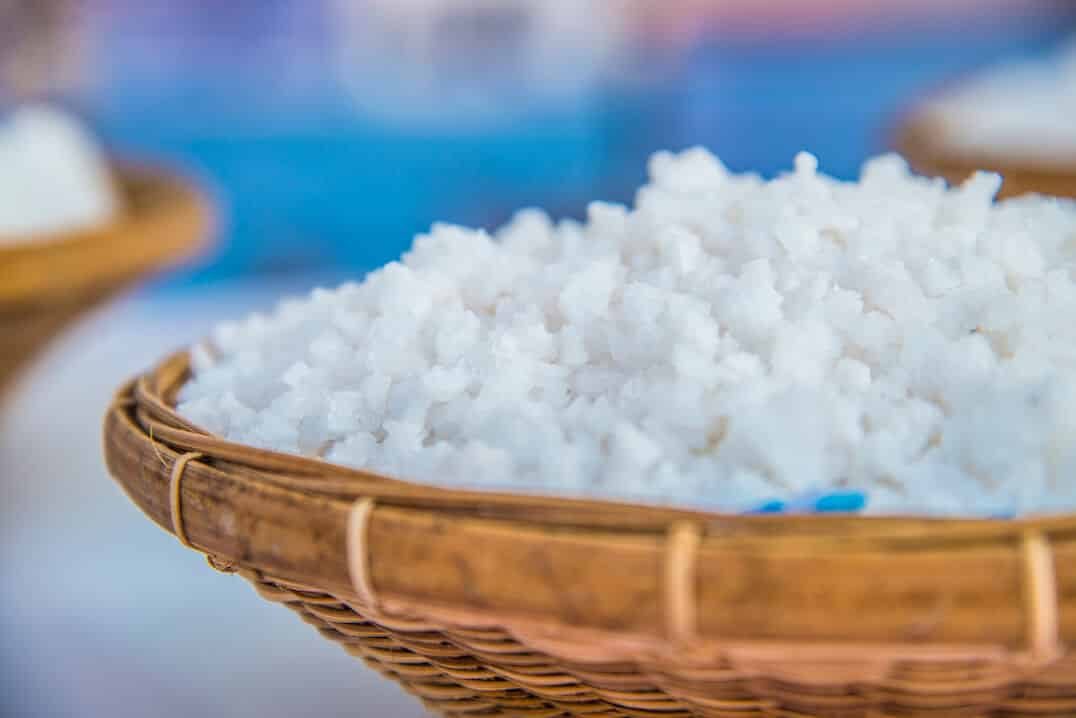
Kosher salt is coarse-grained salt, sodium chloride like any other, named for its traditional use in koshering meat.12 In American kitchens it mostly means one of two brands, Morton and Diamond Crystal, and the most useful thing to know about kosher salt is that those two are not the same by volume. A teaspoon of Morton weighs 4.8 grams; a teaspoon of Diamond Crystal weighs 2.8 grams.3 This page covers how each is made, what is and isn’t in it, how to convert between salts, and where it earns its place.
At a glance
| What it is | Coarse-grained sodium chloride; about 40% sodium, like table salt24 |
| How it’s made | Diamond Crystal: brine heated and stirred in open pans (the Alberger process). Morton: brine evaporated in vacuum evaporators, then pressed flat between rollers3 |
| Crystal form | Diamond Crystal: hollow pyramid-shaped crystals. Morton: thin flakes3 |
| Additives | Not iodized.25 Morton contains yellow prussiate of soda as an anticaking agent; Diamond Crystal contains no anticaking agent63 |
| Grams per teaspoon | Morton: 4.8 g (ATK; Morton’s label gives 1.2 g per ¼ teaspoon). Diamond Crystal: 2.8 g (ATK). Table salt for comparison: about 6 g367 |
| Kosher certification | Morton states its kosher salt is kosher certified6 |
Measured values
1 figure, sourced| Measure | Value | Scope | Source |
|---|---|---|---|
| Sodium | 40 % by weight (about) | table salt, kosher salt and most sea salts, general statement by the American Heart AssociationGeneral figure; per-teaspoon sodium depends on brand crystal size | heart.org |
Each figure is quoted as its source states it, with the samples or standard it applies to. Where sources differ, both are shown; nothing is averaged. All measured values
What kosher salt is
The name comes from what the salt was used for, not from how it was made. America’s Test Kitchen describes kosher salt as originally used for koshering meat, and the Tufts Health & Nutrition Letter explains that its coarse grains draw blood out of meat, as Jewish dietary law requires, which is why it carries the name.12 Morton states that its kosher salt is kosher certified.6 We found no source for the claim that any salt made under rabbinical supervision may be called kosher salt, so this page doesn’t make it.
The two big brands get their large grains in different ways. ATK’s 2019 review describes Diamond Crystal as made by the Alberger process, in which brine is heated and agitated in open containers so that hollow, pyramid-shaped crystals form on the surface and are never flattened.3 Morton’s salt is evaporated from brine in vacuum evaporators, then pressed through rollers into large, thin flakes and screened for size.3 Morton now sells it as “Kosher Salt Flakes.”6
Neither is iodized. Tufts notes that kosher salt is not iodized and usually has no other additives, with Morton the exception because of its anticaking agent.2 Morton’s label lists salt and yellow prussiate of soda (an anticaking agent); ATK reports Diamond Crystal contains no anticaking agents.63
Flavor
Weight for weight, kosher salt tastes like any other salt. In ATK’s test, chicken broths seasoned with equal weights of Morton and Diamond Crystal tasted exactly the same.3 Where tasters did notice a difference was texture: sprinkled plain and on buttered bread, they preferred Diamond Crystal’s “delicate and fleeting crunch,” and found Morton’s grains harder and less easy to spread evenly.3
The common claim that kosher salt tastes “cleaner” or “milder” than table salt rests mostly on the idea that iodine or additives in table salt add an off taste. ATK’s tasters found no detectable taste difference between iodized and noniodized salt.1 So the case for kosher salt is handling, not flavor.
How kosher salt is used
ATK’s testers make kosher salt their first choice for seasoning meat, because the large grains spread easily and cling.1 Its coarse grains are easy to pinch and to see on the surface of food, which makes it easier to judge how much has gone on; that is common kitchen reasoning rather than a tested finding. Morton suggests its kosher salt for brining poultry and for grilled meats and vegetables.6
Because the grains are larger, kosher salt dissolves more slowly than table salt, which Tufts notes can help season the surface of food with less salt.2 For that reason many bakers keep fine salt for quick doughs and batters, or dissolve kosher salt in the recipe’s liquid first; that is common practice rather than a tested rule.
Two older claims don’t hold up as stated. Kosher salt is not a curing salt: curing salt is a separate product, covered at curing salt. And we found no source showing kosher salt is better than other salts for pickling brines; Morton’s kosher salt contains an anticaking agent, while a dedicated pickling salt is sold for that job. For more, see cooking with kosher salt.
Measuring and converting
This is where kosher salt causes real trouble. Volume conversions published by reputable sources do not agree, and the brand on the box changes the answer.
Grams per teaspoon
| Salt | Grams per teaspoon | Source |
|---|---|---|
| Table salt | About 6 g (ATK, “regardless of the brand”); 1.5 g per ¼ teaspoon on Morton’s iodized label | 37 |
| Morton kosher | 4.8 g (ATK); 1.2 g per ¼ teaspoon on Morton’s label | 36 |
| Diamond Crystal kosher | 2.8 g (ATK) | 3 |
ATK’s 2022 article rounds these to about 5 g for Morton and 3 g for Diamond Crystal.8 We could not retrieve Diamond Crystal’s own figure from its maker.
Volume swaps: the sources disagree
| Swap for 1 teaspoon of table salt | Morton kosher | Diamond Crystal | Source |
|---|---|---|---|
| ATK’s rule of thumb | 1½ teaspoons | 2 teaspoons | 18 |
| Morton’s conversion chart (Morton products only) | 1¼ teaspoons | not covered | 9 |
| Computed from ATK’s own gram weights (6.0 ÷ 4.8 and 6.0 ÷ 2.8) | 1¼ teaspoons | about 2⅛ teaspoons | 3 |
ATK’s own weights agree with Morton’s chart on Morton (1¼), not with ATK’s rule (1½). The same ATK review also says to cut Morton by 25% when a recipe was written for Diamond Crystal, while its two gram figures imply a cut of about 40%.3 We publish the disagreement rather than pick a winner. The practical rule that follows from all of it: if a recipe gives salt in grams, weigh it; if it names a brand, use that brand or convert by weight; if it just says “kosher salt,” start low and taste. ATK also recommends weighing salt rather than measuring it by volume.8
Buying and storage
Pick one brand and learn it. Diamond Crystal’s light, hollow crystals are easy to pinch and forgiving if you over-pour; Morton’s denser flakes put more salt in every spoonful.38 Check the box: Morton lists an anticaking agent and Diamond Crystal doesn’t.63
We found no shelf-life figure for kosher salt from a regulator or standards body. Like other plain salt, it just needs to be kept dry.
Safety and health
Kosher salt is not lower in sodium by weight. Table salt, kosher salt and most sea salts are about 40% sodium; a teaspoon of kosher salt holds less sodium than a teaspoon of table salt only because fewer of its larger crystals fit in the spoon.4 Tufts gives a teaspoon of kosher salt as 1,920 mg of sodium against 2,325 mg for table salt, without naming a brand; given the gap between Morton and Diamond Crystal, treat that as a rough figure.2 The FDA’s Daily Value for sodium is less than 2,300 mg a day, about a teaspoon of table salt.10
Kosher salt supplies essentially no iodine. The NIH Office of Dietary Supplements lists kosher salt among the specialty salts that are not usually iodized.5 If you cook only with kosher salt and rely on salt for iodine, keep iodized salt on hand too; see iodized vs. non-iodized salt.
Substitutes and comparisons
Any salt substitutes for kosher salt by weight; by volume, use the tables above. See kosher salt substitutes for the full list, and these comparisons:
- Kosher salt vs. table salt
- Kosher salt vs. sea salt
- Kosher salt vs. Himalayan salt
- Pickling salt vs. kosher salt
- Maldon salt vs. kosher salt
- Fleur de sel vs. kosher salt
If a dish has gone over, see too much salt.
Footnotes
-
Salt Types and Measurements, America’s Test Kitchen. americastestkitchen.com · Publication ↩ ↩2 ↩3 ↩4 ↩5
-
What’s the difference between kosher salt and other salt?, Tufts Health & Nutrition Letter, 2013 (updated 2019). nutritionletter.tufts.edu · Publication ↩ ↩2 ↩3 ↩4 ↩5 ↩6 ↩7
-
Kate Shannon Levine, The Best Kosher Salt, America’s Test Kitchen, 2019. americastestkitchen.com · Publication ↩ ↩2 ↩3 ↩4 ↩5 ↩6 ↩7 ↩8 ↩9 ↩10 ↩11 ↩12 ↩13 ↩14 ↩15 ↩16 ↩17
-
Sodium Sources: Where Does All That Sodium Come From?, American Heart Association, 2025. heart.org · Reference work ↩ ↩2
-
Iodine: Fact Sheet for Health Professionals, NIH Office of Dietary Supplements. ods.od.nih.gov · Regulator ↩ ↩2
-
Morton Kosher Salt Flakes, product page, Morton Salt. mortonsalt.com · Merchant ↩ ↩2 ↩3 ↩4 ↩5 ↩6 ↩7 ↩8 ↩9
-
Morton Iodized Table Salt, product page, Morton Salt. mortonsalt.com · Merchant ↩ ↩2
-
Eden Faithfull, The Wrong Brand of Kosher Salt Could Ruin Your Dinner, America’s Test Kitchen, 2022. americastestkitchen.com · Publication ↩ ↩2 ↩3 ↩4
-
Salt Conversion Chart, Morton Salt. mortonsalt.com · Merchant ↩
-
Sodium in Your Diet, U.S. Food and Drug Administration. fda.gov · Regulator ↩