Spice Comparisons · Comparison
Kosher Salt vs. Table Salt: Grain, Additives and How to Convert Between Them
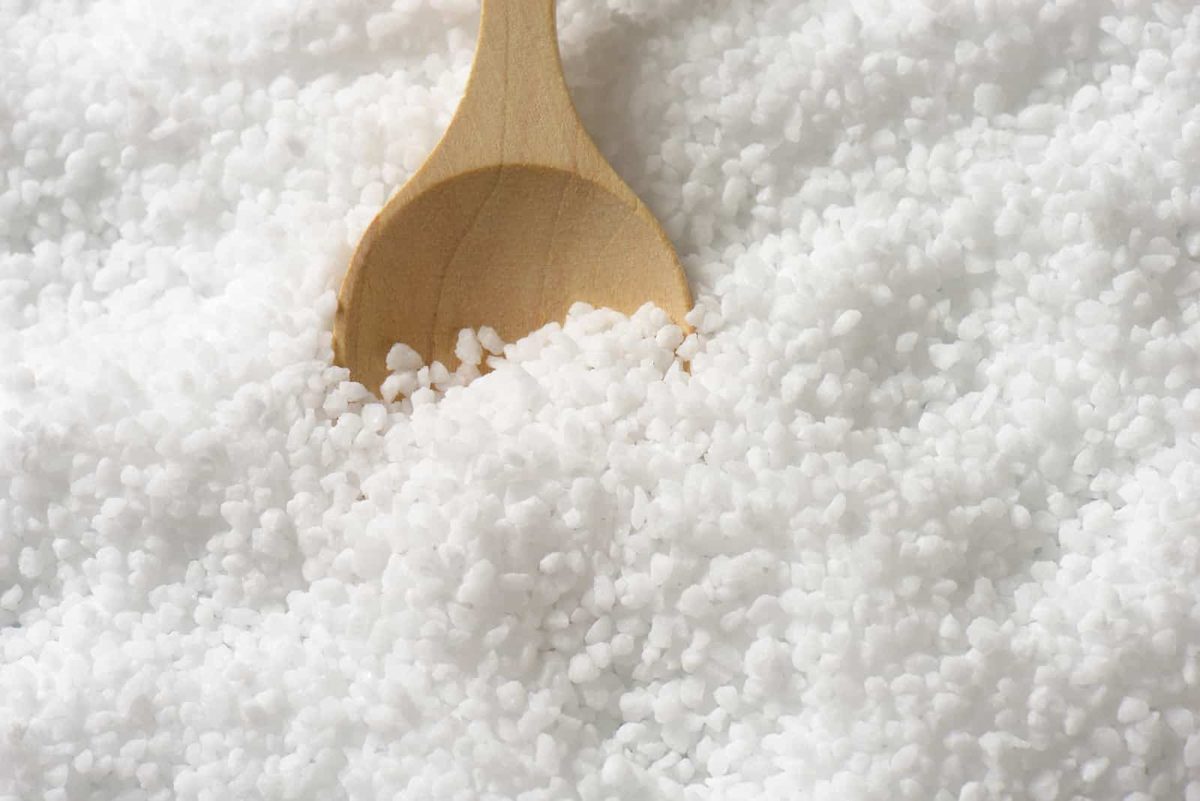
Kosher salt and table salt are the same substance, sodium chloride, and about the same share of each is sodium.12 What separates them is the grain and what goes in the box. Table salt is made of tiny, uniform crystals and usually carries an anticaking agent, and often iodine.1 Kosher salt is coarse-grained, rarely iodized, and named for its use in koshering meat.3 The grain matters more than it sounds, because it decides how much salt fits in a spoon: about 6 grams of table salt per teaspoon, 4.8 grams of Morton kosher salt and 2.8 grams of Diamond Crystal.4
Side by side
| Kosher salt | Table salt | |
|---|---|---|
| What it is | Coarse-grained sodium chloride, named for koshering meat13 | Fine-grained sodium chloride12 |
| How it’s made | Diamond Crystal: brine heated and stirred in open pans, forming hollow pyramid crystals. Morton: vacuum evaporators, then pressed flat between rollers4 | Tiny, uniform crystals from rapid vacuum evaporation (ATK);1 the AHA describes it as mined and processed to a fine texture2 |
| Additives | Morton: yellow prussiate of soda, an anticaking agent.5 Diamond Crystal: none, per ATK4 | Usually an anticaking agent.1 Morton iodized: calcium silicate, dextrose, potassium iodide6 |
| Iodine | Not usually iodized73 | Iodized or plain. US iodized salt: 45 mcg iodine per gram7 |
| Grams per teaspoon (ATK) | Morton 4.8 g; Diamond Crystal 2.8 g4 | About 6 g, regardless of brand4 |
| Grams per ¼ teaspoon (Morton labels) | Morton kosher 1.2 g5 | Morton iodized 1.5 g6 |
| Sodium per ¼ teaspoon (Morton labels) | 480 mg5 | 590 mg6 |
| Dissolving | More slowly than table salt3 | Faster than kosher salt3 |
| Main job | Seasoning by hand; ATK’s first choice for seasoning meat1 | Measured cooking and baking, and the shaker6 |
| Flavor (editorial) | Salty; Diamond Crystal crisp and light, Morton harder | Salty; fine and quick to dissolve on the tongue |
| Price | No dated, sourced comparison found | No dated, sourced comparison found |
The label rows compare one brand’s products with each other. They are rounded serving sizes, not laboratory weighings.
Grain: the difference that matters
How the salt is crystallized sets the grain. ATK describes table salt’s tiny, uniform crystals as the product of rapid vacuum evaporation.1 Kosher salt’s two big brands get their large grains in different ways: Diamond Crystal grows hollow pyramids in open, heated pans of brine, while Morton presses vacuum-evaporated salt through rollers into thin flakes.4
Three things follow from the grain.
- How much fits in a spoon. A coarse grain leaves air between crystals, so a spoonful holds less salt. The AHA notes that a coarse salt has less sodium per teaspoon only because fewer crystals fit.2 Weight for weight, they are the same.
- How fast it dissolves. Tufts notes that kosher salt’s coarser grains dissolve more slowly than table salt, which can help season the surface of food.3
- How it handles. ATK’s testers make kosher salt their first choice for seasoning meat because the coarse grains are easy to pinch and spread.1 On buttered bread, they preferred Diamond Crystal’s “delicate and fleeting crunch.”4
Where the name comes from
Kosher salt is named for its use, not for how it is made. Its coarse grains were used to draw blood out of meat, as Jewish dietary law requires.31 Morton states that its kosher salt is kosher certified.5 A common explanation adds that the large grains sit on the meat’s surface without dissolving and so keep it from tasting too salty; we found no source for that mechanism.
What’s in the box
Table salt usually contains an anticaking agent that helps it pour.1 Morton’s iodized table salt lists salt, calcium silicate (an anticaking agent), dextrose and potassium iodide.6 Under US rules, salt with added iodide may be labeled “iodized salt” and must state that it supplies iodide, a necessary nutrient, and salt with an anticaking agent may be labeled “free flowing.”8
Kosher salt is not iodized and usually has nothing else added.3 The exception is Morton’s, which contains yellow prussiate of soda as an anticaking agent; ATK reports that Diamond Crystal contains none.54 So “kosher salt has no anticaking agent” is true of one major brand, not both.
Do the additives change the taste? ATK’s tasters found no detectable taste difference between iodized and noniodized salt.1 In a separate test, broths seasoned with equal weights of Morton and Diamond Crystal tasted the same.4
Measuring: where the swap goes wrong
Measured by weight, the two are interchangeable. Measured by volume, they are not, and the published conversions disagree.
| Salt | Grams per teaspoon | Source |
|---|---|---|
| Table salt | About 6 g, regardless of brand | ATK4 |
| Morton kosher | 4.8 g | ATK4 |
| Diamond Crystal kosher | 2.8 g (rounded to 3 g in a later ATK article) | ATK49 |
For 1 teaspoon of table salt: the sources disagree
| Source | Morton kosher | Diamond Crystal |
|---|---|---|
| ATK’s rule of thumb | 1½ teaspoons | 2 teaspoons |
| Morton’s conversion chart (Morton products only) | 1¼ teaspoons | not covered |
| Computed from ATK’s own gram weights (6.0 ÷ 4.8 and 6.0 ÷ 2.8) | 1¼ teaspoons | about 2⅛ teaspoons |
| Computed from Morton’s own label weights (1.5 g ÷ 1.2 g per ¼ teaspoon) | 1¼ teaspoons | not covered |
Sources: ATK rule,1 Morton chart,10 ATK weights,4 Morton labels.65 Three of the four routes give 1¼ teaspoons of Morton kosher; ATK’s own rule of thumb gives more. We publish the disagreement rather than pick one (treatment: Disputed). The same table appears on our kosher salt page. ATK itself recommends weighing salt.9
Can one stand in for the other?
Yes. Any salt substitutes for another by weight; by volume, adjust for the grain. These treatments follow our kosher salt substitute page.
| Swap | Starting amount | Treatment |
|---|---|---|
| Either, measured by weight | The same weight | Computed |
| Morton kosher in place of 1 teaspoon table salt | 1¼ teaspoons (ATK’s rule says 1½) | Disputed (see above) |
| Diamond Crystal in place of 1 teaspoon table salt | 2 teaspoons (ATK’s weights imply about 2⅛) | Disputed (see above) |
| Table salt in place of 1 teaspoon Morton kosher | ¾ teaspoon, then taste | Method |
| Table salt in place of 1 teaspoon Diamond Crystal | ½ teaspoon, then taste | Method |
| Table salt in place of kosher salt for seasoning meat by hand | Use less and sprinkle from a height, then taste | Method |
How these were worked out. By weight: the Codex standard requires food-grade salt to be at least 97% sodium chloride on a dry basis, not counting additives.11 By volume: the kosher-to-table amounts reverse the conversions above (1 ÷ 1¼ is ⅘ and 1 ÷ 2 is ½), rounded down so you start low. In baking, where salt has to disperse through a dough and is often measured by the spoon, fine salt is the predictable choice; that is common practice rather than a tested rule.
Which to use when
- Kosher salt: seasoning meat and vegetables by hand before cooking, where ATK’s testers prefer it;1 brining poultry, which Morton suggests for its kosher salt.5
- Table salt: anything measured by the spoon, and the shaker. Morton markets its iodized salt for cooking, baking and seasoning at the table.6
Using kosher salt at the table and fine salt in measured recipes is a sensible split, though it is kitchen judgment rather than a tested rule.
Health notes
- Sodium. Weight for weight there is no difference: the AHA says table salt, kosher salt and most sea salts are about 40% sodium.2 Per spoonful, kosher salt carries less. Morton’s labels give 480 mg of sodium per ¼ teaspoon of its kosher salt and 590 mg for its iodized table salt;56 Tufts gives a teaspoon of kosher salt as 1,920 mg against 2,325 mg for table salt, without naming a brand.3 The FDA’s Daily Value for sodium is less than 2,300 mg a day, about a teaspoon of table salt.12 Switching to kosher salt only lowers sodium if you end up using less salt by weight.
- Iodine. This is a real difference. US iodized salt contains 45 mcg of iodine per gram, and iodization in the US is voluntary.7 The NIH Office of Dietary Supplements lists kosher salt among specialty salts that are not usually iodized.7 Most salt in the American diet comes from processed foods, which almost always use noniodized salt.7 If you cook only with kosher salt and rely on salt for iodine, keep iodized salt on hand too; see iodized vs. non-iodized salt.
What isn’t known
- No laboratory analysis of either kosher brand was found. The Swiss government survey of 25 salts included one standard iodized table salt but reported no sodium figure for it, and did not include kosher salt.13
- Diamond Crystal’s own weight per teaspoon could not be retrieved from its maker; the figures here are ATK’s.
- No published test of how either salt dissolves or distributes on meat was found, beyond Tufts’ general statement that kosher salt dissolves more slowly.
- No dated, sourced price comparison.
Related
- Kosher salt and table salt, the full profiles
- Kosher salt substitutes
- Kosher salt vs. sea salt, pickling salt vs. kosher salt, Maldon salt vs. kosher salt and fleur de sel vs. kosher salt
- Himalayan salt vs. table salt, rock salt vs. table salt and Celtic sea salt vs. table salt
- Cooking with kosher salt, the best salt for cooking and too much salt
Footnotes
-
Salt Types and Measurements, America’s Test Kitchen. americastestkitchen.com · Publication ↩ ↩2 ↩3 ↩4 ↩5 ↩6 ↩7 ↩8 ↩9 ↩10 ↩11 ↩12 ↩13 ↩14
-
Sodium Sources: Where Does All That Sodium Come From?, American Heart Association, 2025. heart.org · Reference work ↩ ↩2 ↩3 ↩4 ↩5
-
What’s the difference between kosher salt and other salt?, Tufts Health & Nutrition Letter, 2013 (updated 2019). nutritionletter.tufts.edu · Publication ↩ ↩2 ↩3 ↩4 ↩5 ↩6 ↩7 ↩8 ↩9
-
Kate Shannon Levine, The Best Kosher Salt, America’s Test Kitchen, 2019. americastestkitchen.com · Publication ↩ ↩2 ↩3 ↩4 ↩5 ↩6 ↩7 ↩8 ↩9 ↩10 ↩11 ↩12 ↩13
-
Morton Kosher Salt Flakes, product page, Morton Salt. mortonsalt.com · Merchant ↩ ↩2 ↩3 ↩4 ↩5 ↩6 ↩7 ↩8
-
Morton Iodized Table Salt, product page, Morton Salt. mortonsalt.com · Merchant ↩ ↩2 ↩3 ↩4 ↩5 ↩6 ↩7 ↩8
-
Iodine: Fact Sheet for Health Professionals, NIH Office of Dietary Supplements. ods.od.nih.gov · Regulator ↩ ↩2 ↩3 ↩4 ↩5
-
21 CFR 100.155, Salt and iodized salt, Electronic Code of Federal Regulations. ecfr.gov · Regulator ↩
-
Eden Faithfull, The Wrong Brand of Kosher Salt Could Ruin Your Dinner, America’s Test Kitchen, 2022. americastestkitchen.com · Publication ↩ ↩2
-
Salt Conversion Chart, Morton Salt. mortonsalt.com · Merchant ↩
-
Standard for Food Grade Salt, CXS 150-1985 (rev. 2012), Codex Alimentarius. services.bis.gov.in · Standard ↩
-
Sodium in Your Diet, U.S. Food and Drug Administration. fda.gov · Regulator ↩
-
Esther Infanger and Max Haldimann, Report on the composition of prevalent salt varieties, Swiss Federal Food Safety and Veterinary Office, 2016. warwick.ac.uk · Regulator ↩