Spice Comparisons · Comparison
Pickling Salt vs. Sea Salt: Grain, Additives and Which to Use in the Jar
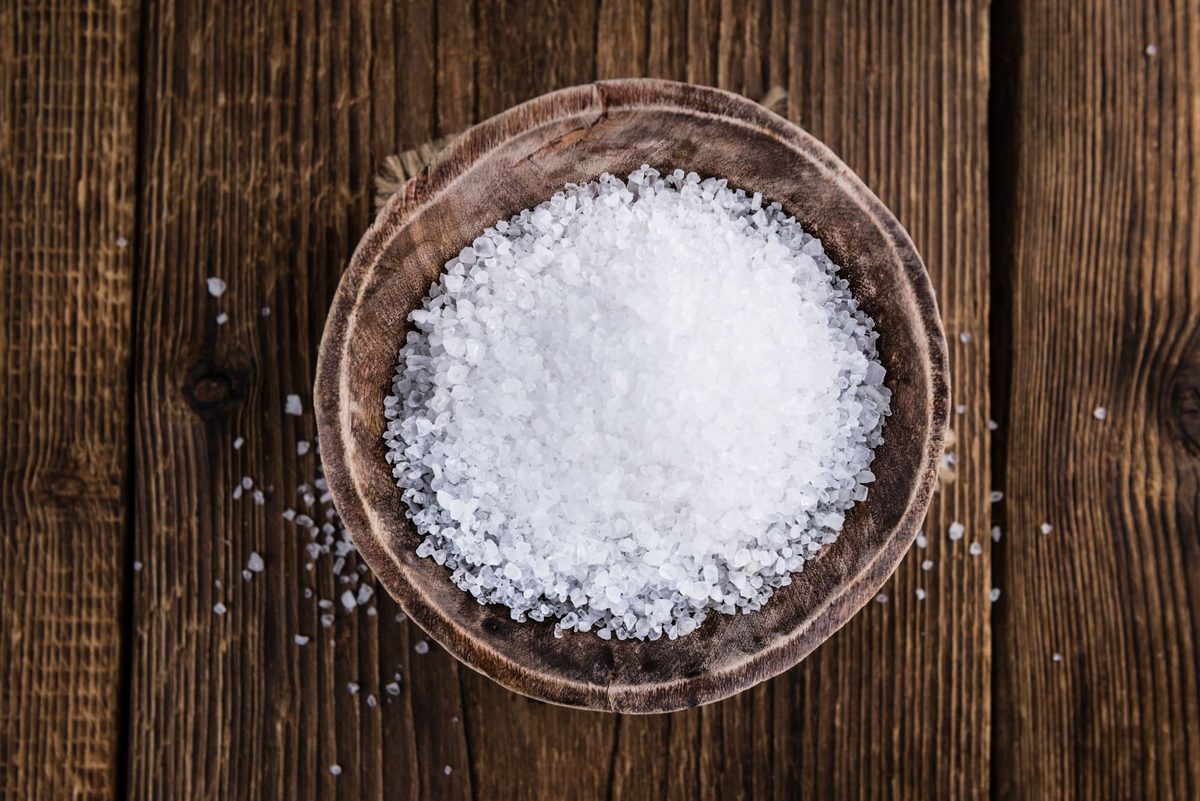
Pickling salt and sea salt are the same substance, sodium chloride, and once mixed into food sea salt tastes no different from table salt in America’s Test Kitchen’s testing.12 What separates them for a canner is grain and consistency. Pickling salt has the same crystal size as table salt and is the salt home-canning guidance recommends;34 “sea salt” covers everything from a fine grain that measures like table salt to flakes whose density varies, which canning guidance does not recommend.54
Side by side
| Pickling salt | Sea salt | |
|---|---|---|
| What it is | Salt sold for canning and pickling; Morton says its version makes a clear brine6 | The salt left behind when seawater evaporates7 |
| Grain | Same crystal size as table salt3 | Anything from fine grains to coarse crystals and flakes2 |
| Additives | Sold for clear brines; check the label, since Morton’s product page lists no ingredients | Usually none; Morton’s fine sea salt lists only sea salt8 |
| Iodine | Not stated on Morton’s product page | Not usually iodized; noniodized sea salt provides virtually no iodine9 |
| Volume vs. table salt (Morton chart) | 1 teaspoon = 1 teaspoon table salt5 | Morton fine or coarse sea salt: 1 teaspoon = 1 teaspoon table salt5 |
| Weight per ¼ teaspoon (Morton labels) | No nutrition panel on Morton’s page | Fine and coarse sea salt: 1.4 g each810 |
| Sodium | About 40%, like other salts7 | 38.9% to 40.7% in seven sea salts measured in Switzerland11 |
| Canning guidance | Recommended by the National Center for Home Food Preservation4 | Can share kosher salt’s crystal-size problem (OSU); flake salt not recommended (NCHFP)34 |
| Main job | Brines, plus everyday cooking and baking6 | Finishing, where crunch shows; fine sea salt for cooking2 |
The label rows compare Morton’s own products. They are rounded serving sizes, not laboratory weighings.
Grain and measuring
In a pickle recipe, the problem with sea salt is not what it is but how it fills a spoon. Oklahoma State University Extension warns that sea salt can have the same crystal-size problem as kosher salt: larger grains put less salt in a measuring spoon than a recipe written for fine pickling salt expects.3 Coarse salts have less sodium per teaspoon only because fewer crystals fit, as the AHA puts it.7
How big that problem is depends on the sea salt. Morton’s chart treats a teaspoon of its fine sea salt and a teaspoon of its coarse sea salt as equal to a teaspoon of its table salt, and a teaspoon of table salt as equal to a teaspoon of its canning and pickling salt; the chart covers swaps between Morton products only.5 Its labels agree: 1.4 g per ¼ teaspoon for both its fine and coarse sea salts.810 Flaky sea salts are the other extreme. NCHFP does not recommend flake salt for pickling because its density varies,4 and we found no published weight per teaspoon for any flaky salt.
Additives and iodine
NCHFP recommends canning or pickling salt because anticaking agents in other salts can cloud a brine or leave a white sediment, and because iodized salt is one cause of darkened pickles.1213 Pickles can still be made safely with either iodized or noniodized table salt.4
Many sea salts avoid both issues. The NIH Office of Dietary Supplements lists sea salt among specialty salts that are not usually iodized,9 and Morton’s fine sea salt lists sea salt as its only ingredient.8 That makes a fine, additive-free sea salt a workable pickling salt. Check the label all the same; we did not survey sea salt brands for additives.
Minerals and flavor
Sea salt may carry trace levels of minerals such as magnesium, potassium and calcium.7 Measured, they are small. In a 2016 survey by Switzerland’s food safety office, six of seven sea salts bought at retail or online had potassium below 0.05 g per kg, and their sodium ran 38.9% to 40.7%.11 The same report concluded that specialty salts have no advantages over standard salts.11 ATK found that sea salts vary in color but only slightly in flavor, and taste no different from table salt once mixed into food.2
A widely repeated claim says fine pickling salt tastes “saltier” than sea salt. Per spoonful, a fine salt can hold more salt than a coarse one; weight for weight, no test we found shows a difference in saltiness.
Why the amount matters
In sauerkraut and brined or fermented pickles, salt favors desirable bacteria while holding back others, and NCHFP warns against making them with less salt than the recipe requires.12 The University of Kentucky’s extension guide says the salt in these products is necessary for safety, while the salt in quick vinegar pickles can be safely reduced.14 So an under-measured coarse sea salt is a safety question in a crock of sauerkraut and a flavor question in a jar of refrigerator pickles.
Can one stand in for the other?
Yes, matched to the grain. These treatments follow our pickling salt substitute and sea salt substitute pages.
| Swap | Starting amount | Treatment |
|---|---|---|
| Fine sea salt for pickling salt, any pickle | 1 teaspoon per teaspoon, if the label lists only salt | Attributed (Morton products only) |
| Coarse sea salt for pickling salt, fermented or brined pickles | Weigh the recipe’s amount of pickling or table salt and match it | Computed |
| Flaky sea salt for pickling salt | Not recommended for pickling | n/a |
| Pickling salt for fine sea salt in cooking | 1 teaspoon per teaspoon | Attributed (Morton products only) |
| Pickling salt for flaky sea salt as a finishing salt | Not a good fit; use by the pinch, sparingly | Method |
How these were worked out. By volume, Morton’s chart treats its canning and pickling salt, table salt and fine and coarse sea salts as equal teaspoon for teaspoon.5 By weight: OSU suggests weighing the recipe’s amount of table salt, which has the same crystal size as pickling salt, and matching it;3 the Codex standard requires food-grade salt from any source to be at least 97% sodium chloride on a dry basis.1 Fine salt in place of flakes is a judgment call: it vanishes into food rather than sitting on top, and a fine salt is easy to overdo by the pinch.
Which to use when
- Pickling salt: tested canning and pickling recipes, as NCHFP recommends,4 and any everyday cooking; Morton lists cooking, baking, marinating and brining.6
- Sea salt: finishing, where ATK recommends it and its crunch shows;2 fine sea salt for everyday cooking. In pickles, use a fine, additive-free sea salt, or weigh a coarser one.
Health notes
- Sodium. Table salt, kosher salt and most sea salts are about 40% sodium.7 The FDA’s Daily Value for sodium is less than 2,300 mg a day.15
- Iodine. Neither is a reliable source. Noniodized sea salt provides virtually no iodine;9 see iodized vs. non-iodized salt.
- Microplastics. In a 2018 study of 39 salt brands, reported in a Greenpeace press release, microplastic contamination was highest in sea salt, then lake salt, then rock salt.16 That is one study of specific products.
What isn’t known
- No published grams-per-teaspoon figure for canning and pickling salt, or for any flaky sea salt.
- No survey of additives across sea salt brands.
- No test of whether sea salt’s trace minerals affect pickle color, texture or flavor.
- No timed comparison of how fast either dissolves in brine.
Related
- Pickling salt and sea salt, the full profiles
- Pickling salt substitutes and sea salt substitutes
- Pickling salt vs. kosher salt, table salt vs. sea salt, kosher salt vs. sea salt and sea salt vs. iodized salt
- Pickling spice and cooking with sea salt
Footnotes
-
Standard for Food Grade Salt, CXS 150-1985 (rev. 2012), Codex Alimentarius. services.bis.gov.in · Standard ↩ ↩2
-
Salt Types and Measurements, America’s Test Kitchen. americastestkitchen.com · Publication ↩ ↩2 ↩3 ↩4 ↩5
-
Canning and Pickling Salt, Oklahoma State University Extension, 2026. extension.okstate.edu · Reference work ↩ ↩2 ↩3 ↩4 ↩5
-
Salts Used in Pickling, National Center for Home Food Preservation, adapted from USDA Complete Guide to Home Canning. nchfp.uga.edu · Reference work ↩ ↩2 ↩3 ↩4 ↩5 ↩6 ↩7
-
Salt Conversion Chart, Morton Salt. mortonsalt.com · Merchant ↩ ↩2 ↩3 ↩4 ↩5
-
Morton Canning and Pickling Salt, product page, Morton Salt. mortonsalt.com · Merchant ↩ ↩2 ↩3
-
Sodium Sources: Where Does All That Sodium Come From?, American Heart Association, 2025. heart.org · Reference work ↩ ↩2 ↩3 ↩4 ↩5
-
Morton Fine Sea Salt, product page, Morton Salt. mortonsalt.com · Merchant ↩ ↩2 ↩3 ↩4
-
Iodine: Fact Sheet for Health Professionals, NIH Office of Dietary Supplements. ods.od.nih.gov · Regulator ↩ ↩2 ↩3
-
Morton Coarse Sea Salt, product page, Morton Salt. mortonsalt.com · Merchant ↩ ↩2
-
Esther Infanger and Max Haldimann, Report on the composition of prevalent salt varieties, Swiss Federal Food Safety and Veterinary Office, 2016. warwick.ac.uk · Regulator ↩ ↩2 ↩3
-
General Information on Pickling, National Center for Home Food Preservation, reviewed 2018. nchfp.uga.edu · Reference work ↩ ↩2
-
Causes and Possible Solutions for Problems with Pickled Foods, National Center for Home Food Preservation. nchfp.uga.edu · Reference work ↩
-
Sandra Bastin and Annhall Norris, Home Canning Pickled and Fermented Foods (FCS3-582), University of Kentucky Cooperative Extension Service, reviewed 2019. publications.ca.uky.edu · Reference work ↩
-
Sodium in Your Diet, U.S. Food and Drug Administration. fda.gov · Regulator ↩
-
Over 90% of sampled salt brands globally found to contain microplastics, Greenpeace International press release, 2018, on Kim J-S et al., Environmental Science & Technology, 2018. greenpeace.org · Publication ↩