Spice Comparisons · Comparison
Iodized vs. Non-Iodized Salt: Iodine, Taste, Pickling and Swaps
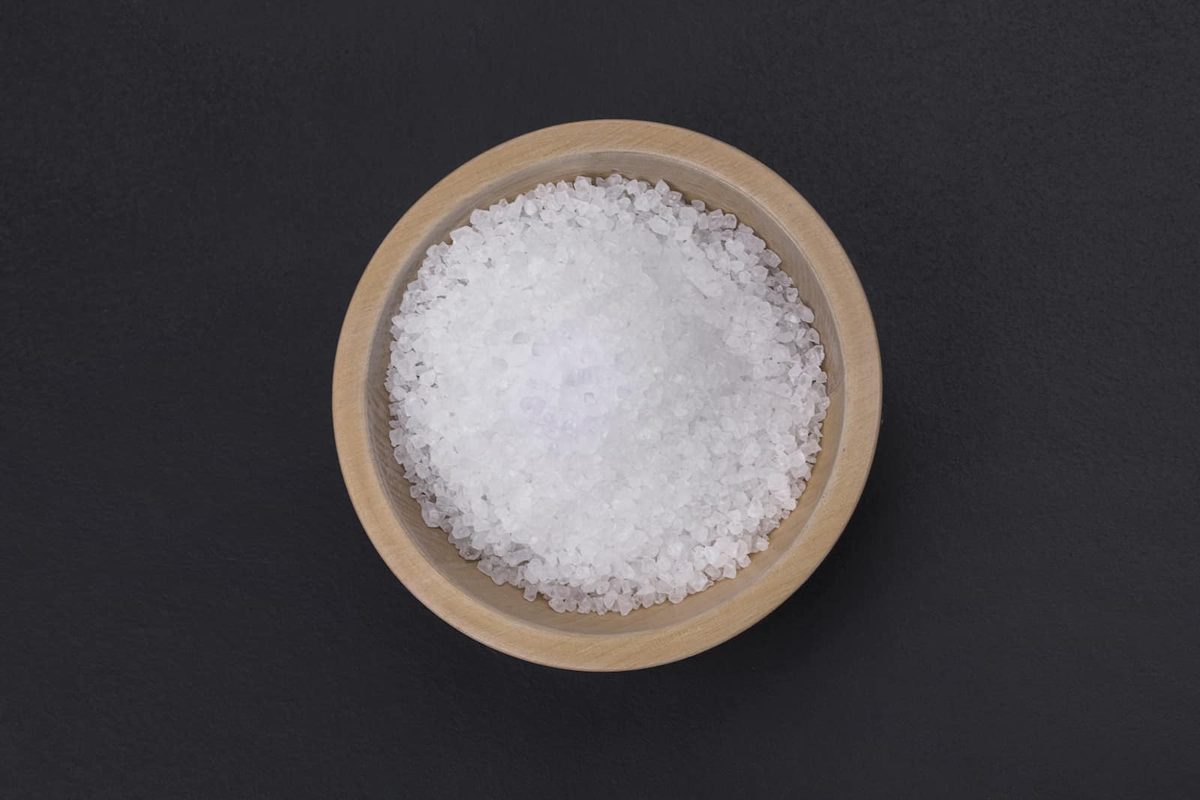
Iodized salt is salt with iodide added; non-iodized salt is everything else. In the United States, iodized salt carries 45 micrograms of iodine per gram, and salt makers have added it to table salt since the 1920s, though it is still voluntary.1 “Non-iodized” covers plain table salt and nearly all the specialty salts: the NIH Office of Dietary Supplements lists sea salt, kosher salt, Himalayan salt and fleur de sel as not usually iodized.1 In the kitchen the two behave the same. America’s Test Kitchen’s tasters found no detectable difference in taste,2 and home-canning guidance says pickles can be made safely with either.3 The real difference is nutritional.
Side by side
| Iodized salt | Non-iodized salt | |
|---|---|---|
| What it is | Salt with added iodide; US labels must say “This salt supplies iodide, a necessary nutrient”4 | Plain salt, which US rules require to be labeled as not supplying iodide, plus most specialty salts41 |
| Iodine | 45 mcg per gram on US labels; measured samples average 47.5 to 50.71 | Noniodized sea salt provides virtually no iodine1 |
| Typical additives | Morton iodized: calcium silicate (anticaking agent), dextrose, potassium iodide5 | Varies by product: Morton kosher salt lists an anticaking agent, yellow prussiate of soda;6 ATK reports Diamond Crystal kosher salt has none7 |
| Forms | Table salt1 | Plain table salt and specialty salts such as sea, kosher and Himalayan salt14 |
| Sodium | About 40%, like other salts8 | About 40% for table, kosher and most sea salts8 |
| Taste | No detectable difference from noniodized salt in ATK’s test2 | Same |
| Pickling | Safe; may darken pickles39 | Canning or pickling salt is the recommended choice3 |
| Price | No dated, sourced comparison found | No dated, sourced comparison found |
How much iodine is in each
| Salt (scope) | Iodine | Source |
|---|---|---|
| US iodized salt, label | 45 mcg per gram (45,000 µg/kg) | NIH ODS1 |
| US iodized salt, measured samples | 47.5 to 50.7 mcg per gram on average | NIH ODS1 |
| Morton iodized table salt, label | 68 mcg per ¼ teaspoon (1.5 g) | Morton5 |
| Swiss iodized table salt | 25 mg/kg, the national fortification level since 2014 | Swiss FSVO 201610 |
| Sea salts, 7 samples bought in Switzerland | Below 20 µg/kg or not detected in four; 28 to 54 µg/kg in three | Swiss FSVO 201610 |
| Fleur de sel, 4 samples | 21 to 61.7 µg/kg | Swiss FSVO 201610 |
| Himalaya salt, 4 samples | Below 20 µg/kg in all four | Swiss FSVO 201610 |
The rows come from different labels and studies, so compare the orders of magnitude, not the decimals. The highest specialty-salt figure in the Swiss survey, 61.7 µg/kg, is more than 700 times lower than the US iodized label (our arithmetic). The Swiss report notes plainly that specialty salts are not iodized in general.10
A ¼ teaspoon of Morton’s iodized salt supplies 68 mcg,5 close to half the adult recommended intake of 150 mcg a day (our arithmetic).1
Why the iodine matters
Iodine is an essential part of the thyroid hormones thyroxine (T4) and triiodothyronine (T3).1 Too little causes iodine deficiency disorders: goiter is usually the earliest sign, and in pregnancy severe deficiency can cause major neurodevelopmental deficits.1 The adult recommended intake is 150 mcg a day, rising to 220 mcg in pregnancy and 290 mcg while breastfeeding; the adult upper limit is 1,100 mcg.1
Salt iodization programs have dramatically reduced iodine deficiency worldwide, and about 88% of households now use iodized salt.1 The Codex standard for food-grade salt says salt shall be iodized in iodine-deficient areas.11
Who should think about it. The ODS says the general US population gets enough iodine, but surveys suggest many pregnant women may not.1 Two things weaken salt as an iodine source in American kitchens. Most dietary salt comes from processed foods, and manufacturers almost always use noniodized salt.1 And a cook who switches to kosher, sea or Himalayan salt at home is usually switching to a noniodized salt.1 Seafood, eggs, milk and milk products are among the best food sources of iodine.1 This page makes no claim that iodized salt treats or prevents any condition; it describes a public-health fortification program.
Taste
A widely repeated claim says iodine gives salt a bitter or metallic aftertaste that some people can detect. America’s Test Kitchen’s tasters found no detectable difference in taste between iodized and noniodized salt.2 We found no study of individual sensitivity to iodine in salt, so that part of the claim is untested rather than disproven.
Pickling and canning
A common warning says iodine kills the bacteria needed for fermentation, so iodized salt must never go into pickles. The National Center for Home Food Preservation says otherwise: pickles may be safely made with either iodized or noniodized table salt.3 It does recommend canning or pickling salt,3 for two reasons it lists among causes of pickle problems: iodized salt as a cause of darkened pickles, and anticaking agents or other additives as the cause of cloudy brine or white sediment.912 For fermented pickles and sauerkraut, the amount of salt matters more than the kind: NCHFP warns not to cut back on salt, which is vital to safety and texture.12 Flake salt is not recommended for pickling because its density varies.3
Can one stand in for the other?
Yes, for flavor, in any recipe. Swapping changes only the iodine and, by volume, sometimes the amount of salt, because non-iodized salts come in every crystal size.
| Per 1 teaspoon iodized table salt | Starting amount | Treatment |
|---|---|---|
| Any salt, by weight | The same weight | Computed |
| Noniodized table salt, canning and pickling salt, or fine sea salt (Morton) | 1 teaspoon | Attributed (Morton products only) |
| Morton kosher salt | 1¼ to 1½ teaspoons; start at 1¼ | Disputed |
| Diamond Crystal kosher salt | 2 to about 2⅛ teaspoons; start at 2 | Disputed |
| Flaky sea salt | Weigh it; by volume no published figure exists | Method |
How these were worked out. By weight: the Codex standard requires food-grade salt to be at least 97% sodium chloride on a dry basis.11 By volume: Morton’s chart treats its table salt, fine sea salt and canning and pickling salt as equal, teaspoon for teaspoon, within its own products.13 For kosher salt, named sources disagree. America’s Test Kitchen’s rule of thumb gives 1½ teaspoons of Morton kosher or 2 of Diamond Crystal per teaspoon of table salt;214 Morton’s chart gives 1¼ teaspoons of its kosher salt;13 and ATK’s own weights (about 6 g per teaspoon of table salt, 4.8 g for Morton, 2.8 g for Diamond Crystal) work out to 1¼ and about 2⅛.7 We start at the lower figure, because salt is easy to add and hard to take out. The full disagreement table is on the kosher salt page.
Storage
For iodized salt, the Codex standard includes storage precautions meant to limit iodine loss.11 We found no shelf-life figure from a regulator for either kind; keep both dry and closed.
What isn’t known
- No study of whether some people can taste iodine in salt.
- No figure for how much iodine US iodized salt loses in a home pantry over time.
- No dated, sourced price comparison.
- No published grams-per-teaspoon figure for flaky sea salts.
Related
- Table salt, kosher salt, sea salt and pickling salt
- Sea salt vs. iodized salt, Himalayan salt vs. table salt and kosher salt vs. table salt
- Pickling salt vs. kosher salt and pickling salt substitutes
- Sea salt substitutes and kosher salt substitutes
- The best salt for cooking and too much salt
Footnotes
-
Iodine: Fact Sheet for Health Professionals, NIH Office of Dietary Supplements. ods.od.nih.gov · Regulator ↩ ↩2 ↩3 ↩4 ↩5 ↩6 ↩7 ↩8 ↩9 ↩10 ↩11 ↩12 ↩13 ↩14 ↩15 ↩16 ↩17 ↩18
-
Salt Types and Measurements, America’s Test Kitchen. americastestkitchen.com · Publication ↩ ↩2 ↩3 ↩4
-
Salts Used in Pickling, National Center for Home Food Preservation. nchfp.uga.edu · Reference work ↩ ↩2 ↩3 ↩4 ↩5 ↩6
-
21 CFR 100.155, Salt and iodized salt, Electronic Code of Federal Regulations. ecfr.gov · Regulator ↩ ↩2 ↩3
-
Morton Iodized Table Salt, product page, Morton Salt. mortonsalt.com · Merchant ↩ ↩2 ↩3
-
Morton Kosher Salt Flakes, product page, Morton Salt. mortonsalt.com · Merchant ↩
-
Kate Shannon Levine, The Best Kosher Salt, America’s Test Kitchen, 2019. americastestkitchen.com · Publication ↩ ↩2
-
Sodium Sources: Where Does All That Sodium Come From?, American Heart Association, 2025. heart.org · Reference work ↩ ↩2
-
Causes and Possible Solutions for Problems with Pickled Foods, National Center for Home Food Preservation. nchfp.uga.edu · Reference work ↩ ↩2
-
Esther Infanger and Max Haldimann, Report on the composition of prevalent salt varieties, Swiss Federal Food Safety and Veterinary Office, 2016. warwick.ac.uk · Regulator ↩ ↩2 ↩3 ↩4 ↩5
-
Standard for Food Grade Salt, CXS 150-1985 (rev. 2012), Codex Alimentarius. services.bis.gov.in · Standard ↩ ↩2 ↩3
-
General Information on Pickling, National Center for Home Food Preservation. nchfp.uga.edu · Reference work ↩ ↩2
-
Salt Conversion Chart, Morton Salt. mortonsalt.com · Merchant ↩ ↩2
-
Eden Faithfull, The Wrong Brand of Kosher Salt Could Ruin Your Dinner, America’s Test Kitchen, 2022. americastestkitchen.com · Publication ↩