Spice Comparisons · Comparison
Kosher Salt vs. Sea Salt: Same Chemistry, Different Crystals and Spoon Weights
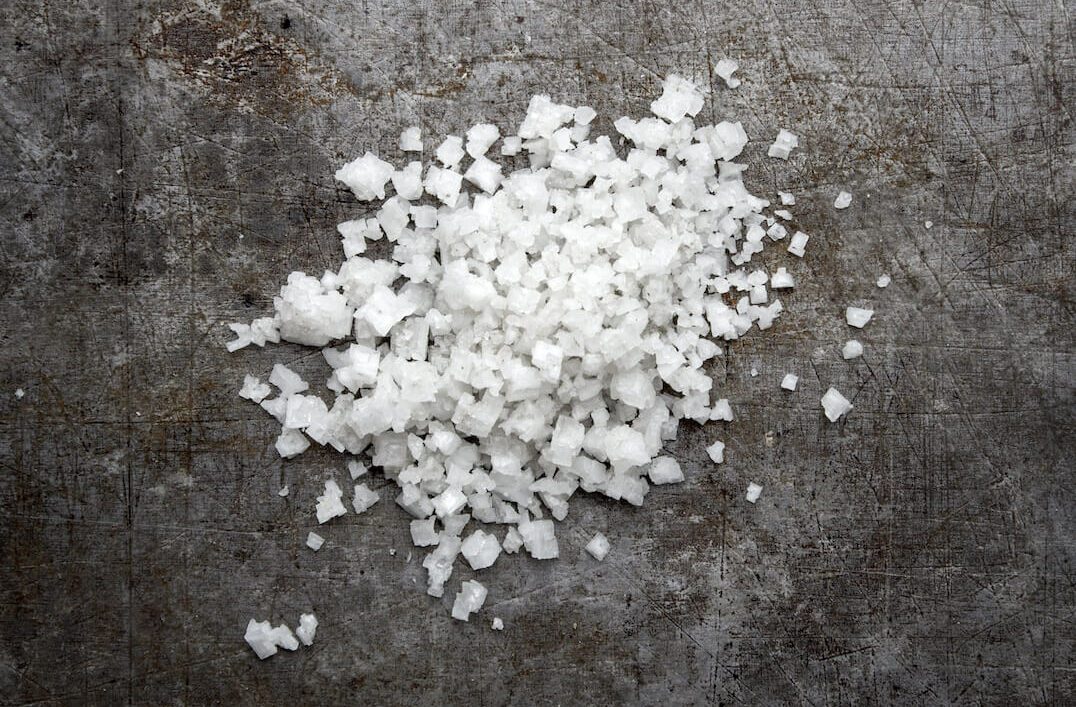
Kosher salt and sea salt are both sodium chloride. America’s Test Kitchen (ATK) puts it plainly: whatever the source, salt in its most basic form is the same.1 Sea salt is named for where it comes from, the salt left behind when seawater evaporates.2 Kosher salt is named for a use, koshering meat, and its coarse grains are what define it.13 In the kitchen the differences come down to the crystal, how much salt a spoonful carries, and which job each one does best. The spoonful is where recipes go wrong: a teaspoon of Morton kosher salt weighs 4.8 grams, a teaspoon of Diamond Crystal 2.8 grams.4
Side by side
| Kosher salt | Sea salt | |
|---|---|---|
| What it is | Coarse-grained sodium chloride, named for koshering meat13 | Salt left behind when seawater evaporates2 |
| How it’s made | Both big US brands start from brine. Diamond Crystal: brine heated and stirred in open pans, forming hollow pyramid crystals. Morton: vacuum evaporators, then pressed flat between rollers4 | Varies by product. Morton’s fine and coarse sea salts are seawater evaporated by the sun56 |
| Grain | Coarse: hollow pyramids (Diamond Crystal) or thin flakes (Morton)4 | Fine, coarse or flaky, depending on the product |
| Additives | Morton: yellow prussiate of soda, an anticaking agent.7 Diamond Crystal: none, per ATK4 | Morton’s fine and coarse sea salts list sea salt as the only ingredient56 |
| Iodine | Not usually iodized8 | Not usually iodized8 |
| Sodium | About 40%, the AHA’s general figure for table, kosher and most sea salts.2 No laboratory analysis of either kosher brand found | 38.9% to 40.7% in seven standard sea salts analyzed in Switzerland9 |
| Grams per teaspoon | Morton 4.8 g; Diamond Crystal 2.8 g (ATK)4 | No measured figure found; Morton’s labels give 1.4 g per ¼ teaspoon for both its fine and coarse sea salt56 |
| Main job | Seasoning and cooking; ATK’s first choice for seasoning meat1 | Fine: everyday cooking. Coarse and flaky: finishing15 |
| Flavor (editorial) | Salty; Diamond Crystal crisp and light, Morton harder | Salty; fine sea salt behaves like table salt, coarse crystals crunch |
| Price | No dated, sourced comparison found | No dated, sourced comparison found |
The sodium row sets a laboratory measurement of seven sea salts beside a general figure from the American Heart Association. They are different kinds of number, and none of the Swiss samples was kosher salt.
How each is made
Kosher salt. It is sometimes described as mined salt, but ATK describes both major US brands as made from brine. Diamond Crystal uses the Alberger process: brine is heated and agitated in open containers, and hollow, pyramid-shaped crystals form on the surface. Morton pumps its brine into vacuum evaporators and then presses the salt through rollers into large, thin flakes.4 The name comes from use. The coarse grains were used to draw blood out of meat, as Jewish dietary law requires.31 Morton states that its kosher salt is kosher certified.7
Sea salt. The category is broad. Morton’s fine and coarse sea salts are both seawater evaporated by the sun, with nothing added.56 Flaky sea salts and fleur de sel are made differently; see fleur de sel vs. sea salt for those. The AHA describes sea salt as usually unprocessed or lightly processed.2
Flavor: smaller differences than the labels suggest
ATK’s tasters found that sea salts vary in color but only slightly in flavor, and that sea salt tastes no different from table salt once it is mixed into food.1 In ATK’s kosher salt test, chicken broths seasoned with equal weights of Morton and Diamond Crystal tasted the same.4
Two common explanations for flavor differences don’t hold up as stated:
- “Neither has iodine, so neither tastes bitter.” Both are usually noniodized,8 but ATK’s tasters found no detectable taste difference between iodized and noniodized salt.1
- “Sea salt’s minerals give it a distinctive flavor.” The AHA says sea salt may carry trace minerals such as magnesium, potassium and calcium.2 In the Swiss government survey, six of the seven standard sea salts had potassium below 0.05 g/kg, and the seventh had 1.2 g/kg, about 0.12% of its weight (our arithmetic).9 The survey concluded that specialty salts “do not possess any advantages over standard salts.”9
What does differ is texture: Diamond Crystal’s “delicate and fleeting crunch,” in ATK’s words, Morton’s harder flakes, and the crunch of coarse sea salt on a finished plate.4
Measured: what the Swiss survey found in sea salt
The Federal Food Safety and Veterinary Office (FSVO) analyzed 25 salts bought from local retailers or online, including seven it classed as standard sea salts.9 Kosher salt was not among them.
| Measured (Swiss FSVO, 2016) | Seven standard sea salts |
|---|---|
| Sodium, % | 38.9 to 40.7 |
| Potassium, g/kg | Below 0.05 in six; 1.2 in one |
| Iodine, µg/kg | Below 20, or not detected, in four; 28, 44 and 54 in three |
All figures from the FSVO report’s Tables 1 and 2.9 For scale, US iodized salt contains 45 micrograms of iodine per gram, or 45,000 µg/kg.8 The highest sea salt in the survey had roughly a thousandth of that (our arithmetic).
Measuring: where the swap goes wrong
Most home recipes measure salt by the spoon, and a spoon holds very different weights of different salts.
| Salt | Weight | Source |
|---|---|---|
| Morton kosher | 4.8 g per teaspoon (ATK); 1.2 g per ¼ teaspoon (Morton label) | ATK4; Morton7 |
| Diamond Crystal kosher | 2.8 g per teaspoon (ATK; rounded to 3 g in a later ATK article) | ATK410 |
| Morton fine sea salt | 1.4 g per ¼ teaspoon (label) | Morton5 |
| Morton coarse sea salt | 1.4 g per ¼ teaspoon (label) | Morton6 |
| Flaky sea salts | No published figure found |
ATK’s figures are its own weighings; Morton’s are label serving sizes, which are rounded. Compare like with like: the label figures with each other, ATK’s with each other.
Sea salt to Morton kosher, by volume: the figures disagree.
| For 1 teaspoon of Morton sea salt (fine or coarse) | Morton kosher | Source |
|---|---|---|
| Morton’s conversion chart (Morton products only) | 1¼ teaspoons | Morton11 |
| Computed from Morton’s own label weights (1.4 g ÷ 1.2 g per ¼ teaspoon) | about 1⅙ teaspoons | Morton57 |
The chart and the labels come from the same company and differ by about 7%. We publish both rather than pick one (treatment: Disputed). In practice the gap is smaller than a pinch, so start with the lower amount and taste.
Sea salt to Diamond Crystal. No source publishes this swap, and no one publishes a measured weight for a teaspoon of sea salt alongside ATK’s Diamond Crystal figure. Morton’s chart treats its fine sea salt as equal to table salt by volume,11 and ATK’s rule for table salt is 2 teaspoons of Diamond Crystal per teaspoon.1 Chaining two sources like that gives a direction, not a measured ratio: start with about twice the volume of Diamond Crystal and taste (treatment: Method).
The table salt conversions disagree too. The kosher salt page sets out ATK’s rule (1½ teaspoons Morton, 2 Diamond Crystal per teaspoon of table salt) against Morton’s chart (1¼ Morton) and the 1¼ that ATK’s own gram weights imply.1114 ATK itself recommends weighing salt.10
Can one stand in for the other?
Yes, as long as you account for the spoon. These treatments follow our kosher salt substitute and sea salt substitute pages.
| Swap | Starting amount | Treatment |
|---|---|---|
| Either, measured into a recipe by weight | The same weight | Computed |
| Morton kosher in place of 1 teaspoon fine or coarse sea salt | 1⅙ to 1¼ teaspoons, then taste | Disputed (see above) |
| Diamond Crystal in place of 1 teaspoon fine sea salt | About 2 teaspoons, then taste | Method |
| Fine sea salt in place of 1 teaspoon Morton kosher | About ¾ teaspoon, then taste | Method |
| Fine sea salt in place of 1 teaspoon Diamond Crystal | About ½ teaspoon, then taste | Method |
| Kosher salt in place of flaky sea salt, for finishing | By the pinch, to taste | Method |
| Coarse sea salt in place of kosher salt, for seasoning meat before cooking | By the pinch, to taste | Method |
How these were worked out. By weight: the Codex standard requires food-grade salt to be at least 97% sodium chloride on a dry basis,12 and the Swiss sea salts measured close to pure sodium chloride,9 so a gram of either carries about the same salt. By volume: the kosher-to-sea-salt amounts reverse the figures above, rounded down so you start low.
Two older pieces of advice need care. A teaspoon of fine sea salt does carry more salt than a teaspoon of kosher salt, but “far more” depends on the brand: about 17% more than Morton kosher by Morton’s own label weights (our arithmetic),57 and roughly twice as much as Diamond Crystal if Morton’s chart and ATK’s rule are combined, which is an estimate rather than a measurement. And the idea that fine crystals clump and make some bites saltier is a common claim we found no test of.
Which to use when
ATK’s testers make kosher salt their first choice for seasoning meat, because the coarse grains are easy to pinch and spread.1 Its grains dissolve more slowly than table salt’s, which Tufts notes can help season the surface of food.3 Morton suggests its kosher salt for brining poultry and for grilled meats and vegetables.7
ATK recommends sea salts as finishing salts.1 Morton pitches its coarse sea salt for crunch on vegetables, roasted potatoes, fruit and chocolate desserts, and its fine sea salt, which it calls quick-dissolving, for marinades, soups and dressings.65 So “sea salt” is not one job: fine sea salt does what table salt does, while coarse and flaky sea salts do the finishing.
The common claim that a sea salt’s mineral taste disappears in cooking, and so it should be kept for finishing, has no source behind it, and ATK found that sea salt tastes no different from table salt once mixed into food.1 The reason to finish with sea salt is texture.
Colored sea salts
Some sea salts are sold for color. Red Hawaiian (ʻalaea) salt is white salt mixed with red ʻalaea clay, and its color comes from iron oxide in the clay rather than from the salt.13 See Hawaiian sea salt and alaea salt.
Health notes
- Sodium. The AHA says table salt, kosher salt and most sea salts are about 40% sodium by weight; a coarse salt holds less sodium per teaspoon only because fewer crystals fit in the spoon.2 Choosing sea salt over kosher salt does not lower sodium.
- Iodine. The NIH Office of Dietary Supplements lists both sea salt and kosher salt among specialty salts that are not usually iodized, and says noniodized sea salt provides virtually no iodine.8 If you cook only with these and rely on salt for iodine, see sea salt vs. iodized salt and iodized vs. non-iodized salt.
What isn’t known
- No laboratory analysis of Morton or Diamond Crystal kosher salt was found; the Swiss survey did not include kosher salt.
- No independent weighing of a teaspoon of fine, coarse or flaky sea salt was found; only Morton’s rounded label figures.
- No published test of how differently the two dissolve or distribute in food.
- No dated, sourced price comparison.
Related
- Kosher salt and sea salt, the full profiles
- Kosher salt substitutes and sea salt substitutes
- Kosher salt vs. table salt, kosher salt vs. Himalayan salt and Maldon salt vs. kosher salt
- Table salt vs. sea salt, fleur de sel vs. kosher salt and fleur de sel vs. sea salt
- Cooking with kosher salt, cooking with sea salt and too much salt
Footnotes
-
Salt Types and Measurements, America’s Test Kitchen. americastestkitchen.com · Publication ↩ ↩2 ↩3 ↩4 ↩5 ↩6 ↩7 ↩8 ↩9 ↩10 ↩11 ↩12 ↩13
-
Sodium Sources: Where Does All That Sodium Come From?, American Heart Association, 2025. heart.org · Reference work ↩ ↩2 ↩3 ↩4 ↩5 ↩6
-
What’s the difference between kosher salt and other salt?, Tufts Health & Nutrition Letter, 2013 (updated 2019). nutritionletter.tufts.edu · Publication ↩ ↩2 ↩3 ↩4
-
Kate Shannon Levine, The Best Kosher Salt, America’s Test Kitchen, 2019. americastestkitchen.com · Publication ↩ ↩2 ↩3 ↩4 ↩5 ↩6 ↩7 ↩8 ↩9 ↩10 ↩11
-
Morton Fine Sea Salt, product page, Morton Salt. mortonsalt.com · Merchant ↩ ↩2 ↩3 ↩4 ↩5 ↩6 ↩7 ↩8 ↩9
-
Morton Coarse Sea Salt, product page, Morton Salt. mortonsalt.com · Merchant ↩ ↩2 ↩3 ↩4 ↩5 ↩6
-
Morton Kosher Salt Flakes, product page, Morton Salt. mortonsalt.com · Merchant ↩ ↩2 ↩3 ↩4 ↩5 ↩6
-
Iodine: Fact Sheet for Health Professionals, NIH Office of Dietary Supplements. ods.od.nih.gov · Regulator ↩ ↩2 ↩3 ↩4 ↩5
-
Esther Infanger and Max Haldimann, Report on the composition of prevalent salt varieties, Swiss Federal Food Safety and Veterinary Office, 2016. warwick.ac.uk · Regulator ↩ ↩2 ↩3 ↩4 ↩5 ↩6
-
Eden Faithfull, The Wrong Brand of Kosher Salt Could Ruin Your Dinner, America’s Test Kitchen, 2022. americastestkitchen.com · Publication ↩ ↩2
-
Salt Conversion Chart, Morton Salt. mortonsalt.com · Merchant ↩ ↩2 ↩3
-
Standard for Food Grade Salt, CXS 150-1985 (rev. 2012), Codex Alimentarius. services.bis.gov.in · Standard ↩
-
Traditional Ways of Knowing: Salt Harvesting, University of Hawaiʻi at Mānoa, 2011. manoa.hawaii.edu · Reference work ↩