Spice Substitutes · Substitutes
Sand Ginger (Kencur) Substitutes: Dried Kencur, Fingerroot, Galangal and Ginger
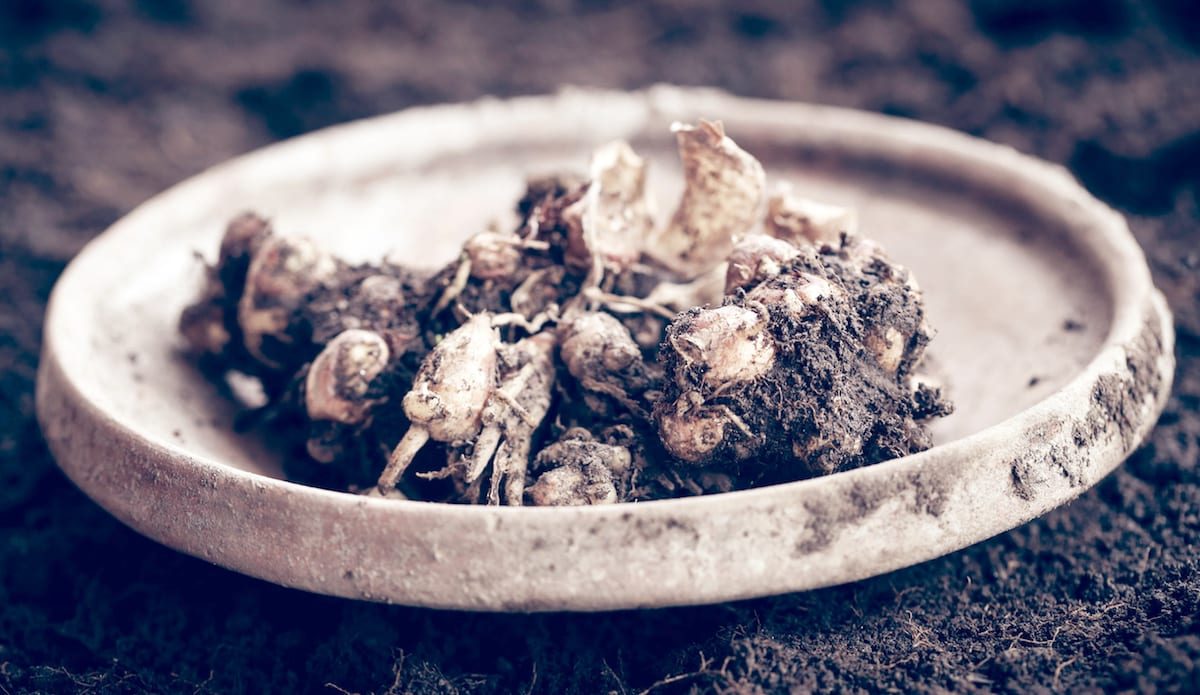
Sand ginger is Kaempferia galanga, a member of the ginger family (Zingiberaceae).1 Chinese cookbooks often call it “sand ginger,” a translation of the Chinese sha jiang.2 It is also known as kencur in Indonesia and Malaysia,3 and as aromatic ginger.4 Katzer describes its flavor as strongly aromatic and almost medical.2 Its essential oil is dominated by ethyl p-methoxycinnamate and ethyl cinnamate,24 and no common spice shares that profile. The best substitute depends on whether your recipe uses it fresh, as in Indonesian cooking, or dried, as in Chinese cooking.
Quick answer
| How sand ginger is used | Best substitute | Starting amount, per 1-inch piece of fresh sand ginger | Treatment |
|---|---|---|---|
| Fresh, in Indonesian pastes, sauces and salads | Dried kencur powder | 1/2 to 1 teaspoon | Attributed |
| Same, if you have dried slices | Dried kencur slices, soaked | Soak 30 minutes, then use | Attributed |
| Fresh, and no kencur in any form | Fingerroot | About 1 inch, then taste | Method |
| Fresh, with only supermarket rhizomes | Half ginger, half galangal | 1/2 inch of each | Attributed |
| Dried, in Chinese broths and braises | Dried galangal slices or ground galangal | Less than the sand ginger called for | Method |
How the ratios on this page are labeled
- Computed: based on a measurable physical relationship, with the source named.
- Attributed: a named source publishes this ratio. We quote it as theirs.
- Disputed: named sources give different answers to the same swap. We show each one and do not average them.
- Method: we found no published ratio. We give a direction and a cautious starting point, and say so.
Very little has been published on substituting for sand ginger. The figures below come from a university’s Indonesian-cooking reference and one Indonesian food writer’s recipe. No study compares its flavor strength with any substitute.
Why nothing matches it exactly
The ginger-family rhizomes that people reach for differ in their main aroma compounds:
| Rhizome | Main essential-oil compounds | Flavor, per the sources |
|---|---|---|
| Sand ginger (Kaempferia galanga) | Ethyl p-methoxycinnamate (30%) and ethyl cinnamate (25%) in Katzer;2 28.4 to 70.0% ethyl p-methoxycinnamate in Indian samples reviewed by Wang et al.4 | Strongly aromatic, almost medical2 |
| Fingerroot (Boesenbergia rotunda) | 1,8-cineole 18 to 41%, camphor 13%5 | Strong, dominating; Katzer says its taste resembles sand ginger62 |
| Galangal (Alpinia galanga)7 | 1,8-cineole the main component, per 1980s studies8 | Strong, pungent, like a mix of pepper and ginger8 |
| Ginger (Zingiber officinale)9 | Zingiberenes and related sesquiterpenes; heat from gingerols and shogaols10 | Pungent |
The chemistry suggests why a substitute will taste different, but no source we found has tested the swaps.
If the recipe uses fresh sand ginger
Katzer calls sand ginger essential to Javanese cooking and notes that it often flavors peanut sauce.2 In Southeast Asia it is mostly used fresh, grated or crushed.2 Northern Illinois University’s Indonesian-cooking reference says it has a “unique, champor [camphor] flavor” and should be used sparingly.11
1. Dried kencur, sliced or powdered
If you can find kencur in any form, use it. Look for it under the names kencur or cekur.3
Ratio (Attributed): The NIU reference gives dried sliced kencur or kencur powder as the substitute for fresh. It says to soak dried slices in boiling water for about 30 minutes and to use 1/2 to 1 teaspoon of powder for each 1-inch piece of fresh root.11 The reference does not say how it arrived at the figure.
2. Fingerroot
Fingerroot (Boesenbergia rotunda) is another ginger-family rhizome.5 Katzer says it is very frequently confused with sand ginger and that “its taste, however, resembles lesser galanga,” his name for sand ginger.2 Of the substitutes here, it is the only one a reference describes as tasting like sand ginger. Katzer also calls fingerroot’s flavor strong and dominating.6
It is easier to find than you might expect. Katzer says it is quite often available in Thai food stores,6 and Pailin Chongchitnant notes that it is sold in brine in jars at Asian grocery stores.12
Ratio (Method): We found no published ratio. Start with roughly the same size piece of fingerroot as the sand ginger called for, and taste, since both are strong.
3. Ginger and galangal together
Marvellina of What To Cook Today, writing about the West Javanese salad karedok, says that if you can’t find kencur you can replace it with ginger and galangal in equal parts.13
Ratio (Attributed): Her recipe replaces 2 inches of kencur with 1 inch of ginger and 1 inch of galangal.13 That is one writer’s swap for one dish, not a tested equivalence.
Galangal alone is a less certain fit. Katzer finds sand ginger’s aroma less pleasant than greater galangal’s,2 and says galangal itself cannot be substituted by any other spice,14 which suggests the two are not interchangeable. Ginger alone adds heat from its gingerols10 but none of sand ginger’s aroma.
If the recipe uses dried sand ginger
Katzer says sand ginger is always used dried in Chinese cooking, is particularly common in Sichuan, and is popular for flavoring broths.2 He also lists it as an optional ingredient in five-spice powder.2 If a Chinese recipe calls for dried sand ginger slices or powder, try a Chinese grocery before substituting.
Ratio (Method): We found no published substitute for dried sand ginger. Dried galangal slices are the nearest dried rhizome most stores carry. Katzer finds dried, powdered galangal “less fresh but more spicy” than fresh,14 so start with less than the sand ginger called for and add more after tasting the broth. Ground ginger is a fallback. McCormick counts 1 teaspoon of grated fresh ginger as 1/4 teaspoon ground,15 which shows how concentrated the powder is. Start small.
Zedoary: not a good fit
Zedoary (Curcuma zedoaria) is sometimes suggested. PROSEA says its oil smells like ginger oil mixed with camphor,16 and Katzer describes it as strongly aromatic, medical and not very pleasant, and too bitter to be used alone as a spice.17 We found no source that recommends it in place of sand ginger.
What isn’t known
- No study compares the flavor strength of sand ginger with any substitute. The two Attributed figures are a reference guide’s rule and one writer’s recipe swap.
- No published ratio was found for fingerroot, galangal alone or ginger alone in place of sand ginger.
- A widely repeated claim says that if a recipe calls for both ginger and sand ginger, you should double the ginger. No source reviewed here supports it.
- The suggestion that cinnamon and mace can imitate sand ginger could not be traced.
Related
- Sand ginger, fingerroot, galangal, ginger, zedoary
- Galangal vs ginger, dried galangal vs fresh, fresh ginger vs ground ginger
- Galangal substitutes, ginger substitutes, cooking with ginger
Footnotes
-
Kaempferia galanga, Plants of the World Online, Royal Botanic Gardens, Kew. powo.science.kew.org · Reference work ↩
-
Lesser galangale (Kaempferia galanga), Gernot Katzer’s Spice Pages. gernot-katzers-spice-pages.com · Reference work ↩ ↩2 ↩3 ↩4 ↩5 ↩6 ↩7 ↩8 ↩9 ↩10 ↩11 ↩12
-
Halijah Ibrahim, Kaempferia galanga, PROSEA. uses.plantnet-project.org · Reference work ↩ ↩2
-
Wang et al., Kaempferia galanga L.: Progresses in Phytochemistry, Pharmacology, Toxicology and Ethnomedicinal Uses, Frontiers in Pharmacology, 2021. frontiersin.org · Peer-reviewed ↩ ↩2 ↩3
-
Ibrahim and Nugroho, Boesenbergia rotunda, PROSEA. uses.plantnet-project.org · Reference work ↩ ↩2
-
Fingerroot, Gernot Katzer’s Spice Pages. gernot-katzers-spice-pages.com · Reference work ↩ ↩2 ↩3
-
Alpinia galanga, Plants of the World Online, Royal Botanic Gardens, Kew. powo.science.kew.org · Reference work ↩
-
Scheffer and Jansen, Alpinia galanga, PROSEA. uses.plantnet-project.org · Reference work ↩ ↩2
-
Zingiber officinale, Plants of the World Online, Royal Botanic Gardens, Kew. powo.science.kew.org · Reference work ↩
-
Sutarno, Hadad and Brink, Zingiber officinale, PROSEA. uses.plantnet-project.org · Reference work ↩ ↩2
-
Ingredients Reference, SEAsite, Northern Illinois University. seasite.niu.edu · Reference work ↩ ↩2
-
Chongchitnant, Thai Rice Noodles with Fish Curry, Hot Thai Kitchen. hot-thai-kitchen.com · Publication ↩
-
Marvellina, Karedok, What To Cook Today. whattocooktoday.com · Publication ↩ ↩2
-
Greater Galangale, Gernot Katzer’s Spice Pages. gernot-katzers-spice-pages.com · Reference work ↩ ↩2
-
How to Grind Your Own Spices, McCormick. mccormick.com · Merchant ↩
-
Ibrahim and Jansen, Curcuma zedoaria, PROSEA. uses.plantnet-project.org · Reference work ↩
-
Zedoary, Gernot Katzer’s Spice Pages. gernot-katzers-spice-pages.com · Reference work ↩