Cooking · Cooking with
Cooking With Ginger: Peeling, Cutting, Timing and Fresh vs. Ground
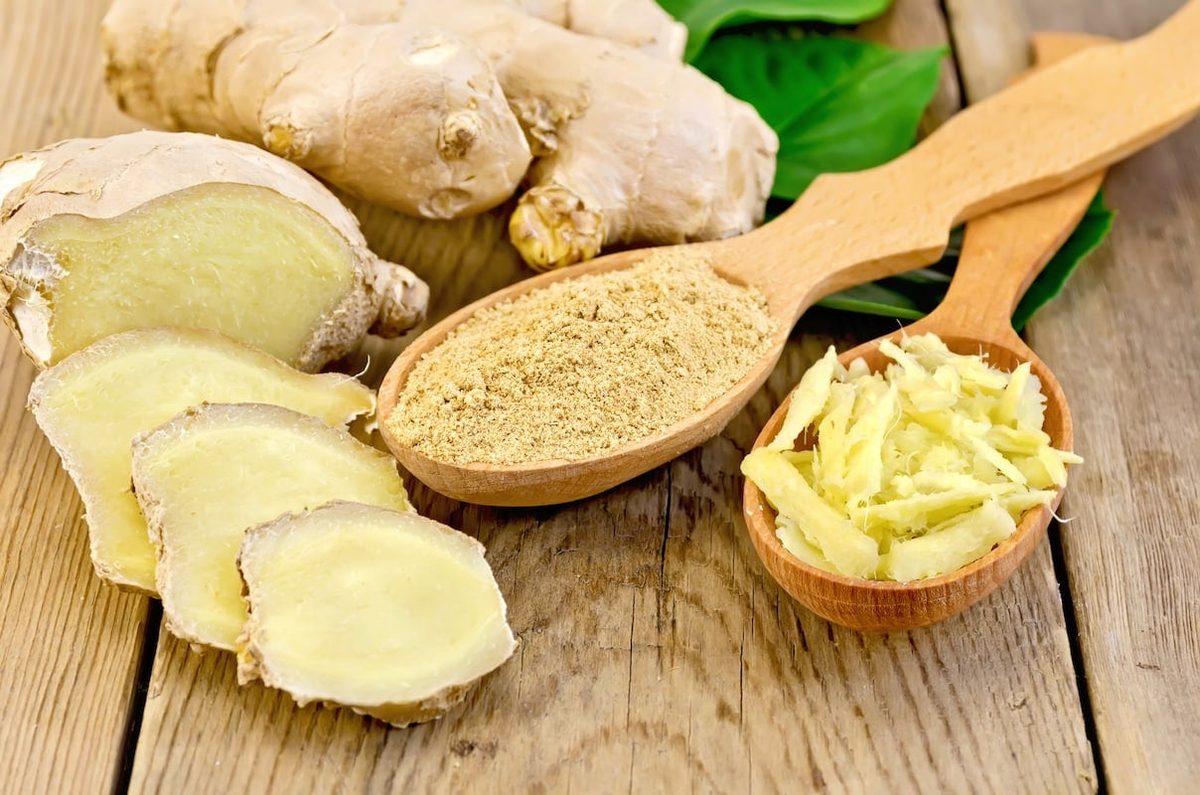
Fresh ginger is easy to cook with once you know three things: how to get the skin off without wasting the root, how to cut it so the fibers don’t end up in your teeth, and when to add it. Early in hot oil it turns mellow; added late or raw it stays sharp and bright.1 Ground ginger is a different ingredient with its own jobs, mostly in baking.
At a glance
| Question | Short answer |
|---|---|
| Best peeling tool | The edge of a teaspoon; knives and peelers take too much flesh2 |
| Best cut for smooth sauces and dressings | Grate it to a fine pulp, which shortens the fibers2 |
| Mellow or sharp? | Fried in oil it turns mellow and mild; cooking also makes it hotter but less fresh-tasting1 |
| Fresh or ground? | Fresh is central to many Asian dishes; dried ground ginger is the European habit, especially in baking34 |
| Swapping fresh for ground | Published conversions disagree (table below) |
| Leftovers | Freeze peeled pieces and grate from frozen52 |
Buying fresh ginger
Choose firm, heavy rhizomes with smooth, taut skin and skip any that are shriveled, soft or moldy (kitchen judgment). Shriveling matters for flavor: America’s Test Kitchen notes that ginger loses pungency once it starts to shrivel and dry out.2
You may also see young ginger. Tasting Table describes it as harvested about eight months after planting, mild and delicate with a floral sweetness, while mature ginger has a potent heat and thicker skin.6 Young ginger suits raw dishes and pickles where you want only a hint of heat; mature ginger is the everyday supermarket root (our judgment, consistent with that description).
Peeling
ATK’s advice is to skip the paring knife and the vegetable peeler, both of which remove too much of the flesh, and scrape the thin brown skin off with the edge of a teaspoon while holding the ginger against the cutting board.2 A curved spoon follows the knobs and bends far more easily than a blade.2 Peel only the section you are about to use and hold the unpeeled part as a handle while you grate.2
Whether you need to peel at all depends on the dish. For coins that will be fished out of a broth, many cooks leave the skin on (common practice).
Cutting it for the job
| Cut | Best for | Why |
|---|---|---|
| Grated to a fine pulp | Dressings, marinades, sauces, batters | Grating fine shortens the fibers so they are less noticeable; minced or coarsely grated ginger can still be fibrous2 |
| Minced | Stir-fries and sautés where small bits are welcome | Cooking judgment; expect some fiber2 |
| Coins or thick slices | Broths, braises, poaching liquids, tea | Infuse gently and lift out before serving (common practice) |
| Smashed | Broths and braises (common practice) | ATK smashes it by pressing on the flat side of a chef’s knife with the heel of the hand2 |
| Thin matchsticks | Garnishes, steamed fish, stir-fries | Cooking judgment |
A food processor or rasp-style grater handles larger amounts. Freezing the ginger first makes grating easier.2
When to add it
Ginger changes with heat, and the change is useful.
- Early, in hot oil. Katzer describes chopped ginger fried in oil losing its hot, spicy taste to a mellow, mild, rich flavor, and notes that northern Indian cooks use this as the base of sauces.1 Chinese cooking uses fresh ginger both boiled and fried.1
- Cooked longer. Katzer also says cooking makes fresh ginger more pungent but less fresh-tasting.1 The chemistry behind this is covered in is ginger spicy?: heat converts some gingerols into shogaols.
- Late or raw. For the brightest, juiciest ginger flavor, add it at the end or use it uncooked, as in dressings and the sauce below (common practice, consistent with Katzer’s point about freshness).
A good example of a raw-to-just-scalded use is scallion-ginger sauce. In Andy Liang’s Food Network Kitchen recipe, 3 tablespoons of finely chopped ginger go into a heatproof bowl with 2 chopped scallions and 1 teaspoon of salt, and 1/4 cup of neutral oil heated to about 375°F is poured over them and stirred.7 Sugar and white pepper finish it, and it is served with white cut chicken (bai qie ji).7 The hot oil softens the raw edge without fully cooking the ginger.
Fresh, ground, pickled and preserved
Fresh and dried ginger are not interchangeable in every dish. Kew notes that the fresh rhizome is essential to many Asian dishes while the dried, powdered spice is more popular in European cooking,3 and PROSEA notes that ground ginger goes into processed foods, especially baked goods and desserts.4 Katzer says dried ginger tastes more aromatic than pungent.1 More on how drying changes the flavor is in fresh vs. ground ginger.
| Form | Typical uses |
|---|---|
| Fresh | Stir-fries, curries, marinades, broths, dressings; in India, a core ingredient of masala chai8 |
| Ground | Gingerbread, gingersnaps, spice cakes, rubs and blends (see baking below) |
| Gari (pickled) | Pale ginger pickled in rice vinegar and sugar, eaten between pieces of sushi as a palate cleanser9 |
| Beni shoga (pickled) | Red pickle made with umezu, served with richer dishes such as gyudon, yakisoba and okonomiyaki9 |
| Preserved in syrup or crystallized | Jams and baking;4 King Arthur offers diced crystallized ginger as an optional extra in gingerbread cake10 |
Ground ginger in baking
Ground ginger has carried gingerbread for a long time. Amelia Simmons’s American Cookery (1796) uses it by the ounce, with one gingerbread calling for two ounces of ginger alongside a grated nutmeg.11 A modern example: King Arthur Baking’s gingerbread cake uses 1 1/2 teaspoons of ginger with 1 teaspoon of cinnamon and 1/4 teaspoon each of cloves and nutmeg (Attributed).10
Swapping fresh and ground
The two can stand in for each other in a pinch, but published conversions disagree, and none explains its basis. Per tablespoon of grated fresh ginger:
| Source | Ground ginger |
|---|---|
| NDSU Extension12 | 1/8 teaspoon |
| The Spice House13 | 1/4 teaspoon |
| King Arthur Baking, gingerbread cake10 | 1/2 teaspoon (3 tablespoons grated fresh in place of 1 1/2 teaspoons dried) |
| McCormick14 | 3/4 teaspoon (stated as 1/4 teaspoon per teaspoon of fresh) |
King Arthur also advises combining grated fresh ginger with the butter and molasses before they go into the batter.10 Our Method starting point, as on ginger substitutes: start low, around 1/8 to 1/4 teaspoon of ground per tablespoon of fresh in a savory dish, and taste after it simmers. Ground ginger is less bright than fresh, and the Spice House suggests a little citrus or pepper to make up for it.13
Storing what you don’t use
- Fresh, short term: Food Network keeps unpeeled ginger up to a month in the refrigerator and peeled ginger 2 to 3 weeks.15 ATK says a wrapped nub lasts only a few days in the fridge.2 These figures disagree and none is from a storage study.
- Fresh, longer: ATK’s four-week test found peeled ginger frozen, or kept in vodka in the fridge, held its flavor; ginger kept in water turned mushy.5 Details are in how to store ginger and can you freeze ginger?.
- Ground: University of California Cooperative Extension gives ground spices about a year.16 The same release names air, light, moisture and heat as what speeds flavor loss, so keep the jar closed and away from the stove.16 If the smell is faint, it has faded (kitchen judgment).
How much is too much?
In food amounts ginger is a flavor question, not a safety one. Ginger taken by mouth can cause heartburn, abdominal discomfort, diarrhea and mouth or throat irritation, and NIH’s National Center for Complementary and Integrative Health advises talking to a health care provider before using ginger if you take any medicine.17 Those cautions come from research on ginger taken deliberately, mostly as supplements. If a dish has gone too far, see too much ginger.
Not yet measured
- How long fresh ginger keeps in a home refrigerator: published figures range from a few days to a month, with no study behind them.
- Why the four fresh-to-ground conversions differ; none of their sources says how it was reached.
- Whether peeling makes any measurable difference to flavor in cooked dishes.
Related
- Ginger
- Fresh ginger vs. ground ginger
- Is ginger spicy?
- Ginger substitutes
- Too much ginger
- How to store ginger and can you freeze ginger?
- Garlic vs. ginger, galangal vs. ginger and turmeric vs. ginger
- Chai spices
Footnotes
-
Ginger, Gernot Katzer’s Spice Pages. gernot-katzers-spice-pages.com · Reference work ↩ ↩2 ↩3 ↩4 ↩5 ↩6
-
Megan Ginsberg, The Best Way to Grate Ginger, America’s Test Kitchen, 2022. americastestkitchen.com · Publication ↩ ↩2 ↩3 ↩4 ↩5 ↩6 ↩7 ↩8 ↩9 ↩10 ↩11 ↩12
-
Zingiber officinale Roscoe, Plants of the World Online, Royal Botanic Gardens, Kew. powo.science.kew.org · Reference work ↩ ↩2
-
H. Sutarno, E.A. Hadad and M. Brink, Zingiber officinale, Plant Resources of South-East Asia (PROSEA). uses.plantnet-project.org · Reference work ↩ ↩2 ↩3
-
Two Ways to Store Ginger, America’s Test Kitchen. americastestkitchen.com · Publication ↩ ↩2
-
September Grace Mahino, Young Ginger Vs Mature: What’s The Difference?, Tasting Table, 2023. tastingtable.com · Publication ↩
-
Andy Liang, Scallion-Ginger Sauce, Food Network Kitchen. foodnetwork.com · Publication ↩ ↩2
-
Jeff Koehler, Spice Migrations: Ginger, AramcoWorld, 2021. aramcoworld.com · Publication ↩
-
Corin MJ Bae, The Major Flavor Difference Between Beni Shoga And Gari Ginger, Tasting Table, 2023. tastingtable.com · Publication ↩ ↩2
-
PJ Hamel, Gingerbread cake, King Arthur Baking, 2019. kingarthurbaking.com · Publication ↩ ↩2 ↩3 ↩4
-
Amelia Simmons, American Cookery, 1796 (Project Gutenberg). gutenberg.org · Reference work ↩
-
Julie Garden-Robinson, Ingredient Substitutions (FN198), NDSU Extension, 2018. ksre.ksu.edu · Reference work ↩
-
Ginger Substitute, The Spice House, 2018. thespicehouse.com · Merchant ↩ ↩2
-
McCormick Kitchens, How to Grind Your Own Spices, Plus Spice Conversions, McCormick, 2025. mccormick.com · Merchant ↩
-
Layla Khoury-Hanold, How to Store Ginger, Food Network Kitchen, 2023. foodnetwork.com · Publication ↩
-
Anna Martin, Add a Little Spice to Your Life! Part II, University of California Cooperative Extension, 2002. ucanr.edu · Reference work ↩ ↩2
-
Ginger: Usefulness and Safety, National Center for Complementary and Integrative Health, 2025. nccih.nih.gov · Regulator ↩