Seasonings · Profile
Za’atar: The Herb, the Blend, and How Recipes Compare
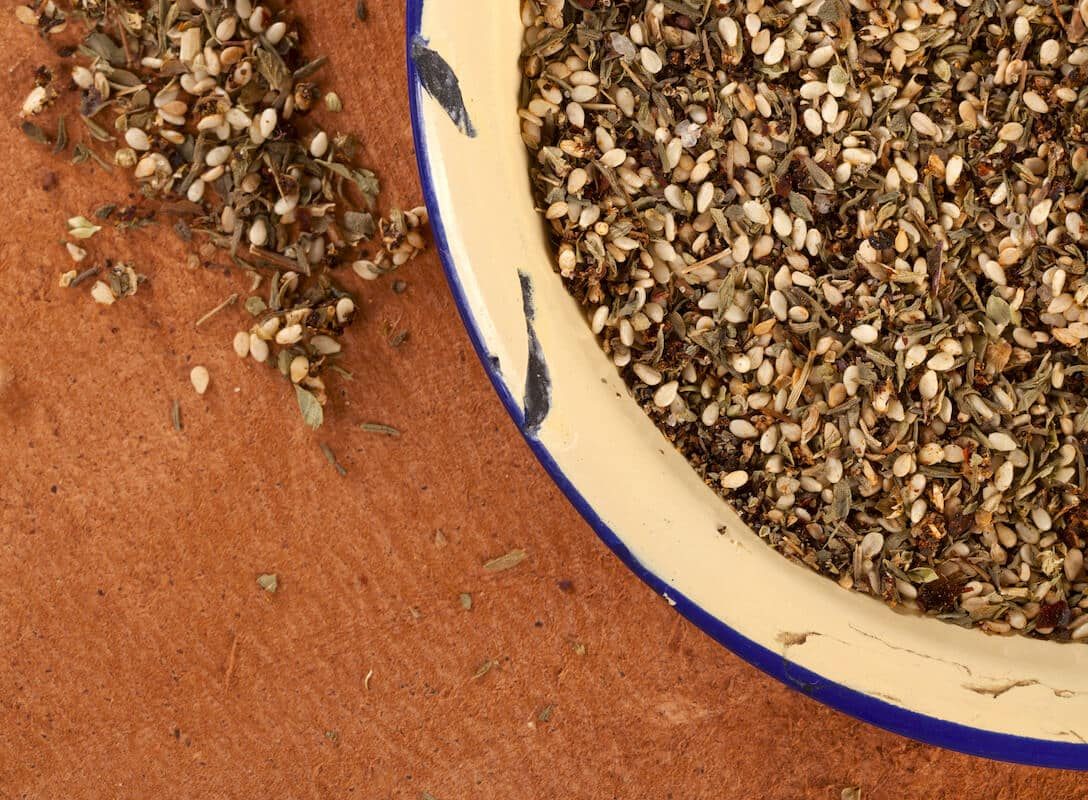
Za’atar is two things at once. In Arabic it is the name of a group of wild herbs, and it is also the name of a seasoning built on those herbs, usually with sumac and toasted sesame seeds.12 At its most basic, the blend is sumac, thyme, oregano and sesame seeds, often with marjoram and salt.2 It tastes herbal, sour and nutty, and its classic use is mixed with olive oil on flatbread.3
At a glance
| The herb | Arabic zatar or satar covers several native herbs, including oregano, marjoram, thyme and savory1; Origanum syriacum is one plant known in Arabic as za’atar43 |
| The blend | Dried thyme and oregano or marjoram, ground sumac, toasted sesame seeds, usually salt23 |
| Region | Origanum syriacum is native from the eastern Mediterranean to the Arabian Peninsula5 |
| Flavor drivers | Thymol and carvacrol from the herbs; organic acids from sumac; toasted-sesame aroma6789 |
| Main uses | With olive oil on flatbread; on eggs, vegetables, chickpeas and hummus, chicken, fish and kebabs23 |
| Allergen | Contains sesame, a major food allergen in the U.S.10 |
The herb called za’atar
In the eastern Mediterranean, names like Turkish kekik and Arabic zatar or satar are applied to a range of native herbs, including oregano, marjoram, thyme and savory, according to Gernot Katzer.1 One species stands out: Origanum syriacum, sometimes called Syrian oregano, is known in Arabic as za’atar.43 Kew gives its native range as the eastern Mediterranean to the Arabian Peninsula.5
Where it isn’t available, Susan Belsinger suggests equal parts thyme and marjoram, oregano or both as a stand-in.3
Three named versions side by side
There is no single recipe. In Jordan, Katzer notes, zahtar usually means a spice mixture containing these herbs;1 powdered sumac is sometimes part of it,8 and sesame seeds occur in it too.9 Here is how three named sources build it.
| Laura Crowley, UC Master Food Preservers2 | Susan Belsinger, Fine Gardening (2010)3 | Rexford H. Talbert, as cited by Belsinger3 | |
|---|---|---|---|
| Herbs | 1 tbsp dried thyme; 1 tbsp dried oregano, marjoram or a mix | 2 tbsp dried thyme; 2 tbsp dried marjoram and/or oregano | 4 parts Origanum syriacum |
| Sumac | 2 tbsp ground | About 1 tbsp | 1 part |
| Sesame | 1 tbsp toasted white | 1/4 cup, toasted pale gold | 4 parts, roasted |
| Salt | Optional, 1 tsp to 5 tbsp | 2 to 3 tsp kosher or coarse sea salt | 1 part |
| Character | Sumac-forward | Sesame-forward | Herb- and sesame-forward |
The proportions differ widely. Crowley’s version uses twice as much sumac as sesame; Belsinger’s uses about four times as much sesame as sumac; and Talbert’s puts the herb and sesame at four times the sumac. All three agree on the core: a za’atar herb (or thyme with oregano or marjoram), sumac and sesame, plus salt.23
Flavor and the compounds behind it
- Thyme and oregano. The characteristic constituents of thyme oil are thymol and carvacrol.6 The same two phenols make up roughly 78 to 85% of oregano essential oil.7 They give za’atar its warm, resinous, slightly medicinal edge.
- Sumac. Katzer describes sumac as tart and sour with slightly astringent overtones, and attributes the sourness to organic acids, including malic and citric acid.8 Sumac gives the blend its lemony note.
- Sesame. Some of sesame’s aroma compounds form only during toasting; at mild toasting temperatures (around 160 °C), pyrazines dominate the flavor.9 That is the nutty note.
How to use it
- On bread. Brush flatbread, pitas, rolls or pizza with olive oil and sprinkle with za’atar, or work it into bread or cracker dough.3
- As a dip. Belsinger mixes the blend with an equal amount of olive oil for dipping, and keeps it in the refrigerator for up to a week.3
- On eggs and vegetables. Crowley pairs it with eggs, chickpeas and hummus, and vegetables such as cauliflower, cucumber and eggplant.2
- On meat and fish. Sprinkle it on chicken, fish or kebabs.23
- On grains and salads. Belsinger also uses it on grains, legumes, salads and soups.3
Buying and making your own
Store-bought blends vary as much as the recipes above, so check the label for salt and for sesame if anyone at the table is allergic. To make your own, toast the sesame first; Belsinger toasts until the seeds just turn pale gold, cools them, and grinds them lightly with some of the salt before stirring in the herbs and sumac.3 Use sumac that is deep red and tart.
Health and safety
Sesame allergy. Sesame became the ninth major food allergen in the U.S. when the FASTER Act took effect on 1 January 2023, and it must now be declared on food labels.10
Sumac and blood sugar. A 2025 systematic review and meta-analysis of sumac supplementation trials found improvements in blood sugar and blood lipid measures, but the authors rated the indirectness of the evidence as serious because the trials came from a narrow set of countries.11 Those trials used sumac supplements, not the amount in a sprinkle of za’atar, and they do not show that za’atar treats or prevents any disease.
Related
- Za’atar substitutes, za’atar uses and cooking with za’atar
- Sumac, sumac substitutes and sumac uses
- Thyme, oregano and marjoram; oregano vs thyme and marjoram vs oregano
- Sesame seeds and hulled vs unhulled sesame seeds
- Hyssop, a different herb sometimes confused with za’atar
- Other blends: dukkah and baharat; hummus spices
Footnotes
-
Oregano, Gernot Katzer’s Spice Pages. gernot-katzers-spice-pages.com · Reference work ↩ ↩2 ↩3 ↩4
-
Laura Crowley, Za’atar Spice Blend, UC Cooperative Extension Master Food Preservers of El Dorado County. ccfruitandnuts.ucanr.edu · Reference work ↩ ↩2 ↩3 ↩4 ↩5 ↩6 ↩7 ↩8
-
Susan Belsinger, “Za’atar: An Exotic Herb Blend,” Fine Gardening, 2010. finegardening.com · Publication ↩ ↩2 ↩3 ↩4 ↩5 ↩6 ↩7 ↩8 ↩9 ↩10 ↩11 ↩12 ↩13 ↩14
-
Hyssop, Plants of the Bible, Old Dominion University. ww2.odu.edu · Reference work ↩ ↩2
-
Origanum syriacum L., Plants of the World Online, Kew. powo.science.kew.org · Reference work ↩ ↩2
-
Thymus vulgaris, PROSEA. uses.plantnet-project.org · Reference work ↩ ↩2
-
Lombrea et al., International Journal of Molecular Sciences, 2020. mdpi.com · Peer-reviewed ↩ ↩2
-
Sumac, Gernot Katzer’s Spice Pages. gernot-katzers-spice-pages.com · Reference work ↩ ↩2 ↩3
-
Sesame, Gernot Katzer’s Spice Pages. gernot-katzers-spice-pages.com · Reference work ↩ ↩2 ↩3
-
An Update on Sesame Allergen Labeling on Food Packages, FDA, 2023. fda.gov · Regulator ↩ ↩2
-
Jafari et al., Endocrinology, Diabetes & Metabolism, 2025. pmc.ncbi.nlm.nih.gov · Peer-reviewed ↩