Spice Substitutes · Substitutes
Lemon Pepper Substitutes: A Homemade Blend and Other Swaps
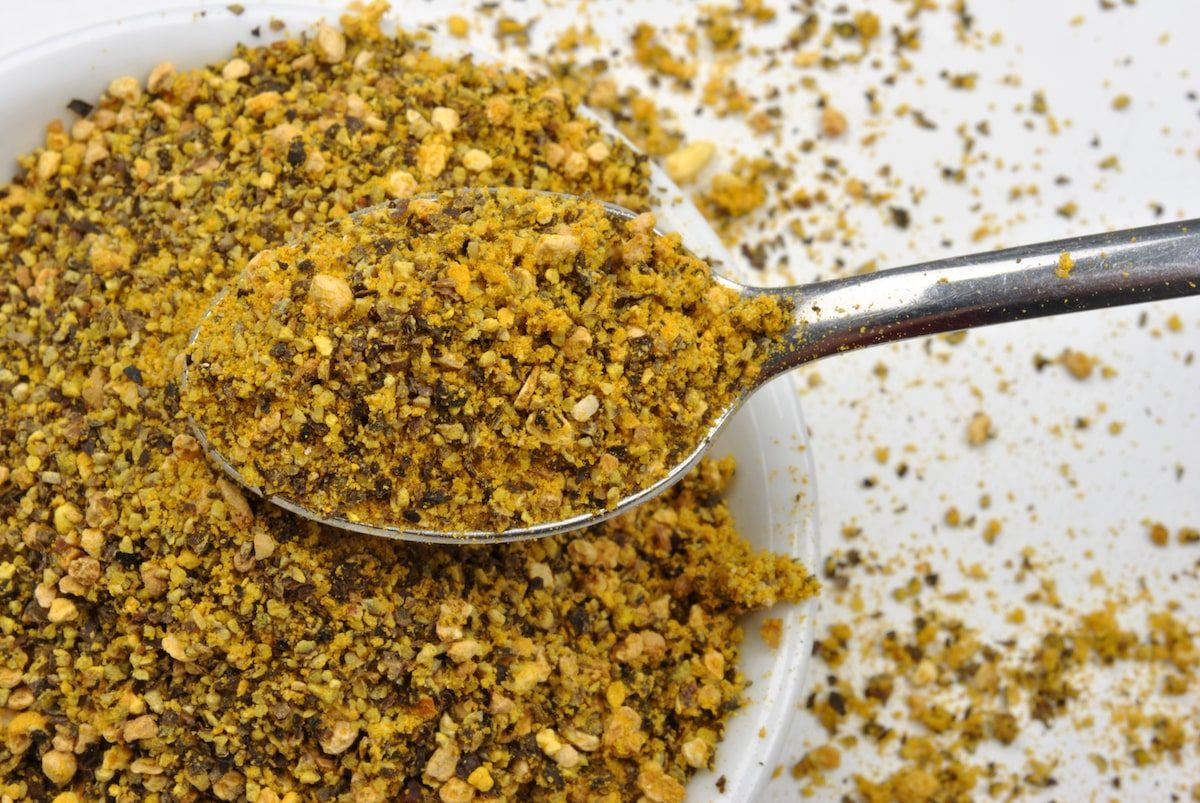
Lemon pepper is a blend, not a single spice, so the best substitute is usually a quick homemade version. Store blends are mostly seasoned salts: McCormick’s lists salt first, then black pepper, citric acid, onion, sugar and garlic, with lemon oil for the lemon, while The Spice House’s leads with pepper and gets its lemon from dried peel and citric acid.12 So before you choose a substitute, decide which of the three jobs you need covered: salt, pepper heat, or lemon aroma.
Quick answer
| What lemon pepper is doing | Best substitute | Starting amount, per 1 part lemon pepper | Treatment |
|---|---|---|---|
| All-purpose seasoning on fish, chicken or wings | Homemade blend: 2 parts dried lemon zest, 1 part cracked pepper, salt, garlic and onion | 1 part of the blend | Attributed |
| Matching the saltiness of a store blend | Table salt, added separately | About 1/4 part plus a pinch, for McCormick’s level | Computed |
| Lemon and pepper without salt | Dried lemon zest (or fresh zest) and black pepper | 2 parts dried zest to 1 part pepper; fresh zest at 1 to 2 times the dried amount | Attributed |
| A softer, herbal lemon note in a marinade or roast | Lemon thyme plus black pepper | Fresh leaves to taste, pepper as above | Method |
| A tart sprinkle with some heat | Sumac plus black pepper, or shichimi togarashi | 1/2 part, then taste | Method |
How the ratios on this page are labeled
- Computed: based on a measurable physical relationship, with the source named.
- Attributed: a named source publishes this ratio. We quote it as theirs.
- Disputed: named sources give different answers to the same swap. We show each one and do not average them.
- Method: we found no published ratio. We give a direction and a starting point, and say so.
Where the flavor comes from
The pepper half is black pepper, whose characteristic flavor Britannica attributes principally to piperine.3 The lemon half is the aroma of lemon peel oil. In one study of cold-pressed peel oil from Venezuelan lemons, limonene made up about 66 percent of the oil, and the main aldehydes were geranial and neral,4 the two forms of citral.5 Citral is what several lemon-scented herbs below have in common with lemon. Many store blends also add citric acid.12
If you need the whole blend: make it
1. A homemade lemon pepper blend
The UC Master Food Preservers of El Dorado County publish a recipe that makes about 1 cup: 1/2 cup dried lemon zest, 1/4 cup cracked black peppercorns, 2 tablespoons salt (or to taste), 2 teaspoons each garlic powder and onion powder, and 1 teaspoon sugar, which they call optional but say balances the flavors.6 Mix and store airtight in a cool, dry place.6
For a single recipe, one sixteenth of that is about 1 tablespoon: 1 1/2 teaspoons dried zest, 3/4 teaspoon cracked pepper, 3/8 teaspoon salt, 1/8 teaspoon each garlic and onion powder, and a pinch of sugar. The scaling is our arithmetic.
Ratio (Attributed): Use the blend one for one in place of store-bought lemon pepper. The proportions are the UC recipe’s;6 the one-for-one use is common practice, since the blend is meant to stand in for the commercial product.
2. If you want it as salty as a store blend (Computed, salt only)
Store blends vary. McCormick Signature Lemon Pepper lists 170 mg of sodium per 1/4 teaspoon,7 which is about 680 mg per teaspoon. Morton iodized table salt lists 590 mg per 1/4 teaspoon,8 about 2,360 mg per teaspoon. So matching one teaspoon of that McCormick blend takes about 0.29 teaspoon of table salt, a generous 1/4 teaspoon.
The UC recipe, made with table salt, carries roughly 1/8 teaspoon of salt per teaspoon of blend (2 tablespoons in about a cup), so it is less than half as salty as that McCormick product. If a recipe was written around a store blend, add salt to taste at the end. This figure covers salt only and applies only to the named products.
If you want lemon and pepper without the salt
1. Dried or fresh lemon zest plus black pepper
Lemon oil is pressed from the peel,4 so the zest is the part to use. The UC recipe’s ratio, 2 parts dried zest to 1 part cracked pepper by volume,6 works as a salt-free base. Salt the dish separately.
Fresh zest (Attributed): NDSU Extension gives 1 teaspoon dried lemon peel as equal to 1 to 2 teaspoons grated fresh peel, or the grated peel of one medium lemon.9 Fresh zest is moist, so it will clump in a dry rub; it works best stirred into butter, oil or a marinade. That last point is kitchen judgment.
Lemon extract (Attributed): NDSU gives 1/2 teaspoon lemon extract as equal to 1 teaspoon dried lemon peel.9 Mix it into the oil or butter, then add pepper.
Pepper ratio (Method): For every teaspoon of lemon pepper called for, start with about 1/3 teaspoon cracked black pepper and 2/3 teaspoon dried zest, which keeps the UC recipe’s 2-to-1 proportion without the salt, then taste.
If you want a softer, herbal lemon note
1. Lemon thyme plus black pepper
Lemon thyme is a thyme with a lemon scent. UF/IFAS Extension says it adds a citrus overtone to the usual thyme flavor and suggests it for any recipe calling for lemon juice, lemon zest or lemon flavoring.10 One study describes lemon thyme oil as a natural source of geraniol and citral,11 which helps explain the overlap with lemon peel. It has no pepper heat of its own, so add black pepper.
Ratio (Method): No published ratio was found. Start with about 1 teaspoon chopped fresh lemon thyme leaves and 1/3 teaspoon black pepper per teaspoon of lemon pepper, salt separately, and taste. The thyme will read as herb first, lemon second.
2. Lemon myrtle plus black pepper
Lemon myrtle is an Australian leaf whose oil is typically 90 to 98 percent citral.12 Katzer calls it “more lemon than lemon.”13 Ground dried leaf is a strong, salt-free lemon note.
Ratio (Method): No published ratio was found. Start with a pinch, about 1/4 teaspoon per teaspoon of lemon pepper, with black pepper as above, and taste.
If you want tartness, or some heat
1. Sumac plus black pepper
Sumac is tart rather than lemon-scented. Katzer describes it as tart and sour with slightly astringent overtones,14 and a 2021 review attributes the sour taste to malic acid and notes that it is used to add a lemony taste to minced meat.15
Ratio (Method): No published ratio was found. Start with half as much sumac as the lemon pepper called for, plus black pepper and salt to taste.
2. Shichimi or nanami togarashi
These Japanese chile blends include citrus peel and Japanese pepper, but no lemon. Yagenbori’s shichimi uses roasted chile and mandarin peel among its seven ingredients;16 S&B’s nanami togarashi lists chili pepper, orange peel, sesame, Japanese pepper, ginger and seaweed.17 Just One Cookbook calls the Japanese pepper in shichimi sansho, and names noodle soups, gyudon and yakitori among its uses.18 Expect chile heat that lemon pepper doesn’t have.
Sichuan pepper on its own is another way to get a lemony pepper aroma without chile: Katzer describes its aroma as lemon-like, with warm and woodsy overtones.19 It also brings its own tingle. See Sichuan pepper.
Ratio (Method): No published ratio was found. Start with half as much as the lemon pepper called for, taste for heat, and add salt separately.
What isn’t known
- There is no standard lemon pepper recipe, so no substitute can match “lemon pepper” in general; the salt figure above is for one named product.
- No source compares the lemon strength of dried zest, fresh zest, extract or lemon herbs by measurement. NDSU’s conversions are a guide, not a test.
- No published ratio was found for lemon thyme, lemon myrtle, sumac or shichimi togarashi in place of lemon pepper.
Related
- Lemon pepper, black pepper and black pepper substitutes
- Lemon thyme, thyme vs. lemon thyme, lemon thyme uses, lemon myrtle
- Sumac, shichimi togarashi, nanami togarashi, Sichuan pepper
- Seasoned salt, too much pepper, the master list of herbs and spices
Footnotes
-
McCormick Lemon & Pepper Seasoning product page, McCormick & Company. mccormick.com · Merchant ↩ ↩2
-
Lemon Pepper Seasoning product page, The Spice House. thespicehouse.com · Merchant ↩ ↩2
-
“Black pepper”, Encyclopaedia Britannica. britannica.com · Reference work ↩
-
Ojeda de Rodríguez et al., Composition of Venezuelan lemon essential oil, Revista de la Facultad de Agronomía (LUZ), 1998. produccioncientifica.luz.edu.ve · Peer-reviewed ↩ ↩2
-
Lim et al., Chemical Composition of Backhousia citriodora Essential Oil, Molecules, 2022. pmc.ncbi.nlm.nih.gov · Peer-reviewed ↩
-
Lemon Pepper Seasoning, UCCE Master Food Preservers of El Dorado County, University of California Agriculture and Natural Resources. ccfruitandnuts.ucanr.edu · Reference work ↩ ↩2 ↩3 ↩4
-
McCormick Signature Seasonings Lemon Pepper, retailer listing with Nutrition Facts, Stop & Shop. stopandshop.com · Merchant ↩
-
Morton Iodized Table Salt product page, Morton Salt. mortonsalt.com · Merchant ↩
-
Julie Garden-Robinson, Ingredient Substitutions (FN198), NDSU Extension, 2018. ksre.ksu.edu · Reference work ↩ ↩2
-
Busbee, Andrews and Criss, Lemon Thyme, UF/IFAS Extension Santa Rosa County, 2024. sfyl.ifas.ufl.edu · Reference work ↩
-
Jurevičiūtė et al., Composition of essential oil of lemon thyme, Natural Product Research, 2019. iris.unipa.it · Peer-reviewed ↩
-
Ian Southwell, Backhousia citriodora (Lemon Myrtle), an Unrivaled Source of Citral, Foods, 2021. mdpi.com · Peer-reviewed ↩
-
Gernot Katzer, Lemon Myrtle (Backhousia citriodora), Gernot Katzer’s Spice Pages. gernot-katzers-spice-pages.com · Reference work ↩
-
Gernot Katzer, Sumac (Rhus coriaria), Gernot Katzer’s Spice Pages. gernot-katzers-spice-pages.com · Reference work ↩
-
Alsamri et al., Pharmacological and Antioxidant Activities of Rhus coriaria L. (Sumac), Antioxidants, 2021. mdpi.com · Peer-reviewed ↩
-
七味について (About shichimi), Yagenbori. yagenbori.jp · Merchant ↩
-
S&B Nanami Togarashi product page, H-E-B. heb.com · Merchant ↩
-
Namiko Hirasawa Chen, Shichimi Togarashi, Just One Cookbook, 2023. justonecookbook.com · Publication ↩
-
Gernot Katzer, Sichuan pepper (Zanthoxylum), Gernot Katzer’s Spice Pages. gernot-katzers-spice-pages.com · Reference work ↩